




Global Biocompatible 3d Printing Market
Market Size in USD Million
CAGR :
% 
 USD
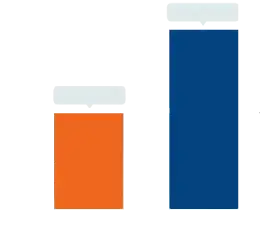
751.70 Million
USD
3,629.07 Million
2025
2033
USD
751.70 Million
USD
3,629.07 Million
2025
2033
 Forecast Period Forecast Period |
2026 –2033 |
 Market Size (Base Year) Market Size (Base Year) |
USD 751.70 Million |
 Market Size (Forecast Year) Market Size (Forecast Year) |
USD 3,629.07 Million |
 CAGR CAGR |
% |
| Major Markets Players |
|
Biocompatible 3-Dimensional (3D) Printing Market Size
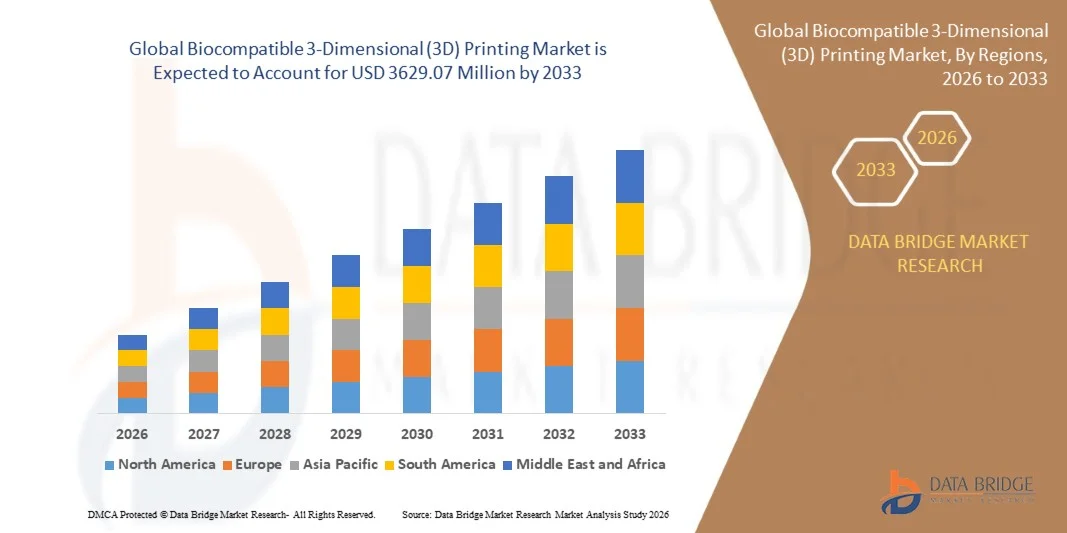
- The global biocompatible 3-Dimensional (3D) printing market size was valued at USD 751.7 million in 2025 and is expected to reach USD 3629.07 million by 2033, at a CAGR of 21.75% during the forecast period
- The market growth is largely fueled by increasing demand for patient-specific medical solutions and rapid advancements in additive manufacturing technologies, enabling precise fabrication of complex biological structures and customized implants across healthcare applications
- Furthermore, rising investments in regenerative medicine and growing adoption of biocompatible materials for tissue engineering, prosthetics, and surgical planning are positioning 3D printing as a transformative solution in modern healthcare. These converging factors are accelerating the adoption of biocompatible 3D printing technologies, thereby significantly boosting the market’s growth
Biocompatible 3-Dimensional (3D) Printing Market Analysis
- Biocompatible 3D printing refers to the use of additive manufacturing technologies to create medical-grade structures, implants, and tissues using materials that are compatible with the human body. These solutions enable high precision, customization, and improved patient outcomes across applications such as implants, prosthetics, and tissue engineering
- The escalating demand for biocompatible 3D printing is primarily driven by advancements in biomaterials, increasing prevalence of chronic diseases requiring implants, and growing emphasis on personalized medicine. In addition, the integration of 3D printing with healthcare innovation is enhancing surgical efficiency and accelerating product development in the medical field
- North America dominated the biocompatible 3-Dimensional (3D) printing market with a share of 37.6% in 2025, due to advanced healthcare infrastructure, strong adoption of innovative medical technologies, and increasing demand for patient-specific implants and prosthetics
- Asia-Pacific is expected to be the fastest growing region in the biocompatible 3-Dimensional (3D) printing market during the forecast period due to rapid urbanization, expanding healthcare infrastructure, and increasing adoption of advanced medical technologies in countries such as China, Japan, and India
- Powder segment dominated the market with a market share of 51.7% in 2025, due to its extensive use in powder bed fusion technologies for both polymer and metal printing. Powder-based materials enable high precision, uniformity, and efficient layer-by-layer fabrication, making them suitable for complex medical components. Their compatibility with a wide range of 3D printing systems enhances flexibility in manufacturing processes
Report Scope and Biocompatible 3-Dimensional (3D) Printing Market Segmentation
|
Attributes |
Biocompatible 3-Dimensional (3D) Printing Key Market Insights |
|
Segments Covered |
|
|
Countries Covered |
North America
Europe
Asia-Pacific
Middle East and Africa
South America
|
|
Key Market Players |
|
|
Market Opportunities |
|
|
Value Added Data Infosets |
In addition to the insights on market scenarios such as market value, growth rate, segmentation, geographical coverage, and major players, the market reports curated by the Data Bridge Market Research also include import export analysis, production capacity overview, production consumption analysis, price trend analysis, climate change scenario, supply chain analysis, value chain analysis, raw material/consumables overview, vendor selection criteria, PESTLE Analysis, Porter Analysis, and regulatory framework. |
Biocompatible 3-Dimensional (3D) Printing Market Trends
“Increasing Advancements in Bioprinting and Regenerative Medicine”
- A significant trend in the biocompatible 3-Dimensional (3D) printing market is the rapid advancement of bioprinting technologies that enable the fabrication of complex biological tissues and structures for medical applications. This progress is strengthening the role of 3D printing in regenerative medicine, supporting the development of functional tissues and enhancing treatment possibilities for chronic and critical conditions
- For instance, CELLINK has developed advanced bioprinting platforms and bioinks that are widely used in tissue engineering and drug discovery applications. These solutions are enabling researchers to create realistic biological models, improving accuracy in preclinical testing and accelerating innovation in life sciences
- The integration of biocompatible 3D printing in tissue engineering is expanding as researchers focus on developing scaffold-based structures that support cell growth and tissue regeneration. This is improving outcomes in areas such as wound healing and organ repair, reinforcing the importance of additive manufacturing in healthcare advancements
- Healthcare institutions are increasingly adopting bioprinting technologies for surgical planning and patient-specific models, enabling better visualization and precision during complex procedures. This trend is enhancing clinical efficiency and reducing surgical risks, further supporting adoption across hospitals and research centers
- The development of advanced bioinks and biomaterials is enabling improved structural integrity and biological compatibility in printed tissues. These innovations are expanding the scope of applications and allowing for more accurate replication of human tissue environments in laboratory settings
- The continuous evolution of bioprinting capabilities is positioning the market toward long-term transformation, where the potential for organ fabrication and regenerative therapies is becoming more viable. This trend is reinforcing sustained investment and innovation, shaping the future trajectory of the biocompatible 3D printing market
Biocompatible 3-Dimensional (3D) Printing Market Dynamics
Driver
“Rising Demand for Personalized and Patient-Specific Implants”
- The increasing demand for personalized healthcare solutions is driving the adoption of biocompatible 3D printing technologies for the production of patient-specific implants and prosthetics. These technologies enable precise customization based on individual anatomical requirements, improving treatment outcomes and reducing post-surgical complications
- For instance, Materialise provides patient-specific 3D printed implants and surgical guides that are widely used in orthopedic and cranio-maxillofacial procedures. These solutions enhance surgical accuracy and reduce operation time, supporting improved patient recovery and clinical efficiency
- The growing prevalence of chronic diseases and orthopedic conditions is increasing the need for customized implants that offer better compatibility and long-term performance. This is driving healthcare providers to adopt advanced manufacturing techniques that ensure precision and reliability
- Medical professionals are leveraging 3D printing for pre-surgical planning and simulation, enabling better decision-making and improved procedural outcomes. This is strengthening confidence in additive manufacturing technologies across various medical specialties
- The continued shift toward personalized medicine and precision healthcare is reinforcing this driver, as the need for tailored treatment solutions grows across global healthcare systems. This demand is significantly contributing to the expansion of the biocompatible 3D printing market
Restraint/Challenge
“High Cost of Biocompatible Materials and Advanced Printing Technologies”
- The biocompatible 3-Dimensional (3D) printing market faces challenges due to the high cost of specialized biomaterials and advanced printing systems required for medical-grade applications. These costs create barriers for widespread adoption, particularly in small and mid-sized healthcare facilities and research institutions
- For instance, Stratasys Ltd. offers high-performance medical 3D printers and materials that require significant capital investment and operational expertise. The cost of acquiring and maintaining such systems can limit accessibility for organizations with constrained budgets
- The production of biocompatible materials involves stringent regulatory standards and complex processing techniques, which increase manufacturing expenses and extend product development timelines. These requirements add to the overall cost burden across the value chain
- The need for highly skilled professionals to operate advanced 3D printing systems further contributes to operational costs and limits scalability. Training and workforce development remain critical challenges for market expansion
- These cost-related challenges continue to influence adoption rates and create pressure on market players to develop more affordable solutions. Addressing these limitations is essential for achieving broader penetration and sustained growth in the biocompatible 3D printing market
Biocompatible 3-Dimensional (3D) Printing Market Scope
The market is segmented on the basis of type, application, and form.
• By Type
On the basis of type, the Biocompatible 3-Dimensional (3D) Printing market is segmented into polymer, metal, and others. The polymer segment dominated the largest market revenue share in 2025, driven by its superior biocompatibility, flexibility, and ease of processing in additive manufacturing. Polymers are widely used in medical applications due to their ability to mimic biological tissues and support customization for patient-specific solutions. Their cost-effectiveness compared to metals further strengthens adoption across healthcare facilities and research institutions. The availability of a wide range of medical-grade polymers and advancements in biodegradable materials continue to enhance their applicability in implants and tissue engineering. In addition, polymers enable faster prototyping cycles, supporting rapid innovation in medical device development.
The metal segment is anticipated to witness the fastest growth rate from 2026 to 2033, fueled by increasing demand for durable and high-strength implants in orthopedic and dental applications. Metals such as titanium and stainless steel offer superior mechanical strength and long-term stability, making them ideal for load-bearing implants. The growing adoption of advanced 3D printing technologies for precise metal fabrication supports improved patient outcomes and reduced surgical risks. In addition, the rising prevalence of chronic conditions requiring implant procedures accelerates demand for metal-based solutions. Continuous innovations in metal powders and printing techniques further enhance efficiency and scalability in production.
• By Application
On the basis of application, the Biocompatible 3-Dimensional (3D) Printing market is segmented into implants and prosthesis, prototyping and surgical guides, tissue engineering, hearing aid, and others. The implants and prosthesis segment dominated the largest market revenue share in 2025, driven by the increasing demand for patient-specific medical solutions and advancements in personalized healthcare. 3D printing enables precise customization of implants, improving compatibility and reducing the risk of rejection. The growing aging population and rising incidence of orthopedic and dental disorders further support segment growth. Healthcare providers increasingly rely on 3D printed implants for enhanced surgical precision and faster recovery times. In addition, regulatory approvals and clinical success stories continue to strengthen confidence in these applications.
The tissue engineering segment is expected to witness the fastest CAGR from 2026 to 2033, driven by ongoing research in regenerative medicine and the development of bio-printed tissues. The ability to create complex biological structures using biocompatible materials is transforming treatment approaches for organ damage and chronic diseases. Increasing investments in biotechnology and collaborations between research institutions and healthcare providers accelerate innovation in this space. The rising need for organ transplantation alternatives further boosts demand for tissue engineering solutions. Advancements in bio-inks and scaffold fabrication technologies continue to expand the scope of this segment.
• By Form
On the basis of form, the Biocompatible 3-Dimensional (3D) Printing market is segmented into powder, liquid, and others. The powder segment dominated the largest market revenue share of 51.7% in 2025, driven by its extensive use in powder bed fusion technologies for both polymer and metal printing. Powder-based materials enable high precision, uniformity, and efficient layer-by-layer fabrication, making them suitable for complex medical components. Their compatibility with a wide range of 3D printing systems enhances flexibility in manufacturing processes. The ability to recycle unused powder further improves cost efficiency and sustainability in production. In addition, advancements in material science have led to the development of high-quality biocompatible powders with enhanced performance characteristics.
The liquid segment is anticipated to witness the fastest growth rate from 2026 to 2033, fueled by the increasing adoption of technologies such as stereolithography and digital light processing. Liquid resins offer high resolution and smooth surface finishes, making them ideal for detailed medical models and surgical guides. Their ability to produce intricate geometries supports the growing demand for precision in healthcare applications. The development of advanced biocompatible resins further expands their usability across various medical fields. In addition, continuous improvements in curing technologies and material formulations enhance efficiency and output quality.
Biocompatible 3-Dimensional (3D) Printing Market Regional Analysis
- North America dominated the biocompatible 3-Dimensional (3D) printing market with the largest revenue share of 37.6% in 2025, driven by advanced healthcare infrastructure, strong adoption of innovative medical technologies, and increasing demand for patient-specific implants and prosthetics
- The region benefits from significant investments in research and development, along with the presence of leading biotechnology and medical device companies focusing on regenerative medicine and 3D bioprinting applications
- This widespread adoption is further supported by favorable regulatory frameworks, high healthcare expenditure, and growing awareness regarding personalized treatment solutions, establishing biocompatible 3D printing as a critical component in modern healthcare systems
U.S. Biocompatible 3-Dimensional (3D) Printing Market Insight
The U.S. biocompatible 3D printing market captured the largest revenue share in 2025 within North America, fueled by strong technological advancements and rapid integration of 3D printing in medical applications such as implants, prosthetics, and surgical planning. The presence of key market players and continuous innovation in biomaterials and printing technologies accelerates market growth. Increasing demand for customized healthcare solutions and rising adoption of precision medicine further drive expansion. Moreover, strong funding support from government and private organizations enhances research activities in tissue engineering and regenerative medicine.
Europe Biocompatible 3-Dimensional (3D) Printing Market Insight
The Europe biocompatible 3D printing market is projected to expand at a substantial CAGR throughout the forecast period, primarily driven by increasing focus on advanced healthcare solutions and supportive regulatory policies for medical innovations. The rising demand for personalized implants and growing investments in medical research are fostering market adoption. European countries are emphasizing sustainable and efficient healthcare technologies, contributing to increased use of biocompatible materials. The integration of 3D printing in hospitals and research institutions further strengthens market growth across the region.
U.K. Biocompatible 3-Dimensional (3D) Printing Market Insight
The U.K. biocompatible 3D printing market is anticipated to grow at a noteworthy CAGR during the forecast period, driven by increasing adoption of advanced medical technologies and rising demand for patient-specific treatment solutions. The strong presence of research institutions and growing collaborations between academia and healthcare providers support innovation in 3D bioprinting. In addition, government initiatives promoting digital healthcare transformation contribute to market expansion. The demand for efficient surgical planning tools and customized implants further accelerates growth.
Germany Biocompatible 3-Dimensional (3D) Printing Market Insight
The Germany biocompatible 3D printing market is expected to expand at a considerable CAGR during the forecast period, fueled by strong industrial capabilities and increasing investment in healthcare innovation. Germany’s emphasis on precision engineering and advanced manufacturing supports the development of high-quality biocompatible materials. The growing adoption of 3D printing in dental and orthopedic applications drives market demand. In addition, collaborations between research organizations and medical device manufacturers enhance technological advancements in the country.
Asia-Pacific Biocompatible 3-Dimensional (3D) Printing Market Insight
The Asia-Pacific biocompatible 3D printing market is poised to grow at the fastest CAGR during the forecast period of 2026 to 2033, driven by rapid urbanization, expanding healthcare infrastructure, and increasing adoption of advanced medical technologies in countries such as China, Japan, and India. The region is witnessing rising investments in healthcare modernization and growing awareness regarding personalized medicine, which significantly boosts the demand for 3D printed medical solutions. In addition, the presence of a large patient population, cost-effective manufacturing capabilities, and supportive government initiatives promoting digital healthcare contribute to accelerated market growth across the region.
Japan Biocompatible 3-Dimensional (3D) Printing Market Insight
The Japan biocompatible 3D printing market is gaining momentum due to strong technological advancements and increasing focus on regenerative medicine and tissue engineering. The country’s advanced healthcare system and high adoption of innovative technologies support the integration of 3D printing in medical applications. Rising demand for precision-based treatments and customized implants further drives growth. Moreover, Japan’s aging population is contributing to increased demand for advanced healthcare solutions, including biocompatible 3D printed products.
China Biocompatible 3-Dimensional (3D) Printing Market Insight
The China biocompatible 3D printing market accounted for the largest market revenue share in Asia Pacific in 2025, attributed to rapid healthcare infrastructure development and strong government support for advanced manufacturing technologies. The country’s expanding biotechnology sector and increasing investments in medical research drive market growth. China’s large population base and rising demand for affordable healthcare solutions further support adoption. In addition, the presence of domestic manufacturers and continuous technological advancements enhance the accessibility of biocompatible 3D printing solutions.
Biocompatible 3-Dimensional (3D) Printing Market Share
The biocompatible 3-Dimensional (3D) printing industry is primarily led by well-established companies, including:
- 3D Systems, Inc. (U.S.)
- Evonik Industries AG (Germany)
- Stratasys Ltd. (U.S.)
- Concept Laser GmbH (Germany)
- EOS GmbH (Germany)
- Renishaw plc (U.K.)
- Formlabs (U.S.)
- EnvisionTEC, Inc. (Germany)
- Markforged, Inc. (U.S.)
- Aspect Biosystems Ltd. (Canada)
- Advanced Solutions Life Sciences, LLC (U.S.)
- Apium Additive Technologies GmbH (Germany)
- Arcam AB (Sweden)
- BIOINK SOLUTIONS, INC. (U.S.)
- CELLINK (Sweden)
- DETAX GmbH (Germany)
- Elix Polymers SLU (Spain)
- Höganäs AB (Sweden)
- Medprin Regenerative Medical Technologies Co., Ltd. (China)
Latest Developments in Global Biocompatible 3-Dimensional (3D) Printing Market
- In February 2025, 3D Systems expanded its regenerative medicine portfolio through advancements in bioprinting technologies focused on producing vascularized tissue structures, strengthening its position in next-generation healthcare solutions. This development is significantly accelerating progress toward functional tissue fabrication capable of supporting nutrient flow and long-term viability, which has historically been a major limitation in bioprinting. As a result, it is driving increased research investments and clinical interest in transplant-ready tissues, reinforcing the market’s transition from experimental applications to real-world therapeutic use and expanding long-term growth potential
- In September 2024, Fiocruz invested in affordable open-source 3D bioprinters developed in collaboration with the Oswaldo Cruz Institute and Veiga de Almeida University to enable the production of artificial biological tissues using bioink. This initiative is lowering entry barriers for institutions and researchers by reducing equipment costs and promoting open innovation in bioprinting technologies. It is expanding the accessibility of advanced tissue engineering tools across emerging markets and academic environments, thereby accelerating experimentation, innovation, and commercialization across healthcare, research, and alternative biomaterial applications
- In April 2024, Materialise partnered with Renishaw to improve operational efficiency for manufacturers utilizing RenAM 500 series systems by integrating advanced build processor software and Magics for streamlined workflows. This collaboration is significantly enhancing end-to-end manufacturing efficiency by reducing manual intervention and improving design-to-production accuracy. It is enabling manufacturers to scale production of complex biocompatible components with greater consistency and reduced lead times, thereby strengthening the industrial adoption of 3D printing in regulated sectors such as medical device manufacturing
- In April 2024, Materialise expanded its material portfolio with the introduction of Polyamide 12S, Polyamide 11 for Multi Jet Fusion, and Carbon Fiber Reinforced Polyamide to support both prototyping and serial production. This advancement is enhancing the mechanical performance, durability, and biocompatibility of printed components, particularly for healthcare applications such as orthotics and prosthetics. It is enabling manufacturers to transition from prototyping to large-scale production while maintaining strict medical standards, thereby accelerating commercialization and broadening the practical use of biocompatible materials in clinical environments
- In December 2023, Stratasys Ltd. received recognition at the 3D Printing Industry Awards for its J5 DentaJet, J5 MediJet, and Digital Anatomy printers in the healthcare category, highlighting strong innovation and market presence. This recognition is reinforcing confidence among healthcare providers and industry stakeholders regarding the reliability and precision of advanced 3D printing solutions. It is also enhancing the company’s competitive positioning while encouraging wider adoption of multi-material and anatomically accurate printing technologies in dental, surgical planning, and medical training applications, thereby contributing to sustained market growth
SKU-
Get online access to the report on the World's First Market Intelligence Cloud

- Interactive Data Analysis Dashboard
- Company Analysis Dashboard for high growth potential opportunities
- Research Analyst Access for customization & queries
- Competitor Analysis with Interactive dashboard
- Latest News, Updates & Trend analysis
- Harness the Power of Benchmark Analysis for Comprehensive Competitor Tracking
Global Biocompatible 3d Printing Market, Supply Chain Analysis and Ecosystem Framework
To support market growth and help clients navigate the impact of geopolitical shifts, DBMR has integrated in-depth supply chain analysis into its Global Biocompatible 3d Printing Market research reports. This addition empowers clients to respond effectively to global changes affecting their industries. The supply chain analysis section includes detailed insights such as Global Biocompatible 3d Printing Market consumption and production by country, price trend analysis, the impact of tariffs and geopolitical developments, and import and export trends by country and HSN code. It also highlights major suppliers with data on production capacity and company profiles, as well as key importers and exporters. In addition to research, DBMR offers specialized supply chain consulting services backed by over a decade of experience, providing solutions like supplier discovery, supplier risk assessment, price trend analysis, impact evaluation of inflation and trade route changes, and comprehensive market trend analysis.
Research Methodology
Data collection and base year analysis are done using data collection modules with large sample sizes. The stage includes obtaining market information or related data through various sources and strategies. It includes examining and planning all the data acquired from the past in advance. It likewise envelops the examination of information inconsistencies seen across different information sources. The market data is analysed and estimated using market statistical and coherent models. Also, market share analysis and key trend analysis are the major success factors in the market report. To know more, please request an analyst call or drop down your inquiry.
The key research methodology used by DBMR research team is data triangulation which involves data mining, analysis of the impact of data variables on the market and primary (industry expert) validation. Data models include Vendor Positioning Grid, Market Time Line Analysis, Market Overview and Guide, Company Positioning Grid, Patent Analysis, Pricing Analysis, Company Market Share Analysis, Standards of Measurement, Global versus Regional and Vendor Share Analysis. To know more about the research methodology, drop in an inquiry to speak to our industry experts.
Customization Available
Data Bridge Market Research is a leader in advanced formative research. We take pride in servicing our existing and new customers with data and analysis that match and suits their goal. The report can be customized to include price trend analysis of target brands understanding the market for additional countries (ask for the list of countries), clinical trial results data, literature review, refurbished market and product base analysis. Market analysis of target competitors can be analyzed from technology-based analysis to market portfolio strategies. We can add as many competitors that you require data about in the format and data style you are looking for. Our team of analysts can also provide you data in crude raw excel files pivot tables (Fact book) or can assist you in creating presentations from the data sets available in the report.












