




Global Biodegradable Tableware Market
Market Size in USD Billion

 USD
17.15 Billion
USD
27.34 Billion
2025
2033
USD
17.15 Billion
USD
27.34 Billion
2025
2033
 Forecast Period Forecast Period |
2026 - 2033 |
 Market Size (Base Year) Market Size (Base Year) |
USD 17.15 Billion |
 Market Size (Forecast Year) Market Size (Forecast Year) |
USD 27.34 Billion |
 CAGR CAGR |
% |
| Major Markets Players |
|
Biodegradable Tableware Market Size
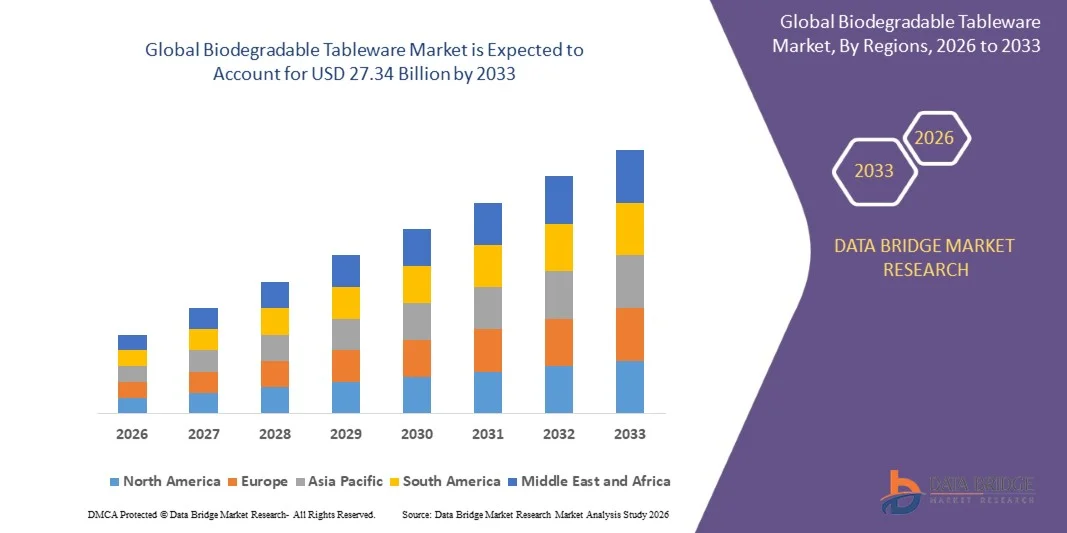
- The global biodegradable tableware market size was valued at USD 17.15 billion in 2025and is expected to reach USD 27.34 billion by 2033, at a CAGR of 6.00% during the forecast period
- The market growth is largely fuelled by the increasing environmental concerns and rising shift toward sustainable and eco-friendly packaging solutions such as compostable plates, cups, and cutlery
- In addition, stringent government regulations on single-use plastics and growing adoption of biodegradable alternatives across food service outlets, hospitality, and quick-service restaurants are supporting market expansion
Biodegradable Tableware Market Analysis
- The market is witnessing strong momentum due to rising consumer awareness regarding plastic pollution and increasing preference for sustainable dining solutions
- Manufacturers are focusing on product innovation using materials such as sugarcane bagasse, cornstarch, and bamboo to enhance durability, cost efficiency, and environmental compliance
- Asia-Pacific dominated the biodegradable tableware market with the largest revenue share in 2025, driven by rapid urbanization, strong growth in food delivery services, and increasing government initiatives to reduce single-use plastic consumption
- North America region is expected to witness the highest growth rate in the global biodegradable tableware market, driven by strict environmental regulations, increasing ban on single-use plastics, and strong demand for sustainable packaging alternatives across commercial and residential sectors
- The bagasse segment held the largest market revenue share in 2025 driven by its wide availability, cost-effectiveness, and strong durability for hot and cold food applications. Bagasse-based tableware is widely adopted across foodservice outlets due to its compostable nature, heat resistance, and suitability for large-scale commercial use
Report Scope and Biodegradable Tableware Market Segmentation
|
Attributes |
Biodegradable Tableware Key Market Insights |
|
Segments Covered |
· By Material: Paper, Bagasse, Bamboo, Palm Leaf, Wheat Bran, and Others · By Product Type: Cups, Plates, Bowls, Silverware, and Others · By Distribution Channel: Online and Offline |
|
Countries Covered |
North America · U.S. · Canada · Mexico Europe · Germany · France · U.K. · Netherlands · Switzerland · Belgium · Russia · Italy · Spain · Turkey · Rest of Europe Asia-Pacific · China · Japan · India · South Korea · Singapore · Malaysia · Australia · Thailand · Indonesia · Philippines · Rest of Asia-Pacific Middle East and Africa · Saudi Arabia · U.A.E. · South Africa · Egypt · Israel · Rest of Middle East and Africa South America · Brazil · Argentina · Rest of South America |
|
Key Market Players |
|
|
Market Opportunities |
• Expansion Of Sustainable Food Service Packaging |
|
Value Added Data Infosets |
In addition to the insights on market scenarios such as market value, growth rate, segmentation, geographical coverage, and major players, the market reports curated by the Data Bridge Market Research also include in-depth expert analysis, pricing analysis, brand share analysis, consumer survey, demography analysis, supply chain analysis, value chain analysis, raw material/consumables overview, vendor selection criteria, PESTLE Analysis, Porter Analysis, and regulatory framework. |
Biodegradable Tableware Market Trends
“Rising Demand for Sustainable And Plastic-Free Food Packaging”
- The increasing shift toward eco-friendly and plastic-free products is significantly shaping the biodegradable tableware market, as consumers and businesses prefer sustainable alternatives such as plates, cups, and cutlery made from renewable materials. Biodegradable tableware is gaining strong adoption due to its ability to reduce environmental impact while maintaining durability and functionality in food service applications. This trend is accelerating usage across quick-service restaurants, catering services, and institutional dining
- Growing awareness regarding environmental pollution and strict regulations on single-use plastics are driving demand for compostable tableware solutions. Governments across multiple regions are promoting bans and restrictions on plastic-based disposables, encouraging manufacturers to develop eco-friendly substitutes. This has led to increased investments in raw materials such as bagasse, cornstarch, and paper-based composites for large-scale production
- Sustainability-focused consumer behavior is influencing purchasing decisions, with food service providers prioritizing biodegradable packaging to enhance brand image and meet corporate sustainability goals. Companies are adopting eco-labeling and certifications to improve product visibility and strengthen consumer trust. This is further encouraging partnerships between raw material suppliers and tableware manufacturers to improve product quality and scalability
- For instance, in 2024, Huhtamaki in Finland and Vegware in the U.K. expanded their biodegradable tableware product lines, introducing compostable cups, plates, and food containers for retail and foodservice sectors. These products were launched in response to rising demand for sustainable packaging and were distributed across restaurants, catering chains, and online channels, strengthening brand positioning in the eco-packaging segment
- While demand is increasing, market growth depends on cost optimization, raw material availability, and performance improvements to match conventional plastic alternatives. Manufacturers are focusing on improving heat resistance, durability, and production scalability to support wider adoption across global markets
Biodegradable Tableware Market Dynamics
Driver
“Increasing Environmental Regulations And Shift Toward Sustainable Packaging”
- Stringent regulations banning single-use plastics are a major driver for the biodegradable tableware market, pushing manufacturers and end-users toward eco-friendly alternatives. Governments and environmental agencies are encouraging the use of compostable materials to reduce landfill waste and marine pollution, accelerating market adoption across foodservice industries
- Expanding food delivery services, quick-service restaurants, and institutional catering are increasing demand for disposable yet sustainable tableware solutions. Biodegradable products offer a balance between convenience and environmental responsibility, making them suitable for large-scale commercial applications. This shift is further supported by rising urbanization and changing consumer lifestyles
- Manufacturers are investing in product innovation and material advancements to enhance strength, moisture resistance, and cost efficiency of biodegradable tableware. These developments are helping companies meet performance expectations while maintaining sustainability standards, supporting broader adoption across global markets
- For instance, in 2023, Pactiv Evergreen Inc. in the U.S. and Dart Container Corporation in the U.S. increased production of biodegradable and compostable tableware products to meet growing demand from foodservice operators. These companies expanded distribution networks and product portfolios in response to regulatory pressure and rising consumer preference for eco-friendly dining solutions
- Although regulatory support and demand growth are strong, market expansion depends on cost reduction, supply chain stability, and improved material performance. Investments in scalable production technologies and sustainable sourcing will be essential for long-term competitiveness
Restraint/Challenge
“Higher Production Costs And Limited Infrastructure For Composting”
- The higher cost of biodegradable tableware compared to conventional plastic alternatives remains a key challenge, limiting adoption among price-sensitive consumers and small foodservice operators. Raw material sourcing, processing complexity, and certification requirements contribute to elevated production costs, impacting overall affordability
- Limited awareness and inconsistent composting infrastructure in several regions restrict the effectiveness of biodegradable products. Without proper waste management systems, compostable tableware may not fully decompose, reducing environmental benefits and slowing adoption in certain markets
- Supply chain constraints and dependency on agricultural raw materials also create challenges for consistent production and scalability. Seasonal availability and quality variations of raw inputs such as bagasse and cornstarch can affect manufacturing efficiency and pricing stability
- For instance, in 2024, foodservice distributors in India and Southeast Asia reported slower adoption of biodegradable tableware due to higher costs and lack of industrial composting facilities. Many small restaurants and catering businesses continued using conventional plastic alternatives due to affordability concerns and limited disposal infrastructure
- Overcoming these challenges will require investment in cost-efficient production technologies, expansion of composting infrastructure, and greater consumer awareness. Collaboration between governments, manufacturers, and waste management companies will be critical to supporting long-term growth of the biodegradable tableware market
Biodegradable Tableware Market Scope
The market is segmented on the basis of material, product type, and distribution channel.
- By Material
On the basis of material, the biodegradable tableware market is segmented into paper, bagasse, bamboo, palm leaf, wheat bran, and others. The bagasse segment held the largest market revenue share in 2025 driven by its wide availability, cost-effectiveness, and strong durability for hot and cold food applications. Bagasse-based tableware is widely adopted across foodservice outlets due to its compostable nature, heat resistance, and suitability for large-scale commercial use.
The bamboo segment is expected to witness the fastest growth rate from 2026 to 2033, driven by increasing demand for premium, durable, and eco-friendly alternatives to plastic disposables. Bamboo tableware is gaining popularity due to its natural strength, biodegradability, and aesthetic appeal, making it highly suitable for restaurants, catering services, and sustainable lifestyle consumers.
- By Product Type
On the basis of product type, the market is segmented into cups, plates, bowls, silverware, and others. The plates segment held the largest market revenue share in 2025 driven by high consumption in quick-service restaurants, events, and institutional catering. Biodegradable plates are widely preferred due to their convenience, cost efficiency, and ability to handle both dry and wet food applications effectively.
The cups segment is expected to witness the fastest growth rate from 2026 to 2033, driven by rising demand for sustainable alternatives to plastic and paper-coated disposable cups in beverage service industries. Biodegradable cups are increasingly adopted in cafes, food delivery services, and takeaway outlets due to their compostable properties and strong alignment with eco-friendly packaging trends.
- By Distribution Channel
On the basis of distribution channel, the market is segmented into online and offline. The offline segment held the largest market revenue share in 2025 driven by strong procurement from restaurants, catering services, and institutional buyers through wholesalers and distributors. Offline channels remain dominant due to bulk purchasing, established supplier relationships, and immediate product availability.
The online segment is expected to witness the fastest growth rate from 2026 to 2033, driven by increasing digitalization, expanding e-commerce platforms, and rising preference for convenient procurement of packaging products. Online channels offer wider product variety, competitive pricing, and easy access to eco-friendly tableware solutions, supporting rapid market expansion among small businesses and individual buyers.
Biodegradable Tableware Market Regional Analysis
- Asia-Pacific dominated the biodegradable tableware market with the largest revenue share in 2025, driven by rapid urbanization, strong growth in food delivery services, and increasing government initiatives to reduce single-use plastic consumption
- Consumers in the region are increasingly adopting eco-friendly dining solutions such as compostable plates, cups, and cutlery due to rising environmental awareness and shifting lifestyle preferences
- This widespread adoption is further supported by expanding quick-service restaurants, growing hospitality industries, and strong manufacturing capabilities for cost-effective biodegradable materials, establishing Asia-Pacific as a key hub for market growth
China Biodegradable Tableware Market Insight
The China biodegradable tableware market captured the largest revenue share in Asia-Pacific in 2025, driven by strict government regulations on plastic bans and rapid expansion of the foodservice and online food delivery sectors. Rising environmental concerns and strong consumer shift toward sustainable packaging solutions are further supporting market growth. In addition, the presence of large-scale domestic manufacturers and continuous innovation in compostable materials such as bagasse and paper-based products are strengthening market penetration across commercial and retail applications.
Japan Biodegradable Tableware Market Insight
The Japan biodegradable tableware market is expected to witness the fastest growth rate from 2026 to 2033, driven by strong environmental consciousness, advanced waste management systems, and high adoption of sustainable consumption practices. Increasing demand from restaurants, convenience stores, and institutional catering is supporting market expansion. In addition, Japan’s focus on innovation and eco-friendly product development is encouraging the use of premium biodegradable materials such as bamboo and molded pulp in tableware applications.
Europe Biodegradable Tableware Market Insight
Europe is expected to witness the fastest growth rate from 2026 to 2033, driven by stringent bans on single-use plastics and strong government support for sustainable packaging solutions. Consumers in the region highly prioritize eco-friendly dining products, compostable packaging, and environmentally responsible alternatives in foodservice and retail sectors. This widespread adoption is further supported by strong sustainability regulations, high environmental awareness, and increasing demand from restaurants, catering services, and institutional buyers, establishing biodegradable tableware as a preferred alternative to plastic-based disposables
Germany Biodegradable Tableware Market Insight
The Germany biodegradable tableware market is expected to witness the fastest growth rate from 2026 to 2033, driven by strict environmental policies and strong emphasis on waste reduction and recycling initiatives. Consumers and foodservice providers are increasingly shifting toward compostable plates, cups, and cutlery made from renewable materials such as bagasse and paper. The growing adoption of sustainable packaging in restaurants, quick-service chains, and institutional catering further supports market growth. In addition, Germany’s strong focus on circular economy practices and eco-certifications is significantly accelerating product adoption across commercial applications.
U.K. Biodegradable Tableware Market Insight
The U.K. biodegradable tableware market is expected to witness the fastest growth rate from 2026 to 2033, driven by rising awareness of plastic pollution and increasing government restrictions on single-use plastics. The expansion of eco-conscious consumer behavior and strong demand from food delivery services and hospitality sectors are further supporting market growth. In addition, the growing popularity of sustainable dining practices and retail availability of compostable tableware products is contributing to widespread adoption across both residential and commercial segments.
North America Biodegradable Tableware Market Insight
North America dominated the biodegradable tableware market is expected to witness the fastest growth rate from 2026 to 2033, driven by strong demand for sustainable food packaging solutions, stringent environmental regulations, and increasing consumer preference for eco-friendly disposable products. Consumers in the region highly prioritize convenience, sustainability, and compliance with plastic reduction initiatives, leading to widespread adoption of compostable tableware across foodservice, retail, and institutional sectors. This strong adoption is further supported by advanced waste management infrastructure, high environmental awareness, and rapid expansion of quick-service restaurants and takeaway services, establishing biodegradable tableware as a preferred alternative to plastic-based disposables.
U.S. Biodegradable Tableware Market Insight
The U.S. biodegradable tableware market is expected to witness the fastest growth rate from 2026 to 2033, driven by rapid growth in food delivery services, strong sustainability initiatives, and increasing restrictions on single-use plastics across several states. Consumers are increasingly shifting toward compostable plates, cups, and cutlery made from materials such as bagasse, paper, and plant-based fibers. In addition, strong presence of major foodservice chains and growing corporate sustainability commitments are accelerating market adoption. The integration of eco-labeling and green packaging standards is further strengthening demand across commercial and residential applications.
Biodegradable Tableware Market Share
The Biodegradable Tableware industry is primarily led by well-established companies, including:
• Biotrem (Poland)
• Georgia-Pacific (U.S.)
• DOpla SpA (Italy)
• Huhtamaki (Finland)
• Natural Tableware (Netherlands)
• Pactiv LLC (U.S.)
• PAPSTAR GmbH (Germany)
• SOLIA (France)
• Eco-Products, Inc (U.S.)
• Al Bayader International (U.A.E.)
• Dart Container Corporation (U.S.)
• Reynolds Consumer Products (U.S.)
• Dinearth (India)
• Yash Pakka Limited (India)
• Cosmos Eco Friends (India)
• Visfortec (India)
• Xiamen Greenday Import & Export Co., Ltd. (China)
• Pappco Greenware (India)
Latest Developments in Global Biodegradable Tableware Market
- In June 2023, Seow Khim Polythelene Co (SKP), expansion development, expanded its sustainable food packaging and cutlery product range in Singapore. This initiative aims to meet the rising demand from both B2B and B2C customers for eco-friendly disposable packaging solutions. It will strengthen SKP’s manufacturing capacity and product diversification in biodegradable packaging. The development is expected to support market growth by increasing the availability of sustainable alternatives and reinforcing the shift toward environmentally responsible consumption
- In August 2021, Novolex, acquisition development, acquired Vegware, a U.K.-based compostable foodservice packaging company. This acquisition is intended to expand Novolex’s sustainable product portfolio and enhance its presence in Europe while improving access to the North American market. It will help integrate Vegware’s compostable packaging solutions with Eco-Products’ renewable material offerings. The development is expected to strengthen Novolex’s global footprint and accelerate the adoption of compostable foodservice packaging across key markets
- In 2023, Kerala Biodegradable Paper Products Makers Association (KBPPMA), industry association development, was established in India to support biodegradable paper product manufacturers. The initiative aims to promote innovation, collaboration, and commercialization of eco-friendly paper-based packaging solutions. It will help small and medium enterprises scale production and improve awareness of sustainable alternatives. The development is expected to strengthen India’s biodegradable packaging ecosystem and support regional market expansion
- In April 2024, Albany Lumber, capacity expansion development, achieved a production milestone by producing its one billionth board foot at its Georgia facility in the U.S. The company focuses on large-scale wood product manufacturing using advanced tracking and production systems. This milestone reflects increased operational efficiency and strong production capabilities. The development is expected to reinforce Albany Lumber’s market position and support growth in sustainable wood-based material supply chains
SKU-

- Interactive Data Analysis Dashboard
- Company Analysis Dashboard for high growth potential opportunities
- Research Analyst Access for customization & queries
- Competitor Analysis with Interactive dashboard
- Latest News, Updates & Trend analysis
- Harness the Power of Benchmark Analysis for Comprehensive Competitor Tracking
Data collection and base year analysis are done using data collection modules with large sample sizes. The stage includes obtaining market information or related data through various sources and strategies. It includes examining and planning all the data acquired from the past in advance. It likewise envelops the examination of information inconsistencies seen across different information sources. The market data is analysed and estimated using market statistical and coherent models. Also, market share analysis and key trend analysis are the major success factors in the market report. To know more, please request an analyst call or drop down your inquiry.
The key research methodology used by DBMR research team is data triangulation which involves data mining, analysis of the impact of data variables on the market and primary (industry expert) validation. Data models include Vendor Positioning Grid, Market Time Line Analysis, Market Overview and Guide, Company Positioning Grid, Patent Analysis, Pricing Analysis, Company Market Share Analysis, Standards of Measurement, Global versus Regional and Vendor Share Analysis. To know more about the research methodology, drop in an inquiry to speak to our industry experts.
Data Bridge Market Research is a leader in advanced formative research. We take pride in servicing our existing and new customers with data and analysis that match and suits their goal. The report can be customized to include price trend analysis of target brands understanding the market for additional countries (ask for the list of countries), clinical trial results data, literature review, refurbished market and product base analysis. Market analysis of target competitors can be analyzed from technology-based analysis to market portfolio strategies. We can add as many competitors that you require data about in the format and data style you are looking for. Our team of analysts can also provide you data in crude raw excel files pivot tables (Fact book) or can assist you in creating presentations from the data sets available in the report.












