




Global Biodiesel Market
Market Size in USD Billion
CAGR :
% 
 USD
40.28 Billion
USD
60.42 Billion
2025
2033
USD
40.28 Billion
USD
60.42 Billion
2025
2033
 Forecast Period Forecast Period |
2026 –2033 |
 Market Size (Base Year) Market Size (Base Year) |
USD 40.28 Billion |
 Market Size (Forecast Year) Market Size (Forecast Year) |
USD 60.42 Billion |
 CAGR CAGR |
% |
| Major Markets Players |
|
Biodiesel Market Size
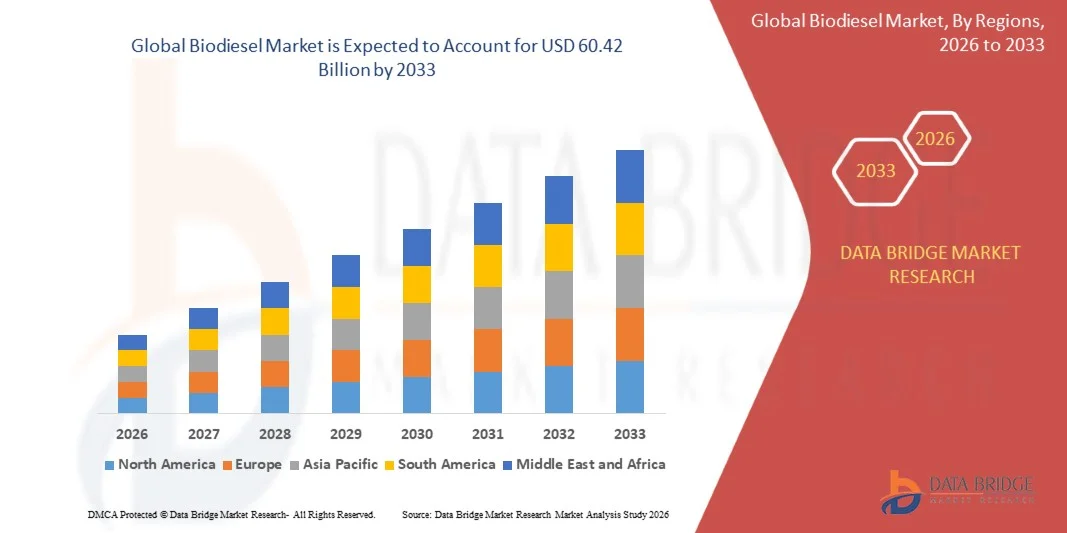
- The global biodiesel market size was valued at USD 40.28 billion in 2025 and is expected to reach USD 60.42 billion by 2033, at a CAGR of 5.20% during the forecast period
- The biodiesel market growth is primarily driven by rising global emphasis on reducing greenhouse gas emissions and accelerating the transition toward renewable and low-carbon fuel alternatives in the transportation and industrial sectors
- Furthermore, government-led blending mandates, renewable fuel standards, and fiscal incentives across major economies are significantly strengthening biodiesel adoption, making it a key component of national energy diversification strategies. These combined factors are accelerating large-scale integration of biodiesel into conventional diesel supply chains, thereby boosting overall market expansion
Biodiesel Market Analysis
- Biodiesel, produced from renewable feedstocks such as vegetable oils, animal fats, and waste cooking oils, is increasingly becoming a critical alternative fuel in transportation, agriculture, and industrial applications due to its lower carbon footprint and compatibility with existing diesel engines
- The growing demand for biodiesel is primarily driven by increasing energy security concerns, volatility in crude oil prices, and rising investments in sustainable fuel production infrastructure, alongside strong policy support for cleaner mobility solutions
- Europe dominated the biodiesel market with a share of 47.2% in 2025, due to stringent renewable energy mandates, blending obligations, and strong decarbonization targets across transport and industrial sectors
- Asia-Pacific is expected to be the fastest growing region in the biodiesel market during the forecast period due to rapid urbanization, rising energy demand, and supportive government blending policies in countries such as China, India, and Indonesia
- Vegetable oils segment dominated the market with a market share of 63.95% in 2025, due to abundant availability from agricultural crops and established supply chains across major producing regions. Feedstocks such as soybean oil, rapeseed oil, and palm oil are widely used due to their high oil yield and consistent conversion efficiency
Report Scope and Biodiesel Market Segmentation
|
Attributes |
Biodiesel Key Market Insights |
|
Segments Covered |
|
|
Countries Covered |
North America
Europe
Asia-Pacific
Middle East and Africa
South America
|
|
Key Market Players |
|
|
Market Opportunities |
|
|
Value Added Data Infosets |
In addition to the insights on market scenarios such as market value, growth rate, segmentation, geographical coverage, and major players, the market reports curated by the Data Bridge Market Research also include import export analysis, production capacity overview, production consumption analysis, price trend analysis, climate change scenario, supply chain analysis, value chain analysis, raw material/consumables overview, vendor selection criteria, PESTLE Analysis, Porter Analysis, and regulatory framework. |
Biodiesel Market Trends
“Growing Shift Toward Advanced and Waste-Based Biodiesel Production”
- A significant trend in the biodiesel market is the increasing transition toward advanced biodiesel and waste-based feedstocks such as used cooking oil, animal fats, and agricultural residues. This shift is being driven by tightening sustainability regulations and the need to reduce indirect land-use impacts associated with conventional crop-based biodiesel. It is reshaping production strategies across global biofuel producers by prioritizing circular economy-based fuel systems
- For instance, Neste Oyj processes renewable waste and residue oils at its Singapore and Rotterdam facilities to produce advanced biodiesel and renewable diesel. This approach significantly reduces lifecycle greenhouse gas emissions and strengthens compliance with strict European and global renewable fuel standards
- The adoption of waste-based biodiesel is expanding across transportation and industrial fuel markets as governments enforce stricter carbon reduction targets. This is improving the environmental profile of biodiesel while also ensuring long-term feedstock sustainability for large-scale production
- Refining companies are increasingly integrating co-processing technologies to convert waste feedstocks into biodiesel and renewable diesel within existing refinery infrastructure. This is reducing capital expenditure requirements and accelerating the transition toward cleaner fuel production systems
- Growing demand for certified sustainable fuels in aviation and heavy transport is further supporting advanced biodiesel adoption. This is driving investment in traceable and low-carbon fuel supply chains that meet international sustainability certification requirements
- The overall trend is reinforcing a structural shift in the biodiesel industry toward non-food-based and circular feedstock models, ensuring long-term scalability and regulatory alignment across major fuel markets
Biodiesel Market Dynamics
Driver
“Rising Global Demand for Low-Carbon and Renewable Transportation Fuels”
- The biodiesel market is strongly driven by increasing global demand for low-carbon transportation fuels as governments and industries intensify decarbonization efforts across road transport, shipping, and aviation sectors. Biodiesel is gaining importance as a drop-in fuel that reduces lifecycle emissions without requiring major engine modifications, making it a practical alternative to fossil diesel
- For instance, the U.S. Renewable Fuel Standard administered by the Environmental Protection Agency (EPA) mandates blending of renewable fuels, directly supporting biodiesel consumption across the transport sector. This regulatory framework ensures stable demand and encourages continuous investment in biodiesel production capacity
- The increasing focus on reducing crude oil dependency is pushing countries to adopt domestically produced renewable fuels, strengthening energy security. This is particularly important in regions with high fuel import dependence and volatile global oil prices
- Transportation fleets, logistics operators, and public transit systems are increasingly adopting biodiesel blends to meet corporate sustainability targets. This is expanding commercial demand beyond regulatory compliance into voluntary green fuel adoption
- Industrial users are also shifting toward biodiesel for heating and power generation applications to reduce carbon emissions. This diversification of end-use applications is broadening the overall demand base for biodiesel. The growing alignment of national net-zero strategies with renewable fuel adoption continues to reinforce biodiesel market expansion globally
Restraint/Challenge
“Feedstock Price Volatility and Supply Constraints of Raw Materials”
- A major challenge in the biodiesel market is the volatility in feedstock prices and limited availability of key raw materials such as soybean oil, palm oil, and used cooking oil. Since feedstock costs account for a significant portion of biodiesel production expenses, fluctuations directly impact profitability and pricing stability
- For instance, Archer Daniels Midland Company (ADM) experiences cost pressure in its biofuel operations when global soybean oil prices fluctuate due to changing crop yields and trade dynamics. This creates uncertainty in production margins and affects long-term supply planning
- Competition between food and fuel industries for agricultural oils further constrains feedstock availability, especially during periods of high food demand. This increases input costs and creates supply-demand imbalances in biodiesel production markets
- Weather variability, climate-related disruptions, and geopolitical factors also impact agricultural output, reducing feedstock consistency. This leads to irregular supply chains and production inefficiencies for biodiesel manufacturers
- The growing demand for waste-based oils has created additional competition among biofuel producers, food processors, and recycling industries. This has intensified sourcing challenges and increased procurement costs for sustainable feedstocks. These combined factors continue to limit cost predictability and scalability in biodiesel production, making feedstock security one of the most critical challenges for market growth
Biodiesel Market Scope
The market is segmented on the basis of feedstock type, blend, application, and production technology.
•By Feedstock Type
On the basis of feedstock type, the biodiesel market is segmented into vegetable oils, animal fats, biomass, and others. The vegetable oils segment dominated the market with the largest revenue share of 63.95% in 2025, driven by abundant availability from agricultural crops and established supply chains across major producing regions. Feedstocks such as soybean oil, rapeseed oil, and palm oil are widely used due to their high oil yield and consistent conversion efficiency. Government policies supporting renewable fuel blending further strengthen the preference for vegetable-based biodiesel production. The segment also benefits from well-developed extraction and refining infrastructure, ensuring stable production costs and scalability.
The animal fats segment is anticipated to witness the fastest growth rate from 2026 to 2033, driven by increasing utilization of waste-derived feedstocks for cost-effective and sustainable biodiesel production. For instance, companies such as Darling Ingredients are expanding processing capabilities to convert tallow and used cooking oil into advanced biofuels. Rising emphasis on circular economy practices and waste valorization supports strong adoption of this segment. The lower feedstock cost compared to edible oils further enhances its competitiveness in biodiesel manufacturing.
•By Blend
On the basis of blend, the biodiesel market is segmented into B100, B20, B10, and B5. The B20 segment dominated the market with the largest revenue share in 2025, driven by its optimal balance between performance compatibility and emission reduction benefits. B20 blends are widely accepted in existing diesel engines without major modifications, making them suitable for large-scale transportation and commercial fleets. Government mandates promoting partial biodiesel blending in fossil diesel further support its widespread adoption. The segment also benefits from strong infrastructure compatibility across fuel distribution networks.
The B100 segment is anticipated to witness the fastest growth rate from 2026 to 2033, driven by rising demand for pure biodiesel in regions focused on aggressive carbon reduction targets. Increased adoption in captive fleets and industrial applications where engine modification is feasible supports its expansion. Growing investment in advanced engine technologies capable of handling higher biodiesel concentrations further accelerates demand. Environmental regulations targeting near-zero emission fuels continue to strengthen the shift toward pure biodiesel usage.
•By Application
On the basis of application, the biodiesel market is segmented into automotive, aviation, industrial, marine, residential and commercial heating, power generation, agriculture, and others. The automotive segment dominated the market with the largest revenue share in 2025, driven by extensive use of biodiesel blends in passenger vehicles, trucks, and public transportation systems. Rising fuel demand in road transport coupled with stringent emission regulations supports strong consumption. Fleet operators increasingly adopt biodiesel to reduce carbon footprint without altering existing diesel engines significantly. The segment also benefits from well-established fueling infrastructure and government blending mandates.
The aviation segment is anticipated to witness the fastest growth rate from 2026 to 2033, driven by increasing adoption of sustainable aviation fuel derived from biodiesel pathways. For instance, companies such as Neste are expanding production of renewable aviation fuels to meet airline decarbonization targets. Airlines are increasingly investing in low-carbon alternatives to comply with international emission reduction frameworks. Growing research into advanced bio-jet fuel technologies further accelerates adoption in this segment.
•By Production Technology
On the basis of production technology, the biodiesel market is segmented into conventional alcohol trans-esterification, pyrolysis, and hydro heating. The conventional alcohol trans-esterification segment dominated the market with the largest revenue share in 2025, driven by its cost-effectiveness, simplicity, and widespread commercial adoption. This process efficiently converts vegetable oils and animal fats into biodiesel using methanol or ethanol with catalysts. Established industrial infrastructure and proven scalability make it the preferred technology for large-scale biodiesel production. The segment also benefits from continuous process optimization improving yield and reducing production costs.
The hydro heating segment is anticipated to witness the fastest growth rate from 2026 to 2033, driven by increasing demand for high-quality, drop-in renewable fuels compatible with existing diesel infrastructure. Advanced refining capabilities allow hydro heating to produce cleaner fuel with improved stability and performance. Rising investments in next-generation bio-refining technologies support rapid expansion of this segment. Strong focus on producing advanced biofuels for transportation and aviation further accelerates its adoption trajectory.
Biodiesel Market Regional Analysis
- Europe dominated the biodiesel market with the largest revenue share of 47.2% in 2025, driven by stringent renewable energy mandates, blending obligations, and strong decarbonization targets across transport and industrial sectors
- Industries and fuel distributors in the region highly prioritize low-carbon fuel adoption, energy security, and compliance with EU renewable directives such as RED policies, supporting large-scale biodiesel integration
- Widespread utilization across road transport, aviation biofuel initiatives, and agricultural applications is further strengthened by government incentives and sustainability commitments from major economies
U.K. Biodiesel Market Insight
The U.K. biodiesel market is witnessing steady growth driven by government-backed renewable fuel obligations and rising demand for low-emission transport solutions. Increasing focus on reducing dependency on fossil fuels is encouraging biodiesel blending in road transport and industrial energy use. Expansion of waste-based biodiesel production is improving sustainability performance. Strong policy alignment with net-zero targets continues to support market development.
Germany Biodiesel Market Insight
The Germany biodiesel market captured the largest market share in 2025, due to high environmental standards and advanced renewable energy infrastructure. Rising adoption in automotive and freight transport sectors is supported by national decarbonization strategies. Strong emphasis on circular economy principles is driving the use of waste oils and advanced biofeedstocks. Integration of biodiesel into industrial energy systems further strengthens market penetration.
North America Biodiesel Market Insight
North America held a strong position in the biodiesel market in 2025, driven by supportive regulatory frameworks such as the Renewable Fuel Standard and growing focus on reducing greenhouse gas emissions. Increasing feedstock availability from soybean oil and waste-based oils is enhancing production scalability. The region benefits from well-established bio-refinery infrastructure and strong participation from fuel distributors. Rising adoption in commercial transportation and industrial applications continues to support market expansion.
U.S. Biodiesel Market Insight
The U.S. biodiesel market captured a significant revenue share in 2025 within North America, supported by increasing renewable fuel standards and tax incentives under federal biofuel programs. Rising demand for cleaner transportation fuels across freight, agriculture, and public transport sectors is strengthening consumption. Expansion of renewable diesel capacity and strong investment by domestic producers is accelerating market growth. In addition, blending mandates across several states are encouraging wider biodiesel adoption.
Asia-Pacific Biodiesel Market Insight
The Asia-Pacific biodiesel market is expected to grow at the fastest CAGR during the forecast period of 2026 to 2033, driven by rapid urbanization, rising energy demand, and supportive government blending policies in countries such as China, India, and Indonesia. Expanding transportation fleets and increasing focus on reducing air pollution are accelerating biodiesel consumption. Growing domestic production capacity and investments in bio-refinery infrastructure are improving supply availability. Strong policy support for energy diversification continues to boost regional market growth.
Japan Biodiesel Market Insight
The Japan biodiesel market is gaining traction due to the country’s focus on clean energy transition and reduction of carbon emissions. Increasing use of biodiesel in transportation and industrial heating applications is supporting market development. Technological advancements in biofuel processing are improving efficiency and output quality. Strong emphasis on energy security is encouraging adoption of alternative fuels such as biodiesel.
China Biodiesel Market Insight
The China biodiesel market accounted for the largest revenue share in Asia-Pacific in 2025, supported by rapid industrialization, strong government support for renewable energy, and growing environmental concerns. Expanding urban transportation networks are driving demand for cleaner fuel alternatives. Large-scale production capabilities and availability of diverse feedstocks are strengthening domestic supply. Ongoing push toward carbon neutrality and sustainable fuel adoption continues to accelerate market growth.
Biodiesel Market Share
The biodiesel industry is primarily led by well-established companies, including:
- Archer Daniels Midland Company (ADM) (U.S.)
- Wilmar International Ltd. (Singapore)
- Bunge Limited (U.S.)
- Neste Oyj (Finland)
- Renewable Energy Group, Inc. (U.S.)
- BIOX Corporation (Canada)
- Münzer Bioindustrie GmbH (Germany)
- Amalgamated, Inc. (U.S.)
- FutureFuel Corporation (U.S.)
- Flint Hills Resources (U.S.)
- The Andersons, Inc. (U.S.)
- RB FUELS (U.S.)
- Marathon Petroleum Corporation (U.S.)
- Hebei Jingu Recycling Resources Development Co., Ltd. (China)
Latest Developments in Global Biodiesel Market
- In April 2025, Neste expanded its global SAF capacity to 1.5 million tonnes per annum and advanced the Rotterdam expansion, positioning the site to become the world’s largest renewable diesel and SAF production hub by 2027. This expansion strengthens global renewable fuel availability at a time when aviation and heavy transport sectors are under pressure to decarbonize rapidly. It improves supply chain resilience for sustainable aviation fuel and renewable diesel, reduces dependency on fossil-based fuels, and enhances Europe’s strategic role in clean fuel exports. The scale-up also supports long-term price stabilization by increasing production efficiency and capacity consolidation
- In April 2025, Aemetis India secured USD 31 million in biodiesel orders from state-owned oil companies with rapid delivery timelines, reflecting strong immediate demand from public sector fuel buyers. This development highlights increasing enforcement of blending mandates across India, driven by rising energy demand and import substitution goals. It supports short-term revenue growth for domestic biodiesel producers while signaling stronger government commitment to renewable fuel adoption. The order flow also indicates improving market liquidity and expanding institutional participation in biodiesel procurement
- In March 2025, British Columbia introduced a Canadian-content requirement mandating 8% domestically produced renewable diesel in its provincial blending program, strengthening local sourcing policies. This regulation is designed to promote domestic biofuel manufacturing, reduce reliance on imported renewable diesel, and stimulate regional investment in refining infrastructure. It is expected to improve supply chain localization and encourage long-term capacity expansion within Canada’s clean fuel ecosystem. The policy also enhances energy security while supporting emissions reduction targets in the transport sector
- In January 2025, OMV commissioned a EUR 200 million co-processing unit at its Schwechat refinery capable of converting 160,000 tonnes per annum of liquid biomass into HVO components. This development enhances refinery integration of renewable feedstocks, allowing conventional facilities to transition toward low-carbon fuel production without complete infrastructure replacement. It strengthens Europe’s renewable diesel output capacity and improves feedstock flexibility through co-processing technologies. The investment also supports industrial decarbonization strategies by reducing lifecycle emissions from transportation fuels
- In December 2024, TotalEnergies expanded its La Mède biorefinery in France to increase production of biodiesel and renewable diesel using waste-based feedstocks. This expansion reinforces Europe’s shift toward advanced biofuels derived from sustainable raw materials such as used cooking oil and animal fats. It improves feedstock diversification and reduces dependency on crop-based inputs, addressing sustainability concerns in biofuel production. The development also strengthens regional supply security while supporting EU renewable energy and carbon neutrality objectives in the transport fuel sector
SKU-
Get online access to the report on the World's First Market Intelligence Cloud

- Interactive Data Analysis Dashboard
- Company Analysis Dashboard for high growth potential opportunities
- Research Analyst Access for customization & queries
- Competitor Analysis with Interactive dashboard
- Latest News, Updates & Trend analysis
- Harness the Power of Benchmark Analysis for Comprehensive Competitor Tracking
Global Biodiesel Market, Supply Chain Analysis and Ecosystem Framework
To support market growth and help clients navigate the impact of geopolitical shifts, DBMR has integrated in-depth supply chain analysis into its Global Biodiesel Market research reports. This addition empowers clients to respond effectively to global changes affecting their industries. The supply chain analysis section includes detailed insights such as Global Biodiesel Market consumption and production by country, price trend analysis, the impact of tariffs and geopolitical developments, and import and export trends by country and HSN code. It also highlights major suppliers with data on production capacity and company profiles, as well as key importers and exporters. In addition to research, DBMR offers specialized supply chain consulting services backed by over a decade of experience, providing solutions like supplier discovery, supplier risk assessment, price trend analysis, impact evaluation of inflation and trade route changes, and comprehensive market trend analysis.
Research Methodology
Data collection and base year analysis are done using data collection modules with large sample sizes. The stage includes obtaining market information or related data through various sources and strategies. It includes examining and planning all the data acquired from the past in advance. It likewise envelops the examination of information inconsistencies seen across different information sources. The market data is analysed and estimated using market statistical and coherent models. Also, market share analysis and key trend analysis are the major success factors in the market report. To know more, please request an analyst call or drop down your inquiry.
The key research methodology used by DBMR research team is data triangulation which involves data mining, analysis of the impact of data variables on the market and primary (industry expert) validation. Data models include Vendor Positioning Grid, Market Time Line Analysis, Market Overview and Guide, Company Positioning Grid, Patent Analysis, Pricing Analysis, Company Market Share Analysis, Standards of Measurement, Global versus Regional and Vendor Share Analysis. To know more about the research methodology, drop in an inquiry to speak to our industry experts.
Customization Available
Data Bridge Market Research is a leader in advanced formative research. We take pride in servicing our existing and new customers with data and analysis that match and suits their goal. The report can be customized to include price trend analysis of target brands understanding the market for additional countries (ask for the list of countries), clinical trial results data, literature review, refurbished market and product base analysis. Market analysis of target competitors can be analyzed from technology-based analysis to market portfolio strategies. We can add as many competitors that you require data about in the format and data style you are looking for. Our team of analysts can also provide you data in crude raw excel files pivot tables (Fact book) or can assist you in creating presentations from the data sets available in the report.












