

Global Biomimetic Materials Market
Market Size in USD Billion
CAGR :
% 
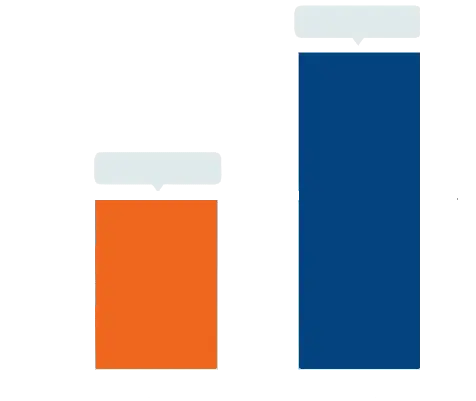 USD
2.57 Billion
USD
4.15 Billion
2025
2033
USD
2.57 Billion
USD
4.15 Billion
2025
2033
 Forecast Period Forecast Period |
2026 –2033 |
 Market Size (Base Year) Market Size (Base Year) |
USD 2.57 Billion |
 Market Size (Forecast Year) Market Size (Forecast Year) |
USD 4.15 Billion |
 CAGR CAGR |
% |
| Major Markets Players |
|
Biomimetic Materials Market Size
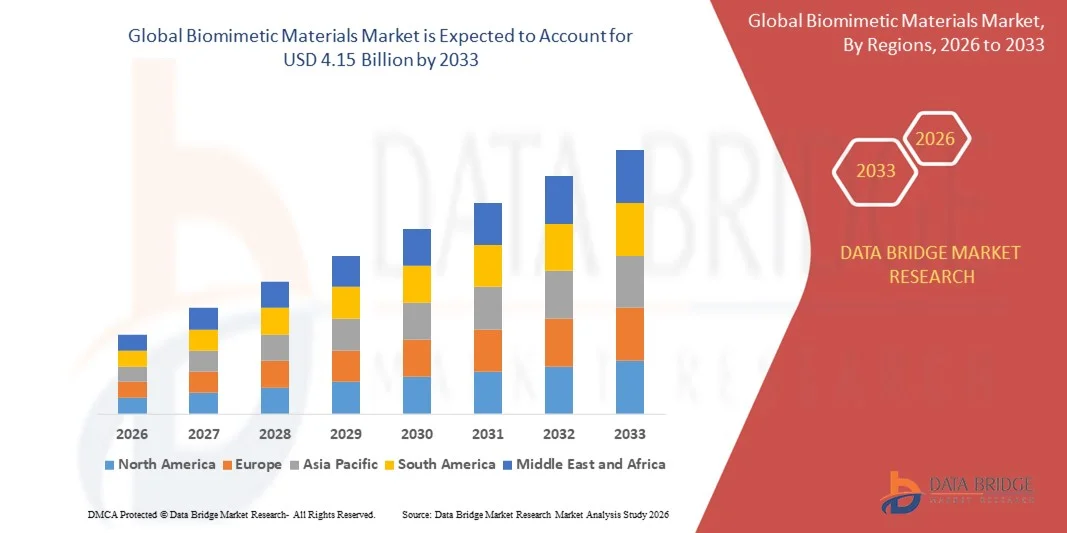
- The global biomimetic materials market size was valued at USD 2.57 billion in 2025 and is expected to reach USD 4.15 billion by 2033, at a CAGR of 6.2% during the forecast period
- The market growth is largely fueled by the increasing adoption of advanced materials that replicate natural structures and functions, along with technological progress in robotics, medical devices, and sustainable engineering, driving demand across multiple industries
- Furthermore, rising focus on sustainability, energy efficiency, and enhanced performance in medical, industrial, and consumer applications is establishing biomimetic materials as a preferred solution for innovation-driven companies. These converging factors are accelerating the development and deployment of biomimetic solutions, thereby significantly boosting the industry's growth
Biomimetic Materials Market Analysis
- Biomimetic materials are nature-inspired substances designed to emulate biological structures and processes, offering enhanced mechanical properties, biocompatibility, and functional efficiency. These materials are applied in medical implants, prosthetics, robotics, sensors, and environmentally friendly manufacturing solutions
- The escalating demand for biomimetic materials is primarily fueled by technological advancements, growing research and development initiatives, and increasing industrial and consumer awareness of sustainable and high-performance material solutions. The integration of biomimetic principles into advanced applications is expanding market adoption across healthcare, robotics, aerospace, and automotive sectors
- North America dominated the biomimetic materials market with a share of 42.5% in 2025, due to growing investments in advanced materials research, increased adoption in medical and robotics applications, and awareness of sustainable, nature-inspired technologies
- Asia-Pacific is expected to be the fastest growing region in the biomimetic materials market during the forecast period due to rapid urbanization, increasing industrialization, and expanding medical and robotics sectors in countries such as China, Japan, and India
- Biomimetic sensors segment dominated the market with a market share of 39.2% in 2025, due to its critical role in emulating biological sensing mechanisms for industrial, medical, and environmental applications. These sensors are highly valued for their sensitivity, adaptability, and efficiency in detecting physical, chemical, and biological signals. Industries such as healthcare, robotics, and environmental monitoring increasingly incorporate biomimetic sensors to achieve higher precision and real-time response in complex systems. The growing focus on IoT and smart device integration further supports the adoption of biomimetic sensing technologies
Report Scope and Biomimetic Materials Market Segmentation
|
Attributes |
Biomimetic Materials Key Market Insights |
|
Segments Covered |
|
|
Countries Covered |
North America
Europe
Asia-Pacific
Middle East and Africa
South America
|
|
Key Market Players |
|
|
Market Opportunities |
|
|
Value Added Data Infosets |
In addition to the insights on market scenarios such as market value, growth rate, segmentation, geographical coverage, and major players, the market reports curated by the Data Bridge Market Research also include import export analysis, production capacity overview, production consumption analysis, price trend analysis, climate change scenario, supply chain analysis, value chain analysis, raw material/consumables overview, vendor selection criteria, PESTLE Analysis, Porter Analysis, and regulatory framework. |
Biomimetic Materials Market Trends
Rising Integration of Biomimetic Materials in Medical Devices and Robotics
- A prominent trend in the biomimetic materials market is the growing adoption of materials inspired by natural structures and processes in medical devices and robotic systems, driven by the need for enhanced performance, biocompatibility, and efficiency. This trend is positioning biomimetic materials as essential enablers for innovation in advanced healthcare and automation technologies
- For instance, Boston Dynamics incorporates biomimetic materials in robotic joints and actuators to replicate natural movement and improve energy efficiency. These applications demonstrate how bio-inspired materials contribute to improved functionality and adaptability in robotics
- The use of biomimetic hydrogels and scaffolds is increasing in tissue engineering, wound healing, and implantable medical devices, where properties such as flexibility, biodegradability, and mechanical strength are critical. This trend is accelerating research in regenerative medicine and minimally invasive surgical tools
- Industries are exploring biomimetic coatings and surfaces to reduce friction, prevent bacterial adhesion, and improve durability in medical instruments. These applications highlight the expanding role of biomimetic materials in enhancing product performance and safety
- The integration of biomimetic composites in prosthetics and wearable exoskeletons is gaining traction to provide more natural movement, reduce user fatigue, and increase comfort. This approach is fostering innovation in personalized medical solutions and assistive technologies
- The market is witnessing an increased emphasis on multifunctional biomimetic materials that combine sensing, structural, and adaptive capabilities. Such materials are reinforcing the transition toward smarter medical devices and robotics with higher efficiency, resilience, and sustainability
Biomimetic Materials Market Dynamics
Driver
Growing Focus on Sustainable and High-Performance Materials
- The rising demand for materials that are both high-performing and environmentally sustainable is driving the adoption of biomimetic materials across industries. These materials offer functional advantages such as self-healing, lightweight strength, and energy efficiency while reducing environmental impact
- For instance, BASF has developed bio-inspired polymer composites used in automotive and medical applications that reduce material consumption and improve performance. Such initiatives highlight the growing emphasis on sustainability combined with superior functional properties
- Research in bio-inspired nanomaterials, polymers, and composites is expanding due to their potential in medical, aerospace, and industrial applications. These materials provide improved durability, responsiveness, and efficiency, fueling further market growth
- The adoption of biomimetic materials in high-performance applications is supported by increasing R&D investments from governments and private players, accelerating commercialization and technical advancement. This trend reinforces the role of biomimetic innovation in achieving competitive advantage
- The focus on developing materials that mimic nature to achieve superior mechanical and functional properties continues to drive innovation. This sustained interest in bio-inspired solutions is fostering a more dynamic and forward-looking biomimetic materials industry
Restraint/Challenge
High Research and Development Costs Limiting Commercialization
- The biomimetic materials market faces challenges due to the substantial R&D expenditure required to design, synthesize, and test bio-inspired materials for industrial and medical applications. These high costs limit accessibility and slow the transition from lab-scale research to commercial production
- For instance, companies such as MIT’s Self-Assembly Lab invest heavily in developing biomimetic metamaterials and composites, which require advanced facilities and expertise. These costs create barriers for smaller players and emerging markets seeking to adopt similar technologies
- Complex material design, modeling, and testing processes extend development timelines and increase financial risk for manufacturers and research institutions. These factors contribute to slower commercialization cycles and cautious market adoption
- Specialized equipment, precise fabrication methods, and stringent regulatory requirements for medical and industrial applications further exacerbate cost challenges. These constraints limit the scalability of production and widespread use of biomimetic materials
- Market growth is also restrained by limited availability of high-quality raw materials and the technical expertise needed for bio-inspired manufacturing. Overcoming these challenges requires coordinated R&D efforts and strategic investment to balance innovation with cost-efficiency
Biomimetic Materials Market Scope
The market is segmented on the basis of processes and application.
- By Processes
On the basis of processes, the biomimetic materials market is segmented into climate and energy biomimetics, biomimetic construction, biomimetic sensors, and bionic kinematics and dynamics. The biomimetic sensors segment dominated the largest market revenue share of 39.2% in 2025, driven by its critical role in emulating biological sensing mechanisms for industrial, medical, and environmental applications. These sensors are highly valued for their sensitivity, adaptability, and efficiency in detecting physical, chemical, and biological signals. Industries such as healthcare, robotics, and environmental monitoring increasingly incorporate biomimetic sensors to achieve higher precision and real-time response in complex systems. The growing focus on IoT and smart device integration further supports the adoption of biomimetic sensing technologies.
The climate and energy biomimetics segment is expected to witness the fastest CAGR from 2026 to 2033, driven by the demand for sustainable and energy-efficient solutions that mimic natural processes for energy harvesting, thermal regulation, and climate adaptation. For instance, Tesla’s research into biomimetic cooling surfaces and wind energy technologies illustrates how climate-inspired designs can improve efficiency and reduce environmental footprint. These solutions are increasingly applied in building materials, energy storage, and renewable energy systems. Rising awareness of climate change and energy conservation is creating new opportunities for biomimetic process innovations, making this segment a high-growth area in the market.
- By Application
On the basis of application, the biomimetic materials market is segmented into medical, information technology, robotics, defense, telecommunication, and automotive. The medical segment dominated the largest market revenue share in 2025, driven by the expanding use of biomimetic materials in tissue engineering, drug delivery, and surgical implants. These materials replicate biological structures to improve biocompatibility and patient outcomes, making them essential for advanced healthcare solutions. Hospitals and research institutes prioritize biomimetic medical applications for regenerative medicine, prosthetic development, and minimally invasive procedures. The growing prevalence of chronic diseases and demand for innovative healthcare solutions further boosts market adoption.
The robotics segment is anticipated to witness the fastest growth rate from 2026 to 2033, fueled by increasing implementation of biomimetic designs in humanoid robots, soft robotics, and industrial automation. For instance, Boston Dynamics integrates biomimetic principles in its robotics systems to achieve agility, flexibility, and precise motion control. These applications enhance operational efficiency, reduce energy consumption, and enable robots to interact more safely and effectively with humans. The rapid evolution of AI, machine learning, and robotic systems is driving the adoption of biomimetic designs, making robotics one of the fastest-growing application areas in the biomimetic materials market.
Biomimetic Materials Market Regional Analysis
- North America dominated the biomimetic materials market with the largest revenue share of 42.5% in 2025, driven by growing investments in advanced materials research, increased adoption in medical and robotics applications, and awareness of sustainable, nature-inspired technologies
- Consumers in the region highly value the innovation, efficiency, and performance enhancements offered by biomimetic materials in industries such as healthcare, aerospace, and defense
- This widespread adoption is further supported by high R&D expenditure, strong industrial infrastructure, and the presence of leading biomimetic material manufacturers, establishing North America as a key market for both commercial and research applications
U.S. Biomimetic Materials Market Insight
The U.S. biomimetic materials market captured the largest revenue share in 2025 within North America, fueled by the rapid adoption of advanced prosthetics, robotics, and medical devices incorporating biomimetic designs. Organizations and research institutes are increasingly prioritizing nature-inspired solutions to improve product performance, energy efficiency, and patient outcomes. The growing integration of biomimetic sensors and materials in industrial automation and healthcare solutions further propels market growth. Moreover, collaborations between universities and companies such as Harvard Wyss Institute and Boston Dynamics are accelerating innovation, driving the expansion of biomimetic applications.
Europe Biomimetic Materials Market Insight
The Europe biomimetic materials market is projected to expand at a substantial CAGR throughout the forecast period, primarily driven by strong investments in research, sustainable construction initiatives, and the growing need for advanced robotics and defense technologies. Increasing urbanization and the demand for innovative healthcare solutions are fostering adoption across the region. European consumers and businesses are also attracted to the efficiency, durability, and eco-friendly properties of biomimetic materials. The market is experiencing notable growth across medical, industrial, and defense sectors, with applications extending from advanced prosthetics to intelligent sensors and robotics.
U.K. Biomimetic Materials Market Insight
The U.K. biomimetic materials market is anticipated to grow at a noteworthy CAGR during the forecast period, driven by the increasing focus on biomedical applications, robotics, and sustainable engineering solutions. Rising awareness of eco-friendly materials and the desire to implement cutting-edge technologies in healthcare and industrial automation are contributing factors. The U.K.’s strong academic and research infrastructure, alongside collaborations with companies such as Cambridge Consultants and University College London, continues to support market development.
Germany Biomimetic Materials Market Insight
The Germany biomimetic materials market is expected to expand at a considerable CAGR during the forecast period, fueled by technological advancements, industrial automation, and sustainable manufacturing practices. Germany’s emphasis on research and innovation, coupled with its robust industrial base, promotes the adoption of biomimetic solutions across medical devices, robotics, and automotive sectors. Integration of biomimetic materials in precision engineering and advanced prosthetics is becoming increasingly prevalent, aligning with local expectations for high-quality, efficient, and eco-conscious solutions.
Asia-Pacific Biomimetic Materials Market Insight
The Asia-Pacific biomimetic materials market is poised to grow at the fastest CAGR during the forecast period of 2026 to 2033, driven by rapid urbanization, increasing industrialization, and expanding medical and robotics sectors in countries such as China, Japan, and India. Government initiatives promoting advanced manufacturing, healthcare innovation, and sustainable technologies are fueling adoption. Furthermore, APAC is emerging as a hub for research, manufacturing, and cost-effective biomimetic solutions, increasing accessibility and application across multiple industries.
Japan Biomimetic Materials Market Insight
The Japan biomimetic materials market is gaining momentum due to the country’s high-tech culture, aging population, and focus on robotics and healthcare innovation. Adoption is driven by the demand for advanced prosthetics, intelligent robotic systems, and medical devices with nature-inspired functionality. Integration of biomimetic materials with IoT-enabled devices and robotics solutions is fueling growth. Moreover, Japan’s focus on improving patient care and industrial efficiency is expected to continue driving market expansion.
China Biomimetic Materials Market Insight
The China biomimetic materials market accounted for the largest market revenue share in Asia-Pacific in 2025, attributed to rapid urbanization, technological adoption, and growing industrial and healthcare applications. China is a key hub for research and manufacturing of biomimetic materials, with strong domestic companies contributing to market expansion. Government initiatives supporting smart manufacturing, medical innovation, and sustainable technologies are further accelerating adoption. The availability of affordable solutions and increasing awareness of advanced biomimetic applications are key factors propelling the market in China.
Biomimetic Materials Market Share
The biomimetic materials industry is primarily led by well-established companies, including:
- T.D.K. Corporation (Japan)
- C.T.S. Corporation (U.S.)
- CeramTec Group (Germany)
- Terumo Corporation (Japan)
- A.P.C. International (U.S.)
- Kyocera Corporation (Japan)
- Channel Technologies Pvt. Ltd. (India)
- The American Ceramic Society (U.S.)
- LORD Corporation (U.S.)
- AVINENT Science and Technology (Spain)
- Zimmer Biomet (U.S.)
- Applied Biomimetic (U.S.)
- BIOKON e.V. (Germany)
- Getinge AB (Sweden)
- Coorstek Inc. (U.S.)
- Aortec.com.cn Inc. (China)
- B. Braun Melsungen AG (Germany)
Latest Developments in Global Biomimetic Materials Market
- In January 2025, 3M Company unveiled a new biomimetic nanocoating designed for anti‑biofouling and reduced‑friction surfaces, aimed at improving performance and durability in biomedical implants and soft robotics applications. This product launch reflects the increasing commercial focus on nature‑inspired solutions that enhance efficiency and lifespan of high‑tech components, potentially accelerating adoption in healthcare and advanced automation sectors as companies seek materials that boost performance while reducing maintenance needs
- In September 2024, Teijin announced a multi‑year partnership with Organica to co‑develop plant‑based biomimetic materials for wearable devices and prosthetics, aiming to elevate biocompatibility and mechanical performance. This strategic collaboration underscores the rising trend of integrating biomimetic materials into next‑generation medical and wearable technologies, strengthening the foundation for broader market uptake in personalized healthcare and consumer electronics sectors
- In March 2024, Covestro entered a strategic collaboration with Slippery Science to co‑develop bio‑inspired slippery surface coatings for medical devices and consumer electronics, leveraging biomimetic design to reduce surface fouling and wear. This partnership highlights growing industry interest in applying nature‑inspired materials to address real‑world durability and hygiene challenges, enhancing product life cycles and cost‑effectiveness
- In March 2024, Ecovative announced a collaboration with a major food delivery company to create environmentally friendly mushroom‑based packaging, demonstrating the expanding application of biomimetic methods to reduce plastic waste and support sustainability goals across industries. This initiative illustrates how biomimetic materials are influencing packaging innovation, contributing to reduced environmental impact and meeting rising consumer demand for eco‑friendly solutions
- In March 2024, the Biomimicry Research Centre launched a research effort focusing on biomimetic solutions for water purification, reinforcing the market’s alignment with sustainability and environmental remediation priorities. Investments in such fundamental research can catalyze new product development and open up expanded market opportunities in water treatment and clean technology sectors
SKU-
Get online access to the report on the World's First Market Intelligence Cloud

- Interactive Data Analysis Dashboard
- Company Analysis Dashboard for high growth potential opportunities
- Research Analyst Access for customization & queries
- Competitor Analysis with Interactive dashboard
- Latest News, Updates & Trend analysis
- Harness the Power of Benchmark Analysis for Comprehensive Competitor Tracking
Global Biomimetic Materials Market, Supply Chain Analysis and Ecosystem Framework
To support market growth and help clients navigate the impact of geopolitical shifts, DBMR has integrated in-depth supply chain analysis into its Global Biomimetic Materials Market research reports. This addition empowers clients to respond effectively to global changes affecting their industries. The supply chain analysis section includes detailed insights such as Global Biomimetic Materials Market consumption and production by country, price trend analysis, the impact of tariffs and geopolitical developments, and import and export trends by country and HSN code. It also highlights major suppliers with data on production capacity and company profiles, as well as key importers and exporters. In addition to research, DBMR offers specialized supply chain consulting services backed by over a decade of experience, providing solutions like supplier discovery, supplier risk assessment, price trend analysis, impact evaluation of inflation and trade route changes, and comprehensive market trend analysis.
Research Methodology
Data collection and base year analysis are done using data collection modules with large sample sizes. The stage includes obtaining market information or related data through various sources and strategies. It includes examining and planning all the data acquired from the past in advance. It likewise envelops the examination of information inconsistencies seen across different information sources. The market data is analysed and estimated using market statistical and coherent models. Also, market share analysis and key trend analysis are the major success factors in the market report. To know more, please request an analyst call or drop down your inquiry.
The key research methodology used by DBMR research team is data triangulation which involves data mining, analysis of the impact of data variables on the market and primary (industry expert) validation. Data models include Vendor Positioning Grid, Market Time Line Analysis, Market Overview and Guide, Company Positioning Grid, Patent Analysis, Pricing Analysis, Company Market Share Analysis, Standards of Measurement, Global versus Regional and Vendor Share Analysis. To know more about the research methodology, drop in an inquiry to speak to our industry experts.
Customization Available
Data Bridge Market Research is a leader in advanced formative research. We take pride in servicing our existing and new customers with data and analysis that match and suits their goal. The report can be customized to include price trend analysis of target brands understanding the market for additional countries (ask for the list of countries), clinical trial results data, literature review, refurbished market and product base analysis. Market analysis of target competitors can be analyzed from technology-based analysis to market portfolio strategies. We can add as many competitors that you require data about in the format and data style you are looking for. Our team of analysts can also provide you data in crude raw excel files pivot tables (Fact book) or can assist you in creating presentations from the data sets available in the report.