Global Biopharmacy Market
Market Size in USD Billion
CAGR :
% 
 USD
666.95 Billion
USD
1,504.09 Billion
2025
2033
USD
666.95 Billion
USD
1,504.09 Billion
2025
2033
 Forecast Period Forecast Period |
2026 –2033 |
 Market Size (Base Year) Market Size (Base Year) |
USD 666.95 Billion |
 Market Size (Forecast Year) Market Size (Forecast Year) |
USD 1,504.09 Billion |
 CAGR CAGR |
% |
| Major Markets Players |
|
Biopharmacy Market Size
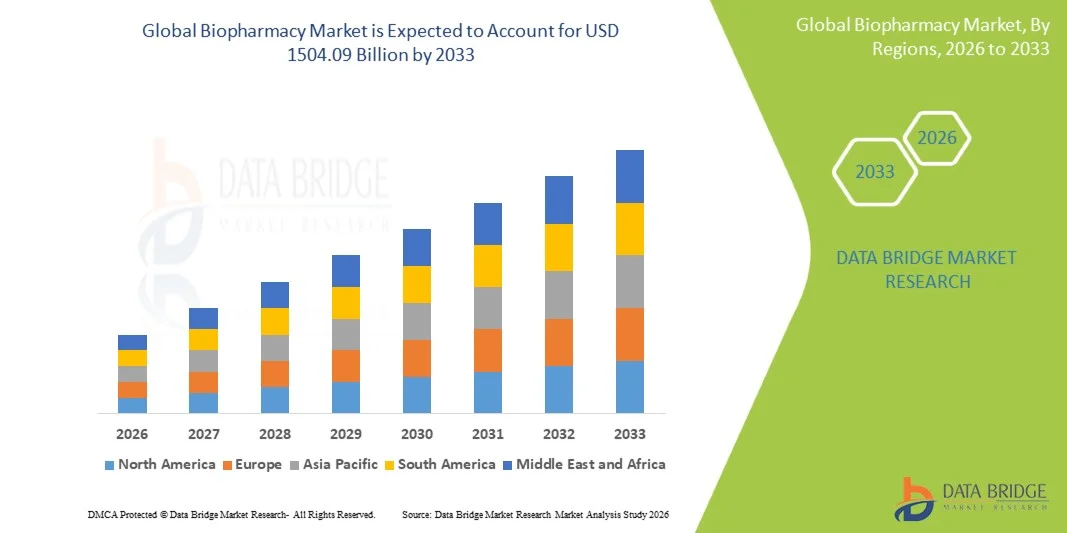
- The global Biopharmacy market size was valued at USD 666.95 billion in 2025and is expected to reach USD 1504.09 billion by 2033, at a CAGR of 10.70% during the forecast period
- The market growth is largely fueled by increasing demand for biologic drugs, rapid advancements in biotechnology, and expanding investments in pharmaceutical research and development, leading to accelerated innovation across therapeutic areas and healthcare systems
- Furthermore, rising demand for targeted, effective, and personalized treatment solutions is establishing Biopharmacy as a key pillar of modern healthcare. These converging factors are accelerating the uptake of Biopharmacy solutions, thereby significantly boosting the industry's growth
Biopharmacy Market Analysis
- Biopharmacy, encompassing biologic drugs, biosimilars, monoclonal antibodies, recombinant proteins, vaccines, and advanced therapeutic products, is increasingly vital to modern healthcare due to its ability to provide targeted, highly effective, and personalized treatment solutions across multiple disease areas
- The escalating demand for Biopharmacy is primarily fueled by the rising prevalence of chronic diseases, increasing adoption of biologics in oncology and autoimmune disorders, expanding biotechnology innovation, and growing investments in advanced pharmaceutical manufacturing capabilities
- North America dominated the Biopharmacy market with the largest revenue share of 41.9% in 2025, characterized by advanced healthcare infrastructure, high healthcare expenditure, strong presence of leading biopharmaceutical companies, and robust R&D activity, with the U.S. witnessing substantial growth in biologics approvals, clinical trials, and commercial manufacturing capacity
- Asia-Pacific is expected to be the fastest-growing region in the Biopharmacy market during the forecast period, projected to register a CAGR of 11.7%, due to rising healthcare investments, expanding biotechnology ecosystems, increasing demand for biosimilars, and improving access to advanced therapeutics across emerging economies
- The monoclonal antibodies segment dominated the largest market revenue share of 38.7% in 2025, driven by their widespread use in targeted therapy, high clinical efficacy, and expanding approvals across multiple disease areas
Report Scope and Biopharmacy Market Segmentation
|
Attributes |
Biopharmacy Key Market Insights |
|
Segments Covered |
|
|
Countries Covered |
North America · U.S. · Canada · Mexico Europe · Germany · France · U.K. · Netherlands · Switzerland · Belgium · Russia · Italy · Spain · Turkey · Rest of Europe Asia-Pacific · China · Japan · India · South Korea · Singapore · Malaysia · Australia · Thailand · Indonesia · Philippines · Rest of Asia-Pacific Middle East and Africa · Saudi Arabia · U.A.E. · South Africa · Egypt · Israel · Rest of Middle East and Africa South America · Brazil · Argentina · Rest of South America |
|
Key Market Players |
· Roche Holding AG (Switzerland) · Novartis AG (Switzerland) · Pfizer Inc. (U.S.) · Johnson & Johnson (U.S.) · Merck & Co., Inc. (U.S.) · AbbVie Inc. (U.S.) · Amgen Inc. (U.S.) · Bristol-Myers Squibb Company (U.S.) · Eli Lilly and Company (U.S.) · Sanofi S.A. (France) · GlaxoSmithKline plc (U.K.) · AstraZeneca plc (U.K.) · Biogen Inc. (U.S.) · Gilead Sciences, Inc. (U.S.) · Regeneron Pharmaceuticals, Inc. (U.S.) · Takeda Pharmaceutical Company Limited (Japan) · CSL Limited (Australia) · Bayer AG (Germany) · Samsung Biologics Co., Ltd. (South Korea) · WuXi Biologics (China) |
|
Market Opportunities |
· Growing demand for biosimilars and cost-effective biologic therapies · Expansion of personalized medicine and next-generation biologics |
|
Value Added Data Infosets |
In addition to the insights on market scenarios such as market value, growth rate, segmentation, geographical coverage, and major players, the market reports curated by the Data Bridge Market Research also include in-depth expert analysis, patient epidemiology, pipeline analysis, pricing analysis, and regulatory framework. |
Biopharmacy Market Trends
“Expansion of Personalized Medicine and Specialty Drug Services”
- A significant and accelerating trend in the global Biopharmacy market is the growing emphasis on personalized medicine, biologic therapies, and specialized pharmaceutical care tailored to individual patient needs. Advances in genomics, biomarker testing, and targeted treatment approaches are reshaping the way therapies are developed, prescribed, and monitored across multiple disease areas
- For instance, in March 2025, Roche announced expanded investment in precision diagnostics and companion testing solutions to strengthen targeted oncology treatment pathways. Such developments are encouraging wider adoption of biopharmacy solutions that integrate therapeutics with diagnostic support
- Biopharmacy providers are increasingly focusing on complex biologics, biosimilars, cell and gene therapies, and specialty medicines that require temperature-controlled logistics, patient education, and close adherence monitoring. These high-value therapies demand advanced dispensing models and coordinated care networks
- The increasing prevalence of chronic diseases such as cancer, autoimmune disorders, diabetes, and rare genetic conditions is driving demand for customized treatment regimens supported by specialty pharmacy infrastructure. Patients and healthcare providers are seeking therapies that improve outcomes while minimizing adverse reactions
- Digital health platforms, remote consultations, and connected adherence tools are also enhancing patient engagement by enabling refill reminders, virtual counseling, and therapy tracking. These capabilities are improving treatment continuity and satisfaction levels
- This trend toward more precise, patient-centric, and clinically integrated pharmaceutical services is fundamentally reshaping the global healthcare delivery model. Consequently, leading companies are expanding specialty drug portfolios, cold-chain capabilities, and personalized support programs to capture emerging demand
Biopharmacy Market Dynamics
Driver
“Rising Demand for Specialty Medicines and Growth in Chronic Disease Burden”
- The increasing global burden of chronic and life-threatening diseases, combined with the rapid introduction of specialty pharmaceuticals, is a major driver supporting growth in the biopharmacy market. Conditions such as oncology disorders, rheumatoid arthritis, multiple sclerosis, and rare diseases often require advanced biologic or targeted therapies
- For instance, in January 2025, Pfizer announced continued expansion of its specialty medicine pipeline focused on oncology and immunology treatments. Such strategic developments are expected to accelerate demand for biopharmacy distribution, patient support, and adherence management services
- Many specialty drugs require prior authorization support, cold-chain transportation, clinical monitoring, and dosage management, creating strong demand for specialized pharmacy networks with technical expertise
- Aging populations across developed and emerging markets are also contributing to higher prescription volumes and longer treatment durations, particularly for chronic and degenerative conditions
- In addition, rising healthcare awareness, better insurance access, and improved diagnosis rates are enabling more patients to receive advanced therapies that were previously underutilized
- As pharmaceutical innovation continues to shift toward biologics and precision medicines, biopharmacy providers are becoming essential partners in ensuring timely access, safe handling, and optimized therapeutic outcomes
Restraint/Challenge
“High Therapy Costs, Regulatory Complexity, and Supply Chain Constraints”
- One of the major challenges in the biopharmacy market is the high cost associated with biologics, specialty drugs, and personalized therapies. Premium-priced treatments can limit patient affordability and create reimbursement pressure for healthcare systems and insurers
- For instance, in 2025, several healthcare payers across North America and Europe tightened reimbursement scrutiny for high-cost specialty medicines, increasing access hurdles for patients requiring advanced therapies. Such pricing pressures can slow adoption of innovative treatments
- Regulatory compliance is another significant restraint, as biopharmacy providers must meet strict standards related to storage conditions, pharmacovigilance, serialization, documentation, and patient safety. Non-compliance can result in costly delays or penalties
- Cold-chain logistics disruptions, transportation delays, and inventory shortages can negatively affect the availability of temperature-sensitive biologics and vaccines, especially in remote or low-resource regions
- In addition, biosimilar competition and pricing pressure may compress margins for manufacturers and distributors, requiring continuous operational efficiency improvements
- Overcoming these challenges through value-based pricing models, stronger supply chain resilience, digital inventory management, and supportive reimbursement frameworks will be vital for sustained growth in the global biopharmacy market
Biopharmacy Market Scope
The market is segmented on the basis of product type and therapeutic applications.
- By Product Type
On the basis of product type, the Biopharmacy market is segmented into monoclonal antibodies, recombinant growth factors, purified proteins, recombinant proteins, recombinant hormones, vaccines, and synthetic immunomodulators. The monoclonal antibodies segment dominated the largest market revenue share of 38.7% in 2025, driven by their widespread use in targeted therapy, high clinical efficacy, and expanding approvals across multiple disease areas. Monoclonal antibodies are extensively prescribed in oncology, autoimmune disorders, inflammatory diseases, and infectious disease management due to their precision mechanism of action. Growing demand for biologics with improved safety profiles compared with conventional drugs is further accelerating adoption. Pharmaceutical companies continue to invest heavily in next-generation antibody-drug conjugates, biosimilars, and personalized antibody therapies. Rising prevalence of cancer and chronic immune-mediated conditions has significantly increased treatment demand worldwide. Strong reimbursement support in developed markets also contributes to segment leadership. Advancements in cell line development and biomanufacturing technologies are reducing production timelines. Increasing collaborations between biotech firms and large pharmaceutical companies further strengthen commercialization. As a result, monoclonal antibodies remained the leading product segment in 2025.
The vaccines segment is anticipated to witness the fastest growth rate of 19.8% CAGR from 2026 to 2033, fueled by rising focus on preventive healthcare and rapid innovation in biologic vaccine platforms. Growing immunization programs, expanding adult vaccination awareness, and government funding are supporting demand globally. Advances in recombinant and mRNA technologies are accelerating new vaccine launches. Increased preparedness for emerging infectious diseases is also expected to drive long-term segment growth.
- By Therapeutic Applications
On the basis of therapeutic applications, the Biopharmacy market is segmented into oncology, inflammatory and infectious diseases, autoimmune disorders, metabolic disorders, hormonal disorders, disease prevention, cardiovascular diseases, neurological disorders, and other diseases. The oncology segment held the largest market revenue share of 31.4% in 2025, driven by the increasing global cancer burden and growing preference for biologic-based targeted therapies. Biopharmaceutical products such as monoclonal antibodies, immune checkpoint inhibitors, growth factors, and therapeutic proteins are widely used in cancer treatment protocols. Rising demand for personalized medicine and companion diagnostics has further strengthened biologics adoption in oncology. Continuous pipeline innovation and fast-track regulatory approvals for novel cancer biologics are supporting market expansion. Hospitals and specialty cancer centers increasingly utilize advanced biologics for improved survival outcomes and lower systemic toxicity. Growing investments in oncology research by public and private sectors also reinforce segment leadership. Expansion of biosimilars is improving accessibility in cost-sensitive regions. Increasing aging populations worldwide continue to raise cancer incidence rates. Therefore, oncology remained the dominant therapeutic application in 2025.
The neurological disorders segment is expected to witness the fastest CAGR of 21.1% from 2026 to 2033, driven by increasing research into biologics for Alzheimer’s disease, Parkinson’s disease, multiple sclerosis, and rare neurodegenerative conditions. Advances in blood-brain barrier delivery systems and neuro-targeted antibodies are creating new treatment opportunities. Rising prevalence of age-related neurological disorders is further accelerating demand. Strong pipeline development and unmet clinical need are expected to sustain rapid future growth.
Biopharmacy Market Regional Analysis
- North America dominated the biopharmacy market with the largest revenue share of 41.9% in 2025, characterized by advanced healthcare infrastructure, high healthcare expenditure, strong presence of leading biopharmaceutical companies, and robust R&D activity
- Healthcare providers and patients in the region highly value innovative biologics, targeted therapies, advanced drug delivery systems, and rapid access to next-generation therapeutics for chronic and complex diseases
- This widespread adoption is further supported by favorable reimbursement frameworks, strong regulatory support, substantial investment in life sciences innovation, and expanding commercial manufacturing capacity, establishing biopharmacy as a key pillar of the modern pharmaceutical industry
U.S. Biopharmacy Market Insight
The U.S. biopharmacy market captured the largest revenue share in 2025 within North America, fueled by strong demand for biologics, monoclonal antibodies, gene-based therapies, and specialty pharmaceuticals. Healthcare organizations are increasingly prioritizing precision medicine, advanced treatment solutions, and accelerated drug development pipelines. The growing number of biologics approvals, expanding clinical trial activity, and increasing investment in large-scale manufacturing facilities further propel the Biopharmacy industry. Moreover, the presence of leading pharmaceutical and biotechnology companies is significantly contributing to the market's expansion.
Europe Biopharmacy Market Insight
The Europe biopharmacy market is projected to expand at a substantial CAGR throughout the forecast period, primarily driven by increasing healthcare innovation, rising demand for biosimilars, and growing investments in biologics research and manufacturing. The region’s strong regulatory environment, advanced healthcare systems, and increasing focus on cost-effective specialty therapies are fostering market growth. Significant expansion is being witnessed across hospitals, specialty clinics, and research centers, with biologic medicines being incorporated into both existing and newly launched treatment programs.
U.K. Biopharmacy Market Insight
The U.K. biopharmacy market is anticipated to grow at a noteworthy CAGR during the forecast period, driven by strong life sciences research capabilities, increasing demand for advanced therapeutics, and supportive government initiatives for biotechnology innovation. Healthcare providers are increasingly adopting biologics and biosimilars for oncology, autoimmune diseases, and rare disorders. The country’s expanding clinical research ecosystem, alongside robust pharmaceutical manufacturing infrastructure, is expected to continue stimulating market growth.
Germany Biopharmacy Market Insight
The Germany biopharmacy market is expected to expand at a considerable CAGR during the forecast period, fueled by increasing awareness of innovative treatment options, rising healthcare expenditure, and strong pharmaceutical manufacturing expertise. Germany’s well-developed healthcare infrastructure, combined with its emphasis on research, quality, and technological advancement, promotes the adoption of biologics and advanced therapeutics. The integration of biopharmaceutical innovation with precision medicine and specialty care programs is also becoming increasingly prevalent, aligning with local healthcare priorities.
Asia-Pacific Biopharmacy Market Insight
The Asia-Pacific biopharmacy market is poised to grow at the fastest CAGR of approximately 11.7% during the forecast period, driven by rising healthcare investments, expanding biotechnology ecosystems, increasing demand for biosimilars, and improving access to advanced therapeutics across emerging economies. The region’s growing focus on healthcare modernization, domestic biologics production, and expanding patient populations is accelerating market growth. Furthermore, as APAC emerges as a major manufacturing and innovation hub for biologics and biosimilars, affordability and accessibility are expanding to a wider consumer base.
Japan Biopharmacy Market Insight
The Japan biopharmacy market is gaining momentum due to the country’s advanced healthcare system, strong biotechnology capabilities, and rising demand for innovative therapies. The Japanese market places significant emphasis on treatment quality and safety, and the adoption of biologics is driven by increasing use in oncology, immunology, and chronic disease management. The integration of advanced therapeutics with personalized medicine strategies is fueling growth. Moreover, Japan's aging population is expected to spur demand for effective long-term treatment solutions in both hospital and outpatient care settings.
China Biopharmacy Market Insight
The China biopharmacy market accounted for the largest market revenue share in Asia Pacific in 2025, attributed to the country's expanding healthcare expenditure, rapid biotechnology development, and strong government support for pharmaceutical innovation. China stands as one of the largest markets for biologics and biosimilars, with increasing adoption across hospitals, specialty clinics, and retail pharmacy channels. The push towards domestic biopharmaceutical production, expanding clinical research activity, and the availability of cost-effective treatment options are key factors propelling the market in China.
Biopharmacy Market Share
The Biopharmacy industry is primarily led by well-established companies, including:
- Roche Holding AG (Switzerland)
- Novartis AG (Switzerland)
- Pfizer Inc. (U.S.)
- Johnson & Johnson (U.S.)
- Merck & Co., Inc. (U.S.)
- AbbVie Inc. (U.S.)
- Amgen Inc. (U.S.)
- Bristol-Myers Squibb Company (U.S.)
- Eli Lilly and Company (U.S.)
- Sanofi S.A. (France)
- GlaxoSmithKline plc (U.K.)
- AstraZeneca plc (U.K.)
- Biogen Inc. (U.S.)
- Gilead Sciences, Inc. (U.S.)
- Regeneron Pharmaceuticals, Inc. (U.S.)
- Takeda Pharmaceutical Company Limited (Japan)
- CSL Limited (Australia)
- Bayer AG (Germany)
- Samsung Biologics Co., Ltd. (South Korea)
- WuXi Biologics (China)
Latest Developments in Global Biopharmacy Market
- In January 2021, Moderna, Inc. announced continued global expansion of its mRNA vaccine manufacturing network following emergency authorizations for its COVID-19 vaccine. The success of the platform accelerated investment in biopharmacy technologies, particularly messenger RNA therapeutics and next-generation biologics
- In June 2021, Biogen Inc. received U.S. FDA approval for Aduhelm (aducanumab) for Alzheimer’s disease, marking one of the first disease-modifying biologic therapies approved for the condition. The approval highlighted growing innovation in neurological biopharmaceuticals and monoclonal antibody therapeutics
- In March 2022, Pfizer Inc. completed its USD 11.6 billion acquisition of Biohaven Pharmaceutical, strengthening its neuroscience and rare disease portfolio through access to innovative CGRP-targeted biologic and specialty therapies. The deal reflected strong consolidation trends across the global biopharmacy market
- In December 2022, Amgen Inc. announced the U.S. FDA approval of Amjevita, the first biosimilar interchangeable to Humira in several markets, expanding patient access to lower-cost biologic therapies. This milestone significantly boosted momentum in the biosimilar segment of the biopharmacy industry
- In April 2023, Gamida Cell Ltd. received U.S. FDA approval for Omisirge (omidubicel-onlv), a stem cell-based therapy for patients undergoing umbilical cord blood transplantation. The approval represented a major advancement in cell-based biopharmaceutical products and regenerative medicine commercialization
- In December 2023, Vertex Pharmaceuticals and CRISPR Therapeutics received approvals in multiple markets for Casgevy, the first approved CRISPR gene-edited cell therapy for sickle cell disease and beta thalassemia. This launch marked a historic milestone for advanced biopharmacy and gene-editing therapeutics
- In August 2024, Recursion Pharmaceuticals announced its $688 million acquisition of Exscientia, combining AI-driven drug discovery capabilities with advanced clinical development expertise. The transaction demonstrated the increasing role of artificial intelligence in next-generation biopharmaceutical R&D
- In December 2024, Mesoblast Limited received U.S. FDA approval for Ryoncil (remestemcel-L) for steroid-refractory acute graft-versus-host disease in pediatric patients. The therapy became the first FDA-approved mesenchymal stromal cell treatment in the United States, expanding commercial regenerative biopharmacy offerings
- In June 2025, Sanofi announced the acquisition of Blueprint Medicines for more than $9 billion, strengthening its rare immunology and precision medicine portfolio. The deal reflected continued strategic investment in high-value specialty biopharmaceutical assets
SKU-
Get online access to the report on the World's First Market Intelligence Cloud

- Interactive Data Analysis Dashboard
- Company Analysis Dashboard for high growth potential opportunities
- Research Analyst Access for customization & queries
- Competitor Analysis with Interactive dashboard
- Latest News, Updates & Trend analysis
- Harness the Power of Benchmark Analysis for Comprehensive Competitor Tracking
Research Methodology
Data collection and base year analysis are done using data collection modules with large sample sizes. The stage includes obtaining market information or related data through various sources and strategies. It includes examining and planning all the data acquired from the past in advance. It likewise envelops the examination of information inconsistencies seen across different information sources. The market data is analysed and estimated using market statistical and coherent models. Also, market share analysis and key trend analysis are the major success factors in the market report. To know more, please request an analyst call or drop down your inquiry.
The key research methodology used by DBMR research team is data triangulation which involves data mining, analysis of the impact of data variables on the market and primary (industry expert) validation. Data models include Vendor Positioning Grid, Market Time Line Analysis, Market Overview and Guide, Company Positioning Grid, Patent Analysis, Pricing Analysis, Company Market Share Analysis, Standards of Measurement, Global versus Regional and Vendor Share Analysis. To know more about the research methodology, drop in an inquiry to speak to our industry experts.
Customization Available
Data Bridge Market Research is a leader in advanced formative research. We take pride in servicing our existing and new customers with data and analysis that match and suits their goal. The report can be customized to include price trend analysis of target brands understanding the market for additional countries (ask for the list of countries), clinical trial results data, literature review, refurbished market and product base analysis. Market analysis of target competitors can be analyzed from technology-based analysis to market portfolio strategies. We can add as many competitors that you require data about in the format and data style you are looking for. Our team of analysts can also provide you data in crude raw excel files pivot tables (Fact book) or can assist you in creating presentations from the data sets available in the report.