




Global Bioresorbable Polymers Market
Market Size in USD Billion
CAGR :
% 
 USD
1.98 Billion
USD
6.10 Billion
2025
2033
USD
1.98 Billion
USD
6.10 Billion
2025
2033
 Forecast Period Forecast Period |
2026 –2033 |
 Market Size (Base Year) Market Size (Base Year) |
USD 1.98 Billion |
 Market Size (Forecast Year) Market Size (Forecast Year) |
USD 6.10 Billion |
 CAGR CAGR |
% |
| Major Markets Players |
|
What is the Global Bioresorbable Polymers Market Size and Growth Rate?
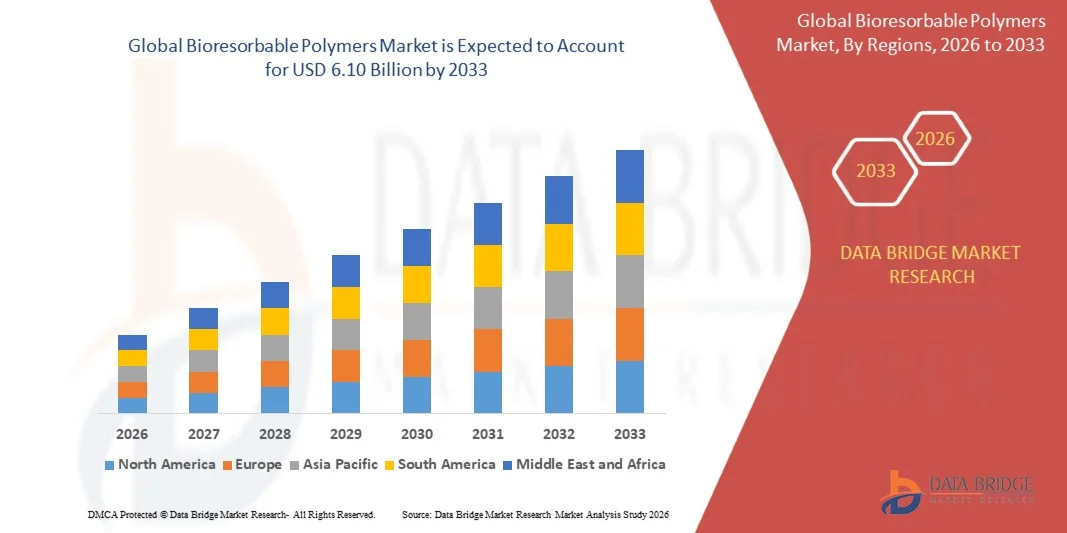
- The global bioresorbable polymers market size was valued at USD 1.98 billion in 2025 and is expected to reach USD 6.10 billion by 2033, at a CAGR of 15.1% during the forecast period
- The increase in the number of surgical interventions across the globe acts as one of the major factors driving the growth of bioresorbable polymers market
- The high demand for these polymers as they can be easily dissolved in the body fluids without causing any residual side effects, and rise in the demand in drug delivery application accelerate the market growth
What are the Major Takeaways of Bioresorbable Polymers Market?
- The high usage of the product in biomedical applications such as prostheses, and replacing damaged joints, among others, and favorable reimbursement scenario further influence the market
- In addition, surge in investments, favorable government regulations, surge in investments and growing number of orthopedic patients positively affect the bioresorbable polymers market. Furthermore, emergence of electrospinning and 3D printing technologies extend profitable opportunities to the market players
- On the other hand, higher cost of bioresorbable polymers than that of conventional polymers and Lack of quality control measures in developing countries are expected to obstruct the market growth. The increase in the preference for minimally invasive surgeries and stringent regulatory framework for medical devices are projected to challenge the bioresorbable polymers market
- North America dominated the bioresorbable polymers market with a 33.5% revenue share in 2025, driven by strong growth in advanced healthcare infrastructure, medical device manufacturing, and rising adoption of absorbable implants and drug delivery systems across the U.S. and Canada
- Asia-Pacific is projected to register the fastest CAGR of 15.9% from 2026 to 2033, driven by rapid expansion of healthcare infrastructure, medical tourism, rising surgical procedures, and growing medical device manufacturing across China, Japan, India, South Korea, and Southeast Asia
- The Polylactic Acid (PLA) segment dominated the market with a 29.5% share, owing to its excellent biocompatibility, biodegradability, and broad usage in orthopedic implants, sutures, and fixation devices
Report Scope and Bioresorbable Polymers Market Segmentation
|
Attributes |
Bioresorbable Polymers Key Market Insights |
|
Segments Covered |
|
|
Countries Covered |
North America
Europe
Asia-Pacific
Middle East and Africa
South America
|
|
Key Market Players |
|
|
Market Opportunities |
|
|
Value Added Data Infosets |
In addition to the insights on market scenarios such as market value, growth rate, segmentation, geographical coverage, and major players, the market reports curated by the Data Bridge Market Research also include in-depth expert analysis, pricing analysis, brand share analysis, consumer survey, demography analysis, supply chain analysis, value chain analysis, raw material/consumables overview, vendor selection criteria, PESTLE Analysis, Porter Analysis, and regulatory framework. |
What is the Key Trend in the Bioresorbable Polymers Market?
“Increasing Shift Toward Advanced Medical Implants and Drug Delivery Applications”
- The bioresorbable polymers market is witnessing strong adoption across orthopedic fixation devices, sutures, cardiovascular scaffolds, and controlled drug delivery systems due to their ability to safely degrade inside the body
- Manufacturers are increasingly developing high-performance polymers such as PLA, PGA, PCL, and PLGA with improved mechanical strength, biocompatibility, and predictable degradation rates for clinical use
- Growing demand for minimally invasive surgeries and temporary implants is accelerating the use of bioresorbable materials that eliminate the need for secondary removal procedures
- For instance, companies such as Corbion, Evonik Industries, DSM, and Foster Corporation are expanding portfolios for medical-grade absorbable polymers used in implants, tissue engineering, and drug release systems
- Rising integration of 3D printing and patient-specific scaffold development is further driving innovation in regenerative medicine and customized surgical applications
- As healthcare moves toward safer, personalized, and biodegradable implant solutions, bioresorbable polymers will remain vital for advanced medical device development and long-term treatment efficiency
What are the Key Drivers of Bioresorbable Polymers Market?
- Rising demand for biodegradable medical implants and absorbable sutures is a major growth driver, especially in orthopedics, cardiovascular, and wound closure applications
- For instance, in 2025–2026, leading companies such as Evonik, Corbion, and DSM strengthened their medical biomaterial offerings for implantable devices and drug delivery technologies
- Growing prevalence of chronic diseases, bone disorders, cardiovascular conditions, and aging population is boosting demand across the U.S., Europe, and Asia-Pacific
- Advancements in polymer chemistry, degradation control, and mechanical performance have significantly improved clinical acceptance and functionality
- Rising use in drug-eluting stents, microspheres, scaffolds, and tissue regeneration is creating strong long-term commercial demand
- Supported by steady investments in medical R&D, biomaterials innovation, and regenerative medicine, the market is expected to witness strong long-term growth
Which Factor is Challenging the Growth of the Bioresorbable Polymers Market?
- High costs associated with medical-grade raw materials, sterilization, and complex polymer processing continue to restrict wider adoption
- For instance, during 2024–2026, fluctuations in specialty polymer feedstock prices and strict medical compliance requirements increased production costs for global manufacturers
- Complexity in achieving predictable degradation rates and sufficient mechanical strength remains a major technical challenge, especially for load-bearing implants
- Limited long-term clinical data and stringent FDA / CE regulatory approvals slow product commercialization and market entry timelines
- Competition from metallic implants, ceramic biomaterials, and conventional non-resorbable polymers creates pricing pressure and adoption barriers
- To address these issues, companies are focusing on advanced polymer engineering, clinical validation, and cost-optimized manufacturing to expand global adoption
How is the Bioresorbable Polymers Market Segmented?
The market is segmented on the basis of product and application.
• By Product
On the basis of product, the bioresorbable polymers market is segmented into Polylactic Acid (PLA), Polyglycolic Acid (PGA), Polylactic-Co-Glycolic Acid (PLGA), Polycaprolactone (PCL), and Others. The Polylactic Acid (PLA) segment dominated the market with a 29.5% share, owing to its excellent biocompatibility, biodegradability, and broad usage in orthopedic implants, sutures, and fixation devices. PLA is widely preferred because it degrades into lactic acid, which is naturally metabolized by the body, eliminating the need for secondary surgeries. Its high mechanical strength and stiffness further support its usage in medical device manufacturing.
The PLGA segment is expected to grow at the fastest CAGR from 2026 to 2033, driven by increasing adoption in controlled drug delivery systems, microspheres, nanoparticles, and tissue engineering scaffolds. Its customizable degradation profile and rising demand in long-acting injectable therapies are accelerating growth across pharmaceutical and biomedical applications.
• By Application
On the basis of application, the market is segmented into Drug Delivery, Orthopedic Devices, and Others. The Orthopedic Devices segment dominated the market with a 43.6% share, supported by rising cases of osteoporosis, arthritis, bone fractures, sports injuries, and age-related orthopedic disorders. Bioresorbable polymers are extensively used in screws, pins, plates, sutures, and fixation devices, as they provide temporary structural support and gradually dissolve after tissue healing. Increasing surgical volumes and the growing aging population are further strengthening segment demand.
The Drug Delivery segment is projected to grow at the fastest CAGR from 2026 to 2033, driven by increasing use of controlled-release formulations, injectable depots, microspheres, and implantable drug carriers. Rising demand for targeted therapies, cancer treatments, and long-acting biologics is significantly boosting adoption of PLGA- and PLA-based delivery systems across the global pharmaceutical industry.
Which Region Holds the Largest Share of the Bioresorbable Polymers Market?
- North America dominated the bioresorbable polymers market with a 33.5% revenue share in 2025, driven by strong growth in advanced healthcare infrastructure, medical device manufacturing, and rising adoption of absorbable implants and drug delivery systems across the U.S. and Canada. High utilization of orthopedic fixation devices, sutures, cardiovascular stents, and tissue engineering scaffolds continues to fuel market demand across hospitals, ambulatory surgical centres, and specialty clinics
- Leading companies in North America are introducing high-performance medical-grade polymers such as PLA, PGA, PLGA, and PCL with improved biodegradability, biocompatibility, and mechanical strength, strengthening the region’s technological leadership. Continuous investment in biomaterials R&D, regenerative medicine, and minimally invasive surgical technologies drives long-term market expansion
- Strong regulatory support, advanced clinical research ecosystems, and sustained healthcare spending further reinforce regional market leadership
U.S. Bioresorbable Polymers Market Insight
The U.S. is the largest contributor in North America, supported by strong medical research capabilities, rising orthopedic surgeries, and extensive use of absorbable biomaterials across hospitals and medical device companies. Increasing development of drug-eluting implants, tissue scaffolds, orthopedic screws, and bioresorbable fixation devices intensifies demand for advanced polymer solutions. The presence of major medical technology firms, strong innovation ecosystems, and high healthcare expenditure further drive market growth
Canada Bioresorbable Polymers Market Insight
Canada contributes significantly to regional growth, driven by expanding medical device research clusters, growing orthopedic procedures, and increasing investments in healthcare innovation. Hospitals and research institutions increasingly utilize bioresorbable polymers for implantable devices, wound care, and controlled drug release systems. Government-supported healthcare initiatives and skilled biomedical research talent strengthen market adoption across the country
Asia-Pacific Bioresorbable Polymers Market
Asia-Pacific is projected to register the fastest CAGR of 15.9% from 2026 to 2033, driven by rapid expansion of healthcare infrastructure, medical tourism, rising surgical procedures, and growing medical device manufacturing across China, Japan, India, South Korea, and Southeast Asia. High-volume demand for orthopedic implants, drug delivery systems, and biodegradable sutures is accelerating regional adoption. Growth in healthcare investments and biomaterial innovation continues to strengthen demand across the region
China Bioresorbable Polymers Market Insight
China is the largest contributor to Asia-Pacific due to massive healthcare investments, strong manufacturing capabilities, and government support for advanced medical materials. Rising development of cost-effective absorbable implants and pharmaceutical delivery systems is driving strong domestic demand. Local production capabilities and competitive pricing further expand adoption across hospitals and export markets
Japan Bioresorbable Polymers Market Insight
Japan shows steady growth supported by advanced medical technology infrastructure, precision healthcare systems, and growing demand for minimally invasive procedures. Strong focus on high-quality surgical materials and regenerative medicine drives adoption of premium bioresorbable polymers. Increasing use in orthopedics and drug delivery reinforces long-term market expansion
India Bioresorbable Polymers Market Insight
India is emerging as a major growth hub, driven by expanding hospital infrastructure, rising orthopedic surgeries, and government-backed healthcare modernization initiatives. Growing demand for drug delivery implants, surgical sutures, and trauma fixation devices fuels market penetration. Increasing R&D investments and medical tourism further accelerate growth
South Korea Bioresorbable Polymers Market Insight
South Korea contributes significantly due to strong demand for advanced surgical devices, regenerative medicine, and biomedical research applications. Rapid development of drug delivery technologies and absorbable orthopedic solutions supports increasing polymer demand. Strong innovation capabilities and healthcare technology ecosystems support sustained market growth
Which are the Top Companies in Bioresorbable Polymers Market?
The bioresorbable polymers industry is primarily led by well-established companies, including:
- Corbion (Netherlands)
- Poly-Med (U.S.)
- Foster Corporation (U.S.)
- Evonik Industries AG (Germany)
- Sigma-Aldrich (U.S.)
- Mar-Lee Companies (U.S.)
- LACTEL Absorbable Polymers (U.S.)
- DSM (Netherlands)
- PCAS (France)
- Galatea Surgical (U.S.)
- Edge Design Services (U.K.)
- Degradable Solutions (U.S.)
- Amplitude Systems (France)
- MAST Biosurgery (U.S.)
- KLS-Med (Germany)
- Sunwin Chemicals (China)
- Amino (Japan)
- American Crystal Sugar (U.S.)
- Wickham (U.K.)
- Repsol (Spain)
- Carclo (U.K.)
- Borealis Borouge (U.A.E.)
- Nelipak (U.S.)
- Albis (Germany)
What are the Recent Developments in Global Bioresorbable Polymers Market?
- In August 2024, Ashland expanded its manufacturing facility in Ireland to strengthen bioresorbable polymer production capabilities, with a specific focus on injectable technologies used in advanced pharmaceutical applications such as long-acting drug formulations, bioresorbable medical devices, and tissue engineering solutions. This expansion is expected to significantly support the growing global demand for next-generation healthcare materials and improve supply chain efficiency
- In April 2024, Evonik expanded its RESOMER powder biomaterial production facility in Germany by integrating advanced solvent-free micronization technology, enabling the company to provide customized medical-grade powders for implants, esthetic procedures, and other healthcare applications. This development is expected to enhance product customization capabilities and strengthen Evonik’s position in the medical biomaterials market
- In August 2021, Evonik acquired German biotech company JeNaCell to broaden its biomaterials portfolio, adding innovative cellulose-based materials designed for wound care, dermatology, and medical technology applications to its Health Care division. This acquisition is expected to accelerate innovation and expand the company’s presence in advanced wound healing solutions
- In September 2020, Corbion and Total announced the development of a new PLA bioplastics plant in Europe through their Total Corbion PLA joint venture, with an annual production capacity of 100,000 tons, making it the first global-scale PLA production facility in Europe, planned in France and operational by 2024. This strategic investment is expected to strengthen regional PLA supply and support long-term growth in sustainable and bioresorbable polymer applications
SKU-
Get online access to the report on the World's First Market Intelligence Cloud

- Interactive Data Analysis Dashboard
- Company Analysis Dashboard for high growth potential opportunities
- Research Analyst Access for customization & queries
- Competitor Analysis with Interactive dashboard
- Latest News, Updates & Trend analysis
- Harness the Power of Benchmark Analysis for Comprehensive Competitor Tracking
Global Bioresorbable Polymers Market, Supply Chain Analysis and Ecosystem Framework
To support market growth and help clients navigate the impact of geopolitical shifts, DBMR has integrated in-depth supply chain analysis into its Global Bioresorbable Polymers Market research reports. This addition empowers clients to respond effectively to global changes affecting their industries. The supply chain analysis section includes detailed insights such as Global Bioresorbable Polymers Market consumption and production by country, price trend analysis, the impact of tariffs and geopolitical developments, and import and export trends by country and HSN code. It also highlights major suppliers with data on production capacity and company profiles, as well as key importers and exporters. In addition to research, DBMR offers specialized supply chain consulting services backed by over a decade of experience, providing solutions like supplier discovery, supplier risk assessment, price trend analysis, impact evaluation of inflation and trade route changes, and comprehensive market trend analysis.
Research Methodology
Data collection and base year analysis are done using data collection modules with large sample sizes. The stage includes obtaining market information or related data through various sources and strategies. It includes examining and planning all the data acquired from the past in advance. It likewise envelops the examination of information inconsistencies seen across different information sources. The market data is analysed and estimated using market statistical and coherent models. Also, market share analysis and key trend analysis are the major success factors in the market report. To know more, please request an analyst call or drop down your inquiry.
The key research methodology used by DBMR research team is data triangulation which involves data mining, analysis of the impact of data variables on the market and primary (industry expert) validation. Data models include Vendor Positioning Grid, Market Time Line Analysis, Market Overview and Guide, Company Positioning Grid, Patent Analysis, Pricing Analysis, Company Market Share Analysis, Standards of Measurement, Global versus Regional and Vendor Share Analysis. To know more about the research methodology, drop in an inquiry to speak to our industry experts.
Customization Available
Data Bridge Market Research is a leader in advanced formative research. We take pride in servicing our existing and new customers with data and analysis that match and suits their goal. The report can be customized to include price trend analysis of target brands understanding the market for additional countries (ask for the list of countries), clinical trial results data, literature review, refurbished market and product base analysis. Market analysis of target competitors can be analyzed from technology-based analysis to market portfolio strategies. We can add as many competitors that you require data about in the format and data style you are looking for. Our team of analysts can also provide you data in crude raw excel files pivot tables (Fact book) or can assist you in creating presentations from the data sets available in the report.












