


Biotech Ingredient Market Overview
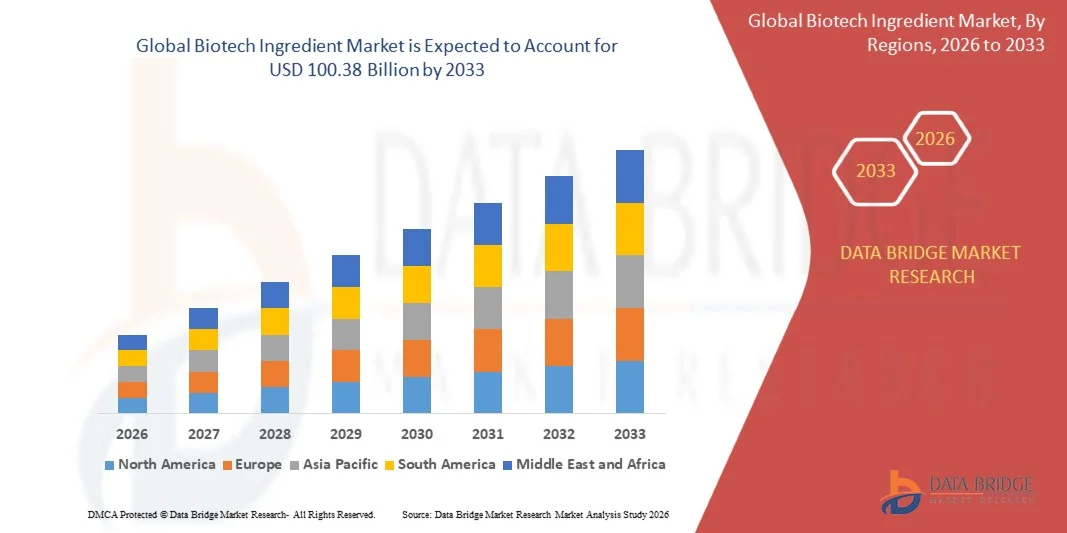
As per Data Bridge Market Research analysis the biotech ingredient market was valued at USD 66.41 billion in 2025 and is projected to reach USD 100.38 billion by 2033, growing at a CAGR of 5.30% from 2026 to 2033. The market is witnessing significant expansion driven by increasing demand for sustainable and bio-based ingredients across pharmaceuticals, food and beverages, cosmetics, and industrial applications. Continuous advancements in biotechnology, including synthetic biology, precision fermentation, and genetic engineering, are further accelerating innovation and commercialization of high-value biotech ingredients worldwide.
The growing emphasis on environmentally sustainable manufacturing practices, coupled with rising consumer preference for natural and functional products, is encouraging manufacturers to invest in biotechnology-derived ingredients. In addition, supportive regulatory frameworks, increasing R&D investments, and the expanding use of biotech ingredients in personalized nutrition, therapeutic formulations, and specialty chemicals are contributing to market growth. Biotech ingredients are increasingly replacing conventional synthetic alternatives, offering enhanced functionality, improved production efficiency, and reduced environmental impact across multiple end-use industries.
Market Size & Forecast
- Market Value (2025): USD 66.41 Billion
- Expected Market Value (2033): USD 100.38 Billion
- Forecast CAGR (2026–2033): 5.30%
- Leading Region in 2025: Europe
- Fastest Growing Region: Asia-Pacific
Key Market Trends & Insights
- Europe dominated the biotech ingredient market with the largest revenue share of 37.9% in 2025, primarily driven by stringent sustainability regulations and increasing adoption of biotechnology across healthcare and consumer industries.
- Asia-Pacific biotech ingredient market is expected to witness the fastest growth rate from 2026 to 2033, supported by rapid industrialization, rising healthcare expenditures, and increasing biotechnology investments across emerging economies.
- The innovative biotech APIs segment held the largest market revenue share of approximately 58.4% in 2025, driven by increasing investments in biologics research, a strong pipeline of novel therapies, and growing approvals for advanced biologic drugs across oncology, immunology, and rare disease applications. Innovative biotech APIs continue to dominate due to their high therapeutic value, patent protection, and extensive utilization in next-generation biopharmaceutical development.
- The generic biotech APIs/biosimilars segment is projected to register the fastest growth at a CAGR of 12.6% from 2026 to 2033, driven by the expiration of patents for blockbuster biologics, increasing healthcare cost-containment initiatives, and expanding regulatory support for biosimilar approvals globally. Rising adoption of cost-effective biologic alternatives across emerging markets and healthcare systems is accelerating segment expansion.
- The monoclonal antibodies segment held the largest market revenue share in 2025, driven by their extensive application in oncology, autoimmune disorders, and infectious disease treatment. Their superior target specificity, strong clinical efficacy, and increasing number of regulatory approvals have established monoclonal antibodies as the leading product category within the biotech ingredient landscape.
- The hormones and growth factors segment is projected to register the fastest growth at a CAGR from 2026 to 2033, driven by rising prevalence of diabetes and hormonal disorders, increasing demand for recombinant insulin and growth hormone therapies, and continued advancements in recombinant protein manufacturing technologies. Growing investments in endocrine therapeutics and personalized medicine are further supporting segment growth.
Report Scope and Biotech Ingredient Market Segmentation
|
Attributes |
Biotech Ingredient Key Market Insights |
|
Segments Covered |
|
|
Countries Covered |
North America
Europe
Asia-Pacific
Middle East and Africa
South America
|
|
Key Market Players |
|
|
Market Opportunities |
|
|
Value Added Data Infosets |
In addition to the insights on market scenarios such as market value, growth rate, segmentation, geographical coverage, and major players, the market reports curated by the Data Bridge Market Research also include import export analysis, production capacity overview, production consumption analysis, price trend analysis, climate change scenario, supply chain analysis, value chain analysis, raw material/consumables overview, vendor selection criteria, PESTLE Analysis, Porter Analysis, and regulatory framework. |
Biotech Ingredient Market Trends
Trend: Rising Adoption Of Sustainable And Bio-Based Ingredients Across Consumer Industries
Growing consumer preference for sustainable, naturally derived, and high-performance ingredients is accelerating the adoption of biotech ingredients across pharmaceuticals, food and beverages, cosmetics, and personal care applications. Manufacturers are increasingly leveraging precision fermentation, synthetic biology, and microbial technologies to develop ingredients with improved purity, scalability, and reduced environmental impact. These biotechnology platforms are enabling the transition away from conventional animal- and petroleum-derived ingredients while supporting sustainability objectives.
The expansion of clean-label products and biotechnology-enabled formulations continues to create sustained demand for biotech ingredients across multiple industries. For instance, in September 2024, French biotechnology startup Abolis Biotechnologies secured a EUR 35 million funding round backed by L'Oréal and Evonik to accelerate the development of bio-based ingredients for the beauty industry. The investment reflects growing industry commitment toward sustainable biotech ingredients and highlights increasing capital inflows into biotechnology innovation for consumer applications.
The growing shift toward sustainable and bio-based ingredients, coupled with continued investments in biotechnology innovation, is expected to reinforce long-term demand for biotech ingredients, positioning the market to benefit from increasing adoption across pharmaceutical, food, and cosmetic applications.
Biotech Ingredients Market Dynamics
Key Market Driver: Increasing Demand For Biologics And Sustainable Consumer Products
The shift toward biologics, personalized healthcare, and sustainable consumer products continues to drive demand for biotech ingredients. These ingredients are increasingly utilized in advanced therapeutics, functional foods, nutraceuticals, and cosmetic formulations due to their enhanced functionality, consistency, and lower environmental footprint.
The increasing demand for biotechnology-enabled healthcare solutions continues to accelerate investments in biopharmaceutical manufacturing and critical ingredient production. For instance, in July 2025, the U.S. Department of Health and Human Services (HHS) announced its continued commitment to expanding domestic pharmaceutical manufacturing capabilities through support for Phlow Corp.'s manufacturing ecosystem, which produces key starting materials (KSMs), active pharmaceutical ingredients (APIs), and finished dosage forms for 15 essential medicines. The initiative underscores the growing importance of biotechnology-derived ingredients in strengthening healthcare supply chains and supporting national health security.
As demand for biologics, clean-label products, and biotechnology-enabled formulations continues to expand globally, biotech ingredient manufacturers are expected to benefit from sustained growth driven by increasing R&D investments and broader adoption across end-use industries.
Key Restraint/Challenge: High Production Costs And Complex Regulatory Requirements
Biotech ingredient manufacturers remain heavily dependent on specialized production processes, including fermentation, cell culture, and recombinant technologies, which require substantial capital investment and sophisticated manufacturing infrastructure. In addition, stringent regulatory requirements governing biotechnology-derived products continue to increase development timelines and commercialization costs.
Stringent regulatory requirements continue to influence commercialization timelines for biotechnology-derived products worldwide. For instance, in October 2025, the U.S. Food and Drug Administration (FDA) announced significant actions to accelerate biosimilar development by proposing updates to simplify biosimilarity studies and reduce unnecessary clinical testing. Despite these efforts, the FDA noted that biologic drugs accounted for approximately 51% of total U.S. drug spending in 2024, highlighting the complexity and cost associated with bringing biotechnology products to market and the continued regulatory oversight required for the sector.
Despite robust market demand, high production costs, manufacturing complexities, and evolving regulatory requirements are expected to remain significant restraints, increasing commercialization expenses and limiting market expansion throughout the forecast period.
Key Market Opportunity: Expansion Of Precision Fermentation And Synthetic Biology Technologies
Governments, research institutions, and biotechnology companies are accelerating investments in precision fermentation and synthetic biology to enhance production efficiency and reduce dependence on traditional feedstocks. These technologies are creating significant opportunities to commercialize high-value biotech ingredients across food, pharmaceutical, and cosmetic applications while improving sustainability metrics.
For instance, in February 2024, Evonik announced the launch of Vecollage Fortify L, a biotech-based vegan collagen ingredient produced using fermentation technology for the beauty and personal care market. The ingredient was developed to meet rising demand for sustainable and animal-free cosmetic formulations, demonstrating the growing commercial viability of precision fermentation technologies in ingredient manufacturing.
As investments in precision fermentation and synthetic biology continue to increase globally, the commercialization of biotechnology-enabled ingredients is expected to create substantial long-term growth opportunities for the biotech ingredients market.
Biotech Ingredient Market Scope
The market is segmented on the basis of type, product, and expression system.
- By Type
On the basis of type, the biotech ingredient market is segmented into innovative biotech APIs and generic biotech APIs/biosimilars. The innovative biotech APIs segment held the largest market revenue share of approximately 58.4% in 2025, driven by increasing investments in biologics research, a strong pipeline of novel therapies, and growing approvals for advanced biologic drugs across oncology, immunology, and rare disease applications. Innovative biotech APIs continue to dominate due to their high therapeutic value, patent protection, and extensive utilization in next-generation biopharmaceutical development.
The generic biotech APIs/biosimilars segment is projected to register the fastest growth at a CAGR of 12.6% from 2026 to 2033, driven by the expiration of patents for blockbuster biologics, increasing healthcare cost-containment initiatives, and expanding regulatory support for biosimilar approvals globally. Rising adoption of cost-effective biologic alternatives across emerging markets and healthcare systems is accelerating segment expansion.
- By Product
On the basis of product, the biotech ingredient market is segmented into monoclonal antibodies, vaccines, hormones and growth factors, cytokines, fusion proteins, therapeutic enzymes, and blood factors. The monoclonal antibodies segment held the largest market revenue share in 2025, driven by their extensive application in oncology, autoimmune disorders, and infectious disease treatment. Their superior target specificity, strong clinical efficacy, and increasing number of regulatory approvals have established monoclonal antibodies as the leading product category within the biotech ingredient landscape.
The hormones and growth factors segment is projected to register the fastest growth at a CAGR from 2026 to 2033, driven by rising prevalence of diabetes and hormonal disorders, increasing demand for recombinant insulin and growth hormone therapies, and continued advancements in recombinant protein manufacturing technologies. Growing investments in endocrine therapeutics and personalized medicine are further supporting segment growth.
- By Expression System
On the basis of expression system, the biotech ingredient market is segmented into mammalian, microbial, yeast, plant, and insect. The mammalian segment held the largest market revenue share of in 2025, driven by its critical role in the production of complex biologics, including monoclonal antibodies, fusion proteins, and recombinant vaccines. Mammalian expression systems are widely preferred due to their ability to provide accurate protein folding and post-translational modifications, making them indispensable for high-value therapeutic applications.
The plant segment is projected to register the fastest growth at a CAGR from 2026 to 2033, driven by increasing interest in sustainable biomanufacturing methods, lower production costs, and advancements in plant-based recombinant protein technologies. Growing adoption in vaccine production and emerging biologic applications is contributing significantly to the expansion of this segment.
Biotech Ingredient Market Regional Analysis
Europe Biotech Ingredient Market Insight
The Europe dominated the biotech ingredient market with the largest revenue share of 37.9% in 2025, primarily driven by stringent sustainability regulations and increasing adoption of biotechnology across healthcare and consumer industries. The region's focus on reducing environmental impact and promoting circular bioeconomy initiatives is fostering demand for biotechnology-derived ingredients. Europe is also witnessing significant growth in precision fermentation and synthetic biology applications, with biotech ingredients increasingly incorporated into pharmaceutical, cosmetic, and food formulations.
U.K. Biotech Ingredient Market Insight
The U.K. biotech ingredient market is expected to witness the fastest growth rate from 2026 to 2033, driven by expanding investments in life sciences and biotechnology innovation. The country's strong academic and research infrastructure, coupled with growing government support for biotechnology commercialization, is contributing to market growth. In addition, increasing demand for sustainable consumer products and advanced healthcare solutions is expected to support broader adoption of biotech ingredients across multiple end-use sectors.
Germany Biotech Ingredient Market Insight
The Germany biotech ingredient market is expected to witness the fastest growth rate from 2026 to 2033, fueled by increasing investments in industrial biotechnology and the country's strong emphasis on sustainability and technological innovation. Germany's well-developed pharmaceutical and chemical industries continue to drive demand for biotech-derived ingredients, particularly in healthcare and personal care applications. Moreover, the increasing adoption of bio-based manufacturing processes aligns with national sustainability objectives, further supporting market expansion.
North America Biotech Ingredient Market Insight
North America biotech ingredient market is expected to witness the fastest growth rate from 2026 to 2033, supported by the presence of a well-established biotechnology ecosystem, substantial investments in research and development, and increasing demand for biologics and sustainable ingredients. The region benefits from strong collaborations among biotechnology firms, research institutions, and regulatory agencies, alongside a growing emphasis on precision medicine and advanced therapeutics. Rising adoption of biotech-derived ingredients across pharmaceuticals, cosmetics, and food applications continues to reinforce North America's leadership in the market.
U.S. Biotech Ingredient Market Insight
The U.S. biotech ingredient market captured the largest revenue share in 2025 within North America, fueled by robust biotechnology infrastructure and increasing commercialization of biologics, biosimilars, and bio-based consumer products. The country continues to benefit from significant public and private investments in biotechnology, supported by favorable innovation ecosystems and a high concentration of industry participants. Furthermore, growing demand for personalized healthcare, functional ingredients, and sustainable manufacturing solutions is expected to drive continued market expansion.
Asia-Pacific Biotech Ingredient Market Insight
The Asia-Pacific biotech ingredient market is expected to witness the fastest growth rate from 2026 to 2033, supported by rapid industrialization, rising healthcare expenditures, and increasing biotechnology investments across emerging economies. Countries such as China, Japan, India, and South Korea are strengthening their biotechnology capabilities through supportive government policies and expanding R&D activities. Furthermore, the growing demand for sustainable ingredients and biologics is accelerating the adoption of biotech ingredients across pharmaceutical, food, and cosmetic applications throughout the region.
Japan Biotech Ingredient Market Insight
The Japan biotech ingredient market is expected to witness the fastest growth rate from 2026 to 2033 due to the country's advanced biotechnology capabilities, aging population, and increasing demand for innovative healthcare solutions. Japan continues to prioritize biotechnology research and precision medicine, creating opportunities for biotech ingredient manufacturers. In addition, growing adoption of functional foods, nutraceuticals, and biotechnology-enabled cosmetic products is expected to contribute to sustained market growth.
China Biotech Ingredient Market Insight
The China biotech ingredient market accounted for the largest market revenue share in Asia-Pacific in 2025, attributed to the country's expanding biotechnology sector, substantial government support, and increasing investments in biopharmaceutical manufacturing. China has emerged as a major producer and consumer of biotechnology products, supported by rapid urbanization, rising healthcare spending, and growing demand for sustainable ingredients. The country's strategic focus on biotechnology innovation and domestic production capabilities continues to position it as a key contributor to the biotech ingredient market.
Biotech Ingredient Market Share
The biotech ingredient industry is primarily led by well-established companies, including:
- Fermenta Biotech Limited (India)
- Titan Biotech Limited (India)
- Conagen, Inc. (U.S.)
- Advanced Biotech (U.S.)
- Bell Flavors & Fragrances, Inc. (U.S.)
- Merck KGaA (Germany)
- International Flavors & Fragrances Inc. (U.S.)
- dsm-firmenich AG (Switzerland)
- Symrise AG (Germany)
- Evonik Industries AG (Germany)
- Ginkgo Bioworks Holdings, Inc. (U.S.)
- Novonesis Group (Denmark)
- BASF SE (Germany)
- Kerry Group plc (Ireland)
- Chr. Hansen Holding A/S (Denmark)
Latest Developments in Biotech Ingredient Market
- In March 2024, Roquette announced the acquisition of IFF Pharma Solutions, a leading producer of excipients for oral dosage formulations. This strategic acquisition is intended to strengthen Roquette's position in the pharmaceutical and biotechnology ingredients market by expanding its portfolio of high-value excipients and enhancing its global manufacturing capabilities. The development is expected to improve product offerings, support innovation in drug delivery solutions, and contribute to the continued growth of the biotech ingredients market.
- In February 2024, Evonik Industries AG introduced Vecollage Fortify L, a biotechnology-derived vegan collagen ingredient developed for the beauty and personal care market. The product leverages Evonik's expertise in biotechnology and skincare to address growing consumer demand for sustainable, animal-free ingredients used in anti-aging and moisturizing applications. This launch is expected to accelerate the adoption of biotech ingredients in cosmetics and support market expansion across premium personal care segments.
- In March 2023, Symrise AG expanded its Diana Food bioactives portfolio with the introduction of innovative nutricosmetic ingredients targeting anti-aging, skin conditioning, skin brightening, hair care, and nail care applications. The expanded range incorporates naturally sourced bioactives such as vitamin C, vitamin A, collagen type I, and polyphenols to meet rising demand for functional and wellness-focused ingredients. This development is expected to strengthen Symrise's market presence and drive further innovation within the global biotech ingredients industry.

- Interactive Data Analysis Dashboard
- Company Analysis Dashboard for high growth potential opportunities
- Research Analyst Access for customization & queries
- Competitor Analysis with Interactive dashboard
- Latest News, Updates & Trend analysis
- Harness the Power of Benchmark Analysis for Comprehensive Competitor Tracking
Global Biotech Ingredient Market, Supply Chain Analysis and Ecosystem Framework
To support market growth and help clients navigate the impact of geopolitical shifts, DBMR has integrated in-depth supply chain analysis into its Global Biotech Ingredient Market research reports. This addition empowers clients to respond effectively to global changes affecting their industries. The supply chain analysis section includes detailed insights such as Global Biotech Ingredient Market consumption and production by country, price trend analysis, the impact of tariffs and geopolitical developments, and import and export trends by country and HSN code. It also highlights major suppliers with data on production capacity and company profiles, as well as key importers and exporters. In addition to research, DBMR offers specialized supply chain consulting services backed by over a decade of experience, providing solutions like supplier discovery, supplier risk assessment, price trend analysis, impact evaluation of inflation and trade route changes, and comprehensive market trend analysis.
Data collection and base year analysis are done using data collection modules with large sample sizes. The stage includes obtaining market information or related data through various sources and strategies. It includes examining and planning all the data acquired from the past in advance. It likewise envelops the examination of information inconsistencies seen across different information sources. The market data is analysed and estimated using market statistical and coherent models. Also, market share analysis and key trend analysis are the major success factors in the market report. To know more, please request an analyst call or drop down your inquiry.
The key research methodology used by DBMR research team is data triangulation which involves data mining, analysis of the impact of data variables on the market and primary (industry expert) validation. Data models include Vendor Positioning Grid, Market Time Line Analysis, Market Overview and Guide, Company Positioning Grid, Patent Analysis, Pricing Analysis, Company Market Share Analysis, Standards of Measurement, Global versus Regional and Vendor Share Analysis. To know more about the research methodology, drop in an inquiry to speak to our industry experts.
Data Bridge Market Research is a leader in advanced formative research. We take pride in servicing our existing and new customers with data and analysis that match and suits their goal. The report can be customized to include price trend analysis of target brands understanding the market for additional countries (ask for the list of countries), clinical trial results data, literature review, refurbished market and product base analysis. Market analysis of target competitors can be analyzed from technology-based analysis to market portfolio strategies. We can add as many competitors that you require data about in the format and data style you are looking for. Our team of analysts can also provide you data in crude raw excel files pivot tables (Fact book) or can assist you in creating presentations from the data sets available in the report.













