Global Bluetooth Hearing Aids Market
Market Size in USD Billion
CAGR :
% 
 USD
6.43 Billion
USD
12.07 Billion
2025
2033
USD
6.43 Billion
USD
12.07 Billion
2025
2033
 Forecast Period Forecast Period |
2026 –2033 |
 Market Size (Base Year) Market Size (Base Year) |
USD 6.43 Billion |
 Market Size (Forecast Year) Market Size (Forecast Year) |
USD 12.07 Billion |
 CAGR CAGR |
% |
| Major Markets Players |
|
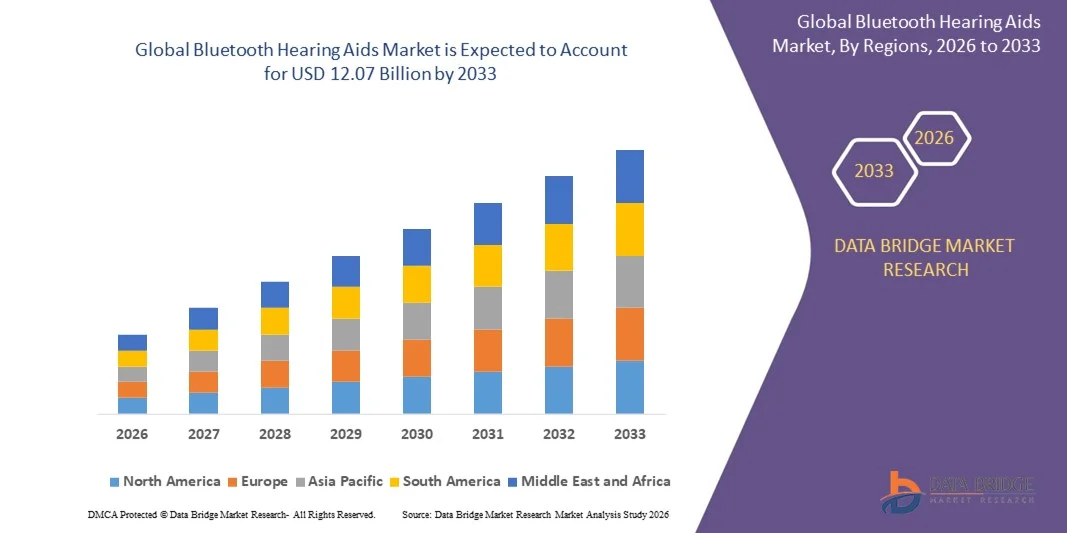
Bluetooth Hearing Aids Market Size
- The global bluetooth hearing aids market size was valued at USD 6.43 billion in 2025 and is expected to reach USD 12.07 billion by 2033, at a CAGR of 8.18% during the forecast period
- The market growth is largely fuelled by the increasing prevalence of hearing loss across all age groups, coupled with rising consumer preference for smart, connected, and user-friendly hearing solutions
- Growing adoption of advanced technologies such as Bluetooth connectivity, smartphone integration, and rechargeable batteries is accelerating market demand, enabling seamless streaming of audio and calls
Bluetooth Hearing Aids Market Analysis
- Technological innovations in miniaturization, sound quality enhancement, and noise cancellation are enhancing the user experience, driving adoption among both elderly and younger populations
- Integration with telehealth services, mobile apps, and smart devices is creating new opportunities for personalized hearing solutions, expanding market potential across global regions
- North America dominated the bluetooth hearing aids market with the largest revenue share in 2025, driven by high awareness of hearing loss, advanced healthcare infrastructure, and rapid adoption of connected health technologies
- Asia-Pacific region is expected to witness the highest growth rate in the global bluetooth hearing aids market, driven by growing geriatric population, rapid urbanization, and increasing penetration of connected healthcare devices
- The BTE segment held the largest market revenue share in 2025, driven by its ease of fitting, superior amplification, and compatibility with Bluetooth connectivity for streaming audio from smartphones and TVs. BTE devices are widely preferred by audiologists for both adults and pediatric patients due to their comfort, battery life, and advanced functionality
Report Scope and Bluetooth Hearing Aids Market Segmentation
|
Attributes |
Bluetooth Hearing Aids Key Market Insights |
|
Segments Covered |
|
|
Countries Covered |
North America
Europe
Asia-Pacific
Middle East and Africa
South America
|
|
Key Market Players |
• Medtronic (U.S.) |
|
Market Opportunities |
|
|
Value Added Data Infosets |
In addition to the insights on market scenarios such as market value, growth rate, segmentation, geographical coverage, and major players, the market reports curated by the Data Bridge Market Research also include in-depth expert analysis, pricing analysis, brand share analysis, consumer survey, demography analysis, supply chain analysis, value chain analysis, raw material/consumables overview, vendor selection criteria, PESTLE Analysis, Porter Analysis, and regulatory framework. |
Bluetooth Hearing Aids Market Trends
Rise of Wireless Connectivity in Hearing Aids
- The increasing integration of Bluetooth technology in hearing aids is transforming the hearing device landscape by enabling wireless connectivity with smartphones, TVs, and other audio sources. This allows users to stream sound directly to their devices, improving speech comprehension and overall listening experience, particularly in noisy environments. The trend is driving widespread adoption among tech-savvy and aging populations, supporting the growth of premium and mid-tier hearing aid segments. Enhanced connectivity also encourages multi-device pairing, expanding user convenience and satisfaction
- The growing demand for remote hearing healthcare solutions is accelerating the adoption of Bluetooth-enabled hearing aids with mobile app support. These devices allow audiologists to perform remote adjustments, track usage, and monitor hearing performance, improving patient compliance and reducing clinic visits. Tele-audiology services are also facilitating follow-ups and hearing assessments, particularly in underserved regions, while reducing operational costs for providers
- The compact design, energy efficiency, and ease of pairing of modern Bluetooth hearing aids are making them attractive for daily use. Users benefit from seamless integration with multiple devices, hands-free calling, and personalized sound settings, enhancing convenience and satisfaction. Longer battery life, reduced maintenance, and ergonomic designs are further encouraging adoption in both developed and emerging markets
- For instance, in 2023, hearing aid manufacturers in the U.S. and Europe launched new Bluetooth-enabled models with advanced noise reduction, smartphone control, and AI-assisted sound processing, resulting in higher consumer preference and market expansion. These innovations also allowed users to customize hearing profiles and receive firmware updates remotely, enhancing the perceived value of Bluetooth devices
- While Bluetooth-enabled hearing aids are growing in popularity, sustained adoption depends on continuous innovation, battery life improvements, and user-friendly interfaces. Manufacturers must focus on integrating advanced connectivity features, voice assistant support, and app-based personalization while educating users to fully capitalize on the market opportunity. Efforts to improve interoperability with multiple brands of devices will further boost adoption and user loyalty
Bluetooth Hearing Aids Market Dynamics
Driver
Rising Demand for Advanced and Connected Hearing Devices
- Increasing awareness of hearing loss and the desire for seamless connectivity are driving the adoption of Bluetooth hearing aids. Users are seeking devices that enhance audio clarity, integrate with smartphones, and provide remote control options, boosting market growth. Rising disposable income and willingness to invest in premium technology also contribute to market expansion across mature regions
- The convenience of streaming calls, music, and TV audio directly to hearing aids enhances user satisfaction and lifestyle quality, particularly for aging populations and tech-savvy individuals. This functionality encourages frequent device upgrades and brand loyalty. In addition, users benefit from reduced stigma due to smaller and aesthetically pleasing device designs that blend into daily life
- Technological advancements, such as low-latency streaming, rechargeable batteries, and AI-based noise cancellation, are encouraging consumers to adopt Bluetooth hearing aids. These features improve sound quality and user experience, driving higher adoption rates. Integration with health tracking and fall detection features adds further utility, making hearing aids a multifunctional health device
- For instance, in 2022, major hearing aid brands in North America introduced AI-powered Bluetooth models with mobile app connectivity and adaptive sound processing, leading to increased sales and market expansion. The ability to personalize audio settings based on different environments also contributed to improved user retention and positive word-of-mouth
- While demand is fueled by convenience and technological benefits, manufacturers must focus on affordability, product education, and interoperability to ensure continued adoption and long-term market growth. Partnerships with audiologists, telehealth platforms, and consumer electronics companies are critical to expanding reach and educating end-users
Restraint/Challenge
High Cost of Advanced Devices and Limited Awareness in Emerging Regions
- The high price of Bluetooth-enabled hearing aids compared to traditional devices limits adoption, particularly in price-sensitive and emerging markets. Advanced features, such as AI integration and wireless connectivity, increase manufacturing costs and retail prices, creating barriers for middle- and lower-income consumers. Limited insurance coverage or government subsidies in developing regions further constrain affordability
- Limited awareness about the benefits of Bluetooth-enabled hearing aids, especially in rural and underdeveloped regions, constrains market penetration. Lack of audiology infrastructure, trained professionals, and access to professional fitting services further reduce adoption. Cultural factors and social stigma around hearing aid use also inhibit market growth in certain demographics
- Supply chain limitations, including component shortages, reliance on specialized manufacturing, and logistics delays, can affect device availability and timely delivery. This may result in delayed product launches and reduced market reach in certain regions, affecting overall market growth. Disruptions in battery supply or wireless chipsets can particularly impact production timelines
- For instance, in 2023, audiology clinics in Sub-Saharan Africa reported challenges in acquiring Bluetooth-enabled hearing aids due to cost, limited local distribution networks, and lack of trained fitting professionals, restricting access for end-users. The limited number of certified service providers also hindered post-sale support and adoption
- While technology continues to advance, addressing affordability, accessibility, and awareness is crucial. Market stakeholders must focus on scalable manufacturing, consumer education, government collaborations, and partnerships with healthcare providers to unlock the full potential of the global Bluetooth hearing aids market. Expansion of e-commerce and tele-audiology platforms can also bridge the accessibility gap
Bluetooth Hearing Aids Market Scope
The market is segmented on the basis of product type, sales channel, application, and end user.
- By Product Type
On the basis of product type, the Bluetooth hearing aids market is segmented into In-The-Ear Hearing Aid (ITE), In-The-Canal Hearing Aid (ITC), Behind-The-Ear Hearing Aid (BTE), Completely-In-The Canal Hearing Aid (CIC), and Receiver-In-The-Ear Hearing Aid (RIE). The BTE segment held the largest market revenue share in 2025, driven by its ease of fitting, superior amplification, and compatibility with Bluetooth connectivity for streaming audio from smartphones and TVs. BTE devices are widely preferred by audiologists for both adults and pediatric patients due to their comfort, battery life, and advanced functionality.
The CIC and RIE segments are expected to witness the fastest growth rate from 2026 to 2033, driven by consumer demand for discreet, compact devices that offer high-quality wireless streaming, personalized sound settings, and enhanced convenience for daily use. These devices are particularly attractive to tech-savvy users and individuals seeking minimal visibility without compromising performance.
- By Sales Channel
On the basis of sales channel, the market is segmented into Wholesalers/Distributors, Online Retailers, Multi-brand Stores, Speciality Stores, Hypermarkets/Supermarkets, ENT Clinics and Audiology Centres, and Other Sales Channels. The ENT Clinics and Audiology Centres segment held the largest market revenue share in 2025, supported by professional fitting, personalized consultation, and post-sales support that ensures optimal device performance.
The Online Retailers segment is expected to witness the fastest growth rate from 2026 to 2033, driven by increasing e-commerce adoption, direct-to-consumer sales models, and the convenience of home delivery combined with virtual fitting and remote audiology services
- By Application
On the basis of application, the market is segmented into Clinics, Hospitals, Medical Centres, Individuals, and Others. The Individuals segment held the largest market revenue share in 2025, fueled by rising awareness of hearing health, growing disposable incomes, and demand for wireless, connected hearing devices for personal use.
The Clinics and Hospitals segment is expected to witness the fastest growth rate from 2026 to 2033, driven by the integration of advanced hearing solutions in audiology departments, tele-audiology services, and the need for high-quality patient care in both urban and rural regions.
- By End User
On the basis of end user, the market is segmented into Adults and Paediatrics. The Adults segment held the largest market revenue share in 2025, attributed to the higher prevalence of age-related hearing loss and adoption of advanced Bluetooth-enabled devices for enhanced audio streaming, lifestyle convenience, and personalized hearing support.
The Paediatrics segment is expected to witness the fastest growth rate from 2026 to 2033, driven by early intervention programs, school-based audiology screenings, and child-friendly hearing aids with Bluetooth connectivity for educational, recreational, and social applications.
Bluetooth Hearing Aids Market Regional Analysis
- North America dominated the bluetooth hearing aids market with the largest revenue share in 2025, driven by high awareness of hearing loss, advanced healthcare infrastructure, and rapid adoption of connected health technologies
- Consumers in the region highly value the convenience of wireless streaming, smartphone integration, and personalized sound settings offered by Bluetooth hearing aids.
- This widespread adoption is further supported by a technologically inclined population, high disposable incomes, and strong healthcare accessibility, establishing Bluetooth hearing aids as a preferred solution for both adults and pediatric users
U.S. Bluetooth Hearing Aids Market Insight
The U.S. bluetooth hearing aids market captured the largest revenue share in 2025 within North America, fueled by growing adoption of connected medical devices and increasing hearing loss awareness. Consumers are seeking devices that enhance audio clarity and provide remote audiologist adjustments. The rising demand for tele-audiology, mobile app connectivity, and integration with smartphones and TVs is significantly contributing to market expansion.
Europe Bluetooth Hearing Aids Market Insight
The Europe bluetooth hearing aids market is expected to witness the fastest growth rate from 2026 to 2033, driven by supportive healthcare policies, rising geriatric population, and increasing preference for digital hearing solutions. Urbanization and high smartphone penetration are fostering adoption. European users are increasingly drawn to devices offering advanced noise cancellation, rechargeable batteries, and hands-free connectivity across clinics, hospitals, and personal use.
U.K. Bluetooth Hearing Aids Market Insight
The U.K. bluetooth hearing aids market is expected to witness the fastest growth rate from 2026 to 2033, fueled by the growing trend of remote healthcare, home audiology solutions, and rising awareness of age-related hearing loss. Concerns regarding accessibility, convenience, and quality of care are encouraging individuals and healthcare providers to choose wireless hearing solutions. Strong e-commerce infrastructure further supports market growth.
Germany Bluetooth Hearing Aids Market Insight
The Germany bluetooth hearing aids market is expected to witness the fastest growth rate from 2026 to 2033, driven by increasing adoption of digital healthcare technologies and government support for tele-audiology. Germany’s focus on innovation, quality healthcare delivery, and eco-conscious devices is encouraging uptake across clinics, hospitals, and individual users. Advanced integration with smartphones and home audio systems is further boosting market expansion.
Asia-Pacific Bluetooth Hearing Aids Market Insight
The Asia-Pacific bluetooth hearing aids market is expected to witness the fastest growth rate from 2026 to 2033, driven by rising disposable incomes, growing geriatric population, and increasing smartphone penetration in countries such as China, Japan, and India. Government initiatives promoting hearing health, along with awareness campaigns, are accelerating adoption. APAC is also emerging as a manufacturing hub for hearing aids, making Bluetooth-enabled devices more affordable and accessible to a wider consumer base.
Japan Bluetooth Hearing Aids Market Insight
The Japan bluetooth hearing aids market is expected to witness the fastest growth rate from 2026 to 2033, fueled by the country’s high-tech culture, aging population, and strong emphasis on convenience. Japanese consumers prioritize devices that integrate with smartphones, TVs, and smart home audio systems. The trend toward connected healthcare solutions, combined with the need for easy-to-use and reliable hearing devices, is propelling market growth.
China Bluetooth Hearing Aids Market Insight
The China bluetooth hearing aids market accounted for the largest market revenue share in Asia-Pacific in 2025, attributed to rapid urbanization, high rates of technological adoption, and a growing aging population. The country is experiencing strong demand for digital and wireless hearing solutions in residential, clinical, and hospital settings. Affordable domestic devices, increasing awareness of hearing health, and smart healthcare initiatives are key factors driving market expansion.
Bluetooth Hearing Aids Market Share
The Bluetooth Hearing Aids industry is primarily led by well-established companies, including:
• Medtronic (U.S.)
• Stryker (U.S.)
• Demant A/S (Denmark)
• MED-EL Medical Electronics (Austria)
• Starkey (U.S.)
• Sonova (Switzerland)
• Eartone (U.S.)
• Siemens Healthcare GmbH (Germany)
• WS Audiology A/S (Denmark)
• SUNSKY (U.S.)
• Persona Medical (U.K.)
• Beltone (U.S.)
• Widex A/S (Denmark)
• Cochlear Ltd. (Australia)
• Miracle-Ear (U.S.)
• GN Hearing (Denmark)
• GN Store Nord A/S (Denmark)
• WS Audiology (Denmark)
• RION Co., Ltd. (Japan)
• Union Hearing Aid Centre Ltd. (U.K.)
• Bernafon (Switzerland)
• Natus Medical Incorporated (U.S.)
• SeboTek Hearing Systems, LLC (U.S.)
SKU-
Get online access to the report on the World's First Market Intelligence Cloud

- Interactive Data Analysis Dashboard
- Company Analysis Dashboard for high growth potential opportunities
- Research Analyst Access for customization & queries
- Competitor Analysis with Interactive dashboard
- Latest News, Updates & Trend analysis
- Harness the Power of Benchmark Analysis for Comprehensive Competitor Tracking
Research Methodology
Data collection and base year analysis are done using data collection modules with large sample sizes. The stage includes obtaining market information or related data through various sources and strategies. It includes examining and planning all the data acquired from the past in advance. It likewise envelops the examination of information inconsistencies seen across different information sources. The market data is analysed and estimated using market statistical and coherent models. Also, market share analysis and key trend analysis are the major success factors in the market report. To know more, please request an analyst call or drop down your inquiry.
The key research methodology used by DBMR research team is data triangulation which involves data mining, analysis of the impact of data variables on the market and primary (industry expert) validation. Data models include Vendor Positioning Grid, Market Time Line Analysis, Market Overview and Guide, Company Positioning Grid, Patent Analysis, Pricing Analysis, Company Market Share Analysis, Standards of Measurement, Global versus Regional and Vendor Share Analysis. To know more about the research methodology, drop in an inquiry to speak to our industry experts.
Customization Available
Data Bridge Market Research is a leader in advanced formative research. We take pride in servicing our existing and new customers with data and analysis that match and suits their goal. The report can be customized to include price trend analysis of target brands understanding the market for additional countries (ask for the list of countries), clinical trial results data, literature review, refurbished market and product base analysis. Market analysis of target competitors can be analyzed from technology-based analysis to market portfolio strategies. We can add as many competitors that you require data about in the format and data style you are looking for. Our team of analysts can also provide you data in crude raw excel files pivot tables (Fact book) or can assist you in creating presentations from the data sets available in the report.