Global Bone Morphogenetic Protein Growth Factor Therapy Market
Market Size in USD Billion
CAGR :
% 
 USD
2.21 Billion
USD
3.24 Billion
2025
2033
USD
2.21 Billion
USD
3.24 Billion
2025
2033
 Forecast Period Forecast Period |
2026 –2033 |
 Market Size (Base Year) Market Size (Base Year) |
USD 2.21 Billion |
 Market Size (Forecast Year) Market Size (Forecast Year) |
USD 3.24 Billion |
 CAGR CAGR |
% |
| Major Markets Players |
|
Bone Morphogenetic Protein Growth Factor Therapy Market Size
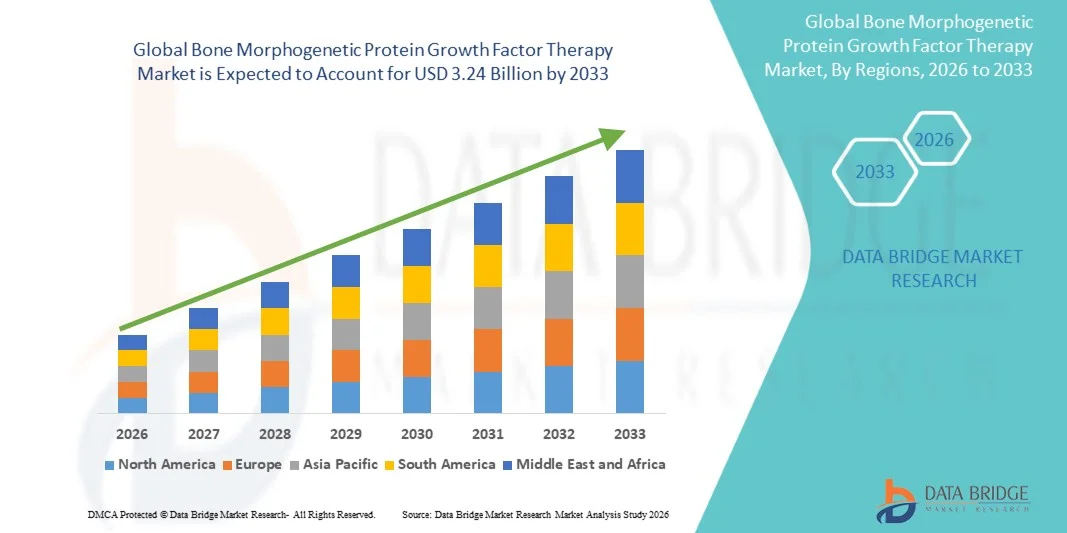
- The global bone morphogenetic protein growth factor therapy market size was valued at USD 2.21 billion in 2025 and is expected to reach USD 3.24 billion by 2033, at a CAGR of 4.9% during the forecast period
- The market growth is primarily driven by the increasing prevalence of orthopedic disorders, spinal fusion procedures, and bone-related injuries, which are boosting the demand for regenerative and biologically based treatment options in clinical practice
- Furthermore, advancements in biotechnology, coupled with rising adoption of minimally invasive surgical procedures and increasing investments in tissue engineering and regenerative medicine, are supporting the expansion of bone morphogenetic protein therapies, thereby accelerating overall market growth
Bone Morphogenetic Protein Growth Factor Therapy Market Analysis
- Bone morphogenetic protein (BMP) growth factor therapies, which utilize biologically active proteins to stimulate bone formation and healing, are increasingly important in orthopedic and spinal applications due to their ability to enhance bone regeneration, improve fusion rates, and reduce the need for autografts in surgical procedures
- The rising adoption of BMP therapies is primarily driven by the growing burden of degenerative bone diseases, spinal disorders, and trauma cases, alongside increasing preference for regenerative medicine approaches and biologics that support faster recovery and improved clinical outcomes
- North America dominated the bone morphogenetic protein growth factor therapy market with the largest revenue share of 38.5% in 2025, supported by advanced healthcare infrastructure, high adoption of innovative biologics, strong presence of key market players, and a high volume of spinal fusion and orthopedic procedures
- Asia-Pacific is expected to be the fastest growing region during the forecast period due to expanding healthcare infrastructure, increasing medical tourism, rising awareness of advanced treatment options, and growing healthcare expenditure across emerging economies
- Spinal fusion applications dominated the bone morphogenetic protein growth factor therapy market in 2025, accounting for a market share of 44.7%, driven by the high prevalence of spinal disorders, increasing aging population, and strong clinical preference for BMP-based solutions to enhance fusion success rates and reduce complications associated with traditional bone grafting techniques
Report Scope and Bone Morphogenetic Protein Growth Factor Therapy Market Segmentation
|
Attributes |
Bone Morphogenetic Protein Growth Factor Therapy Key Market Insights |
|
Segments Covered |
|
|
Countries Covered |
North America
Europe
Asia-Pacific
Middle East and Africa
South America
|
|
Key Market Players |
|
|
Market Opportunities |
|
|
Value Added Data Infosets |
In addition to the insights on market scenarios such as market value, growth rate, segmentation, geographical coverage, and major players, the market reports curated by the Data Bridge Market Research also include in-depth expert analysis, patient epidemiology, pipeline analysis, pricing analysis, and regulatory framework |
Bone Morphogenetic Protein Growth Factor Therapy Market Trends
“Advancements in Regenerative Medicine and Biologic Integration”
- A significant and accelerating trend in the global bone morphogenetic protein growth factor therapy market is the increasing integration of BMP therapies with advanced regenerative medicine approaches, including tissue engineering and combination biologics such as scaffolds and stem cell-based solutions, enhancing bone repair and clinical outcomes
- For instance, BMP-based products such as recombinant human BMP-2 are widely utilized in spinal fusion procedures, demonstrating improved fusion rates and reduced reliance on autografts. Similarly, ongoing research is focusing on combining BMPs with biomaterial scaffolds to optimize delivery and efficacy in bone regeneration applications
- Advances in biologic engineering and controlled-release delivery systems are enabling more targeted and sustained therapeutic effects of BMP therapies, improving safety profiles and reducing complications associated with earlier formulations. Furthermore, innovations in protein expression technologies are enhancing the scalability and consistency of BMP production
- The growing adoption of personalized and minimally invasive orthopedic treatments is further driving the use of BMP growth factors, as these therapies align with modern surgical techniques that prioritize faster recovery and reduced patient morbidity
- This trend toward more advanced, combination-based, and precision-oriented biologic therapies is reshaping expectations in orthopedic and spinal care. Consequently, companies are investing in next-generation BMP formulations and delivery mechanisms to improve clinical performance and expand therapeutic applications across broader patient populations.
- The demand for BMP-based growth factor therapies that offer enhanced efficacy, safety, and compatibility with minimally invasive procedures is increasing rapidly across orthopedic and trauma care segments, as healthcare providers prioritize improved surgical outcomes and reduced complications.
Bone Morphogenetic Protein Growth Factor Therapy Market Dynamics
Driver
“Rising Prevalence of Orthopedic Disorders and Increasing Demand for Bone Regeneration Therapies”
- The increasing prevalence of orthopedic disorders, spinal degenerative conditions, and trauma-related injuries, coupled with a growing aging population, is a significant driver for the heightened demand for bone morphogenetic protein growth factor therapies
- For instance, the rising number of spinal fusion and reconstructive surgeries globally has led to greater adoption of BMP-based biologics to enhance bone healing and improve surgical success rates. Such clinical advancements by healthcare providers and medical device companies are expected to drive market growth in the forecast period
- As patients and surgeons increasingly prefer biologic solutions that promote natural bone regeneration, BMP therapies offer advantages such as improved fusion outcomes, reduced need for secondary procedures, and enhanced recovery timelines, making them a compelling alternative to traditional grafting methods
- Furthermore, growing investments in regenerative medicine and increasing awareness among healthcare professionals regarding advanced biologic treatments are accelerating the integration of BMP therapies into standard orthopedic and spinal care practices
- The convenience of reduced donor site complications, combined with the ability to support complex bone repair procedures, is a key factor propelling the adoption of BMP growth factor therapies in both developed and emerging healthcare markets. The expansion of minimally invasive surgical techniques and improved availability of advanced biologics further contribute to sustained market growth
Restraint/Challenge
“Safety Concerns and Regulatory Compliance Barriers”
- Concerns surrounding potential adverse effects associated with bone morphogenetic protein therapies, including inflammation, ectopic bone formation, and other complications, pose a significant challenge to broader market adoption. As BMP therapies involve potent biologic activity, their use requires careful dosing and clinical oversight, raising safety considerations among healthcare providers
- For instance, reports of complications in certain spinal applications of BMP-2 have led to increased scrutiny from regulatory authorities and cautious usage recommendations in clinical settings
- Addressing these safety concerns through improved formulation design, controlled delivery systems, and stringent clinical guidelines is crucial for building trust among surgeons and patients. In addition, the complex regulatory approval processes for biologic therapies, which require extensive clinical validation and compliance with evolving standards, can delay product launches and limit market entry for new players
- While ongoing research and post-market surveillance are helping improve safety profiles and regulatory clarity, the high development costs and lengthy approval timelines can act as barriers to innovation and commercialization, particularly for smaller biotechnology firms
- Furthermore, variability in reimbursement policies and limited insurance coverage for certain BMP-based procedures in some regions can restrict patient access and slow down market penetration, especially in cost-sensitive healthcare systems
Bone Morphogenetic Protein Growth Factor Therapy Market Scope
The market is segmented on the basis of type and application.
- By Type
On the basis of type, the bone morphogenetic protein growth factor therapy market is segmented into recombinant human bone morphogenetic protein (rhBMP)-2 and recombinant human bone morphogenetic protein (rhBMP)-7. The rhBMP-2 segment dominated the market with the largest market revenue share of 61.3% in 2025, driven by its extensive clinical adoption in spinal fusion procedures and strong efficacy in promoting bone formation. rhBMP-2 is widely used due to its proven ability to enhance osteoinduction, reduce the need for autografts, and improve surgical success rates. Its broad regulatory approvals across multiple geographies and availability in commercially established products further support its dominance. In addition, higher surgeon familiarity and extensive clinical evidence backing rhBMP-2 contribute to its preference in orthopedic and spinal applications. The segment also benefits from continuous advancements in delivery systems that improve safety and controlled release of the protein.
The rhBMP-7 segment is anticipated to witness the fastest growth rate of 5.8% from 2026 to 2033, driven by its increasing use in non-union fracture treatments and reconstructive surgeries. rhBMP-7 is gaining traction as an alternative biologic option in cases where rhBMP-2 may not be suitable or approved, particularly in specific clinical indications. Growing research into its therapeutic potential, combined with rising demand for regenerative solutions in complex bone defects, is supporting its adoption. Furthermore, expanding applications in orthopedic trauma and orthopedic revision surgeries are contributing to segment growth. Increasing awareness among healthcare professionals regarding the benefits of rhBMP-7 in stimulating bone healing is also accelerating its market penetration.
- By Application
On the basis of application, the bone morphogenetic protein growth factor therapy market is segmented into spinal fusion, trauma, reconstructive surgery, oral-maxillofacial, and others. The spinal fusion segment dominated the market with the largest revenue share of 44.7% in 2025, driven by the high prevalence of spinal disorders such as degenerative disc disease and spinal instability. BMP therapies are widely used in spinal fusion procedures to enhance bone growth, improve fusion rates, and reduce the likelihood of revision surgeries. The increasing aging population and rising incidence of chronic back conditions further contribute to the demand for spinal fusion procedures. In addition, strong clinical evidence supporting the effectiveness of BMPs in spinal applications and their integration into standard surgical protocols reinforce this segment’s dominance. The availability of advanced surgical techniques and growing preference for biologics over traditional grafting methods also support sustained growth in this segment.
The oral-maxillofacial segment is expected to witness the fastest growth rate of 6.2% from 2026 to 2033, driven by increasing applications of BMP therapies in dental implantology, facial reconstruction, and bone defect repair. Rising demand for aesthetic and reconstructive dental procedures, along with increasing cases of trauma-related facial injuries, is boosting the adoption of BMP-based treatments. BMPs are increasingly used to support bone regeneration in complex maxillofacial surgeries, improving implant success rates and healing outcomes. Technological advancements in dental biomaterials and growing awareness among dental professionals regarding regenerative therapies are further accelerating adoption. In addition, expanding dental care infrastructure and increasing patient preference for advanced treatment options are contributing to the rapid growth of this segment.
Bone Morphogenetic Protein Growth Factor Therapy Market Regional Analysis
- North America dominated the bone morphogenetic protein growth factor therapy market with the largest revenue share of 38.5% in 2025, supported by advanced healthcare infrastructure, high adoption of innovative biologics, strong presence of key market players, and a high volume of spinal fusion and orthopedic procedures
- Healthcare providers in the region highly value the proven clinical efficacy, improved fusion outcomes, and reduced need for autografts offered by BMP-based therapies in spinal fusion and reconstructive procedures
- This widespread adoption is further supported by advanced healthcare infrastructure, high healthcare expenditure, strong presence of key industry players, and continuous technological advancements in regenerative medicine, establishing BMP therapies as a preferred solution in orthopedic and trauma care
U.S. Bone Morphogenetic Protein Growth Factor Therapy Market Insight
The U.S. bone morphogenetic protein growth factor therapy market captured the largest revenue share of 79% in North America in 2025, driven by the high prevalence of spinal disorders and orthopedic conditions, along with strong adoption of advanced biologic therapies in surgical procedures. Healthcare providers in the country increasingly prioritize BMP-based solutions for spinal fusion and reconstructive surgeries due to their ability to enhance bone regeneration and improve clinical outcomes. The presence of leading biotechnology and medical device companies, coupled with robust R&D investments, further supports innovation and product availability. In addition, favorable reimbursement frameworks and widespread awareness among surgeons contribute to the strong uptake of BMP therapies.
Europe Bone Morphogenetic Protein Growth Factor Therapy Market Insight
The Europe bone morphogenetic protein growth factor therapy market is projected to expand at a steady CAGR throughout the forecast period, primarily driven by the rising incidence of degenerative bone diseases and increasing demand for advanced regenerative treatments. Strict regulatory frameworks ensure the safe adoption of biologics, encouraging the use of BMP therapies in approved clinical applications. The region benefits from well-established healthcare infrastructure and growing investments in orthopedic and trauma care. Increasing adoption of minimally invasive surgical techniques and a strong focus on improving patient outcomes are further fostering market growth across residential healthcare systems.
U.K. Bone Morphogenetic Protein Growth Factor Therapy Market Insight
The U.K. bone morphogenetic protein growth factor therapy market is anticipated to grow at a notable CAGR during the forecast period, driven by increasing awareness of regenerative medicine and the growing burden of orthopedic conditions. The country’s advanced healthcare system and emphasis on adopting innovative biologics are supporting the use of BMP therapies in spinal and reconstructive surgeries. In addition, rising demand for effective alternatives to traditional bone grafting methods is encouraging healthcare providers to adopt BMP-based treatments. Continuous improvements in clinical research and healthcare accessibility are further contributing to market expansion in the region.
Germany Bone Morphogenetic Protein Growth Factor Therapy Market Insight
The Germany bone morphogenetic protein growth factor therapy market is expected to expand at a considerable CAGR during the forecast period, fueled by the country’s strong focus on medical innovation and high standards of healthcare delivery. Increasing prevalence of orthopedic disorders, combined with a well-developed hospital infrastructure, supports the adoption of BMP therapies in clinical practice. Germany’s emphasis on precision medicine and advanced surgical techniques promotes the use of biologics for bone regeneration. Furthermore, rising investments in biotechnology and growing awareness among healthcare professionals are enhancing the integration of BMP-based solutions in orthopedic and trauma applications.
Asia-Pacific Bone Morphogenetic Protein Growth Factor Therapy Market Insight
The Asia-Pacific bone morphogenetic protein growth factor therapy market is poised to grow at the fastest CAGR during the forecast period, driven by increasing healthcare expenditure, rising prevalence of orthopedic conditions, and expanding access to advanced medical treatments in countries such as China, India, and Japan. The region’s growing population and improving healthcare infrastructure are accelerating the adoption of regenerative therapies. In addition, increasing medical tourism and government initiatives supporting healthcare modernization are contributing to market growth. The availability of cost-effective treatment options and expanding clinical awareness are further enhancing the uptake of BMP therapies across both public and private healthcare sectors.
Japan Bone Morphogenetic Protein Growth Factor Therapy Market Insight
The Japan bone morphogenetic protein growth factor therapy market is gaining momentum due to the country’s advanced healthcare system, aging population, and high demand for effective orthopedic treatments. The increasing prevalence of age-related bone disorders is driving the need for regenerative solutions such as BMP therapies. Japan’s strong focus on technological innovation and minimally invasive surgical techniques supports the adoption of biologics in clinical settings. Furthermore, integration of advanced biomaterials and continuous research in regenerative medicine are contributing to improved treatment outcomes and market growth.
India Bone Morphogenetic Protein Growth Factor Therapy Market Insight
The India bone morphogenetic protein growth factor therapy market accounted for a significant revenue share in Asia-Pacific in 2025, attributed to the country’s large patient population, growing healthcare infrastructure, and increasing adoption of advanced medical treatments. Rising awareness of orthopedic care and improving access to specialized surgeries are driving demand for BMP-based therapies. The expansion of private healthcare facilities, along with growing investments in biotechnology and regenerative medicine, is further supporting market growth. In addition, increasing affordability of treatments and the availability of skilled healthcare professionals are key factors propelling the adoption of BMP therapies in India.
Bone Morphogenetic Protein Growth Factor Therapy Market Share
The Bone Morphogenetic Protein Growth Factor Therapy industry is primarily led by well-established companies, including:
- Medtronic (Ireland)
- Stryker (U.S.)
- Thermo Fisher Scientific Inc. (U.S.)
- Merck & Co., Inc. (U.S.)
- Johnson & Johnson Services, Inc. (U.S.)
- Bio-Techne Corporation (U.S.)
- Zimmer Biomet (U.S.)
- Fujifilm Irvine Scientific (U.S.)
- PeproTech (U.S.)
- ProSpec-Tany TechnoGene Ltd. (Israel)
- Cell Guidance Systems LLC (U.K.)
- Creative BioMart (U.S.)
- R&D Systems (U.S.)
- Proteintech Group, Inc. (U.S.)
- Cellumed Co., Ltd. (China)
- Jiuyuan Gene Engineering Co., Ltd. (China)
- Bone Therapeutics SA (Belgium)
- Osiris Therapeutics, Inc. (U.S.)
- SeaSpine Holdings Corporation (U.S.)
- Orthofix Medical Inc. (U.S.)
What are the Recent Developments in Global Bone Morphogenetic Protein Growth Factor Therapy Market?
- In February 2026, Medtronic announced that the U.S. Food and Drug Administration (FDA) granted Premarket Approval (PMA) for its INFUSE™ Bone Graft (a BMP growth factor bone graft) for use in one- and two-level Transforaminal Lumbar Interbody Fusion (TLIF) procedures, broadening its indications beyond previous uses and making it the only PMA-approved growth factor bone graft for multiple spine fusion approaches. This regulatory milestone underscores growing clinical validation of BMP-based therapies in spinal surgery
- In January 2026, scientific coverage reported new insights into BMP signaling’s role in neurogenesis and potential therapeutic targets, reflecting expanding research interest in BMP biology beyond traditional orthopedic applications, which could influence future BMP-based therapies
- In July 2025, scientific research published in Eye and Vision detailed that bone morphogenetic proteins (BMPs), part of the TGF-β family, are expressed in ocular tissues and implicated in multiple therapeutic applications beyond traditional bone regeneration. This reflects broader interest in BMP biology and potential future therapeutic avenues
- In May 2025, researchers published findings on engineered extracellular vesicles that enhance BMP2/BMP7 signaling to promote bone formation, highlighting innovative biologic approaches that could improve BMP therapy effectiveness in bone healing and regenerative medicine
- In March 2024, a study published in Biomolecules showed that recombinant human BMP-7 (rhBMP-7), alone and in combination with PDGF-BB, significantly increased bone volume and density in an osteoporosis rat model, positioning BMP-7 as a potential therapeutic candidate beyond spinal fusion into metabolic bone disorders
SKU-
Get online access to the report on the World's First Market Intelligence Cloud

- Interactive Data Analysis Dashboard
- Company Analysis Dashboard for high growth potential opportunities
- Research Analyst Access for customization & queries
- Competitor Analysis with Interactive dashboard
- Latest News, Updates & Trend analysis
- Harness the Power of Benchmark Analysis for Comprehensive Competitor Tracking
Research Methodology
Data collection and base year analysis are done using data collection modules with large sample sizes. The stage includes obtaining market information or related data through various sources and strategies. It includes examining and planning all the data acquired from the past in advance. It likewise envelops the examination of information inconsistencies seen across different information sources. The market data is analysed and estimated using market statistical and coherent models. Also, market share analysis and key trend analysis are the major success factors in the market report. To know more, please request an analyst call or drop down your inquiry.
The key research methodology used by DBMR research team is data triangulation which involves data mining, analysis of the impact of data variables on the market and primary (industry expert) validation. Data models include Vendor Positioning Grid, Market Time Line Analysis, Market Overview and Guide, Company Positioning Grid, Patent Analysis, Pricing Analysis, Company Market Share Analysis, Standards of Measurement, Global versus Regional and Vendor Share Analysis. To know more about the research methodology, drop in an inquiry to speak to our industry experts.
Customization Available
Data Bridge Market Research is a leader in advanced formative research. We take pride in servicing our existing and new customers with data and analysis that match and suits their goal. The report can be customized to include price trend analysis of target brands understanding the market for additional countries (ask for the list of countries), clinical trial results data, literature review, refurbished market and product base analysis. Market analysis of target competitors can be analyzed from technology-based analysis to market portfolio strategies. We can add as many competitors that you require data about in the format and data style you are looking for. Our team of analysts can also provide you data in crude raw excel files pivot tables (Fact book) or can assist you in creating presentations from the data sets available in the report.