




Global Cannabidiol Market
Market Size in USD Billion
CAGR :
% 
 USD
10.25 Billion
USD
72.94 Billion
2025
2033
USD
10.25 Billion
USD
72.94 Billion
2025
2033
 Forecast Period Forecast Period |
2026 –2033 |
 Market Size (Base Year) Market Size (Base Year) |
USD 10.25 Billion |
 Market Size (Forecast Year) Market Size (Forecast Year) |
USD 72.94 Billion |
 CAGR CAGR |
% |
| Major Markets Players |
|
Cannabidiol (CBD) Market Size
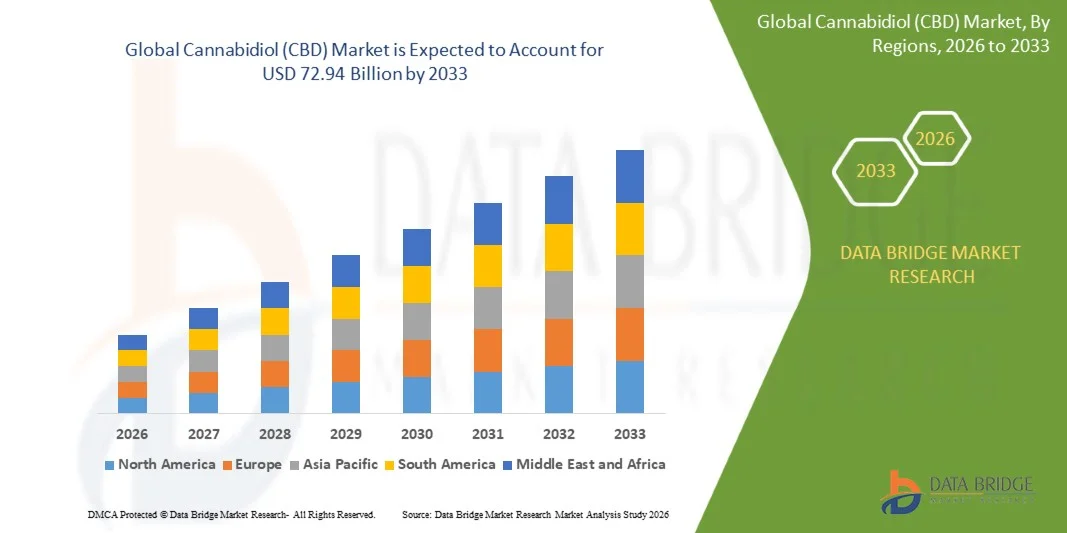
- The global Cannabidiol (CBD) market size was valued at USD 10.25 billion in 2025 and is expected to reach USD 72.94 billion by 2033, at a CAGR of 27.8% during the forecast period
- The market growth is largely fueled by increasing consumer awareness regarding the therapeutic benefits of cannabidiol (CBD), along with expanding legalization of hemp-derived products across multiple regions, leading to greater adoption in wellness, pharmaceutical, and personal care applications
- Furthermore, rising demand for natural, plant-based, and non-psychoactive health solutions is establishing CBD as a preferred ingredient in functional foods, cosmetics, and supplements. These converging factors are accelerating product innovation and commercialization, thereby significantly boosting the industry's growth
Cannabidiol (CBD) Market Analysis
- Cannabidiol (CBD) is a non-psychoactive compound derived from cannabis plants that is widely used for its potential health benefits, including pain relief, anxiety reduction, and anti-inflammatory properties. It is incorporated into a variety of products such as oils, tinctures, edibles, topicals, and pharmaceuticals, catering to both medical and wellness needs
- The escalating demand for CBD products is primarily fueled by increasing research and clinical validation, growing acceptance of cannabis-based therapies, and a rising preference for alternative and holistic healthcare solutions among consumers
- North America dominated the Cannabidiol (CBD) market with a share of 86.30% in 2025, due to the widespread legalization of hemp-derived products and strong consumer awareness regarding wellness applications of CBD
- Asia-Pacific is expected to be the fastest growing region in the Cannabidiol (CBD) market during the forecast period due to increasing awareness, evolving regulatory frameworks, and rising demand for alternative wellness solutions
- Hemp segment dominated the market with a market share of 58.53% in 2025, due to its legal acceptance across multiple countries and lower tetrahydrocannabinol (THC) content, which makes it more suitable for commercial and consumer use. Hemp-derived CBD is widely utilized in wellness, food, and cosmetic products due to its non-psychoactive nature and regulatory compliance. Manufacturers prefer hemp as a raw material because of its scalability, cost efficiency, and ease of cultivation
Report Scope and Cannabidiol (CBD) Market Segmentation
|
Attributes |
Cannabidiol (CBD) Key Market Insights |
|
Segments Covered |
|
|
Countries Covered |
North America
Europe
Asia-Pacific
Middle East and Africa
South America
|
|
Key Market Players |
|
|
Market Opportunities |
|
|
Value Added Data Infosets |
In addition to the insights on market scenarios such as market value, growth rate, segmentation, geographical coverage, and major players, the market reports curated by the Data Bridge Market Research also include in-depth expert analysis, pricing analysis, brand share analysis, consumer survey, demography analysis, supply chain analysis, value chain analysis, raw material/consumables overview, vendor selection criteria, PESTLE Analysis, Porter Analysis, and regulatory framework. |
Cannabidiol (CBD) Market Trends
“Increasing Adoption of CBD-Infused Functional Foods and Beverages”
- A significant trend in the cannabidiol (CBD) market is the increasing incorporation of CBD into functional foods and beverages, driven by rising consumer interest in wellness-oriented and stress-relief products. This shift is positioning CBD as a key ingredient in the evolving functional nutrition and lifestyle segment across global markets
- For instance, Canopy Growth Corporation has expanded its portfolio through CBD-infused beverages under its BioSteel brand, targeting health-conscious consumers seeking hydration combined with functional benefits. Such initiatives highlight the growing commercialization of CBD in mainstream consumable products and reinforce product diversification strategies
- The demand for CBD-infused edibles such as gummies, chocolates, and baked goods is increasing as consumers prefer convenient and discreet consumption formats. This trend is encouraging manufacturers to innovate with flavors, formulations, and dosage control to enhance consumer experience
- Beverage companies are introducing CBD-infused drinks including teas, sparkling waters, and energy drinks that cater to relaxation and mental wellness needs. This is strengthening the presence of CBD products in retail and hospitality channels, supporting broader market penetration
- The growing popularity of plant-based diets and clean-label products is further driving the adoption of CBD in food and beverage applications. Consumers are increasingly seeking natural ingredients that align with holistic health and wellness lifestyles
- The continued expansion of CBD-infused consumables is reinforcing the market’s transition toward functional and lifestyle-driven products. This trend is expected to play a crucial role in shaping product innovation and driving long-term growth across the CBD industry
Cannabidiol (CBD) Market Dynamics
Driver
“Rising Consumer Demand for Natural and Plant-Based Wellness Solutions”
- The increasing preference for natural and plant-based health solutions is a major driver fueling the growth of the cannabidiol (CBD) market, as consumers shift away from synthetic pharmaceuticals toward holistic alternatives. CBD products are widely perceived as safer and more compatible with long-term wellness routines, supporting their adoption across diverse consumer groups
- For instance, CV Sciences, Inc. markets its PlusCBD product line as a plant-based wellness solution, addressing consumer demand for natural supplements that support immunity, stress relief, and overall health. This reflects the growing alignment between consumer preferences and CBD product positioning in the wellness sector
- The rising awareness regarding the therapeutic benefits of CBD, including pain management, anxiety reduction, and anti-inflammatory effects, is further driving demand. Consumers are increasingly integrating CBD into daily routines as part of preventive healthcare practices
- The expansion of product availability across retail stores, pharmacies, and e-commerce platforms is improving accessibility and encouraging adoption. This widespread distribution is supporting market growth by reaching a broader consumer base
- The sustained demand for clean-label, organic, and plant-derived products continues to strengthen this driver. The growing preference for natural wellness solutions is expected to remain a key factor influencing the expansion of the CBD market
Restraint/Challenge
“Regulatory Uncertainty and Lack of Standardization Across Regions”
- The cannabidiol (CBD) market faces significant challenges due to inconsistent regulatory frameworks and the absence of standardized guidelines across different countries. These variations create uncertainty for manufacturers, limiting product approvals and restricting cross-border trade opportunities
- For instance, UK Food Standards Agency has required CBD food products to undergo novel food authorization, introducing strict compliance and safety evaluation processes that delay product commercialization. Such regulatory complexities highlight the challenges companies face in navigating approval systems across regions
- Differences in legal status regarding THC limits and CBD classification create confusion among consumers and businesses. This inconsistency affects product labeling, marketing strategies, and overall market expansion
- The lack of standardized quality and testing protocols raises concerns regarding product safety, potency, and consistency. Manufacturers must invest heavily in compliance measures to meet varying regulatory requirements
- The ongoing regulatory fragmentation continues to pose a major barrier to the CBD market. Addressing these challenges through harmonized standards and clear guidelines will be essential for ensuring sustainable growth and global market integration
Cannabidiol (CBD) Market Scope
The market is segmented on the basis of source, grade, nature, application, and product type.
• By Source
On the basis of source, the Cannabidiol (CBD) market is segmented into hemp and marijuana. The hemp segment dominated the largest market revenue share of 58.53% in 2025, driven by its legal acceptance across multiple countries and lower tetrahydrocannabinol (THC) content, which makes it more suitable for commercial and consumer use. Hemp-derived CBD is widely utilized in wellness, food, and cosmetic products due to its non-psychoactive nature and regulatory compliance. Manufacturers prefer hemp as a raw material because of its scalability, cost efficiency, and ease of cultivation. The increasing demand for plant-based and natural ingredients further strengthens the dominance of this segment.
The marijuana segment is anticipated to witness the fastest growth rate from 2026 to 2033, fueled by expanding legalization for medical and recreational use in several regions. Marijuana-derived CBD is often associated with higher potency and therapeutic effectiveness, making it increasingly popular in pharmaceutical applications. Growing clinical research supporting its efficacy in treating chronic pain, anxiety, and neurological disorders is accelerating its adoption. The evolving regulatory landscape and rising consumer awareness regarding medicinal cannabis are further driving this segment’s growth trajectory.
• By Grade
On the basis of grade, the Cannabidiol (CBD) market is segmented into food grade and therapeutics grade. The food grade segment accounted for the largest market revenue share in 2025, supported by the increasing incorporation of CBD into edible products such as snacks, beverages, and functional foods. Consumers are increasingly seeking wellness-oriented food options that offer relaxation and stress relief benefits. Food-grade CBD is widely accepted due to its safety standards and compatibility with diverse formulations. The expansion of retail channels and product innovation in infused consumables is further boosting demand.
The therapeutics grade segment is expected to witness the fastest growth rate from 2026 to 2033, driven by rising medical applications and increasing clinical validation of CBD-based treatments. Therapeutics-grade CBD is used in prescription and over-the-counter products targeting conditions such as epilepsy, inflammation, and mental health disorders. Growing investments in pharmaceutical research and development are accelerating the commercialization of high-purity CBD formulations. Regulatory approvals and increasing physician acceptance are further contributing to the rapid expansion of this segment.
• By Nature
On the basis of nature, the Cannabidiol (CBD) market is segmented into organic and inorganic. The organic segment dominated the largest market revenue share in 2025, driven by strong consumer preference for chemical-free and sustainably sourced products. Organic CBD products are perceived as safer and more environmentally friendly, which aligns with the growing trend of clean-label consumption. Producers are increasingly adopting organic farming practices to meet certification standards and enhance brand credibility. The premium pricing associated with organic products also contributes to higher revenue generation.
The inorganic segment is anticipated to witness the fastest growth rate from 2026 to 2033, fueled by its cost-effectiveness and higher production scalability. Inorganic CBD products are more accessible to a broader consumer base due to lower pricing and mass availability. Manufacturers are focusing on improving quality standards and transparency to address consumer concerns regarding synthetic inputs. The expansion of large-scale production facilities and increasing demand from emerging markets are supporting the growth of this segment.
• By Application
On the basis of application, the Cannabidiol (CBD) market is segmented into tincture, food, beverages, pharmaceutical, topicals, dietary supplements, and others. The pharmaceutical segment held the largest market revenue share in 2025, driven by the increasing use of CBD in treating chronic conditions and neurological disorders. Pharmaceutical applications benefit from strong clinical backing and regulatory approvals, enhancing consumer trust and adoption. The growing prevalence of health issues such as anxiety, epilepsy, and pain disorders is further driving demand. Continuous research and innovation in drug formulations are strengthening the segment’s market position.
The beverages segment is expected to witness the fastest growth rate from 2026 to 2033, fueled by rising demand for functional and wellness drinks. CBD-infused beverages are gaining popularity among health-conscious consumers seeking relaxation and stress management solutions. Beverage manufacturers are introducing innovative formulations with improved taste and bioavailability. Expanding distribution through retail and e-commerce channels is further accelerating market penetration. Increasing acceptance of CBD-infused lifestyle products is supporting rapid growth in this segment.
• By Product Type
On the basis of product type, the Cannabidiol (CBD) market is segmented into CBD oil, CBD concentrates, CBD isolates, and others. The CBD oil segment dominated the largest market revenue share in 2025, driven by its versatility and widespread use across multiple applications such as tinctures, topicals, and supplements. CBD oil is preferred due to its ease of dosage, high bioavailability, and compatibility with various delivery methods. The growing consumer inclination toward natural wellness solutions further supports its demand. Strong distribution networks and product availability enhance its market dominance.
The CBD isolates segment is anticipated to witness the fastest growth rate from 2026 to 2033, fueled by increasing demand for pure and THC-free CBD products. Isolates offer high potency and consistency, making them suitable for pharmaceutical and nutraceutical applications. Consumers seeking targeted benefits without psychoactive compounds are driving adoption. Advancements in extraction technologies and growing preference for precision-based formulations are further accelerating segment growth.
Cannabidiol (CBD) Market Regional Analysis
- North America dominated the Cannabidiol (CBD) market with the largest revenue share of 86.30% in 2025, driven by the widespread legalization of hemp-derived products and strong consumer awareness regarding wellness applications of CBD
- Consumers in the region increasingly prefer CBD products for stress relief, pain management, and overall health improvement, supported by the availability of diverse product formats such as oils, edibles, and topicals
- This widespread adoption is further supported by advanced retail infrastructure, strong presence of key market players, and increasing product innovation, establishing CBD as a mainstream wellness ingredient across multiple industries
U.S. Cannabidiol (CBD) Market Insight
The U.S. Cannabidiol (CBD) market captured the largest revenue share within North America in 2025, fueled by favorable regulatory frameworks and high consumer acceptance of CBD-infused products. The market is witnessing strong demand across pharmaceuticals, food and beverages, and personal care sectors due to increasing awareness of therapeutic benefits. The presence of leading companies and continuous product innovation are accelerating market expansion. Moreover, the integration of CBD into mainstream retail channels and e-commerce platforms is significantly contributing to the market’s growth trajectory.
Europe Cannabidiol (CBD) Market Insight
The Europe Cannabidiol (CBD) market is projected to expand at a substantial CAGR throughout the forecast period, primarily driven by evolving regulatory clarity and increasing demand for natural and plant-based wellness products. Rising consumer inclination toward organic and sustainable ingredients is fostering CBD adoption across cosmetics and nutraceutical industries. The region is experiencing steady growth across pharmaceutical and personal care applications, supported by growing research activities and product approvals.
U.K. Cannabidiol (CBD) Market Insight
The U.K. Cannabidiol (CBD) market is anticipated to grow at a noteworthy CAGR during the forecast period, driven by increasing awareness regarding mental health and wellness benefits associated with CBD consumption. Consumers are increasingly incorporating CBD products into daily routines for stress management and sleep improvement. The strong presence of online retail channels and expanding product availability are further supporting market growth across the country.
Germany Cannabidiol (CBD) Market Insight
The Germany Cannabidiol (CBD) market is expected to expand at a considerable CAGR during the forecast period, fueled by rising demand for pharmaceutical-grade CBD products and increasing acceptance of medical cannabis. Germany’s well-established healthcare infrastructure and regulatory support are encouraging the adoption of CBD-based treatments. The growing focus on high-quality, lab-tested products is also aligning with consumer expectations and driving market penetration.
Asia-Pacific Cannabidiol (CBD) Market Insight
The Asia-Pacific Cannabidiol (CBD) market is poised to grow at the fastest CAGR during the forecast period of 2026 to 2033, driven by increasing awareness, evolving regulatory frameworks, and rising demand for alternative wellness solutions. The region’s expanding middle-class population and growing interest in plant-based products are accelerating market adoption. Furthermore, increasing investments in cannabis research and the gradual relaxation of legal restrictions are enhancing growth opportunities across emerging economies.
Japan Cannabidiol (CBD) Market Insight
The Japan Cannabidiol (CBD) market is gaining momentum due to increasing demand for natural health supplements and a strong inclination toward preventive healthcare. Consumers are increasingly adopting CBD products for relaxation and lifestyle enhancement purposes. The market is also benefiting from innovations in product formulations and growing availability through online platforms. The focus on high-quality and compliant products is further supporting growth in Japan.
China Cannabidiol (CBD) Market Insight
The China Cannabidiol (CBD) market accounted for a significant market revenue share in Asia Pacific in 2025, attributed to the country’s large-scale hemp cultivation and strong manufacturing capabilities. China plays a crucial role in the global CBD supply chain, particularly in raw material production and exports. Increasing industrial applications and rising interest in CBD-based personal care products are supporting domestic demand. The presence of established production infrastructure and export-oriented strategies are key factors propelling the market in China.
Cannabidiol (CBD) Market Share
The Cannabidiol (CBD) industry is primarily led by well-established companies, including:
- CV Sciences, Inc. (U.S.)
- VIVO Cannabis Inc. (Canada)
- Gaia Herbs Hemp (U.S.)
- Medical Marijuana, Inc. (U.S.)
- The Cronos Group (Canada)
- Charlotte’s Web Holdings, Inc. (U.S.)
- HEXO Corp. (Canada)
- Aurora Cannabis Inc. (Canada)
- Canopy Growth Corporation (Canada)
- Jazz Pharmaceuticals, Inc. (Ireland)
- Tilray Brands, Inc. (Canada)
- Curaleaf Holdings, Inc. (U.S.)
- Koi CBD (U.S.)
- Joy Organics (U.S.)
- Elixinol Wellness Limited (Australia)
- Isodiol International Inc. (Canada)
- NuLeaf Naturals, LLC (U.S.)
- Diamond CBD (U.S.)
- Medterra CBD (U.S.)
- Endoca BV (Netherlands)
- Green Roads (U.S.)
Latest Developments in Global Cannabidiol (CBD) Market
- In October 2025, medical cannabis wellness startup Awshad introduced a highly potent 6500 mg CBD oil specifically formulated to address chronic pain and severe health conditions. This product represents the company’s strongest offering to date, reflecting its focus on advanced therapeutic solutions within the cannabis wellness space. The launch also aligned with Awshad reaching profitability in its fourth year of operations, highlighting both the company’s growth trajectory and the increasing consumer acceptance of cannabis-based wellness products in India
- In September 2025, the UK Food Standards Agency initiated a public consultation process to evaluate the approval of the first CBD-infused food products under the novel foods framework in Great Britain. The review includes three product applications and emphasizes the introduction of mandatory safety guidelines, including clear labeling and usage warnings. This development marks a significant step toward establishing a structured regulatory pathway for CBD food products, enhancing consumer confidence and supporting market expansion in the U.K.
- In November 2024, The Cannabist Company formed a strategic partnership with Veda Warrior, an Ayurvedic wellness brand based in New Jersey. The collaboration aims to develop cannabis-infused culinary products such as ghee, olive oil, and coconut oil, blending traditional Ayurvedic principles with modern cannabis applications. The partnership also outlines future expansion into edibles and topical products, integrating herbal formulations to cater to consumers seeking holistic and plant-based wellness solutions
- In September 2024, Aurora Cannabis, in collaboration with Vectura and Fertin Pharma, launched the LUO CBD lozenge, an innovative oral dissolvable product designed for convenient cannabidiol delivery. This formulation provides an alternative to traditional consumption methods such as inhalation or oils, catering to consumers who prefer discreet and easy-to-use formats. The product highlights ongoing advancements in drug delivery technologies within the CBD market
- In June 2024, Rodedawg International Industries, Inc. expanded its product portfolio with the launch of Nutrient CBD, a diversified line comprising five distinct SKUs. The range includes two CBD oil tinctures, two topical creams, and one roll-on application, addressing various consumer needs from pain relief to skincare. This product introduction underscores the company’s focus on innovation and its effort to provide versatile, natural wellness solutions tailored to evolving consumer preferences
SKU-
Get online access to the report on the World's First Market Intelligence Cloud

- Interactive Data Analysis Dashboard
- Company Analysis Dashboard for high growth potential opportunities
- Research Analyst Access for customization & queries
- Competitor Analysis with Interactive dashboard
- Latest News, Updates & Trend analysis
- Harness the Power of Benchmark Analysis for Comprehensive Competitor Tracking
Global Cannabidiol Market, Supply Chain Analysis and Ecosystem Framework
To support market growth and help clients navigate the impact of geopolitical shifts, DBMR has integrated in-depth supply chain analysis into its Global Cannabidiol Market research reports. This addition empowers clients to respond effectively to global changes affecting their industries. The supply chain analysis section includes detailed insights such as Global Cannabidiol Market consumption and production by country, price trend analysis, the impact of tariffs and geopolitical developments, and import and export trends by country and HSN code. It also highlights major suppliers with data on production capacity and company profiles, as well as key importers and exporters. In addition to research, DBMR offers specialized supply chain consulting services backed by over a decade of experience, providing solutions like supplier discovery, supplier risk assessment, price trend analysis, impact evaluation of inflation and trade route changes, and comprehensive market trend analysis.
Research Methodology
Data collection and base year analysis are done using data collection modules with large sample sizes. The stage includes obtaining market information or related data through various sources and strategies. It includes examining and planning all the data acquired from the past in advance. It likewise envelops the examination of information inconsistencies seen across different information sources. The market data is analysed and estimated using market statistical and coherent models. Also, market share analysis and key trend analysis are the major success factors in the market report. To know more, please request an analyst call or drop down your inquiry.
The key research methodology used by DBMR research team is data triangulation which involves data mining, analysis of the impact of data variables on the market and primary (industry expert) validation. Data models include Vendor Positioning Grid, Market Time Line Analysis, Market Overview and Guide, Company Positioning Grid, Patent Analysis, Pricing Analysis, Company Market Share Analysis, Standards of Measurement, Global versus Regional and Vendor Share Analysis. To know more about the research methodology, drop in an inquiry to speak to our industry experts.
Customization Available
Data Bridge Market Research is a leader in advanced formative research. We take pride in servicing our existing and new customers with data and analysis that match and suits their goal. The report can be customized to include price trend analysis of target brands understanding the market for additional countries (ask for the list of countries), clinical trial results data, literature review, refurbished market and product base analysis. Market analysis of target competitors can be analyzed from technology-based analysis to market portfolio strategies. We can add as many competitors that you require data about in the format and data style you are looking for. Our team of analysts can also provide you data in crude raw excel files pivot tables (Fact book) or can assist you in creating presentations from the data sets available in the report.












