


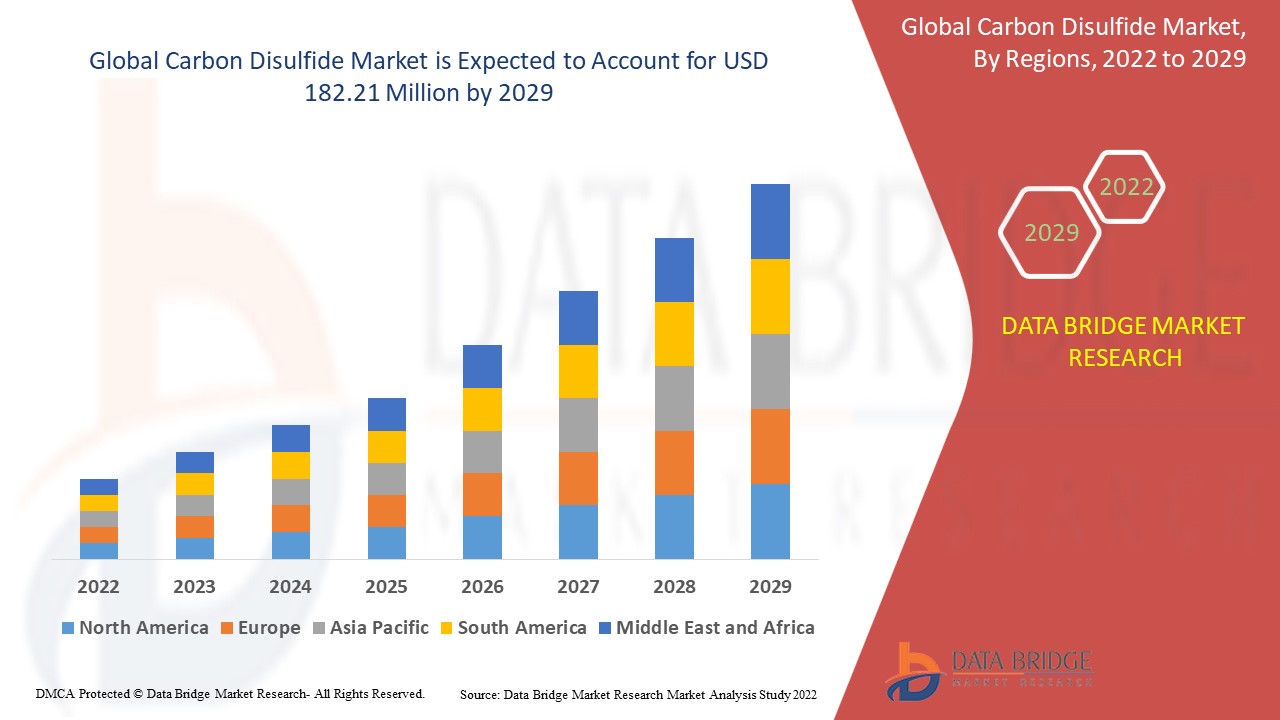
Carbon Disulfide Market Analysis and Size
The production of new chemicals such as rayon, cellophane and carbon tetrachloride accounts for a significant share of the carbon disulfide market. The “packaging” is the fastest growing end user segment due to an exponential rise in the adoption of cellophane in the industry. Furthermore, rising demand for rayon and other cellulosic fibers from fabric and textile industry is likely to boost the carbon disulphide market.
Data Bridge Market Research analyses that the carbon disulfide market is expected to undergo a CAGR of 2.90% during the forecast period. This indicates that the market value, which was USD 144.96 million in 2021, would rocket up to USD 182.21 million by 2029. In addition to the insights on market scenarios such as market value, growth rate, segmentation, geographical coverage, and major players, the market reports curated by the Data Bridge Market Research also include in-depth expert analysis, geographically represented company-wise production and capacity, network layouts of distributors and partners, detailed and updated price trend analysis and deficit analysis of supply chain and demand.
Carbon Disulfide Market Scope and Segmentation
|
Report Metric |
Details |
|
Forecast Period |
2022 to 2029 |
|
Base Year |
2021 |
|
Historic Years |
2020 (Customizable to 2019 - 2014) |
|
Quantitative Units |
Revenue in USD Million, Volumes in Units, Pricing in USD |
|
Segments Covered |
Type (Phosphorus Solvent, Sulfur Solvent, Selenium Solvent, Bromine Solvent), Purity (Pure, Impure), Application (Rubber, Cleaning Carbon Nanotubes, Rayon, Fibers, Perfumes, Cellophane, Others), End User (Pharmaceuticals, Packaging, Textile, Chemical, Others) |
|
Countries Covered |
U.S., Canada and Mexico in North America, Germany, France, U.K., Netherlands, Switzerland, Belgium, Russia, Italy, Spain, Turkey, Rest of Europe in Europe, China, Japan, India, South Korea, Singapore, Malaysia, Australia, Thailand, Indonesia, Philippines, Rest of Asia-Pacific (APAC) in the Asia-Pacific (APAC), Saudi Arabia, U.A.E, South Africa, Egypt, Israel, Rest of Middle East and Africa (MEA) as a part of Middle East and Africa (MEA), Brazil, Argentina and Rest of South America as part of South America |
|
Market Players Covered |
Akzo Nobel N.V. (Netherland), Merck KGaA (Germany), GFS Chemicals Inc. (U.S.), PPG Industries, Inc. (U.S.), Alfa Aesar (U.S.), Univar Solutions Inc. (U.S.), Jiangsu Jinshan Chemical Co. Ltd. (China), Arkema (France), Shikoku Chemicals Corporation (Japan), Zhuzhou Jinyuan Chemical Industry Co.,Ltd. (China), Shanghai Baijin Chemical Group Co., Ltd. (China), Liaoning Ruixing Chemical Group Co.,Ltd. (China) Jiaonian Ruixing Chemical, Tedia (U.S.) |
|
Market Opportunities |
|
Market Definition
Carbon disulfide is a colourless volatile compound and the molecular formula is CS2. It has an ether-like smell and is generally used in liquid form. Formerly, carbon disulfide was produced by heating sulfur and coke together. Now, the manufacturing process is performed at lower temperature, with natural gas serving as the carbon source and being combined with sulfur and either silica gel or aluminium. Here, silica gel or aluminum is acting as a catalyst.
Global Carbon Disulfide Market Dynamics
Drivers
- High usage of carbon disulfide in personal care products
In agricultural sector, the main application of carbon disulfide is in the production of dithiocarbamates, which are used as biocides, fungicides, and fumigants. The major compound manufactured is metam sodium (N-methyldithiocarbamate), used primarily in soil sterilization and fumigation. It is produced by the reaction of carbon di sulphide, methyl methacrylate (MMA), and caustic, which are highly used in home and garden uses for tomatoes and potatoes. Growing usage of carbon disulfide for agricultural purposes is likely to drive the growth of the market.
- Rising demand of carbon disulfide in the pharmaceutical sector
The pharmaceutical industry mainly uses carbon disulfide to synthesize several drugs and intermediates. It is also used as a fumigant to control insects in pulses, food grains, cereals, and other stored products. Carbon disulfide vapors are poisonous to most insects at concentrations of 100 ppm or more but are non-toxic to animals and human health.
- Usage of carbon disulfide as solvent
Carbon disulfide is a solvent for selenium, iodine, asphalt, rubber, resin, phosphorus, sulfur, bromine, and fats. Thus, it is used for cleaning carbon nanotubes. Increasing demand for nanomaterials, mainly carbon nanotubes, is expected to drive the demand for the carbon disulfide as bipolar cleaning solvent and projected to boost the carbon disulfide market.
Opportunities
- Growing usage of carbon disulfide in agrochemical application
The demand for carbon disulfide is also expected to increase in agrochemical applications in upcoming years. The carbon disulfide compound has emerged as the major building block in the production of agricultural chemicals, which help farmers to upsurge the yield while preventing crops from spoilage. Growing usage of carbon disulfide in agrochemical applications is anticipated to create lucrative opportunities for the growth of the market during forecast period 2022-2029.
Furthermore, high usage of carbon disulfide in the manufacture of viscose rayon along with the evolving demand from several countries will further create immense opportunities for the growth of the carbon disulfide market during forecast period.
Restraints/Challenges
- Side effects of carbon disulfide
The severe effects of carbon disulfide on the environment and human health have led to several government guidelines to decrease the incidence of threat. This remains a significant restraint for the growth of the market and may continue to obstruct the growth in upcoming years.
This carbon disulfide market report provides details of new recent developments, trade regulations, import-export analysis, production analysis, value chain optimization, market share, impact of domestic and localized market players, analyses opportunities in terms of emerging revenue pockets, changes in market regulations, strategic market growth analysis, market size, category market growths, application niches and dominance, product approvals, product launches, geographic expansions, technological innovations in the market. To gain more info on the carbon disulfide market contact Data Bridge Market Research for an Analyst Brief, our team will help you take an informed market decision to achieve market growth.
Impact and Current Market Scenario of Raw Material Shortage and Shipping Delays
Data Bridge Market Research offers a high-level analysis of the market and delivers information by keeping in account the impact and current market environment of raw material shortage and shipping delays. This translates into assessing strategic possibilities, creating effective action plans, and assisting businesses in making important decisions.
Apart from the standard report, we also offer in-depth analysis of the procurement level from forecasted shipping delays, distributor mapping by region, commodity analysis, production analysis, price mapping trends, sourcing, category performance analysis, supply chain risk management solutions, advanced benchmarking, and other services for procurement and strategic support.
COVID-19 Impact on Carbon Disulfide Market
The outbreak of COVID-19 had a significant impact on the trade segment and market. Manufacturers are figuring out that how to recover from this situation by restructuring their product innovation and sales channels. The timeframe of the virus outbreak remains a significant factor in determining the overall impact of pandemic. On the other hand the global carbon disulfide market is expected to normalize after pandemic situation.
Expected Impact of Economic Slowdown on the Pricing and Availability of Products
When economic activity slows, industries begin to suffer. The forecasted effects of the economic downturn on the pricing and accessibility of the products are taken into account in the market insight reports and intelligence services provided by DBMR. With this, our clients can typically keep one step ahead of their competitors, project their sales and revenue, and estimate their profit and loss expenditures.
Global Carbon Disulfide Market Scope
The carbon disulfide market is segmented on the basis of type, purity, application and end user. The growth amongst these segments will help you analyze meagre growth segments in the industries and provide the users with a valuable market overview and market insights to help them make strategic decisions for identifying core market applications.
Type
- Phosphorus Solvent
- Sulfur Solvent
- Selenium Solvent
- Bromine Solvent
Purity
- Pure
- Impure
Application
- Rubber
- Cleaning Carbon Nanotubes
- Rayon
- Fibers
- Perfumes
- Cellophane
- Others
End User
- Pharmaceuticals
- Packaging
- Textile
- Chemical
- Others
Carbon Disulfide Market Regional Analysis/Insights
The carbon disulfide market is analysed and market size insights and trends are provided by country, type, purity, application and end user as referenced above.
The countries covered in the aliphatic solvents market report are U.S., Canada and Mexico in North America, Germany, France, U.K., Netherlands, Switzerland, Belgium, Russia, Italy, Spain, Turkey, Rest of Europe in Europe, China, Japan, India, South Korea, Singapore, Malaysia, Australia, Thailand, Indonesia, Philippines, Rest of Asia-Pacific (APAC) in the Asia-Pacific (APAC), Saudi Arabia, U.A.E, South Africa, Egypt, Israel, Rest of Middle East and Africa (MEA) as a part of Middle East and Africa (MEA), Brazil, Argentina and Rest of South America as part of South America.
Asia-Pacific dominates the carbon disulfide market during the forecast period due to the increasing consumption and production of carbon disulfide along with favourable government policies and legislations in the region in this region
North America will continue to project the highest growth rate due to the major import activities of carbon disulfide along with the large adoption in the rubber industries in this region.
The country section of the report also provides individual market impacting factors and changes in regulation in the market domestically that impacts the current and future trends of the market. Data points like down-stream and upstream value chain analysis, technical trends and porter's five forces analysis, case studies are some of the pointers used to forecast the market scenario for individual countries. Also, the presence and availability of global brands and their challenges faced due to large or scarce competition from local and domestic brands, impact of domestic tariffs and trade routes are considered while providing forecast analysis of the country data.
Competitive Landscape and Carbon Disulfide Market Share Analysis
The carbon disulfide market competitive landscape provides details by competitor. Details included are company overview, company financials, revenue generated, market potential, investment in research and development, new market initiatives, global presence, production sites and facilities, production capacities, company strengths and weaknesses, product launch, product width and breadth, application dominance. The above data points provided are only related to the companies' focus related to carbon disulfide market.
Some of the major players operating in the carbon disulfide market are:
- Akzo Nobel N.V. (Netherland)
- Merck KGaA (Germany)
- GFS Chemicals Inc. (U.S.)
- PPG Industries, Inc. (U.S.)
- Alfa Aesar (U.S.)
- Univar Solutions Inc. (U.S.)
- Jiangsu Jinshan Chemical Co. Ltd. (China)
- Arkema (France)
- Shikoku Chemicals Corporation (Japan)
- Zhuzhou Jinyuan Chemical Industry Co.,Ltd. (China)
- Shanghai Baijin Chemical Group Co., Ltd. (China)
- Liaoning Ruixing Chemical Group Co.,Ltd. (China)
- Jiaonian Ruixing Chemical
- Tedia (U.S.)

- Interactive Data Analysis Dashboard
- Company Analysis Dashboard for high growth potential opportunities
- Research Analyst Access for customization & queries
- Competitor Analysis with Interactive dashboard
- Latest News, Updates & Trend analysis
- Harness the Power of Benchmark Analysis for Comprehensive Competitor Tracking
Table of Content
1 INTRODUCTION
1.1 OBJECTIVES OF THE STUDY
1.2 MARKET DEFINITION
1.3 OVERVIEW OF GLOBAL CARBON DISULFIDE MARKET
1.4 CURRENCY AND PRICING
1.5 LIMITATION
1.6 MARKETS COVERED
2 MARKET SEGMENTATION
2.1 KEY TAKEAWAYS
2.2 ARRIVING AT THE GLOBAL CARBON DISULFIDE MARKET SIZE
2.3 VENDOR POSITIONING GRID
2.4 MARKETS COVERED
2.5 GEOGRAPHIC SCOPE
2.6 YEARS CONSIDERED FOR THE STUDY
2.7 RESEARCH METHODOLOGY
2.8 TECHNOLOGY LIFE LINE CURVE
2.9 MULTIVARIATE MODELLING
2.1 PRIMARY INTERVIEWS WITH KEY OPINION LEADERS
2.11 DBMR MARKET POSITION GRID
2.12 MARKET APPLICATION COVERAGE GRID
2.13 DBMR MARKET CHALLENGE MATRIX
2.14 IMPORT AND EXPORT DATA
2.15 SECONDARY SOURCES
2.16 GLOBAL CARBON DISULFIDE MARKET : RESEARCH SNAPSHOT
2.17 ASSUMPTIONS
3 MARKET OVERVIEW
3.1 DRIVERS
3.2 RESTRAINTS
3.3 OPPORTUNITIES
3.4 CHALLENGES
4 EXECUTIVE SUMMARY
5 PREMIUM INSIGHTS
5.1 CONSUMER BUYING BEHAVIOUR
5.2 FACTORS AFFECTING BUYING DECISION
5.3 PRODUCT ADOPTION SCENARIO
5.4 PORTER’S FIVE FORCES
5.5 REGULATION COVERAGE
5.5.1 PRODUCT CODES
5.5.2 CERTIFIED STANDARDS
5.5.3 SAFETY STANDARDS
5.6 RAW MATERIAL SOURCING ANALYSIS
5.7 IMPORT-EXPORT SCENARIO
5.8 INDUSTRY POLICIES AND REGULATIONS
5.9 TECHNOLOGICAL ADVANCEMENTS
6 PRICE INDEX
7 PRODUCTION CAPACITY OVERVIEW
8 SUPPLY CHAIN ANALYSIS
8.1 OVERVIEW
8.2 LOGISTIC COST SCENARIO
8.3 IMPORTANCE OF LOGISTICS SERVICE PROVIDERS
9 CLIMATE CHANGE SCENARIO
9.1 ENVIRONMENTAL CONCERNS
9.2 INDUSTRY RESPONSE
9.3 GOVERNMENT’S ROLE
9.4 ANALYST RECOMMENDATIONS
10 GLOBAL CARBON DISULFIDE MARKET, BY COLOUR FORM, 2021-2030, (USD MILLION)
10.1 OVERVIEW
10.2 WHITE
10.3 YELLOWISH
11 GLOBAL CARBON DISULFIDE MARKET, BY APPLICATION, 2021-2030, (USD MILLION)
11.1 OVERVIEW
11.2 RUBBER VULCANIZATION
11.2.1 RUBBER VULCANIZATION, BY COLOUR FORM
11.2.1.1. WHITE
11.2.1.2. YELLOWISH
11.3 TEXTILE PROCESSING
11.3.1 TEXTILE PROCESSING, BY COLOUR FORM
11.3.1.1. WHITE
11.3.1.2. YELLOWISH
11.4 VACUUM TUBES
11.4.1 VACUUM TUBES, BY COLOUR FORM
11.4.1.1. WHITE
11.4.1.2. YELLOWISH
11.5 SOLVENT
11.5.1 SOLVENT, BY END USE
11.5.1.1. OILS
11.5.1.2. WAXES
11.5.1.3. SULFUR
11.5.1.4. PHOSPHORUS
11.5.1.5. IODINE
11.5.1.6. RUBBER PROCESSING
11.5.1.7. PARAFFIN
11.5.1.8. FIBERS
11.5.1.9. CELLOPHANE
11.5.1.10. CARBON NANOTUBES
11.5.1.11. OTHERS
11.5.2 SOLVENT, BY COLOUR FORM
11.5.2.1. WHITE
11.5.2.2. YELLOWISH
11.6 AGRICULTURE
11.6.1 AGRICULTURE, BY TYPE
11.6.1.1. FUNGICIDES
11.6.1.2. FUMIGANTS
11.6.1.3. INSECTICIDES
11.6.2 AGRICULTURE, BY COLOUR FORM
11.6.2.1. WHITE
11.6.2.2. YELLOWISH
11.7 CHEMICAL PRODUCTION
11.7.1 CHEMICAL PRODUCTION, BY TYPE
11.7.1.1. FLOATATION COLLECTOR
11.7.1.2. XANTHATES
11.7.1.3. RAYON
11.7.1.4. CARBON TETRACHLORIDE
11.7.1.5. OIL FIELD
11.7.1.6. OTHERS
11.7.2 CHEMICAL PRODUCTION, BY COLOUR FORM
11.7.2.1. WHITE
11.7.2.2. YELLOWISH
11.8 PHARMACEUTICALS
11.8.1 PHARMACEUTICALS, BY COLOUR FORM
11.8.1.1. WHITE
11.8.1.2. YELLOWISH
11.9 PERSONAL CARE
11.9.1 PERSONAL CARE, BY TYPE
11.9.1.1. COSMETICS
11.9.1.1.1. SKIN CARE
11.9.1.1.2. HAIR CARE
11.9.1.1.3. PERFUME AND DEODORANTS
11.9.1.1.4. OTHERS
11.9.1.2. PERSONAL HYGIENE
11.9.2 PERSONAL CARE, BY COLOUR FORM
11.9.2.1. WHITE
11.9.2.2. YELLOWISH
11.1 OTHERS
12 GLOBAL CARBON DISULFIDE MARKET, BY GEOGRAPHY
12.1 GLOBAL CARBON DISULFIDE MARKET, (ALL SEGMENTATION PROVIDED ABOVE IS REPRESENTED IN THIS CHAPTER BY COUNTRY)
12.2 NORTH AMERICA
12.2.1 U.S.
12.2.2 CANADA
12.2.3 MEXICO
12.3 EUROPE
12.3.1 GERMANY
12.3.2 U.K.
12.3.3 ITALY
12.3.4 FRANCE
12.3.5 SPAIN
12.3.6 SWITZERLAND
12.3.7 RUSSIA
12.3.8 TURKEY
12.3.9 BELGIUM
12.3.10 NETHERLANDS
12.3.11 SWITZERLAND
12.3.12 DENMARK
12.3.13 NORWAY
12.3.14 FINLAND
12.3.15 SWEDEN
12.3.16 REST OF EUROPE
12.4 ASIA-PACIFIC
12.4.1 JAPAN
12.4.2 CHINA
12.4.3 SOUTH KOREA
12.4.4 INDIA
12.4.5 SINGAPORE
12.4.6 THAILAND
12.4.7 INDONESIA
12.4.8 MALAYSIA
12.4.9 PHILIPPINES
12.4.10 AUSTRALIA
12.4.11 NEW ZEALAND
12.4.12 HONG KONG
12.4.13 TAIWAN
12.4.14 REST OF ASIA-PACIFIC
12.5 SOUTH AMERICA
12.5.1 BRAZIL
12.5.2 ARGENTINA
12.5.3 REST OF SOUTH AMERICA
12.6 MIDDLE EAST AND AFRICA
12.6.1 SOUTH AFRICA
12.6.2 EGYPT
12.6.3 SAUDI ARABIA
12.6.4 UNITED ARAB EMIRATES
12.6.5 ISRAEL
12.6.6 BAHRAIN
12.6.7 KUWAIT
12.6.8 OMAN
12.6.9 QATAR
12.6.10 REST OF MIDDLE EAST AND AFRICA
13 GLOBAL CARBON DISULFIDE MARKET, COMPANY LANDSCAPE
13.1 COMPANY SHARE ANALYSIS: GLOBAL
13.2 COMPANY SHARE ANALYSIS: NORTH AMERICA
13.3 COMPANY SHARE ANALYSIS: EUROPE
13.4 COMPANY SHARE ANALYSIS: ASIA-PACIFIC
13.5 MERGERS & ACQUISITIONS
13.6 NEW PRODUCT DEVELOPMENT & APPROVALS
13.7 EXPANSIONS
13.8 PARTNERSHIP AND OTHER STRATEGIC DEVELOPMENTS
14 SWOT ANALYSIS AND DATABRIDGE MARKET RESEARCH ANALYSIS
15 GLOBAL CARBON DISULFIDE MARKET – COMPANY PROFILE
15.1 NOURYON
15.1.1 COMPANY SNAPSHOT
15.1.2 PRODUCT PORTFOLIO
15.1.3 GEOGRAPHIC PRESENCE
15.1.4 REVENUE ANALYSIS
15.1.5 RECENT UPDATES
15.2 MERCK KGAA
15.2.1 COMPANY SNAPSHOT
15.2.2 PRODUCT PORTFOLIO
15.2.3 GEOGRAPHIC PRESENCE
15.2.4 REVENUE ANALYSIS
15.2.5 RECENT UPDATES
15.3 GFS CHEMICALS, INC.
15.3.1 COMPANY SNAPSHOT
15.3.2 PRODUCT PORTFOLIO
15.3.3 GEOGRAPHIC PRESENCE
15.3.4 REVENUE ANALYSIS
15.3.5 RECENT UPDATES
15.4 ALFA AESAR
15.4.1 COMPANY SNAPSHOT
15.4.2 PRODUCT PORTFOLIO
15.4.3 GEOGRAPHIC PRESENCE
15.4.4 REVENUE ANALYSIS
15.4.5 RECENT UPDATES
15.5 ARKEMA
15.5.1 COMPANY SNAPSHOT
15.5.2 PRODUCT PORTFOLIO
15.5.3 GEOGRAPHIC PRESENCE
15.5.4 REVENUE ANALYSIS
15.5.5 RECENT UPDATES
15.6 SHIKOKU CHEMICALS CORPORATION
15.6.1 COMPANY SNAPSHOT
15.6.2 PRODUCT PORTFOLIO
15.6.3 GEOGRAPHIC PRESENCE
15.6.4 REVENUE ANALYSIS
15.6.5 RECENT UPDATES
15.7 INDO BAIJIN CHEMICALS PVT. LTD.
15.7.1 COMPANY SNAPSHOT
15.7.2 PRODUCT PORTFOLIO
15.7.3 GEOGRAPHIC PRESENCE
15.7.4 REVENUE ANALYSIS
15.7.5 RECENT UPDATES
15.8 TEDIA
15.8.1 COMPANY SNAPSHOT
15.8.2 PRODUCT PORTFOLIO
15.8.3 GEOGRAPHIC PRESENCE
15.8.4 REVENUE ANALYSIS
15.8.5 RECENT UPDATES
15.9 LIAONING RUIXING CHEMICAL GROUP CO.,LTD.
15.9.1 COMPANY SNAPSHOT
15.9.2 PRODUCT PORTFOLIO
15.9.3 GEOGRAPHIC PRESENCE
15.9.4 REVENUE ANALYSIS
15.9.5 RECENT UPDATES
15.1 TOYOBO CO. LTD.
15.10.1 COMPANY SNAPSHOT
15.10.2 PRODUCT PORTFOLIO
15.10.3 GEOGRAPHIC PRESENCE
15.10.4 REVENUE ANALYSIS
15.10.5 RECENT UPDATES
15.11 REAGENTS
15.11.1 COMPANY SNAPSHOT
15.11.2 PRODUCT PORTFOLIO
15.11.3 GEOGRAPHIC PRESENCE
15.11.4 REVENUE ANALYSIS
15.11.5 RECENT UPDATES
15.12 MIL-SPEC INDUSTRIES CORPORATION
15.12.1 COMPANY SNAPSHOT
15.12.2 PRODUCT PORTFOLIO
15.12.3 GEOGRAPHIC PRESENCE
15.12.4 REVENUE ANALYSIS
15.12.5 RECENT UPDATES
15.13 ROBINSON BROTHERS
15.13.1 COMPANY SNAPSHOT
15.13.2 PRODUCT PORTFOLIO
15.13.3 GEOGRAPHIC PRESENCE
15.13.4 REVENUE ANALYSIS
15.13.5 RECENT UPDATES
16 CONCLUSION
17 QUESTIONNAIRE
18 RELATED REPORTS
19 ABOUT DATA BRIDGE MARKET RESEARCH

Global Carbon Disulfide Market, Supply Chain Analysis and Ecosystem Framework
To support market growth and help clients navigate the impact of geopolitical shifts, DBMR has integrated in-depth supply chain analysis into its Global Carbon Disulfide Market research reports. This addition empowers clients to respond effectively to global changes affecting their industries. The supply chain analysis section includes detailed insights such as Global Carbon Disulfide Market consumption and production by country, price trend analysis, the impact of tariffs and geopolitical developments, and import and export trends by country and HSN code. It also highlights major suppliers with data on production capacity and company profiles, as well as key importers and exporters. In addition to research, DBMR offers specialized supply chain consulting services backed by over a decade of experience, providing solutions like supplier discovery, supplier risk assessment, price trend analysis, impact evaluation of inflation and trade route changes, and comprehensive market trend analysis.
Data collection and base year analysis are done using data collection modules with large sample sizes. The stage includes obtaining market information or related data through various sources and strategies. It includes examining and planning all the data acquired from the past in advance. It likewise envelops the examination of information inconsistencies seen across different information sources. The market data is analysed and estimated using market statistical and coherent models. Also, market share analysis and key trend analysis are the major success factors in the market report. To know more, please request an analyst call or drop down your inquiry.
The key research methodology used by DBMR research team is data triangulation which involves data mining, analysis of the impact of data variables on the market and primary (industry expert) validation. Data models include Vendor Positioning Grid, Market Time Line Analysis, Market Overview and Guide, Company Positioning Grid, Patent Analysis, Pricing Analysis, Company Market Share Analysis, Standards of Measurement, Global versus Regional and Vendor Share Analysis. To know more about the research methodology, drop in an inquiry to speak to our industry experts.
Data Bridge Market Research is a leader in advanced formative research. We take pride in servicing our existing and new customers with data and analysis that match and suits their goal. The report can be customized to include price trend analysis of target brands understanding the market for additional countries (ask for the list of countries), clinical trial results data, literature review, refurbished market and product base analysis. Market analysis of target competitors can be analyzed from technology-based analysis to market portfolio strategies. We can add as many competitors that you require data about in the format and data style you are looking for. Our team of analysts can also provide you data in crude raw excel files pivot tables (Fact book) or can assist you in creating presentations from the data sets available in the report.













