




Global Cardamom Oil Market
Market Size in USD Billion
CAGR :
% 
 USD
1.29 Billion
USD
2.05 Billion
2025
2033
USD
1.29 Billion
USD
2.05 Billion
2025
2033
 Forecast Period Forecast Period |
2026 - 2033 |
 Market Size (Base Year) Market Size (Base Year) |
USD 1.29 Billion |
 Market Size (Forecast Year) Market Size (Forecast Year) |
USD 2.05 Billion |
 CAGR CAGR |
% |
| Major Markets Players |
|
Cardamom Oil Market Overview
The Cardamom Oil Market was valued at USD 1.29 billion in 2025 and is projected to reach USD 2.05 billion by 2033, growing at a CAGR of 6.00% from 2026 to 2033. The market is experiencing steady growth driven by increasing demand for natural flavoring agents, rising consumer preference for plant-based wellness products, and expanding applications of essential oils across the food & beverage, personal care, pharmaceutical, and aromatherapy industries.
The growing shift toward natural and organic ingredients, combined with rising awareness regarding the therapeutic properties of essential oils, is encouraging manufacturers to incorporate cardamom oil into a wide range of consumer products. Cardamom oil is increasingly used in functional foods, herbal medicines, fragrances, and cosmetic formulations due to its antioxidant, antimicrobial, and digestive health benefits. In addition, expanding demand for clean-label products, increasing adoption of aromatherapy practices, and growing consumer interest in natural health and wellness solutions are supporting market expansion across both developed and emerging economies.
Key Market Trends & Insights
- North America dominated the cardamom oil market with the largest revenue share of 35.8% in 2025, supported by strong demand for natural ingredients, growing consumption of essential oils, increasing adoption of clean-label products, and rising consumer interest in wellness and aromatherapy applications.
- Asia-Pacific is expected to be the fastest-growing region, recording a CAGR of 7.1% from 2026 to 2033. Growth is driven by expanding food processing industries, increasing disposable incomes, growing awareness of natural health products, rising demand for botanical ingredients, and the strong presence of major cardamom-producing countries in the region.
- The Elettaria Cardamom Oil segment held the largest market revenue share of approximately 71.4% in 2025 driven by its superior aroma profile, widespread use in food flavoring, aromatherapy, and premium personal care products. The oil is extensively derived from green cardamom and is highly preferred by manufacturers due to its consistent quality and strong consumer acceptance across global markets. Its pleasant flavor characteristics make it a preferred ingredient in beverages, confectionery products, bakery applications, and herbal wellness formulations. The increasing demand for premium-grade essential oils across North America and Europe continues to strengthen the segment's market position.
- The Amomum Cardamom Oil segment is projected to register the fastest growth at a CAGR of 6.7% from 2026 to 2033, driven by increasing utilization in traditional medicine, herbal formulations, and specialty wellness products. Growing awareness regarding its therapeutic properties is supporting segment expansion. Rising adoption in Asia-Pacific healthcare products and growing research on medicinal plant extracts are contributing to market growth. The segment is also benefiting from increasing demand for natural ingredients used in functional foods and nutraceutical applications.
- The Concentrates segment accounted for the largest market revenue share of approximately 48.9% in 2025 driven by its extensive application across food and beverage processing, pharmaceutical formulations, and industrial flavoring products. Concentrated oils offer higher potency, longer shelf life, and ease of incorporation into commercial formulations. Manufacturers prefer concentrated cardamom oil due to lower transportation costs and greater formulation flexibility. The segment also benefits from increasing demand for high-intensity natural flavoring ingredients in premium food products.
- The Blends segment is expected to witness the fastest growth at a CAGR of 7.2% from 2026 to 2033, driven by rising demand for customized aromatherapy products, wellness solutions, and premium fragrance formulations. Growing consumer preference for multifunctional essential oil combinations is accelerating segment growth. Blended products are increasingly utilized in spa therapies, massage oils, and personal wellness routines. The expansion of the global aromatherapy industry is creating additional opportunities for manufacturers specializing in essential oil blends.
- The Conventional segment held the largest market revenue share of approximately 74.2% in 2025 driven by its widespread availability, lower production costs, and extensive use across large-scale food, beverage, and personal care manufacturing operations. Established supply chains and broader commercial adoption continue to support segment dominance. Conventional products remain highly preferred by industrial buyers due to their competitive pricing and stable year-round availability. Large-scale commercial production across major cardamom-producing countries further strengthens market leadership.
- The Organic segment is projected to register the fastest growth at a CAGR of 8.1% from 2026 to 2033, driven by increasing consumer preference for clean-label products, growing demand for natural ingredients, and expanding organic certification programs worldwide. Rising premium product consumption is further supporting market expansion. Health-conscious consumers are increasingly seeking chemical-free and sustainably sourced essential oils. Growing retail availability of certified organic wellness products is also contributing to rising segment demand.
- The Digestive segment accounted for the largest market revenue share of approximately 27.8% in 2025 driven by the long-established use of cardamom in digestive health applications, herbal remedies, and functional wellness products. Increasing consumer interest in natural digestive support solutions is contributing to segment growth. Cardamom oil is frequently incorporated into herbal supplements, digestive tonics, and traditional medicinal formulations. Rising awareness regarding gut health and preventive healthcare is further strengthening segment demand.
- The Antimicrobial segment is expected to witness the fastest growth at a CAGR of 7.5% from 2026 to 2033, driven by increasing utilization of natural antimicrobial ingredients in personal care products, food preservation applications, and pharmaceutical formulations. Growing demand for plant-based bioactive ingredients is accelerating adoption. Manufacturers are increasingly exploring essential oils as alternatives to synthetic antimicrobial compounds. Expanding research into natural preservation technologies is expected to create additional growth opportunities for the segment.
- The Indirect Sales Channels segment held the largest market revenue share of approximately 66.5% in 2025 driven by the extensive presence of distributors, wholesalers, specialty retailers, and e-commerce platforms serving a broad customer base across multiple industries. Established distribution networks continue to support market penetration. Retail availability through health stores, supermarkets, and online platforms is increasing product accessibility globally. The segment also benefits from strong relationships between distributors and industrial buyers across food and cosmetic sectors.
- The Direct Sales Channels segment is projected to register the fastest growth at a CAGR of 6.9% from 2026 to 2033, driven by increasing manufacturer-to-business transactions, growing preference for transparent sourcing, and rising adoption of direct procurement strategies among food, pharmaceutical, and cosmetics companies. Direct purchasing allows buyers to secure product quality and supply consistency. Increasing digital procurement platforms and business-to-business sales channels are further supporting market growth.
- The Food and Beverages segment accounted for the largest market revenue share of approximately 41.7% in 2025 driven by widespread utilization of cardamom oil as a natural flavoring ingredient in bakery products, confectionery, beverages, and functional foods. Growing consumer demand for clean-label and natural flavor solutions continues to support segment leadership. Manufacturers are increasingly replacing synthetic flavoring agents with natural spice-derived ingredients to meet changing consumer preferences. Rising demand for premium beverages and specialty food products is also contributing to market growth.
- The Cosmetics and Personal Care segment is expected to witness the fastest growth at a CAGR of 7.8% from 2026 to 2033, driven by increasing incorporation of essential oils into skincare, haircare, fragrances, and wellness products. Rising demand for botanical-based beauty products and premium personal care formulations is accelerating segment expansion. Cardamom oil is valued for its aromatic, soothing, and antimicrobial properties, making it suitable for a wide range of cosmetic applications. The growing popularity of natural beauty and holistic wellness trends is expected to further strengthen demand throughout the forecast period.
Market Size & Forecast
- Global Market Value (2025): USD 1.29 Billion
- Expected Market Value (2033): USD 2.05 Billion
- Forecast CAGR (2026–2033): 6.00%
- Leading Region in 2025: North America
- Fastest Growing Region: Asia-Pacific
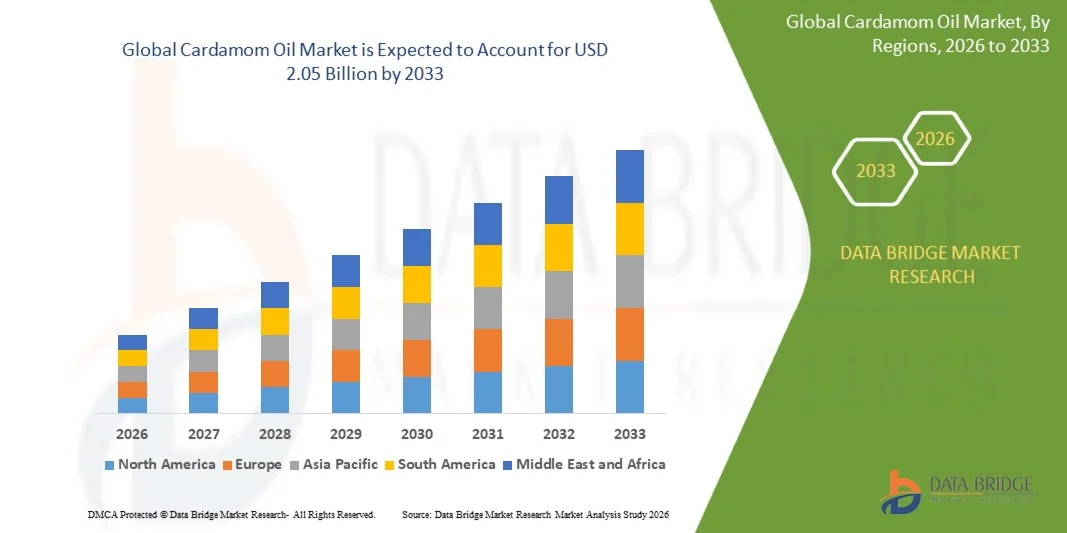
Report Scope and Cardamom Oil Market Segmentation
|
Attributes |
Cardamom Oil Key Market Insights |
|
Segments Covered |
· By Oil Type: Amomum Cardamom Oil and Elettaria Cardamom Oil · By Form: Absolute, Concentrates, and Blends · By Type: Organic and Conventional · By Functions: Antiseptic, Antimicrobial, Aphrodisiac, Astringent, Digestive, Stomachic, and Stimulant · By DistributionChannel: Direct and Indirect Sales Channels · By Application: Food and Beverages, Cosmetics and Personal Care, Pharmaceutical and Others |
|
Countries Covered |
North America · U.S. · Canada · Mexico Europe · Germany · France · U.K. · Netherlands · Switzerland · Belgium · Russia · Italy · Spain · Turkey · Rest of Europe Asia-Pacific · China · Japan · India · South Korea · Singapore · Malaysia · Australia · Thailand · Indonesia · Philippines · Rest of Asia-Pacific Middle East and Africa · Saudi Arabia · U.A.E. · South Africa · Egypt · Israel · Rest of Middle East and Africa South America · Brazil · Argentina · Rest of South America |
|
Key Market Players |
• Chr. Hansen Holding A/S (Denmark) • DSM (Netherlands) • DuPont (U.S.) • Evonik Industries AG (Germany) • Land O'Lakes, Inc. (U.S.) • Kerry Inc. (Ireland) • Novus International, Inc. (U.S.) • Novozymes A/S (Denmark) • Lesaffre (France) • Lallemand Inc. (Canada) • Alltech (U.S.) • Adisseo (France) • Asahi Group Holdings, Ltd. (Japan) • Unique Biotech Limited (India) • Vit-E-Men Company (U.S.) • Suguna Group (India) • Provita Eurotech Limited (India) • Protexin (U.K.) |
|
Market Opportunities |
• Expanding Demand For Natural And Organic Personal Care Products • Growing Utilization Of Essential Oils In Functional Foods And Nutraceutical Applications |
|
Value Added Data Infosets |
In addition to the insights on market scenarios such as market value, growth rate, segmentation, geographical coverage, and major players, the market reports curated by the Data Bridge Market Research also include in-depth expert analysis, pricing analysis, brand share analysis, consumer survey, demography analysis, supply chain analysis, value chain analysis, raw material/consumables overview, vendor selection criteria, PESTLE Analysis, Porter Analysis, and regulatory framework. |
Cardamom Oil Market Trends
Trend: Rising Adoption Of Natural Essential Oils In Wellness And Personal Care Applications
Growing consumer preference for natural, plant-derived, and chemical-free ingredients is significantly increasing the use of cardamom oil across personal care, wellness, aromatherapy, and functional health products. Synthetic fragrances and additives are facing increasing scrutiny due to concerns regarding potential skin irritation and long-term health impacts, encouraging manufacturers to incorporate natural essential oils into premium product formulations.
In personal care applications, manufacturers are increasingly utilizing cardamom oil in skincare products, perfumes, soaps, and haircare formulations due to its pleasant aroma and antimicrobial properties. For instance, luxury fragrance and cosmetic brands are introducing botanical ingredient-based product lines featuring essential oils to align with clean-label consumer preferences. In aromatherapy, cardamom oil is being used to support relaxation, respiratory wellness, and stress management, contributing to growing demand from wellness centers and spa facilities.
The rapid expansion of the global natural cosmetics and wellness industry is further supporting cardamom oil consumption. In addition, food and beverage manufacturers are increasingly incorporating cardamom oil into premium flavoring applications and herbal beverage formulations. Export data from major producing countries such as India and Guatemala during 2024 indicated continued growth in demand for cardamom-derived products, while premium essential oil manufacturers reported double-digit sales growth across wellness-focused product categories.
Cardamom Oil Market Dynamics
Key Market Driver: Growing Demand For Natural Flavors And Functional Ingredients
Consumers worldwide are increasingly seeking natural ingredients that offer both flavor enhancement and potential health benefits, creating strong demand for essential oils derived from spices and herbs. Cardamom oil is widely valued for its distinctive aroma, flavor profile, and therapeutic properties, making it an attractive ingredient across food, beverage, nutraceutical, and pharmaceutical applications.
Food and beverage manufacturers are increasingly incorporating cardamom oil into confectionery products, bakery items, herbal teas, flavored beverages, and functional foods to meet growing clean-label demand. For instance, premium beverage producers are introducing botanical-infused drinks containing natural spice extracts to appeal to health-conscious consumers. Pharmaceutical and nutraceutical companies are also utilizing cardamom oil in digestive health and respiratory wellness formulations due to its traditional medicinal associations.
Similarly, rising consumer awareness regarding natural wellness solutions is supporting increased utilization across dietary supplements and herbal healthcare products. Trade statistics indicate that global cardamom production exceeded 150,000 metric tons annually in recent years, while demand for natural flavoring ingredients continues to expand across North America, Europe, and Asia-Pacific.
Key Restraint/Challenge: Fluctuating Raw Material Supply And High Production Costs
The cardamom oil market remains highly dependent on agricultural production, making it vulnerable to weather conditions, crop diseases, and fluctuations in cardamom cultivation yields. Variations in rainfall patterns, temperature conditions, and pest infestations can significantly impact cardamom harvest volumes, creating supply uncertainties and price volatility across the value chain.
In addition, essential oil extraction requires specialized processing equipment and substantial quantities of raw cardamom, increasing production costs compared to synthetic alternatives. The labor-intensive nature of cardamom cultivation and harvesting further contributes to higher raw material expenses. These factors can limit affordability for manufacturers operating in price-sensitive markets and create margin pressures throughout the supply chain.
Market assessments indicate that cardamom prices have experienced periodic fluctuations exceeding 20–30% in key producing regions due to weather-related production variability. Such volatility directly influences cardamom oil pricing and creates procurement challenges for manufacturers requiring stable ingredient supplies.
Key Market Opportunity: Expansion Across Nutraceuticals And Premium Functional Food Products
The growing popularity of preventive healthcare, functional nutrition, and botanical wellness products is creating significant opportunities for cardamom oil manufacturers. Consumers are increasingly seeking natural ingredients that provide flavor, aroma, and perceived health benefits, driving demand across nutraceutical, dietary supplement, and functional food categories.
Manufacturers are increasingly exploring cardamom oil applications in herbal supplements, digestive health formulations, immunity-support products, and wellness beverages to differentiate premium product offerings. For instance, functional beverage brands are incorporating spice-derived essential oils into herbal drinks and wellness shots targeting health-conscious consumers. In food applications, cardamom oil is gaining traction as a natural flavor enhancer in premium confectionery, bakery, and specialty beverage products.
In addition, expanding research into plant-based bioactive compounds and increasing consumer spending on natural wellness solutions are creating new opportunities across developed and emerging markets. Product launches recorded during 2025 across Europe and Asia-Pacific demonstrated increasing incorporation of cardamom-derived ingredients into premium nutraceutical and functional food formulations, supporting broader commercialization opportunities for cardamom oil producers.
Cardamom Oil Market Scope
The market is segmented on the basis of oil type, form, type, functions, distribution channel, and application.
- By Oil Type
On the basis of oil type, the cardamom oil market is segmented into Amomum Cardamom Oil and Elettaria Cardamom Oil. The Elettaria Cardamom Oil segment held the largest market revenue share of approximately 71.4% in 2025 driven by its superior aroma profile, widespread use in food flavoring, aromatherapy, and premium personal care products. The oil is extensively derived from green cardamom and is highly preferred by manufacturers due to its consistent quality and strong consumer acceptance across global markets. Its pleasant flavor characteristics make it a preferred ingredient in beverages, confectionery products, bakery applications, and herbal wellness formulations. The increasing demand for premium-grade essential oils across North America and Europe continues to strengthen the segment's market position.
The Amomum Cardamom Oil segment is projected to register the fastest growth at a CAGR of 6.7% from 2026 to 2033, driven by increasing utilization in traditional medicine, herbal formulations, and specialty wellness products. Growing awareness regarding its therapeutic properties is supporting segment expansion. Rising adoption in Asia-Pacific healthcare products and growing research on medicinal plant extracts are contributing to market growth. The segment is also benefiting from increasing demand for natural ingredients used in functional foods and nutraceutical applications.
- By Form
On the basis of form, the cardamom oil market is segmented into Absolute, Concentrates, and Blends. The Concentrates segment accounted for the largest market revenue share of approximately 48.9% in 2025 driven by its extensive application across food and beverage processing, pharmaceutical formulations, and industrial flavoring products. Concentrated oils offer higher potency, longer shelf life, and ease of incorporation into commercial formulations. Manufacturers prefer concentrated cardamom oil due to lower transportation costs and greater formulation flexibility. The segment also benefits from increasing demand for high-intensity natural flavoring ingredients in premium food products.
The Blends segment is expected to witness the fastest growth at a CAGR of 7.2% from 2026 to 2033, driven by rising demand for customized aromatherapy products, wellness solutions, and premium fragrance formulations. Growing consumer preference for multifunctional essential oil combinations is accelerating segment growth. Blended products are increasingly utilized in spa therapies, massage oils, and personal wellness routines. The expansion of the global aromatherapy industry is creating additional opportunities for manufacturers specializing in essential oil blends.
- By Type
On the basis of type, the cardamom oil market is segmented into Organic and Conventional. The Conventional segment held the largest market revenue share of approximately 74.2% in 2025 driven by its widespread availability, lower production costs, and extensive use across large-scale food, beverage, and personal care manufacturing operations. Established supply chains and broader commercial adoption continue to support segment dominance. Conventional products remain highly preferred by industrial buyers due to their competitive pricing and stable year-round availability. Large-scale commercial production across major cardamom-producing countries further strengthens market leadership.
The Organic segment is projected to register the fastest growth at a CAGR of 8.1% from 2026 to 2033, driven by increasing consumer preference for clean-label products, growing demand for natural ingredients, and expanding organic certification programs worldwide. Rising premium product consumption is further supporting market expansion. Health-conscious consumers are increasingly seeking chemical-free and sustainably sourced essential oils. Growing retail availability of certified organic wellness products is also contributing to rising segment demand.
- By Functions
On the basis of functions, the cardamom oil market is segmented into Antiseptic, Antimicrobial, Aphrodisiac, Astringent, Digestive, Stomachic, and Stimulant. The Digestive segment accounted for the largest market revenue share of approximately 27.8% in 2025 driven by the long-established use of cardamom in digestive health applications, herbal remedies, and functional wellness products. Increasing consumer interest in natural digestive support solutions is contributing to segment growth. Cardamom oil is frequently incorporated into herbal supplements, digestive tonics, and traditional medicinal formulations. Rising awareness regarding gut health and preventive healthcare is further strengthening segment demand.
The Antimicrobial segment is expected to witness the fastest growth at a CAGR of 7.5% from 2026 to 2033, driven by increasing utilization of natural antimicrobial ingredients in personal care products, food preservation applications, and pharmaceutical formulations. Growing demand for plant-based bioactive ingredients is accelerating adoption. Manufacturers are increasingly exploring essential oils as alternatives to synthetic antimicrobial compounds. Expanding research into natural preservation technologies is expected to create additional growth opportunities for the segment.
- By Distribution Channel
On the basis of distribution channel, the cardamom oil market is segmented into Direct and Indirect Sales Channels. The Indirect Sales Channels segment held the largest market revenue share of approximately 66.5% in 2025 driven by the extensive presence of distributors, wholesalers, specialty retailers, and e-commerce platforms serving a broad customer base across multiple industries. Established distribution networks continue to support market penetration. Retail availability through health stores, supermarkets, and online platforms is increasing product accessibility globally. The segment also benefits from strong relationships between distributors and industrial buyers across food and cosmetic sectors.
The Direct Sales Channels segment is projected to register the fastest growth at a CAGR of 6.9% from 2026 to 2033, driven by increasing manufacturer-to-business transactions, growing preference for transparent sourcing, and rising adoption of direct procurement strategies among food, pharmaceutical, and cosmetics companies. Direct purchasing allows buyers to secure product quality and supply consistency. Increasing digital procurement platforms and business-to-business sales channels are further supporting market growth.
- By Application
On the basis of application, the cardamom oil market is segmented into Food and Beverages, Cosmetics and Personal Care, Pharmaceutical, and Others. The Food and Beverages segment accounted for the largest market revenue share of approximately 41.7% in 2025 driven by widespread utilization of cardamom oil as a natural flavoring ingredient in bakery products, confectionery, beverages, and functional foods. Growing consumer demand for clean-label and natural flavor solutions continues to support segment leadership. Manufacturers are increasingly replacing synthetic flavoring agents with natural spice-derived ingredients to meet changing consumer preferences. Rising demand for premium beverages and specialty food products is also contributing to market growth.
The Cosmetics and Personal Care segment is expected to witness the fastest growth at a CAGR of 7.8% from 2026 to 2033, driven by increasing incorporation of essential oils into skincare, haircare, fragrances, and wellness products. Rising demand for botanical-based beauty products and premium personal care formulations is accelerating segment expansion. Cardamom oil is valued for its aromatic, soothing, and antimicrobial properties, making it suitable for a wide range of cosmetic applications. The growing popularity of natural beauty and holistic wellness trends is expected to further strengthen demand throughout the forecast period.
Cardamom Oil Market Regional Analysis
North America Cardamom Oil Market Insight
North America dominated the cardamom oil market with the largest revenue share in 2025, supported by increasing consumer preference for natural ingredients, rising demand for essential oils, and growing adoption of clean-label food and personal care products. Consumers in the region highly value botanical-based wellness solutions, driving the incorporation of cardamom oil into dietary supplements, aromatherapy products, and premium cosmetic formulations. The growing popularity of natural flavoring agents in food and beverage applications, combined with rising awareness regarding the therapeutic benefits of essential oils, continues to strengthen market demand across the region.
U.S. Cardamom Oil Market Insight
The U.S. cardamom oil market captured the largest revenue share in 2025 within North America, fueled by strong demand for natural wellness products and increasing consumption of functional foods and beverages. Consumers are increasingly seeking plant-derived ingredients that support health and well-being, encouraging manufacturers to utilize cardamom oil across supplements, herbal products, and personal care formulations. The rapid expansion of aromatherapy practices, combined with growing demand for organic and clean-label products, is further contributing to market growth. Moreover, the presence of a well-established natural products industry continues to support adoption across multiple end-use sectors.
Europe Cardamom Oil Market Insight
The Europe cardamom oil market is expected to witness the fastest growth rate from 2026 to 2033, primarily driven by increasing demand for natural food ingredients, organic cosmetics, and plant-based wellness products. The region's strong focus on sustainability and clean-label product development is encouraging greater utilization of essential oils in food, pharmaceutical, and personal care applications. European consumers are increasingly attracted to botanical ingredients with functional benefits, supporting market expansion. The growing popularity of aromatherapy and herbal healthcare products is also contributing significantly to regional demand.
U.K. Cardamom Oil Market Insight
The U.K. cardamom oil market is expected to witness the fastest growth rate from 2026 to 2033, driven by rising consumer interest in natural wellness solutions and increasing demand for premium essential oils. Growing adoption of organic personal care products and functional beverages is creating favorable conditions for market expansion. In addition, increasing awareness regarding the therapeutic and aromatic properties of cardamom oil is encouraging its incorporation into skincare, aromatherapy, and dietary supplement products. The country's strong retail and e-commerce networks further support product accessibility and market growth.
Germany Cardamom Oil Market Insight
The Germany cardamom oil market is expected to witness the fastest growth rate from 2026 to 2033, fueled by increasing demand for natural healthcare products and botanical ingredients. Germany's strong herbal medicine tradition and well-developed natural products sector are encouraging greater utilization of cardamom oil in pharmaceutical, nutraceutical, and personal care applications. Consumers increasingly favor naturally sourced ingredients with proven functionality, supporting sustained market growth. The rising popularity of organic products and clean-label formulations is also accelerating adoption throughout the country.
Asia-Pacific Cardamom Oil Market Insight
The Asia-Pacific cardamom oil market is expected to witness the fastest growth rate from 2026 to 2033, supported by increasing disposable incomes, expanding food processing industries, and growing awareness regarding natural health products. The region benefits from the presence of major cardamom-producing countries and a long-standing tradition of utilizing spices and herbal ingredients in food and medicinal applications. Rising demand for premium essential oils, coupled with increasing urbanization and wellness spending, is supporting market development across Asia-Pacific.
Japan Cardamom Oil Market Insight
The Japan cardamom oil market is expected to witness the fastest growth rate from 2026 to 2033 due to growing demand for natural cosmetic ingredients, functional foods, and wellness products. Japanese consumers place significant emphasis on product quality, safety, and natural formulations, encouraging manufacturers to incorporate premium essential oils into consumer products. The increasing popularity of aromatherapy and relaxation-focused wellness solutions is further driving market demand. Moreover, growing interest in botanical ingredients for skincare and personal care applications continues to support industry expansion.
China Cardamom Oil Market Insight
The China cardamom oil market accounted for the largest market revenue share in Asia Pacific in 2025, attributed to the country's expanding consumer base, growing food and beverage industry, and increasing adoption of natural health products. China represents one of the largest markets for herbal ingredients and botanical extracts, creating substantial opportunities for cardamom oil manufacturers. The growing popularity of traditional herbal remedies, combined with rising demand for natural flavoring ingredients and personal care products, is supporting market growth. Strong manufacturing capabilities and expanding distribution networks continue to propel the cardamom oil market across the country.
Cardamom Oil Market Share
The Cardamom Oil industry is primarily led by well-established companies, including:
- Chr. Hansen Holding A/S (Denmark)
- DSM (Netherlands)
- DuPont (U.S.)
- Evonik Industries AG (Germany)
- Land O'Lakes, Inc. (U.S.)
- Kerry Inc. (Ireland)
- Novus International, Inc. (U.S.)
- Novozymes A/S (Denmark)
- Lesaffre (France)
- Lallemand Inc. (Canada)
- Alltech (U.S.)
- Adisseo (France)
- Asahi Group Holdings, Ltd. (Japan
- Unique Biotech Limited (India)
- Vit-E-Men Company (U.S.
- Suguna Group (India)
- Provita Eurotech Limited (India)
- Protexin (U.K.)
Latest Developments in Cardamom Oil Market
- In November 2025, AOS Products Pvt. Ltd., a manufacturer of natural essential oils, announced a strategic partnership with a leading organic farming cooperative to strengthen its cardamom sourcing network. The collaboration is aimed at ensuring a stable supply of premium-quality raw materials, improving traceability, and enhancing supply chain resilience. This development is expected to support consistent product quality and help meet the growing global demand for organic cardamom oil, thereby strengthening market competitiveness.
- In October 2025, Kumar Organic Products Ltd., a producer of botanical extracts and essential oils, launched a sustainably sourced cardamom oil range utilizing eco-friendly extraction technologies. The initiative is designed to reduce environmental impact while maintaining product purity and quality standards. The launch aligns with rising consumer preference for sustainable ingredients and is expected to encourage wider adoption of environmentally responsible practices across the cardamom oil industry.
- In September 2025, Essential Oils of New Zealand, a supplier of natural essential oils and botanical ingredients, expanded its distribution network across key Asian markets. The expansion is intended to improve product accessibility, strengthen regional customer engagement, and capture opportunities arising from increasing demand for natural wellness products. This move is expected to enhance market penetration and support overall growth of the cardamom oil market in Asia-Pacific.
- In 2024, doTERRA International, a global essential oils company, further expanded its Co-Impact Sourcing® program through direct collaboration with farming communities involved in spice cultivation, including cardamom-producing regions. The initiative focuses on ethical sourcing, supply chain transparency, and sustainable agricultural practices. This development strengthens raw material availability while supporting long-term sustainability and quality assurance across the global cardamom oil supply chain.
- In 2023, Aura Cacia, a provider of aromatherapy and essential oil products, enhanced its quality assurance and responsible sourcing programs for botanical oils, including cardamom oil. The company continued emphasizing third-party testing, traceability, and sustainable procurement practices to meet evolving consumer expectations. This approach is expected to strengthen consumer confidence in natural essential oil products and support market growth through higher product quality standards.
- In 2022, several leading essential oil manufacturers increased investments in advanced steam-distillation and extraction technologies for spice-derived oils, including cardamom oil. These investments were aimed at improving extraction efficiency, preserving active compounds, and enhancing production scalability. The development contributed to higher-quality product output, improved operational efficiency, and greater commercial availability of premium cardamom oil products in global markets.
SKU-
Get online access to the report on the World's First Market Intelligence Cloud

- Interactive Data Analysis Dashboard
- Company Analysis Dashboard for high growth potential opportunities
- Research Analyst Access for customization & queries
- Competitor Analysis with Interactive dashboard
- Latest News, Updates & Trend analysis
- Harness the Power of Benchmark Analysis for Comprehensive Competitor Tracking
Global Cardamom Oil Market, Supply Chain Analysis and Ecosystem Framework
To support market growth and help clients navigate the impact of geopolitical shifts, DBMR has integrated in-depth supply chain analysis into its Global Cardamom Oil Market research reports. This addition empowers clients to respond effectively to global changes affecting their industries. The supply chain analysis section includes detailed insights such as Global Cardamom Oil Market consumption and production by country, price trend analysis, the impact of tariffs and geopolitical developments, and import and export trends by country and HSN code. It also highlights major suppliers with data on production capacity and company profiles, as well as key importers and exporters. In addition to research, DBMR offers specialized supply chain consulting services backed by over a decade of experience, providing solutions like supplier discovery, supplier risk assessment, price trend analysis, impact evaluation of inflation and trade route changes, and comprehensive market trend analysis.
Research Methodology
Data collection and base year analysis are done using data collection modules with large sample sizes. The stage includes obtaining market information or related data through various sources and strategies. It includes examining and planning all the data acquired from the past in advance. It likewise envelops the examination of information inconsistencies seen across different information sources. The market data is analysed and estimated using market statistical and coherent models. Also, market share analysis and key trend analysis are the major success factors in the market report. To know more, please request an analyst call or drop down your inquiry.
The key research methodology used by DBMR research team is data triangulation which involves data mining, analysis of the impact of data variables on the market and primary (industry expert) validation. Data models include Vendor Positioning Grid, Market Time Line Analysis, Market Overview and Guide, Company Positioning Grid, Patent Analysis, Pricing Analysis, Company Market Share Analysis, Standards of Measurement, Global versus Regional and Vendor Share Analysis. To know more about the research methodology, drop in an inquiry to speak to our industry experts.
Customization Available
Data Bridge Market Research is a leader in advanced formative research. We take pride in servicing our existing and new customers with data and analysis that match and suits their goal. The report can be customized to include price trend analysis of target brands understanding the market for additional countries (ask for the list of countries), clinical trial results data, literature review, refurbished market and product base analysis. Market analysis of target competitors can be analyzed from technology-based analysis to market portfolio strategies. We can add as many competitors that you require data about in the format and data style you are looking for. Our team of analysts can also provide you data in crude raw excel files pivot tables (Fact book) or can assist you in creating presentations from the data sets available in the report.












