

Global Cardiac Monitoring Cardiac Rhythm Management Devices Market
Market Size in USD Billion
CAGR :
% 
 USD
26.94 Billion
USD
43.75 Billion
2025
2033
USD
26.94 Billion
USD
43.75 Billion
2025
2033
 Forecast Period Forecast Period |
2026 –2033 |
 Market Size (Base Year) Market Size (Base Year) |
USD 26.94 Billion |
 Market Size (Forecast Year) Market Size (Forecast Year) |
USD 43.75 Billion |
 CAGR CAGR |
% |
| Major Markets Players |
|
Cardiac Monitoring and Cardiac Rhythm Management Devices Market Size
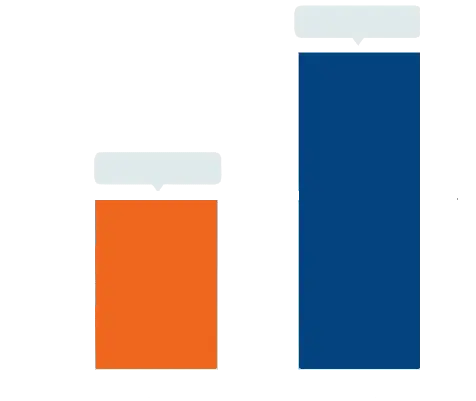
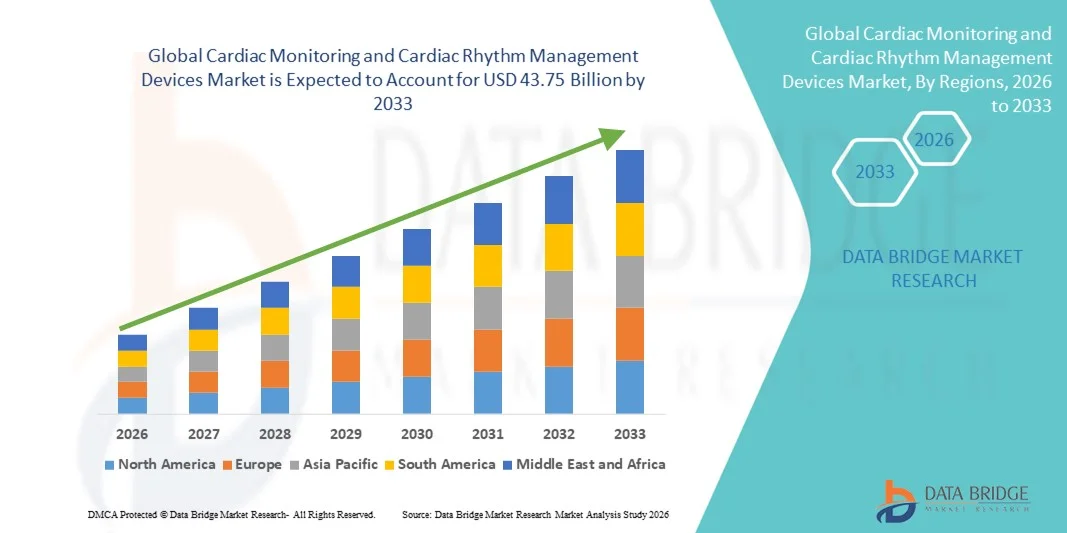
- The global cardiac monitoring and cardiac rhythm management devices market size was valued at USD 26.94 billion in 2025 and is expected to reach USD 43.75 billion by 2033, at a CAGR of 6.25% during the forecast period
- The market growth is largely fueled by the rising prevalence of cardiovascular diseases such as arrhythmias, heart failure, and coronary artery disease, along with the increasing geriatric population and growing demand for continuous and remote cardiac monitoring solutions. Technological advancements in wearable monitors, implantable loop recorders, pacemakers, and defibrillators are further driving innovation and adoption across hospitals and homecare settings
- Furthermore, increasing emphasis on early diagnosis, remote patient monitoring, and minimally invasive cardiac rhythm management procedures is establishing cardiac monitoring and cardiac rhythm management devices as essential components of modern cardiovascular care. These converging factors are accelerating the uptake of Cardiac Monitoring and Cardiac Rhythm Management Devices solutions, thereby significantly boosting overall market growth
Cardiac Monitoring and Cardiac Rhythm Management Devices Market Analysis
- Cardiac monitoring and cardiac rhythm management devices, including ECG monitors, Holter monitors, implantable loop recorders, pacemakers, and implantable cardioverter defibrillators (ICDs), are increasingly vital components of modern cardiovascular care across hospitals, specialty cardiac centers, and homecare settings due to their ability to enable continuous heart rhythm assessment, early detection of arrhythmias, and timely therapeutic intervention
- The escalating demand for cardiac monitoring and cardiac rhythm management devices is primarily fueled by the rising global burden of cardiovascular diseases, increasing geriatric population, growing adoption of remote patient monitoring technologies, and continuous technological advancements such as wearable cardiac monitors and MRI-compatible implantable devices
- North America dominated the Cardiac Monitoring and Cardiac Rhythm Management Devices market with the largest revenue share of 36.4% in 2025, characterized by advanced healthcare infrastructure, high adoption of implantable cardiac devices, favorable reimbursement policies, and strong presence of leading medical device manufacturers, with the U.S. accounting for a significant share of regional revenue
- Asia-Pacific is expected to be the fastest growing region in the Cardiac Monitoring and Cardiac Rhythm Management Devices market during the forecast period, driven by increasing prevalence of heart diseases, expanding healthcare access, rising healthcare expenditure, and growing awareness regarding early cardiac diagnosis in countries such as China, India, and Japan
- The Cardiac Rhythm Management (CRM) segment dominated the largest market revenue share of 58.4% in 2025, driven by the increasing prevalence of arrhythmias, heart failure, and sudden cardiac arrest cases globally
Report Scope and Cardiac Monitoring and Cardiac Rhythm Management Devices Market Segmentation
|
Attributes |
Cardiac Monitoring and Cardiac Rhythm Management Devices Key Market Insights |
|
Segments Covered |
|
|
Countries Covered |
North America
Europe
Asia-Pacific
Middle East and Africa
South America
|
|
Key Market Players |
|
|
Market Opportunities |
|
|
Value Added Data Infosets |
In addition to the insights on market scenarios such as market value, growth rate, segmentation, geographical coverage, and major players, the market reports curated by the Data Bridge Market Research also include in-depth expert analysis, patient epidemiology, pipeline analysis, pricing analysis, and regulatory framework. |
Cardiac Monitoring and Cardiac Rhythm Management Devices Market Trends
Rising Integration of AI and Remote Monitoring Capabilities
- A significant and accelerating trend in the global cardiac monitoring and cardiac rhythm management (CRM) Devices market is the deepening integration of artificial intelligence (AI), advanced analytics, and remote patient monitoring technologies into cardiac care solutions. This technological evolution is enhancing diagnostic accuracy, enabling real-time data interpretation, and improving clinical decision-making across hospitals and homecare settings
- For instance, leading cardiac monitoring systems now incorporate AI-driven algorithms capable of detecting arrhythmias, atrial fibrillation, and other abnormal heart rhythms with greater precision and reduced false positives. Implantable loop recorders and wearable ECG monitors are increasingly equipped with cloud connectivity, allowing physicians to remotely track patient heart activity and intervene proactively when irregular patterns are detected
- AI integration in cardiac rhythm management devices, such as pacemakers and implantable cardioverter defibrillators (ICDs), enables predictive analytics that can anticipate potential cardiac events based on patient-specific data trends. These intelligent systems help optimize therapy delivery, battery performance, and device programming while reducing unnecessary clinical visits
- The seamless connectivity of cardiac monitoring devices with hospital information systems and telehealth platforms facilitates centralized data access and coordinated care. Physicians can review patient data in real time, adjust treatment plans remotely, and provide timely interventions, particularly beneficial for elderly and high-risk populations
- This trend toward intelligent, connected, and data-driven cardiac care solutions is reshaping patient management strategies and improving long-term cardiovascular outcomes. Consequently, manufacturers are increasingly investing in AI-enabled monitoring platforms and cloud-based cardiac data management systems to strengthen their competitive positioning
- The demand for advanced cardiac monitoring and rhythm management devices with remote connectivity and AI-driven insights is growing rapidly across hospitals, ambulatory surgical centers, and home healthcare environments, as healthcare providers prioritize efficiency, early diagnosis, and personalized cardiac treatment
Cardiac Monitoring and Cardiac Rhythm Management Devices Market Dynamics
Driver
Growing Prevalence of Cardiovascular Diseases and Expanding Geriatric Population
- The increasing global prevalence of cardiovascular diseases (CVDs), including arrhythmias, heart failure, and coronary artery disease, is a primary driver for the cardiac monitoring and cardiac rhythm management devices market. Sedentary lifestyles, rising obesity rates, hypertension, and diabetes are significantly contributing to the growing burden of heart-related disorders worldwide
- For instance, the rising incidence of atrial fibrillation has substantially increased the demand for continuous ECG monitoring devices and implantable rhythm management systems to prevent complications such as stroke and heart failure. Hospitals and cardiac centers are increasingly adopting advanced monitoring technologies to enable early detection and timely therapeutic intervention
- In addition, the rapidly expanding geriatric population is further accelerating market growth, as elderly individuals are more susceptible to chronic cardiac conditions requiring long-term monitoring and device-based rhythm management. Pacemakers, implantable cardioverter defibrillators (ICDs), and cardiac resynchronization therapy (CRT) devices are increasingly utilized to manage age-related cardiac dysfunction
- Furthermore, advancements in minimally invasive implantation procedures and improvements in device longevity and battery life are encouraging higher adoption rates among patients and healthcare providers
- The expansion of healthcare infrastructure, increased awareness regarding early cardiac diagnosis, and supportive reimbursement frameworks in developed economies are further propelling demand for cardiac monitoring and CRM devices across both developed and emerging market
Restraint/Challenge
High Device Costs and Regulatory & Reimbursement Complexities
- The high initial cost associated with advanced cardiac monitoring and cardiac rhythm management devices presents a significant barrier to widespread adoption, particularly in low- and middle-income countries. Implantable devices such as ICDs and CRT systems involve substantial procedural and follow-up costs, limiting accessibility for cost-sensitive patient populations
- For instance, the overall cost of device implantation—including hospital stay, physician fees, and post-procedure monitoring—can be considerably high, making affordability a challenge in regions with limited reimbursement coverage
- Regulatory complexities and stringent approval processes for cardiac devices also pose challenges for manufacturers. These devices must meet rigorous clinical safety and efficacy standards, which can extend product development timelines and increase compliance costs
- Moreover, concerns related to device malfunction, battery depletion, and potential cybersecurity risks in connected cardiac monitoring systems may create hesitation among patients and healthcare providers. Ensuring robust data protection and long-term device reliability is essential to maintaining trust in advanced cardiac technologies
- Variability in reimbursement policies across different countries further impacts market penetration, as inconsistent coverage for advanced cardiac devices can limit patient access
- Overcoming these challenges through cost optimization, technological innovation to extend device lifespan, streamlined regulatory pathways, and improved reimbursement support will be critical for sustaining long-term growth in the cardiac monitoring and cardiac rhythm management devices market
Cardiac Monitoring and Cardiac Rhythm Management Devices Market Scope
The market is segmented on the basis of product type and end user.
- By Product Type
On the basis of product type, the Global Cardiac Monitoring and Cardiac Rhythm Management Devices Market is segmented into Cardiac Monitoring and Cardiac Rhythm Management (CRM). The Cardiac Rhythm Management (CRM) segment dominated the largest market revenue share of 58.4% in 2025, driven by the increasing prevalence of arrhythmias, heart failure, and sudden cardiac arrest cases globally. CRM devices such as pacemakers and implantable cardioverter defibrillators (ICDs) are widely adopted for long-term rhythm correction and life-saving interventions. The rising geriatric population significantly contributes to higher implantation rates. Technological advancements including MRI-compatible and leadless pacemakers strengthen demand. Growing awareness about early rhythm disorder management further accelerates adoption. Favorable reimbursement policies in developed countries support procedural volumes. Expansion of electrophysiology labs across hospitals enhances accessibility. Continuous innovation in battery longevity and remote monitoring integration boosts clinical efficiency. Increasing incidence of cardiovascular diseases worldwide sustains long-term demand. Strategic collaborations among device manufacturers and healthcare providers reinforce distribution. Regulatory approvals for next-generation CRM devices further enhance market penetration. These combined factors enabled CRM devices to maintain dominance in 2025.
The Cardiac Monitoring segment is anticipated to witness the fastest growth at a CAGR of 9.8% from 2026 to 2033, driven by rising demand for early diagnosis and continuous heart health tracking. Increasing adoption of wearable and remote cardiac monitoring devices supports expansion. Growing cases of atrial fibrillation and silent arrhythmias encourage routine monitoring. Technological advancements in portable ECG and Holter monitors improve diagnostic accuracy. Telecardiology services expand accessibility in remote and rural regions. Healthcare providers increasingly emphasize preventive cardiology programs. Rising patient preference for home-based monitoring accelerates uptake. Integration with smartphone applications enhances real-time data analysis. Expanding outpatient care models support monitoring device utilization. Government initiatives promoting cardiovascular screening programs strengthen demand. Increasing health awareness and lifestyle-related cardiac risks further drive growth. These factors collectively position cardiac monitoring as the fastest-growing product type segment.
- By End User
On the basis of end user, the Global Cardiac Monitoring and Cardiac Rhythm Management Devices Market is segmented into Ambulatory Centers, Home Care, Cardiac Centers, Hospitals, Clinics, and Others. The Hospitals segment accounted for the largest market revenue share of 46.9% in 2025, driven by high patient admissions for acute cardiac events and complex procedures. Hospitals are primary centers for pacemaker and ICD implantation surgeries. Availability of advanced catheterization laboratories supports CRM procedures. Skilled cardiologists and electrophysiologists strengthen procedural outcomes. Strong reimbursement structures enhance device procurement capacity. Rising emergency admissions for myocardial infarction and arrhythmias sustain utilization. Integration of advanced cardiac monitoring systems improves inpatient care. Expansion of tertiary healthcare infrastructure globally supports growth. Multidisciplinary cardiac teams ensure comprehensive treatment services. Increasing government funding for hospital modernization reinforces adoption. Large patient volumes in urban hospitals further sustain revenue contribution. These factors collectively enabled hospitals to dominate in 2025.
The Home Care segment is expected to witness the fastest growth at a CAGR of 10.6% from 2026 to 2033, fueled by the growing shift toward remote patient monitoring and decentralized healthcare delivery. Rising preference for home-based cardiac care improves patient comfort and compliance. Technological advancements in wearable ECG and implantable loop recorders enhance continuous monitoring. Increasing elderly population requiring chronic cardiac management accelerates demand. Telehealth integration enables real-time physician supervision. Cost-effectiveness compared to prolonged hospital stays supports adoption. Expanding insurance coverage for remote monitoring services strengthens uptake. Growing awareness regarding preventive heart health boosts device usage. Development of user-friendly monitoring systems enhances patient engagement. Increasing smartphone penetration supports connected cardiac devices. Government initiatives encouraging digital health transformation further drive expansion. These combined drivers position home care as the fastest-growing end-user segment during the forecast period.
Cardiac Monitoring and Cardiac Rhythm Management Devices Market Regional Analysis
- North America dominated the cardiac monitoring and cardiac rhythm management devices market with the largest revenue share of 36.4% in 2025, characterized by advanced healthcare infrastructure, high adoption of implantable cardiac devices, favorable reimbursement frameworks, and the strong presence of leading medical device manufacturers
- The region benefits from well-established cardiac care centers, widespread availability of electrophysiology labs, and early adoption of technologically advanced pacemakers, implantable cardioverter defibrillators (ICDs), and cardiac resynchronization therapy (CRT) devices
- The market accounts for a significant share of regional revenue, supported by a high prevalence of cardiovascular diseases, strong insurance coverage, continuous technological innovation, and robust investments in remote cardiac monitoring solutions, further strengthening North America’s leadership in the market
U.S. Cardiac Monitoring and Cardiac Rhythm Management Devices Market Insight
The U.S. cardiac monitoring and cardiac rhythm management devices market captured the largest revenue share within North America in 2025, driven by the country’s high burden of cardiovascular diseases and strong adoption of advanced implantable and wearable cardiac monitoring technologies. The presence of major medical device manufacturers, specialized cardiac hospitals, and experienced electrophysiologists contributes significantly to market growth. In addition, favorable reimbursement policies for pacemakers, ICDs, and remote monitoring services encourage patient adoption. The increasing use of ambulatory cardiac monitors, implantable loop recorders, and home-based cardiac monitoring systems is further expanding the market, particularly as healthcare providers focus on early diagnosis and long-term disease management.
Europe Cardiac Monitoring and Cardiac Rhythm Management Devices Market Insight
The Europe cardiac monitoring and cardiac rhythm management devices market is projected to expand at a substantial CAGR throughout the forecast period, supported by rising incidence of arrhythmias and heart failure, expanding geriatric population, and strong public healthcare systems. Countries such as Germany, the U.K., and France are witnessing increasing demand for advanced cardiac rhythm management devices due to improved awareness regarding early diagnosis and preventive cardiac care. In addition, supportive government healthcare initiatives and growing investments in hospital infrastructure are promoting the adoption of implantable and external cardiac monitoring systems across the region.
U.K. Cardiac Monitoring and Cardiac Rhythm Management Devices Market Insight
The U.K. cardiac monitoring and cardiac rhythm management devices market is anticipated to grow at a noteworthy CAGR during the forecast period, driven by increasing prevalence of cardiovascular disorders and strong emphasis on early cardiac screening programs. The country’s well-structured public healthcare system supports access to advanced diagnostic and therapeutic cardiac devices. Growing adoption of remote cardiac monitoring technologies and wearable ECG devices is enabling continuous patient monitoring outside hospital settings. Furthermore, rising investments in digital healthcare transformation and expansion of specialized cardiac care units are contributing to steady market growth in the U.K.
Germany Cardiac Monitoring and Cardiac Rhythm Management Devices Market Insight
The Germany cardiac monitoring and cardiac rhythm management devices market is expected to expand at a considerable CAGR during the forecast period, fueled by a high incidence of cardiac arrhythmias, advanced hospital infrastructure, and strong medical technology innovation. Germany’s well-established reimbursement framework and emphasis on high-quality cardiac treatment support the widespread adoption of implantable pacemakers, ICDs, and CRT devices. In addition, increasing focus on preventive cardiology and growing investments in research and development are accelerating the integration of advanced cardiac monitoring solutions in both hospital and outpatient settings.
Asia-Pacific Cardiac Monitoring and Cardiac Rhythm Management Devices Market Insight
The Asia-Pacific cardiac monitoring and cardiac rhythm management devices market is poised to grow at the fastest CAGR during the forecast period, driven by increasing prevalence of heart diseases, expanding healthcare access, rising healthcare expenditure, and growing awareness regarding early cardiac diagnosis. Rapid urbanization, lifestyle changes, and aging populations in countries such as China, India, and Japan are significantly contributing to the rising burden of cardiovascular disorders. Governments across the region are strengthening healthcare infrastructure and promoting access to advanced cardiac treatments, which is accelerating the adoption of monitoring and rhythm management devices.
Japan Cardiac Monitoring and Cardiac Rhythm Management Devices Market Insight
The Japan cardiac monitoring and cardiac rhythm management devices market is gaining momentum due to the country’s rapidly aging population and high life expectancy, which increase susceptibility to arrhythmias and heart failure. Japan’s advanced healthcare infrastructure and strong focus on technological innovation are encouraging the adoption of minimally invasive implantable cardiac devices and sophisticated monitoring systems. In addition, growing integration of remote patient monitoring platforms is supporting long-term cardiac disease management and reducing hospital readmissions.
China Cardiac Monitoring and Cardiac Rhythm Management Devices Market Insight
The China cardiac monitoring and cardiac rhythm management devices market accounted for the largest market revenue share in Asia Pacific in 2025, attributed to the country’s large patient population, rising cardiovascular disease burden, and expanding healthcare infrastructure. Increasing government initiatives to improve cardiac care services and expand insurance coverage are enhancing patient access to advanced monitoring and implantable devices. Moreover, growing domestic manufacturing capabilities, rising healthcare investments, and improving awareness regarding early cardiac diagnosis are significantly propelling market growth in China.
Cardiac Monitoring and Cardiac Rhythm Management Devices Market Share
The Cardiac Monitoring and Cardiac Rhythm Management Devices industry is primarily led by well-established companies, including:
- Medtronic (Ireland)
- Abbott (U.S.)
- Boston Scientific Corporation (U.S.)
- BIOTRONIK SE & Co. KG (Germany)
- Koninklijke Philips N.V. (Netherlands)
- GE HealthCare Technologies Inc. (U.S.)
- Siemens Healthineers AG (Germany)
- MicroPort Scientific Corporation (China)
- LivaNova PLC (U.K.)
- iRhythm Technologies, Inc. (U.S.)
- ZOLL Medical Corporation (U.S.)
- Nihon Kohden Corporation (Japan)
- Hill-Rom Holdings, Inc. (U.S.)
- Lepu Medical Technology (Beijing) Co., Ltd. (China)
- Cardiac Science Corporation (U.S.)
Latest Developments in Global Cardiac Monitoring and Cardiac Rhythm Management Devices Market
- In March 2024, Abbott received CE mark approval in Europe for its Assert-IQ insertable cardiac monitor (ICM), which enables long-term remote monitoring of irregular heart rhythms, including atrial fibrillation, for up to six years, representing a significant advancement in continuous cardiac monitoring technology
- In April 2025, MicroPort CRM received CE mark approval for its SmartView Connect app (Android), enabling Bluetooth-equipped pacemakers, ICDs, and CRT-D devices to securely transmit data from patients’ devices to healthcare clinics through a smartphone, removing the requirement of a bedside monitor and facilitating more flexible remote monitoring
- In August 2025, Cardiosense’s CardioTag wearable heart monitor received FDA clearance, offering a noninvasive device capable of capturing ECG, PPG, and SCG signals simultaneously and supporting AI-driven tools for improved heart failure management outside traditional care settings
- In July 2025, Boston Scientific received FDA approval for expanded labeling of its FARAPULSE Pulsed Field Ablation (PFA) System for treatment of drug-refractory persistent atrial fibrillation, reflecting the broadening of minimally invasive rhythm management technologies for complex arrhythmia care
- In April 2025, Boston Scientific completed the acquisition of Preventice Solutions, a digital health company specializing in remote patient monitoring systems, strengthening its portfolio for cardiac rhythm management and expanding capabilities in long-term mobile and wearable cardiac monitoring
- In May 2025, Siemens Healthineers received FDA approval for its new MRI-conditional cardiac resynchronization therapy defibrillator (Cardeas Tarasys G3), enabling patients with implanted CRM devices to safely undergo MRI scans for diagnostic imaging, improving clinical flexibility and care pathways
SKU-
Get online access to the report on the World's First Market Intelligence Cloud

- Interactive Data Analysis Dashboard
- Company Analysis Dashboard for high growth potential opportunities
- Research Analyst Access for customization & queries
- Competitor Analysis with Interactive dashboard
- Latest News, Updates & Trend analysis
- Harness the Power of Benchmark Analysis for Comprehensive Competitor Tracking
Research Methodology
Data collection and base year analysis are done using data collection modules with large sample sizes. The stage includes obtaining market information or related data through various sources and strategies. It includes examining and planning all the data acquired from the past in advance. It likewise envelops the examination of information inconsistencies seen across different information sources. The market data is analysed and estimated using market statistical and coherent models. Also, market share analysis and key trend analysis are the major success factors in the market report. To know more, please request an analyst call or drop down your inquiry.
The key research methodology used by DBMR research team is data triangulation which involves data mining, analysis of the impact of data variables on the market and primary (industry expert) validation. Data models include Vendor Positioning Grid, Market Time Line Analysis, Market Overview and Guide, Company Positioning Grid, Patent Analysis, Pricing Analysis, Company Market Share Analysis, Standards of Measurement, Global versus Regional and Vendor Share Analysis. To know more about the research methodology, drop in an inquiry to speak to our industry experts.
Customization Available
Data Bridge Market Research is a leader in advanced formative research. We take pride in servicing our existing and new customers with data and analysis that match and suits their goal. The report can be customized to include price trend analysis of target brands understanding the market for additional countries (ask for the list of countries), clinical trial results data, literature review, refurbished market and product base analysis. Market analysis of target competitors can be analyzed from technology-based analysis to market portfolio strategies. We can add as many competitors that you require data about in the format and data style you are looking for. Our team of analysts can also provide you data in crude raw excel files pivot tables (Fact book) or can assist you in creating presentations from the data sets available in the report.