




Global Cardiovascular Repair And Reconstruction Market
Market Size in USD Billion
CAGR :
% 
 USD
4.74 Billion
USD
7.72 Billion
2025
2033
USD
4.74 Billion
USD
7.72 Billion
2025
2033
 Forecast Period Forecast Period |
2026 - 2033 |
 Market Size (Base Year) Market Size (Base Year) |
USD 4.74 Billion |
 Market Size (Forecast Year) Market Size (Forecast Year) |
USD 7.72 Billion |
 CAGR CAGR |
% |
| Major Markets Players |
|
Cardiovascular Repair and Reconstruction Market Overview
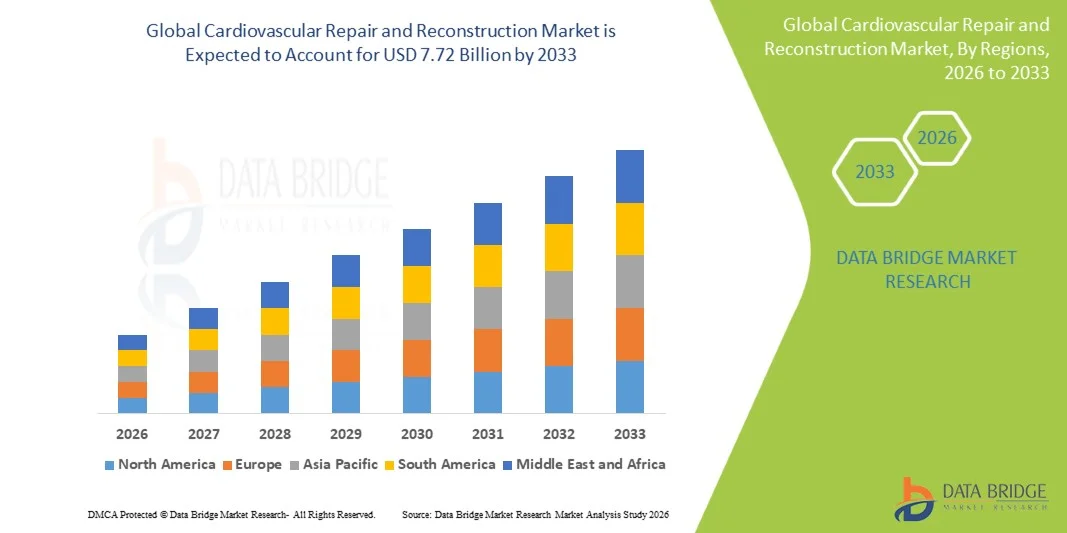
The Cardiovascular Repair and Reconstruction Market was valued at USD 4.74 billion in 2025 and is projected to reach USD 7.72 billion by 2033, growing at a CAGR of 6.30% from 2026 to 2033. The market is witnessing steady expansion driven by the rising prevalence of cardiovascular diseases, increasing demand for minimally invasive and transcatheter procedures, and continuous advancements in biomaterials and surgical technologies.
The growing burden of congenital heart defects, valvular heart diseases, and vascular disorders worldwide, combined with an aging population and lifestyle-related risk factors such as hypertension and diabetes, is significantly boosting the demand for cardiovascular repair and reconstruction solutions. Hospitals and cardiac centers are increasingly adopting advanced heart valve repair systems, vascular grafts, and bioengineered patches to improve surgical outcomes, reduce recovery time, and enhance long-term patient survival rates.
Key Market Trends & Insights
- North America dominated the Cardiovascular Repair and Reconstruction Market with the largest revenue share of 38.6% in 2025, supported by advanced cardiac care infrastructure, high adoption of minimally invasive surgeries, and strong presence of leading medical device companies.
- The Heart Valve Repair segment led the market with a 44.2% share in 2025, driven by the high prevalence of valvular heart diseases and increasing adoption of advanced procedures such as transcatheter aortic valve replacement (TAVR).
- Asia-Pacific is expected to be the fastest-growing region from 2026 to 2033, growing at a CAGR of 7.9%, fueled by rising cardiovascular disease burden, improving healthcare access, expanding cardiac surgery centers, and increasing medical tourism in countries such as India, China, and Thailand.
- Cardiovascular Grafts are the fastest-growing product type, projected to register a CAGR of 7.2%, reflecting the surge in demand for bypass surgeries, aneurysm repair, and peripheral vascular reconstruction procedures.
- The Adults segment dominated the application category with a 86.5% revenue share in 2025, led by high incidence of cardiovascular diseases in the adult and elderly population.
- Synthetic Materials accounted for 38.7% of the market, preferred by their wide availability, cost-effectiveness, and durability in vascular graft and patch applications.
- The Biological Materials segment is the fastest-growing material type category, with a CAGR of 7.5%, driven by increasing demand for biocompatible and low-rejection cardiovascular implants.
Market Size & Forecast
- Global Market Value (2025): USD 4.74 Billion
- Expected Market Value (2033): USD 7.72 Billion
- Forecast CAGR (2026–2033): 6.30%
- Leading Region in 2025: North America
- Fastest Growing Region: Asia Pacific
Report Scope and Cardiovascular Repair and Reconstruction Market Segmentation
|
Attributes |
Cardiovascular Repair and Reconstruction Key Market Insights |
|
Segments Covered |
|
|
Countries Covered |
North America · U.S. · Canada · Mexico Europe · Germany · France · U.K. · Netherlands · Switzerland · Belgium · Russia · Italy · Spain · Turkey · Rest of Europe Asia-Pacific · China · Japan · India · South Korea · Singapore · Malaysia · Australia · Thailand · Indonesia · Philippines · Rest of Asia-Pacific Middle East and Africa · Saudi Arabia · U.A.E. · South Africa · Egypt · Israel · Rest of Middle East and Africa South America · Brazil · Argentina · Rest of South America |
|
Key Market Players |
· Medtronic (Ireland) · Abbott (U.S.) · Stryker (U.S.) · Edwards Lifesciences Corporation (U.S.) · Boston Scientific Corporation (U.S.) · Artivion, Inc. (U.S.) · Terumo Corporation (Japan) · LivaNova PLC (U.K.) · Getinge AB (Sweden) · W. L. Gore & Associates, Inc. (U.S.) · CryoLife Inc. (U.S.) · B. Braun SE (Germany) · Cardinal Health, Inc. (U.S.) · Sorin Group (Italy) · JOTEC GmbH (Germany) · Cook Medical LLC (U.S.) · Johnson & Johnson Services, Inc. (U.S.) · MicroPort Scientific Corporation (China) · LeMaitre Vascular, Inc. (U.S.) · SHL Medical AG (Switzerland) |
|
Market Opportunities |
· Rising adoption of transcatheter and minimally invasive cardiac repair procedures · Growing use of bioengineered and tissue-engineered vascular grafts · Expansion of cardiac care infrastructure in emerging economies |
|
Value Added Data Infosets |
In addition to the insights on market scenarios such as market value, growth rate, segmentation, geographical coverage, and major players, the market reports curated by the Data Bridge Market Research also include in-depth expert analysis, patient epidemiology, pipeline analysis, pricing analysis, and regulatory framework. |
Cardiovascular Repair and Reconstruction Market Trends
Trend: Growth in Minimally Invasive and Transcatheter Cardiac Repair
Minimally invasive and transcatheter cardiovascular procedures are increasingly being adopted to reduce surgical trauma, hospital stay, and post-operative complications in high-risk cardiac patients. Advanced technologies such as transcatheter valve replacement and catheter-based vascular repair are improving procedural precision and expanding treatment eligibility for elderly and comorbid populations. Hospitals and cardiac centers are integrating hybrid operating rooms and real-time imaging systems to support complex interventions, while clinical training programs are shifting toward catheter-based skill development and simulation-guided practice. For instance, widespread adoption of transcatheter aortic valve replacement (TAVR) platforms and catheter-based mitral repair systems in major cardiac centers demonstrates this transformation in surgical practice.
Cardiovascular Repair and Reconstruction Market Dynamics
Key Market Driver: Rising Prevalence of Cardiovascular and Structural Heart Diseases
The increasing global burden of cardiovascular diseases, including valvular disorders, congenital heart defects, and vascular diseases, is significantly driving demand for cardiovascular repair and reconstruction solutions. Aging populations, sedentary lifestyles, and rising incidence of hypertension and diabetes are contributing to higher rates of structural heart damage requiring surgical or interventional correction. Healthcare systems are expanding cardiac care capacity, while medical device companies are innovating advanced grafts, valves, and patches to address complex cases. For instance, growing surgical volumes for aortic valve replacement and congenital septal defect repairs in aging populations highlight this sustained demand.
Key Restraint/Challenge: High Cost and Complexity of Advanced Cardiac Repair Procedures
A major restraint in the cardiovascular repair and reconstruction market is the high cost associated with advanced surgical procedures and specialized implantable devices. Complex operations such as valve reconstruction, vascular graft implantation, and hybrid cardiac surgeries require expensive infrastructure, skilled specialists, and long hospital stays. Reimbursement limitations in developing regions further restrict patient access to advanced treatment options. For instance, limited affordability of bioengineered vascular grafts and transcatheter valve systems in low- and middle-income countries illustrates the adoption barrier for cost-sensitive healthcare systems.
Key Market Opportunity: Expansion of Bioengineered and Next-Generation Tissue Repair Solutions
The growing focus on regenerative medicine and tissue engineering presents a significant opportunity for the cardiovascular repair and reconstruction market. Innovations in bioengineered grafts, tissue scaffolds, and regenerative cardiac patches are enabling improved healing, reduced rejection rates, and longer-lasting repair outcomes. Integration of advanced biomaterials and personalized implant technologies is expected to transform long-term cardiovascular treatment strategies. For instance, increasing clinical use of decellularized heart valves and bioresorbable vascular scaffolds in specialized cardiac centers highlights the shift toward next-generation repair solutions.
Cardiovascular Repair and Reconstruction Market Scope
The cardiovascular repair and reconstruction market is segmented on the basis of product type, application, and material type.
- By Product Type
On the basis of product type, the Cardiovascular Repair and Reconstruction Market is segmented into heart valve repair, cardiovascular grafts, and cardiovascular patches. The Heart Valve Repair segment dominated the market with the largest share of 44.2% in 2025, owing to the high prevalence of valvular heart diseases and increasing adoption of advanced procedures such as transcatheter aortic valve replacement (TAVR). This segment benefits from strong clinical preference for minimally invasive valve correction over open-heart replacement in elderly and high-risk patients. Continuous innovation in bioprosthetic and mechanical valve technologies is further strengthening its dominance. Rising healthcare expenditure and expansion of cardiac surgery centers are also supporting adoption. Increasing procedural volumes in both developed and emerging economies continue to reinforce its leadership position. The segment remains central to structural heart disease treatment pathways.
The Cardiovascular Grafts segment is expected to witness the fastest growth at a CAGR of 7.2% from 2026 to 2033, driven by rising demand for bypass surgeries, aneurysm repair, and peripheral vascular reconstruction procedures. These grafts are increasingly used in patients with severe vascular occlusions and end-stage arterial diseases. Technological advancements in synthetic and bioengineered graft materials are improving long-term patency rates. Growing prevalence of diabetes and peripheral artery disease is significantly expanding the patient pool. Surge in complex cardiovascular surgeries in aging populations is further boosting demand. Increasing preference for minimally invasive vascular repair techniques is also accelerating adoption.
- By Application
On the basis of application, the Cardiovascular Repair and Reconstruction Market is segmented into babies and adults. The Adults segment dominated the market with the largest share of 86.5% in 2025, primarily due to the high incidence of cardiovascular diseases in the adult and elderly population. Conditions such as coronary artery disease, valvular dysfunction, and vascular degeneration are most prevalent in this age group. Rising lifestyle-related risk factors such as hypertension, obesity, and diabetes further contribute to segment dominance. Adults also undergo a higher number of surgical interventions compared to pediatric patients. Expanding access to advanced cardiac care in hospitals and specialty clinics is strengthening procedural volumes. The segment benefits from continuous innovation in adult cardiac surgical techniques and implantable devices.
The Babies (Pediatric) segment is expected to witness the fastest growth at a CAGR of 6.8% from 2026 to 2033, driven by increasing diagnosis of congenital heart defects at early stages. Improved neonatal screening and diagnostic imaging are enabling earlier intervention and treatment. Advances in pediatric cardiac surgery and specialized implantable devices are improving survival rates. Rising awareness among parents and healthcare providers is supporting early treatment adoption. Growth in pediatric cardiac care infrastructure in emerging economies is further boosting demand. Increasing availability of child-specific cardiovascular patches and grafts is also enhancing treatment outcomes.
- By Material Type
On the basis of material type, the Cardiovascular Repair and Reconstruction Market is segmented into synthetic materials, biological materials, and hybrid materials. The Synthetic Materials segment dominated the market with the largest share of 38.7% in 2025, owing to their wide availability, cost-effectiveness, and durability in vascular graft and patch applications. Materials such as PTFE and Dacron are extensively used in bypass surgeries and vascular reconstruction procedures. Their long shelf life and mechanical strength make them suitable for high-pressure vascular environments. Hospitals prefer synthetic options due to consistent performance and ease of handling. Continuous improvements in polymer engineering are enhancing their biocompatibility. The segment remains widely adopted in both developed and cost-sensitive healthcare markets.
The Biological Materials segment is expected to witness the fastest growth at a CAGR of 7.5% from 2026 to 2033, driven by increasing demand for biocompatible and low-rejection cardiovascular implants. These materials, derived from bovine, porcine, or human tissue, offer superior integration with native cardiac structures. Growing preference for natural tissue-based valves and patches is accelerating adoption. Reduced risk of thrombosis and improved long-term outcomes are key advantages. Advances in tissue preservation and decellularization techniques are improving durability. Expanding use in valve repair and congenital heart defect correction is further supporting growth.
Cardiovascular Repair and Reconstruction Market Regional Analysis
North America dominated the Cardiovascular Repair and Reconstruction Market with the largest revenue share of 38.6% in 2025, supported by advanced cardiac care infrastructure, high adoption of minimally invasive surgeries, and strong presence of leading medical device companies. The region benefits from high prevalence of cardiovascular diseases, favorable reimbursement policies, and rapid integration of next-generation heart valve repair and vascular graft technologies. Continuous innovation in transcatheter therapies and bioengineered implants is further strengthening clinical adoption. The presence of specialized cardiac centers and skilled cardiothoracic surgeons is enhancing procedural volumes. Increasing investment in structural heart disease treatment and digital surgical solutions continues to reinforce regional dominance in the global market.
U.S. Cardiovascular Repair and Reconstruction Market Insight
The U.S. cardiovascular repair and reconstruction market is witnessing strong growth due to high prevalence of cardiovascular diseases, advanced cardiac care infrastructure, and rapid adoption of minimally invasive and transcatheter procedures. The country benefits from strong presence of leading medical device companies, extensive clinical research activities, and favorable reimbursement systems supporting complex cardiac surgeries. Increasing use of next-generation heart valve repair systems, vascular grafts, and bioengineered patches is driving procedural volumes across hospitals and specialty cardiac centers. In addition, rising investments in structural heart disease programs and precision-based cardiac interventions are accelerating market expansion.
Europe Cardiovascular Repair and Reconstruction Market Insight
The Europe cardiovascular repair and reconstruction market remains a major contributor to global revenue, driven by strong healthcare systems, stringent regulatory standards, and high adoption of advanced cardiac surgical technologies. The region has widespread use of heart valve repair devices, vascular reconstruction techniques, and tissue-based implants across well-established cardiac centers. Increasing focus on minimally invasive procedures and aging population-related cardiac conditions is further supporting market growth. In addition, strong government support for medical innovation and growing adoption of bioengineered cardiovascular products are enhancing treatment outcomes across the region.
U.K. Cardiovascular Repair and Reconstruction Market Insight
The U.K. cardiovascular repair and reconstruction market is experiencing steady growth, supported by increasing burden of cardiovascular diseases and strong adoption of advanced cardiac surgical procedures. The National Health Service (NHS) plays a key role in expanding access to heart valve repair and vascular reconstruction treatments. Growing use of minimally invasive and catheter-based interventions is improving patient recovery outcomes. Furthermore, rising investment in cardiac research, digital surgery, and next-generation implantable devices is strengthening the country’s position in cardiovascular innovation.
Germany Cardiovascular Repair and Reconstruction Market Insight
The Germany cardiovascular repair and reconstruction market is expanding steadily due to strong medical engineering capabilities, advanced hospital infrastructure, and high adoption of innovative cardiac treatment technologies. The country has a strong focus on surgical precision and bioengineering, supporting widespread use of vascular grafts and heart valve repair systems. Increasing cases of cardiovascular diseases among the aging population are further driving demand for reconstruction procedures. In addition, continuous advancements in biomaterials and minimally invasive surgical techniques are enhancing clinical efficiency and patient outcomes.
Asia-Pacific Cardiovascular Repair and Reconstruction Market Insight
The Asia-Pacific cardiovascular repair and reconstruction market is expected to witness rapid growth, driven by rising cardiovascular disease burden, improving healthcare infrastructure, and increasing access to advanced cardiac care. Countries such as China, India, and Japan are investing heavily in cardiac surgery centers and minimally invasive treatment technologies. Growing awareness of early diagnosis and treatment of heart diseases is boosting procedural volumes across hospitals. In addition, increasing adoption of cost-effective vascular grafts and heart valve repair solutions is accelerating market expansion in the region.
Japan Cardiovascular Repair and Reconstruction Market Insight
The Japan cardiovascular repair and reconstruction market is witnessing consistent growth due to its aging population, high prevalence of heart diseases, and strong adoption of advanced medical technologies. The country is a leader in minimally invasive cardiac surgery and bioengineered implant development. Hospitals and research institutions are increasingly using transcatheter valve repair systems and advanced vascular reconstruction techniques. Moreover, integration of precision medicine and robotic-assisted surgical technologies is further improving clinical outcomes and procedural efficiency.
China Cardiovascular Repair and Reconstruction Market Insight
The China cardiovascular repair and reconstruction market is growing rapidly, driven by rising urbanization, increasing prevalence of cardiovascular diseases, and expanding healthcare infrastructure. Government initiatives to improve cardiac care accessibility and strengthen hospital networks are significantly boosting demand for advanced surgical procedures. Growing adoption of heart valve repair devices, vascular grafts, and cardiovascular patches is accelerating market penetration. In addition, increasing investments in domestic medical device manufacturing and clinical innovation are positioning China as one of the fastest-growing markets globally.
Cardiovascular Repair and Reconstruction Market Share
The cardiovascular repair and reconstruction industry is primarily led by well-established companies, including:
- Medtronic (Ireland)
- Abbott (U.S.)
- Stryker (U.S.)
- Edwards Lifesciences Corporation (U.S.)
- Boston Scientific Corporation (U.S.)
- Artivion, Inc. (U.S.)
- Terumo Corporation (Japan)
- LivaNova PLC (U.K.)
- Getinge AB (Sweden)
- L. Gore & Associates, Inc. (U.S.)
- CryoLife Inc. (U.S.)
- Braun SE (Germany)
- Cardinal Health, Inc. (U.S.)
- Sorin Group (Italy)
- JOTEC GmbH (Germany)
- Cook Medical LLC (U.S.)
- Johnson & Johnson Services, Inc. (U.S.)
- MicroPort Scientific Corporation (China)
- LeMaitre Vascular, Inc. (U.S.)
- SHL Medical AG (Switzerland)
Latest Developments in Cardiovascular Repair and Reconstruction Market
- In February 2024, Edwards Lifesciences announced the U.S. FDA approval of its EVOQUE transcatheter tricuspid valve replacement system, marking a major advancement in minimally invasive treatment for tricuspid regurgitation. The system is designed to replace the native tricuspid valve without open-heart surgery, significantly expanding treatment options for high-risk patients with severe heart valve disease. This approval strengthens Edwards’ leadership in structural heart therapies and reflects the growing shift toward transcatheter valve repair and replacement solutions
- In April 2023, Abbott announced U.S. FDA approval of its TriClip transcatheter edge-to-edge repair (TEER) system for treating tricuspid regurgitation, expanding its structural heart portfolio. The device enables minimally invasive repair of the tricuspid valve in patients who are often ineligible for open-heart surgery. This development highlights the increasing clinical adoption of catheter-based valve repair technologies and reinforces Abbott’s role in advancing heart valve innovation
- In January 2023, Artivion announced that its AMDS Hybrid Prosthesis System received FDA Humanitarian Device Exemption (HDE) approval for the treatment of acute type A aortic dissection. The system combines surgical grafting with endovascular technology to improve survival outcomes in complex aortic repair cases. This milestone underscores growing innovation in hybrid cardiovascular reconstruction solutions for life-threatening vascular conditions
- In March 2022, W. L. Gore & Associates announced FDA clearance for its GORE TAG Conformable Thoracic Stent Graft with ACTIVE CONTROL System, enhancing treatment for thoracic aortic aneurysms and dissections. The system allows improved precision in deployment and better conformability to complex aortic anatomies. This development reflects increasing innovation in endovascular graft technologies and minimally invasive vascular repair procedures
- In January 2021, Medtronic announced U.S. FDA approval of its Harmony Transcatheter Pulmonary Valve (TPV) system, designed for patients with congenital heart disease requiring right ventricular outflow tract repair. The device enables a minimally invasive alternative to open-heart surgery, improving recovery outcomes and reducing procedural risk. This approval highlights Medtronic’s continued expansion in structural heart and congenital cardiac repair technologies
SKU-
Get online access to the report on the World's First Market Intelligence Cloud

- Interactive Data Analysis Dashboard
- Company Analysis Dashboard for high growth potential opportunities
- Research Analyst Access for customization & queries
- Competitor Analysis with Interactive dashboard
- Latest News, Updates & Trend analysis
- Harness the Power of Benchmark Analysis for Comprehensive Competitor Tracking
Research Methodology
Data collection and base year analysis are done using data collection modules with large sample sizes. The stage includes obtaining market information or related data through various sources and strategies. It includes examining and planning all the data acquired from the past in advance. It likewise envelops the examination of information inconsistencies seen across different information sources. The market data is analysed and estimated using market statistical and coherent models. Also, market share analysis and key trend analysis are the major success factors in the market report. To know more, please request an analyst call or drop down your inquiry.
The key research methodology used by DBMR research team is data triangulation which involves data mining, analysis of the impact of data variables on the market and primary (industry expert) validation. Data models include Vendor Positioning Grid, Market Time Line Analysis, Market Overview and Guide, Company Positioning Grid, Patent Analysis, Pricing Analysis, Company Market Share Analysis, Standards of Measurement, Global versus Regional and Vendor Share Analysis. To know more about the research methodology, drop in an inquiry to speak to our industry experts.
Customization Available
Data Bridge Market Research is a leader in advanced formative research. We take pride in servicing our existing and new customers with data and analysis that match and suits their goal. The report can be customized to include price trend analysis of target brands understanding the market for additional countries (ask for the list of countries), clinical trial results data, literature review, refurbished market and product base analysis. Market analysis of target competitors can be analyzed from technology-based analysis to market portfolio strategies. We can add as many competitors that you require data about in the format and data style you are looking for. Our team of analysts can also provide you data in crude raw excel files pivot tables (Fact book) or can assist you in creating presentations from the data sets available in the report.












