What is the Cartoning Food Packaging Market Size and Growth Rate?
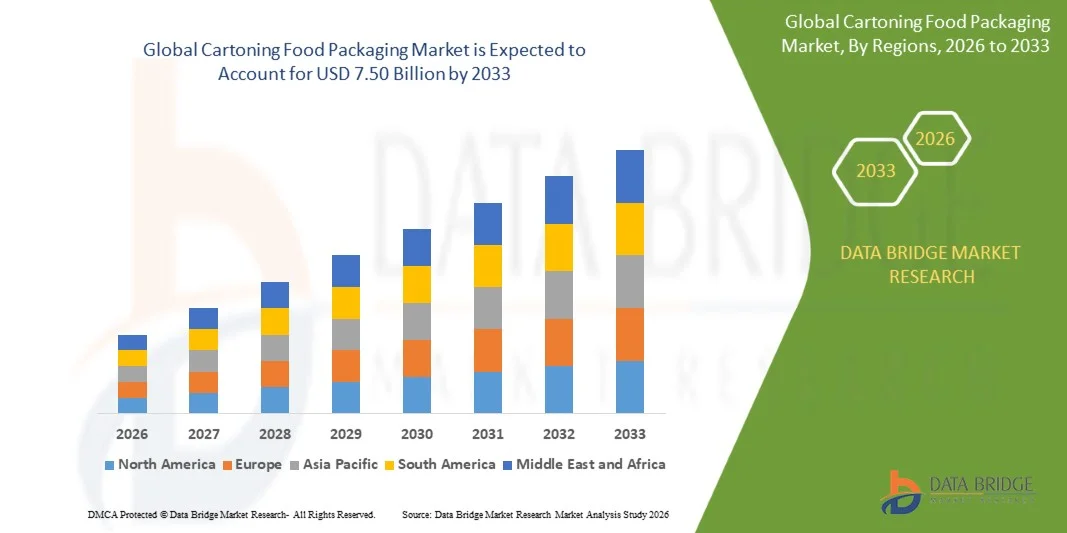
- As per Data Bridge Market Research analysis, the cartoning food packaging market was valued at USD 4.53 billion in 2025 and is projected to reach USD 7.50 billion by 2033, growing at a CAGR of 6.50% from 2026 to 2033.
- The market is expanding steadily on the back of persistent labour shortages on food packaging floors, the shift from plastic wrap toward paperboard and recyclable carton formats, rising demand for packaged, frozen, and ready-to-eat foods, and the arrival of modular, software-enabled cartoning platforms that make automation accessible to a wider range of food producers.
- Cartoning food packaging refers to the machinery and integrated systems that form, erect, load, close, and seal cartons around food products, including horizontal side-load cartoners, vertical end-load and topload cartoners, wrap-around and tray-forming machines, and robotic cartoning lines. Used as secondary packaging downstream of flow wrappers, bagging machines, and filling equipment, cartoners give food brands shelf-ready, tamper-evident, and printable packs for products such as cereals, snacks, confectionery, frozen meals, and dairy. Their commercial relevance is increasingly tied to flexibility, with manufacturers demanding fast format changeovers, robotic product handling, and digital line monitoring rather than simple mechanical speed.
Market Size & Forecast
- Global Market Value (2025): USD 4.53 Billion
- Expected Market Value (2033): USD 7.50 Billion
- Forecast CAGR (2026–2033): 6.50%
- Leading Region in 2025: Europe
- Fastest Growing Region: North America
What are the Major Takeaways of the Cartoning Food Packaging Market?
- Europe dominated the global cartoning food packaging market with the largest revenue share of 35.64% in 2025, supported by the concentration of the world’s leading cartoning machine builders in Germany and Italy, a mature food manufacturing base, and strong regional momentum toward recyclable paperboard packaging.
- North America is expected to be the fastest-growing region at a CAGR of 7.6% from 2026 to 2033, driven by labour-saving automation investment, the conversion of food packs from plastic to paperboard, and active introduction of new modular cartoning platforms to the region by leading European suppliers.
- The horizontal cartoning machines segment led the machine type category with a 44.38% share in 2025, owing to its proven suitability for high-speed packaging of cereals, confectionery, bakery items, and dairy products, and its ability to handle multiple carton styles with fast changeovers.
- The fully automatic segment is expected to witness the fastest CAGR of 7.1% from 2026 to 2033, driven by labour shortages and the availability of compact, modular automatic cartoners aimed at small and mid-sized producers.
- The 60–150 cartons per minute segment dominated the market with a share of 46.52% in 2025, as it matches the output needs of the majority of mid-volume food lines across bakery, dairy, snack, and frozen food production.
- The standard paperboard/folding cartons segment dominated the market with a share of 61.84% in 2025, reflecting its established use across cereals, confectionery, bakery, and frozen food packaging and the broad installed base of machines designed around it.
- The co-packers & contract packagers segment is expected to witness the fastest CAGR of 7.6% from 2026 to 2033, driven by food brands outsourcing packaging operations and by co-packers’ need for flexible cartoners capable of running many SKUs and carton formats with rapid changeovers.
Report Scope and Cartoning Food Packaging Market Segmentation
|
Attributes |
Cartoning Food Packaging Key Market Insights |
|
Segments Covered |
|
|
Countries Covered |
North America
Europe
Asia-Pacific
Middle East and Africa
South America
|
|
Key Market Players |
|
|
Market Opportunities |
|
|
Value Added Data Infosets |
In addition to the insights on market scenarios such as market value, growth rate, segmentation, geographical coverage, and major players, the market reports curated by the Data Bridge Market Research also include in-depth expert analysis, pricing analysis, brand share analysis, consumer survey, demography analysis, supply chain analysis, value chain analysis, raw material/consumables overview, vendor selection criteria, PESTLE Analysis, Porter Analysis, and regulatory framework. |
What is the Key Trend in the Cartoning Food Packaging Market?
- Cartoning food packaging manufacturers are increasingly adopting modular, software-enabled systems that integrate cartoning, robotics, and digital monitoring into scalable packaging lines. These systems enable food producers to expand automation capabilities, accommodate new carton formats, and upgrade existing equipment without replacing entire production lines.
- For instance, in March 2026, Syntegon highlighted its neXt food packaging architecture ahead of interpack 2026, featuring integrated packaging technologies, robotic automation, and digital solutions designed to improve production flexibility and operational efficiency.
- This trend is driven by the need for faster format changes, reduced operator workload, improved production flexibility, and lower downtime as food manufacturers manage increasing product variety, labour shortages, and operational efficiency requirements.
- For instance, in May 2026, when Coesia showcased integrated packaging solutions at interpack 2026, including a bars-in-box line combining wrapping, cartoning, case packing, and robotic palletizing. The solution incorporated equipment from ACMA, R.A. Jones, MGS, and FlexLink, demonstrating the growing emphasis on integrated and automated packaging lines.
- As modular equipment, robotic handling, digital monitoring, and faster format changeovers become increasingly important, flexibility and automation are expected to remain key competitive trends in the cartoning food packaging market throughout the forecast period.
What are the Key Drivers of the Cartoning Food Packaging Market?
- Persistent labour shortages and rising labour costs across food manufacturing are encouraging producers to adopt automated cartoning systems that reduce manual carton erecting, loading, and closing while improving packaging consistency, production efficiency, and throughput.
- Growing demand for sustainable packaging is encouraging food manufacturers to transition from conventional plastic packaging toward recyclable, fibre-based paperboard cartons. This shift is creating opportunities for cartoning equipment manufacturers across food categories, including dairy products, frozen foods, snacks, and ready-to-eat meals.
- For instance, in August 2026, Graphic Packaging Holding Company reported that innovation sales growth in its Americas Paperboard Packaging business was supported by customer adoption of sustainable consumer packaging solutions, with innovation sales increasing by USD 40 million during the second quarter of 2026. This demonstrates continued demand for innovative paperboard packaging formats.
- Packaging machinery suppliers are expanding integrated production-line offerings that combine primary packaging, cartoning, case packing, and automation, enabling food manufacturers to streamline operations and improve line efficiency.
- For instance, in September 2026, Syntegon announced a North American premiere of its integrated bag-to-case line, combining the SVX Agile vertical bagger with the Elematic 4001 gravity case packer.
- Increasing automation, sustainability-driven packaging conversions, and the availability of integrated packaging solutions are expected to support steady growth in the cartoning food packaging market throughout the forecast period.
What Factors are Challenging the Growth of the Cartoning Food Packaging Market?
- Cartoning systems require substantial capital investment and ongoing maintenance, particularly for high-speed, automated production lines, limiting adoption among small and medium-sized food manufacturers.
- For instance, in March 2026, Sonoco Products Company announced a USD 70-per-ton price increase for uncoated recycled paperboard, effective April 3, 2026, highlighting rising packaging material costs.
- Rising paperboard, labor, and equipment costs further pressure packaging budgets, while extended machinery delivery timelines can delay production expansion and equipment replacement. These financial and operational constraints may encourage manufacturers to postpone upgrades or choose lower-cost alternatives, moderating market growth.
- Supplier and customer margins are also under pressure from input costs, as carton converters reported lower pricing and higher commodity and labour cost inflation in the second quarter of 2026, a backdrop that can make food producers more selective about packaging capital spending.
- The combination of high capital and maintenance costs, extended equipment lead times, a widening gap between premium and value-tier machinery, and cost inflation across the packaging supply chain continues to moderate adoption among smaller producers, keeping market growth steady rather than rapid.
How is the Cartoning Food Packaging Market Segmented?
The cartoning food packaging market is segmented on the basis of machine type, operation mode, speed, packaging material, food application, end user and sales channel.
- By Machine Type
On the basis of machine type, the global cartoning food packaging market is segmented into horizontal (side-load) cartoning machines, vertical (end-load & topload) cartoning machines, wrap-around & tray-forming machines, and integrated cartoning & robotic lines. The horizontal cartoning machines segment dominated the market with a 44.38% share in 2025, owing to its proven suitability for high-speed packaging of cereals, confectionery, bakery items, and dairy products, and its ability to handle multiple carton styles with fast changeovers.
The integrated cartoning & robotic lines segment is projected to record the fastest growth at a CAGR of 8.6% from 2026 to 2033, driven by rising demand for turnkey lines that combine cartoning with robotic pick-and-place, case packing, and digital monitoring, reducing manual handling and the number of separate suppliers food manufacturers must coordinate.
- By Operation Mode
On the basis of operation mode, the global cartoning food packaging market is segmented into fully automatic and semi-automatic. The fully automatic segment dominated the market with a share of 78.26% in 2025, reflecting food manufacturers’ efforts to reduce dependence on manual labour, improve pack consistency, and sustain high throughput on continuous production lines.
The fully automatic segment is also expected to witness the fastest CAGR of 7.1% from 2026 to 2033, driven by labour shortages and the availability of compact, modular automatic cartoners aimed at small and mid-sized producers, while the semi-automatic segment is expected to grow at a more modest CAGR of 3.2%, retaining a role in low-volume and specialty food production.
- By Speed
On the basis of speed, the global cartoning food packaging market is segmented into up to 60 cartons per minute, 60–150 cartons per minute, and above 150 cartons per minute. The 60–150 cartons per minute segment dominated the market with a share of 46.52% in 2025, as it matches the output needs of the majority of mid-volume food lines across bakery, dairy, snack, and frozen food production.
The above 150 cartons per minute segment is expected to witness the fastest CAGR of 7.8% from 2026 to 2033, driven by large food manufacturers consolidating production onto fewer, faster lines and by continued servo-drive and robotic infeed advances that raise achievable speeds without sacrificing format flexibility.
- By Packaging Material
On the basis of packaging material, the global cartoning food packaging market is segmented into standard paperboard/folding cartons, barrier-coated & recyclable paperboard, and corrugated fiberboard. The standard paperboard/folding cartons segment dominated the market with a share of 61.84% in 2025, reflecting its established use across cereals, confectionery, bakery, and frozen food packaging and the broad installed base of machines designed around it.
The barrier-coated & recyclable paperboard segment is expected to witness the fastest CAGR of 9.3% from 2026 to 2033, driven by regulatory and retailer pressure to replace plastic wrap and plastic-laminated packs with recyclable fibre-based cartons, which in turn requires machines able to handle new board grades, coatings, and glue or lock-closure systems.
- By Food Application
On the basis of food application, the global cartoning food packaging market is segmented into bakery & confectionery, dairy products, frozen & chilled foods, snacks & cereals, meat, poultry & seafood, and ready meals. The bakery & confectionery segment dominated the market with a share of 27.63% in 2025, supported by the category’s heavy reliance on printed, shelf-ready cartons for gift, multipack, and impulse formats.
The frozen & chilled foods segment is expected to witness the fastest CAGR of 8.2% from 2026 to 2033, driven by growing consumption of frozen meals and chilled convenience foods and by the introduction of line solutions engineered specifically for frozen food, where cartoning must run reliably in cold, moisture-prone environments.
- By End User
On the basis of end user, the global cartoning food packaging market is segmented into large food manufacturers, mid-size & regional producers, and co-packers & contract packagers. The large food manufacturers segment dominated the market with a share of 57.28% in 2025, reflecting their scale of production, standardized multi-site line investment, and preference for high-speed, fully integrated systems from global suppliers.
The co-packers & contract packagers segment is expected to witness the fastest CAGR of 7.6% from 2026 to 2033, driven by food brands outsourcing packaging operations and by co-packers’ need for flexible cartoners capable of running many SKUs and carton formats with rapid changeovers.
- By Sales Channel
On the basis of sales channel, the global cartoning food packaging market is segmented into direct OEM sales, distributors & system integrators, and used & refurbished equipment dealers. The direct OEM sales segment dominated the market with a share of 63.45% in 2025, reflecting the engineering-intensive, custom-configured nature of cartoning lines, which typically require close collaboration between machine builders and food manufacturers.
The distributors & system integrators segment is expected to witness the fastest CAGR of 7.3% from 2026 to 2033, driven by smaller food producers adopting compact, modular cartoners through local integrators who combine machines from several suppliers into complete packaging lines.
Which Region Holds the Largest Share of the Cartoning Food Packaging Market?
- Europe dominated the cartoning food packaging market and accounted for the largest revenue share of 35.64% in 2025, supported by the concentration of leading cartoning machine builders in Germany and Italy, a mature and export-oriented food manufacturing base, and strong regional momentum toward recyclable, fibre-based food packaging.
- The region also benefits from deep engineering expertise and long-standing relationships between machine builders and multinational food brands, with European premium builders dominating high-speed, fully integrated cartoning lines. Continued investment in modular platforms and paperboard-ready machinery is expected to reinforce Europe’s leadership through the forecast period.
Germany Cartoning Food Packaging Market Insight
The Germany cartoning food packaging market holds a leading position within Europe, underpinned by the presence of several of the world’s principal cartoning and secondary packaging specialists, including Syntegon, Schubert, Optima, and Körber, and by a large food and confectionery manufacturing sector. German suppliers are at the forefront of modular, robot-integrated packaging architectures, and the country serves as a primary engineering and innovation base for machines later introduced into North American and Asian markets.
Italy Cartoning Food Packaging Market Insight
The Italy cartoning food packaging market is supported by a dense cluster of packaging machinery builders, including IMA Group, Marchesini Group, and Cama Group, alongside a strong domestic food industry. Italian suppliers are known for high-speed, precisely engineered cartoning systems, and are expanding their food-focused offers beyond their traditional pharmaceutical strength as brand owners seek flexible, high-quality secondary packaging.
North America Cartoning Food Packaging Market Insight
The North America cartoning food packaging market is expected to witness the fastest growth globally, driven by labour-saving automation investment, the conversion of food packs from plastic to paperboard, and the region’s role as a launch market for new platforms. PACK EXPO International 2026, taking place in Chicago from October 18 to 21 and described as the largest packaging and processing event in North America, is serving as the introduction point for several new European cartoning and secondary packaging systems, while domestic builders such as Econocorp and Bartelt continue to offer right-sized, quickly delivered machines for mid-volume food lines.
U.S. Cartoning Food Packaging Market Insight
The U.S. cartoning food packaging market is experiencing steady growth, driven by rising demand for convenient, sustainable, and shelf-ready packaging solutions. Increasing consumption of packaged foods, ready-to-eat meals, dairy products, and frozen foods is supporting market expansion. Manufacturers are adopting recyclable paperboard cartons, automation, and advanced printing technologies to enhance efficiency and product appeal. Growing environmental awareness, regulatory pressures, and e-commerce developments are further encouraging innovation, positioning sustainable cartoning solutions as a key industry priority.
Canada Cartoning Food Packaging Market Insight
The Canada cartoning food packaging market is witnessing steady growth, driven by increasing demand for convenient, sustainable, and cost-effective packaging solutions. Rising consumption of packaged foods, dairy products, frozen meals, and ready-to-eat products is supporting market expansion. Manufacturers are increasingly adopting recyclable paperboard cartons, innovative designs, and automated packaging technologies to improve efficiency and product protection. Growing environmental awareness, sustainability initiatives, and demand for eco-friendly materials are encouraging innovation, strengthening the market outlook for advanced cartoning solutions.
Which are the Top Companies in Cartoning Food Packaging Market?
The cartoning food packaging industry is primarily led by well-established companies, including:
- Syntegon Technology GmbH (Germany)
- IMA Group S.p.A. (Italy)
- Marchesini Group S.p.A. (Italy)
- ProMach, Inc. (U.S.)
- Coesia S.p.A. (R.A Jones) (Italy)
- Gerhard Schubert GmbH (Germany)
- OPTIMA packaging group GmbH (Germany)
- Körber AG (Germany)
- Uhlmann Group (Germany)
- Barry-Wehmiller Companies, Inc. (Bartelt) (U.S.)
- Econocorp, Inc. (U.S.)
- Delkor Systems, Inc. (U.S.)
- ADCO Manufacturing (U.S.)
- Multivac Group (Germany)
- Rovema GmbH (Germany)
- ULMA Packaging, S. Coop. (Spain)
- Cama Group (Italy)
- Bradman Lake Group (U.K.)
- Mpac Group plc (U.K.)
- Jacob White Packaging Ltd (U.K.)
- Ishida Co., Ltd. (Japan)
- Fuji Machinery Co., Ltd. (Japan)
- Omori Machinery Co., Ltd. (Japan)
- ACG Worldwide (India)
- Nichrome India Ltd. (India)
- Tisma Machinery Technology Co., Ltd. (China)
What are Latest Developments in Cartoning Food Packaging Market?
- In September 2026, SOMIC Packaging announced that it would introduce its SOMIC 202 cartoner to North American customers at PACK EXPO International 2026. Designed to handle regular slotted containers, trays, and wraparound cartons at speeds of up to 20 packs per minute, the compact machine features tool-free format changeovers and improved machine accessibility, expanding automated cartoning options for smaller production operations.
- In March 2026, Bartelt Packaging announced that it would showcase its BIC-S cartoner integrated with INVpack stickpack technology at interpack 2026 in Düsseldorf, Germany. The system automatically transfers stickpacks into cartons at speeds of up to 60 cartons per minute, demonstrating how integrated primary and secondary packaging equipment can reduce manual handling and streamline food packaging operations.
- In April 2026, ProMach announced its acquisition of Evolution BPS, a UK-based packaging equipment and engineering services provider. Earlier, on January 9, 2026, ProMach acquired American Holt, DMA Solution, and Pride Engineering from Arcline Investment Management. These acquisitions expanded ProMach’s equipment and service capabilities across food, beverage, and consumer packaged goods markets.
- In September 2026, Bartelt announced that it would showcase cartoning systems, integrated packaging lines, and large-format bagging solutions at PACK EXPO International 2026, scheduled for October 18–21 in Chicago. The event highlights continued investment in integrated packaging automation and end-of-line efficiency.
- In September 2026, Syntegon announced two North American premieres for PACK EXPO International 2026: an integrated bag-to-case line combining its SVX Agile vertical bagger with the Elematic 4001 gravity case packer, and a new corner-seal capability for the SVX Agile that supports premium bag styles at speeds of up to 120 bags per minute.
- Interactive Data Analysis Dashboard
- Company Analysis Dashboard for high growth potential opportunities
- Research Analyst Access for customization & queries
- Competitor Analysis with Interactive dashboard
- Latest News, Updates & Trend analysis
- Harness the Power of Benchmark Analysis for Comprehensive Competitor Tracking
Global Cartoning Food Packaging Market, Supply Chain Analysis and Ecosystem Framework
To support market growth and help clients navigate the impact of geopolitical shifts, DBMR has integrated in-depth supply chain analysis into its Global Cartoning Food Packaging Market research reports. This addition empowers clients to respond effectively to global changes affecting their industries. The supply chain analysis section includes detailed insights such as Global Cartoning Food Packaging Market consumption and production by country, price trend analysis, the impact of tariffs and geopolitical developments, and import and export trends by country and HSN code. It also highlights major suppliers with data on production capacity and company profiles, as well as key importers and exporters. In addition to research, DBMR offers specialized supply chain consulting services backed by over a decade of experience, providing solutions like supplier discovery, supplier risk assessment, price trend analysis, impact evaluation of inflation and trade route changes, and comprehensive market trend analysis.
Data collection and base year analysis are done using data collection modules with large sample sizes. The stage includes obtaining market information or related data through various sources and strategies. It includes examining and planning all the data acquired from the past in advance. It likewise envelops the examination of information inconsistencies seen across different information sources. The market data is analysed and estimated using market statistical and coherent models. Also, market share analysis and key trend analysis are the major success factors in the market report. To know more, please request an analyst call or drop down your inquiry.
The key research methodology used by DBMR research team is data triangulation which involves data mining, analysis of the impact of data variables on the market and primary (industry expert) validation. Data models include Vendor Positioning Grid, Market Time Line Analysis, Market Overview and Guide, Company Positioning Grid, Patent Analysis, Pricing Analysis, Company Market Share Analysis, Standards of Measurement, Global versus Regional and Vendor Share Analysis. To know more about the research methodology, drop in an inquiry to speak to our industry experts.
Data Bridge Market Research is a leader in advanced formative research. We take pride in servicing our existing and new customers with data and analysis that match and suits their goal. The report can be customized to include price trend analysis of target brands understanding the market for additional countries (ask for the list of countries), clinical trial results data, literature review, refurbished market and product base analysis. Market analysis of target competitors can be analyzed from technology-based analysis to market portfolio strategies. We can add as many competitors that you require data about in the format and data style you are looking for. Our team of analysts can also provide you data in crude raw excel files pivot tables (Fact book) or can assist you in creating presentations from the data sets available in the report.