




Global Cerium Oxide Nanoparticles Market
Market Size in USD Billion
CAGR :
% 
 USD
1.04 Billion
USD
3.57 Billion
2025
2033
USD
1.04 Billion
USD
3.57 Billion
2025
2033
 Forecast Period Forecast Period |
2026 –2033 |
 Market Size (Base Year) Market Size (Base Year) |
USD 1.04 Billion |
 Market Size (Forecast Year) Market Size (Forecast Year) |
USD 3.57 Billion |
 CAGR CAGR |
% |
| Major Markets Players |
|
What is the Global Cerium Oxide Nanoparticles Market Size and Growth Rate?
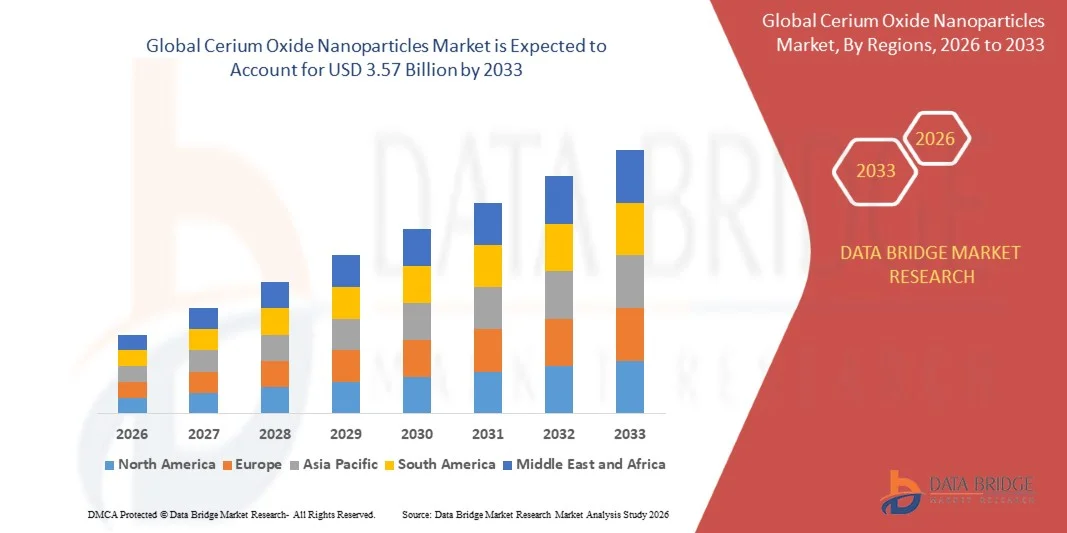
- The global cerium oxide nanoparticles market size was valued at USD 1.04 billion in 2025 and is expected to reach USD 3.57 billion by 2033, at a CAGR of 16.70% during the forecast period
- The rising focus of government on nanotechnology research will influence the growth rate of the cerium oxide nanoparticles market. The upsurge in the demand from semiconductor and healthcare industry is the key elements driving market expansion
- Along with this, rising use of cerium oxide nanoparticles in number of applications will increase the demand for the cerium oxide nanoparticles market. The cerium oxide nanoparticles market is also being driven by significant factors such as the upsurge in the level of disposable income and increasing industrialization. Furthermore, surging use of polishing agent will enhance the growth rate of cerium oxide nanoparticles market
What are the Major Takeaways of Cerium Oxide Nanoparticles Market?
- The rising awareness about bio-relevant properties and its applications in biomedical and catalytic processes will act as major factors influencing the growth of cerium oxide nanoparticles market. The advancement in technologies and high demand of these nanoparticles for the treatment of various diseases will have positive impact on the growth rate of cerium oxide nanoparticles market
- Moreover, expansion of end-user industries and rising government spending on pharmaceutical R&D activities in emerging nations will create beneficial opportunities for the growth of the cerium oxide nanoparticles market. In addition, potential of nanoceria to be utilized in medical application as an antioxidant and environmentally friendly synthesis of nanoceria will provide lucrative opportunities for market’s growth
- North America dominated the cerium oxide nanoparticles market with a 34.6% revenue share in 2025, driven by strong demand from the automotive, semiconductor, biomedical, and energy storage sectors across the U.S. and Canada
- Asia-Pacific is projected to register the fastest CAGR of 8.14% from 2026 to 2033, driven by rapid expansion in electronics manufacturing, automotive production, renewable energy infrastructure, and nanotechnology research across China, Japan, India, and South Korea
- The Powder segment dominated the market with a 61.7% share in 2025, as it remains the most widely used form across catalysts, polishing agents, coatings, and energy storage applications
Report Scope and Cerium Oxide Nanoparticles Market Segmentation
|
Attributes |
Cerium Oxide Nanoparticles Key Market Insights |
|
Segments Covered |
|
|
Countries Covered |
North America
Europe
Asia-Pacific
Middle East and Africa
South America
|
|
Key Market Players |
|
|
Market Opportunities |
|
|
Value Added Data Infosets |
In addition to the insights on market scenarios such as market value, growth rate, segmentation, geographical coverage, and major players, the market reports curated by the Data Bridge Market Research also include in-depth expert analysis, pricing analysis, brand share analysis, consumer survey, demography analysis, supply chain analysis, value chain analysis, raw material/consumables overview, vendor selection criteria, PESTLE Analysis, Porter Analysis, and regulatory framework. |
What is the Key Trend in the Cerium Oxide Nanoparticles Market?
“Increasing Shift Toward High-Performance Applications in Energy Storage and Biomedical Sectors”
- The cerium oxide nanoparticles market is witnessing strong adoption across energy storage, catalytic converters, semiconductor polishing, and biomedical applications due to its superior redox and oxygen storage properties
- Manufacturers are increasingly focusing on high-purity, application-specific nanoceria formulations to improve performance in batteries, fuel cells, CMP slurries, and advanced coatings
- Growing demand for compact, lightweight, and high-efficiency materials is driving adoption across automotive, electronics, healthcare, and renewable energy industries
- For instance, companies such as Cerion, Inframat, NYACOL, and PlasmaChem are expanding their nanoparticle portfolios for applications in drug delivery, UV-resistant coatings, and fuel cell systems
- Rising need for advanced semiconductor polishing and catalytic emission control is accelerating the shift toward high-performance cerium oxide nanoparticles
- As industries increasingly prioritize miniaturization, durability, and energy efficiency, cerium oxide nanoparticles will remain vital for next-generation industrial and medical innovations
What are the Key Drivers of Cerium Oxide Nanoparticles Market?
- Rising demand for high-performance catalytic materials in the automotive industry to meet stricter global emission standards is a major growth driver
- For instance, in 2025–2026, increasing investments in EV batteries, fuel cells, and grid-scale energy storage systems significantly boosted demand for nanoceria-based materials
- Growing adoption across consumer electronics, semiconductors, renewable energy systems, and biomedical research is supporting market expansion across the U.S., Europe, and Asia-Pacific
- Advancements in nanoparticle synthesis, purity enhancement, and surface functionalization have strengthened product efficiency and broadened application areas
- Rising use in chemical mechanical planarization (CMP), antioxidant therapies, and solar cell technologies is creating strong long-term demand
- Supported by steady investments in nanotechnology R&D, semiconductor manufacturing, and clean energy infrastructure, the Cerium Oxide Nanoparticles market is expected to witness strong growth over the forecast period
Which Factor is Challenging the Growth of the Cerium Oxide Nanoparticles Market?
- High costs associated with advanced nanoparticle production, purification, and surface modification technologies restrict adoption among small-scale manufacturers and research institutes
- For instance, during 2024–2025, fluctuations in rare earth raw material prices and supply chain disruptions increased overall production costs for several vendors
- Complexity in maintaining particle size uniformity, dispersion stability, and application-specific purity levels increases the need for advanced manufacturing expertise
- Limited awareness in emerging markets regarding the industrial and biomedical advantages of cerium oxide nanoparticles slows market penetration
- Competition from alternative nanomaterials such as zinc oxide, titanium dioxide, and silica nanoparticles create pricing pressure and reduces differentiation
- To address these issues, companies are focusing on cost-optimized synthesis methods, strategic partnerships, and expanded R&D investments to improve global adoption
How is the Cerium Oxide Nanoparticles Market Segmented?
The market is segmented on the basis of form, application, and synthesis method.
• By Form
On the basis of form, the Cerium Oxide Nanoparticles market is segmented into Powder and Dispersion. The Powder segment dominated the market with a 61.7% share in 2025, as it remains the most widely used form across catalysts, polishing agents, coatings, and energy storage applications. Powder-based cerium oxide nanoparticles offer high stability, easier storage, longer shelf life, and better compatibility with industrial-scale processing systems. Their extensive use in automotive catalysts, semiconductor polishing, and fuel additives continues to support segment dominance across global manufacturing industries.
The Dispersion segment is expected to grow at the fastest CAGR from 2026 to 2033, driven by rising demand in biomedical formulations, personal care products, precision coatings, and CMP slurries. Increasing adoption in liquid-based formulations, nanomedicine, and advanced surface treatment applications is accelerating growth, as dispersions provide improved particle uniformity, easier application, and enhanced process efficiency across end-use industries.
• By Application
On the basis of application, the market is segmented into Catalyst, Chemical Mechanical Planarization (CMP), Biomedical, Energy, Polishing Agent, Personal Care, Pharmaceuticals, and Others. The Catalyst segment dominated the market with a 34.8% share in 2025, supported by strong demand from the automotive and industrial sectors. Cerium oxide nanoparticles are extensively used in catalytic converters, emission control systems, and oxidation-reduction reactions due to their superior oxygen storage and redox properties. Growing environmental regulations and stricter emission norms are further driving demand for catalyst applications.
The Biomedical segment is projected to grow at the fastest CAGR from 2026 to 2033, driven by increasing use in drug delivery, antioxidant therapies, biosensors, and regenerative medicine. Rising investments in nanotechnology-based healthcare research and advanced therapeutic solutions are expected to accelerate segment expansion globally.
• By Synthesis Method
On the basis of synthesis method, the Cerium Oxide Nanoparticles market is segmented into Traditional Synthesis Methods and Green Synthesis Methods. The Traditional Synthesis Methods segment dominated the market with a 68.3% share in 2025, owing to its widespread industrial adoption and established manufacturing infrastructure. Methods such as precipitation, hydrothermal synthesis, sol-gel, and combustion techniques are extensively used due to their scalability, cost efficiency, and ability to produce high-purity nanoparticles for industrial applications.
The Green Synthesis Methods segment is expected to grow at the fastest CAGR from 2026 to 2033, driven by increasing focus on sustainable manufacturing, eco-friendly production processes, and reduced chemical waste generation. Rising environmental regulations and growing demand for biocompatible nanoparticles in biomedical and personal care applications are accelerating adoption. In addition, the use of plant extracts, microorganisms, and bio-based reducing agents is gaining momentum as industries shift toward greener nanotechnology solutions.
Which Region Holds the Largest Share of the Cerium Oxide Nanoparticles Market?
- North America dominated the cerium oxide nanoparticles market with a 34.6% revenue share in 2025, driven by strong demand from the automotive, semiconductor, biomedical, and energy storage sectors across the U.S. and Canada. Increasing use of cerium oxide nanoparticles in catalytic converters, fuel cells, semiconductor polishing, and advanced drug delivery systems continues to support market expansion across industrial and research applications
- Leading companies in North America are expanding their nanomaterial portfolios with high-purity and application-specific nanoparticle formulations, strengthening the region’s technological advantage. Continuous investment in clean energy technologies, advanced healthcare research, and semiconductor manufacturing supports long-term market growth
- Strong research infrastructure, advanced manufacturing ecosystems, and sustained innovation in nanotechnology further reinforce regional market leadership
U.S. Cerium Oxide Nanoparticles Market Insight
The U.S. is the largest contributor in North America, supported by strong adoption across automotive emission control systems, semiconductor fabrication, biomedical R&D, and energy storage solutions. Increasing use in catalytic converters, lithium-ion batteries, solid oxide fuel cells, and precision polishing applications continues to intensify market demand. The presence of major nanomaterial companies, advanced university research centres, and high R&D spending further drives market growth.
Canada Cerium Oxide Nanoparticles Market Insight
Canada contributes significantly to regional growth, driven by expanding investments in clean energy, advanced materials research, and healthcare innovation. Universities and industrial laboratories increasingly utilize cerium oxide nanoparticles for fuel cell development, biomedical applications, and surface coating technologies. Government-supported innovation programs and rising sustainability initiatives continue to strengthen adoption across the country.
Asia-Pacific Cerium Oxide Nanoparticles Market
Asia-Pacific is projected to register the fastest CAGR of 8.14% from 2026 to 2033, driven by rapid expansion in electronics manufacturing, automotive production, renewable energy infrastructure, and nanotechnology research across China, Japan, India, and South Korea. Strong demand from semiconductor polishing, catalysts, batteries, and personal care applications is accelerating regional growth. Rising investments in EV batteries, solar technologies, and industrial nanomaterials continue to support strong long-term expansion.
China Cerium Oxide Nanoparticles Market Insight
China is the largest contributor to Asia-Pacific due to massive investments in electronics manufacturing, automotive catalysts, and battery technologies. Rising development of EVs, semiconductors, and industrial polishing applications drives strong demand for cerium oxide nanoparticles. Competitive manufacturing capabilities and strong government support further accelerate market expansion.
Japan Cerium Oxide Nanoparticles Market Insight
Japan shows steady growth supported by its advanced automotive, electronics, and healthcare industries. Strong focus on precision polishing, high-performance catalysts, and fuel cell innovation continues to drive demand. Increasing R&D in biomedical and nanotechnology applications reinforces long-term market growth.
India Cerium Oxide Nanoparticles Market Insight
India is emerging as a major growth hub, driven by expanding electronics manufacturing, EV ecosystem development, and pharmaceutical research. Growing demand for nanoparticles in catalysts, coatings, and biomedical applications is accelerating adoption. Rising government support for Make in India and semiconductor initiatives further boosts market penetration.
South Korea Cerium Oxide Nanoparticles Market Insight
South Korea contributes significantly due to strong demand from semiconductor fabrication, advanced battery systems, and consumer electronics manufacturing. Rapid development in AI chips, EV batteries, and display technologies is driving adoption of high-purity cerium oxide nanoparticles. Strong innovation ecosystems and manufacturing strength support sustained market growth
Which are the Top Companies in Cerium Oxide Nanoparticles Market?
The cerium oxide nanoparticles industry is primarily led by well-established companies, including:
- Johnson & Johnson (U.S.)
- Bristol-Myers Squibb Company (U.S.)
- HORIBA, Ltd. (Japan)
- Malvern Panalytical Ltd. (U.K.)
- Novartis AG (Switzerland)
- Gilead Sciences, Inc. (U.S.)
- Leadiant Biosciences, Inc. (U.S.)
- Shimadzu Corporation (Japan)
- Agilent Technologies, Inc. (U.S.)
- Microtrac Retsch GmbH (Germany)
- JEOL Ltd. (Japan)
- TSI (U.S.)
- Wyatt Technology Corporation (U.S.)
- Bruker (U.S.)
- Hitachi, Ltd. (Japan)
- Danaher (U.S.)
- PlasmaChem GmbH (Germany)
- Cerion, LLC. (U.S.)
- Inframat Corporation (U.S.)
- NYACOL Nanophase Technologies Corporation (U.S.)
- Nano Technologies Inc. (U.S.)
What are the Recent Developments in Global Cerium Oxide Nanoparticles Market?
- In January 2025, American Elements conducted a study on the eco-friendly synthesis of cerium oxide nanoparticles (CeO2NPs) using C. asiatica leaf extract, where characterization results confirmed the purity, structural stability, and functional properties of the nanoparticles. The study further demonstrated strong free radical scavenging performance and notable protection of SH-SY5Y neuroblastoma cells against hydrogen peroxide-induced oxidative stress. These findings indicate promising therapeutic potential in neurodegenerative disorder treatment and are expected to strengthen future advancements in nanomedicine applications
- In August 2024, Sun Yat-sen University published a study highlighting substantial changes in the growth patterns, photosynthetic efficiency, and gene expression of freshwater algae exposed to cerium oxide nanoparticles. The research emphasized the complex interactions between nanoparticle pollutants and aquatic primary producers, providing critical insights into environmental toxicity and ecosystem-level effects. This development is expected to drive further environmental risk assessment studies and support sustainable nanomaterial regulations
- In July 2024, BASF signed a seven-year biomethane purchase agreement with ENGIE to secure approximately 2.7 to 3.0 terawatt hours of biomethane supply. This initiative aligns with BASF’s sustainability strategy to transition toward greener production alternatives across its manufacturing facilities in Ludwigshafen, Germany, and Antwerp, Belgium. This agreement is expected to enhance sustainable chemical production and strengthen the company’s environmental commitments
- In June 2024, Solvay entered into a supply agreement with Cyclic Materials to source recycled mixed rare earth oxide (rMREO), with initial shipments scheduled for the end of 2024. This collaboration aims to improve Solvay’s rare earth supply chain capabilities for applications in catalysis and electronics manufacturing. This strategic partnership is expected to improve raw material sustainability and support long-term growth in advanced materials applications
- In December 2022, a report by Y Fu identified that cerium oxide nanoparticles (CNPs) combined with therapeutic microRNA-146a (miR146a) demonstrated strong potential in wound healing applications. The study showed that this combination enhanced the healing process by targeting the NFκB pathway, thereby reducing oxidative stress and inflammation at the wound site. This research is expected to accelerate innovation in nanoparticle-based therapeutic and regenerative medicine solutions
SKU-
Get online access to the report on the World's First Market Intelligence Cloud

- Interactive Data Analysis Dashboard
- Company Analysis Dashboard for high growth potential opportunities
- Research Analyst Access for customization & queries
- Competitor Analysis with Interactive dashboard
- Latest News, Updates & Trend analysis
- Harness the Power of Benchmark Analysis for Comprehensive Competitor Tracking
Global Cerium Oxide Nanoparticles Market, Supply Chain Analysis and Ecosystem Framework
To support market growth and help clients navigate the impact of geopolitical shifts, DBMR has integrated in-depth supply chain analysis into its Global Cerium Oxide Nanoparticles Market research reports. This addition empowers clients to respond effectively to global changes affecting their industries. The supply chain analysis section includes detailed insights such as Global Cerium Oxide Nanoparticles Market consumption and production by country, price trend analysis, the impact of tariffs and geopolitical developments, and import and export trends by country and HSN code. It also highlights major suppliers with data on production capacity and company profiles, as well as key importers and exporters. In addition to research, DBMR offers specialized supply chain consulting services backed by over a decade of experience, providing solutions like supplier discovery, supplier risk assessment, price trend analysis, impact evaluation of inflation and trade route changes, and comprehensive market trend analysis.
Research Methodology
Data collection and base year analysis are done using data collection modules with large sample sizes. The stage includes obtaining market information or related data through various sources and strategies. It includes examining and planning all the data acquired from the past in advance. It likewise envelops the examination of information inconsistencies seen across different information sources. The market data is analysed and estimated using market statistical and coherent models. Also, market share analysis and key trend analysis are the major success factors in the market report. To know more, please request an analyst call or drop down your inquiry.
The key research methodology used by DBMR research team is data triangulation which involves data mining, analysis of the impact of data variables on the market and primary (industry expert) validation. Data models include Vendor Positioning Grid, Market Time Line Analysis, Market Overview and Guide, Company Positioning Grid, Patent Analysis, Pricing Analysis, Company Market Share Analysis, Standards of Measurement, Global versus Regional and Vendor Share Analysis. To know more about the research methodology, drop in an inquiry to speak to our industry experts.
Customization Available
Data Bridge Market Research is a leader in advanced formative research. We take pride in servicing our existing and new customers with data and analysis that match and suits their goal. The report can be customized to include price trend analysis of target brands understanding the market for additional countries (ask for the list of countries), clinical trial results data, literature review, refurbished market and product base analysis. Market analysis of target competitors can be analyzed from technology-based analysis to market portfolio strategies. We can add as many competitors that you require data about in the format and data style you are looking for. Our team of analysts can also provide you data in crude raw excel files pivot tables (Fact book) or can assist you in creating presentations from the data sets available in the report.












