Global Clinical Workflow Solutions Market
Market Size in USD Billion
CAGR :
% 
 USD
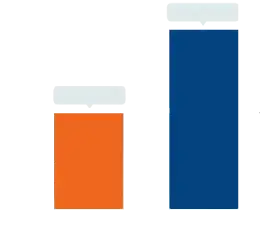
13.90 Billion
USD
36.69 Billion
2025
2033
USD
13.90 Billion
USD
36.69 Billion
2025
2033
 Forecast Period Forecast Period |
2026 - 2033 |
 Market Size (Base Year) Market Size (Base Year) |
USD 13.90 Billion |
 Market Size (Forecast Year) Market Size (Forecast Year) |
USD 36.69 Billion |
 CAGR CAGR |
% |
| Major Markets Players |
|
Clinical Workflow Solutions Market Overview
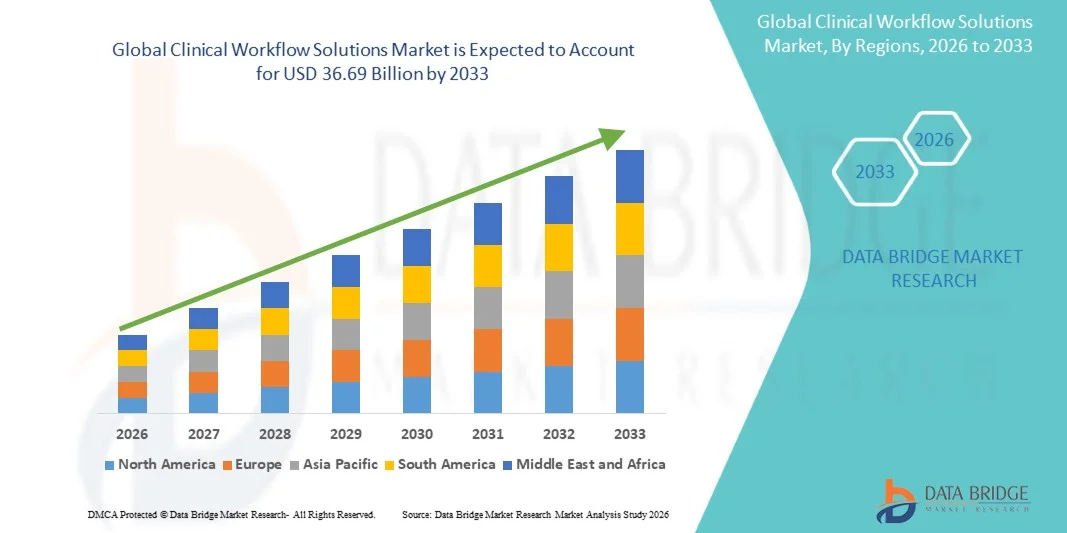
The Clinical Workflow Solutions Market was valued at USD 13.90 billion in 2025 and is projected to reach USD 36.69 billion by 2033, growing at a CAGR of 12.90% from 2026 to 2033. The market is experiencing steady growth driven by the increasing need for healthcare process optimization, rising adoption of digital health technologies, and growing demand for efficient patient care coordination across healthcare facilities.
The growing burden of chronic diseases, increasing patient volumes, and mounting pressure on healthcare providers to improve operational efficiency are encouraging hospitals, clinics, and healthcare systems to implement advanced clinical workflow solutions. Healthcare organizations are increasingly adopting workflow automation platforms, clinical decision support systems, and integrated electronic health record (EHR) solutions to streamline administrative and clinical processes, reduce medical errors, and enhance patient outcomes. Furthermore, advancements in artificial intelligence, cloud-based healthcare platforms, interoperability standards, and real-time data analytics are accelerating market expansion by enabling seamless information exchange, improving care coordination, and supporting value-based healthcare delivery models.
Key Market Trends & Insights
- North America dominated the Clinical Workflow Solutions Market with the largest revenue share of 39.12% in 2025, supported by widespread adoption of healthcare IT systems, advanced digital infrastructure, and strong investments in workflow optimization technologies across healthcare organizations.
- The Workflow Automation Solutions segment dominated the market with a share of 34.86% in 2025 due to its widespread adoption across hospitals, ambulatory care centers, and long-term care facilities for streamlining clinical and administrative processes.
- Asia-Pacific is expected to be the fastest-growing region at a CAGR of 11.4% from 2026 to 2033, fueled by rapid healthcare digitalization, expanding hospital networks, increasing healthcare expenditures, and government initiatives promoting electronic health records and connected care systems.
- Care Collaboration Solutions are the fastest-growing type segment, projected to register a CAGR of 12.1%, reflecting the rising demand for coordinated patient care, interdisciplinary communication, and integrated healthcare delivery models.
- The Hospitals segment dominates the end-user category with a 68.47% revenue share in 2025, led by extensive deployment of clinical workflow platforms to enhance patient management, improve clinical decision-making, and optimize resource utilization.
- Enterprise Reporting and Analytics Solutions continue to witness strong adoption across healthcare systems, driven by increasing demand for real-time clinical insights, performance monitoring, regulatory compliance, and data-driven decision-making.
- The Long-Term Care Facilities segment is anticipated to be the fastest-growing end-user category, with a CAGR of 10.8%, supported by the growing elderly population, rising prevalence of chronic diseases, and increasing adoption of digital tools to improve care coordination and patient outcomes.
Market Size & Forecast
- Global Market Value (2025): USD 13.90 Billion
- Expected Market Value (2033): USD 36.69 Billion
- Forecast CAGR (2026–2033): 12.90%
- Leading Region in 2025: North America
- Fastest Growing Region: Asia-Pacific
Report Scope and Clinical Workflow Solutions Market Segmentation
|
Attributes |
Clinical Workflow Solutions Key Market Insights |
|
Segments Covered |
· By Type: Data Integration Solutions, Real-Time Communication Solutions, Workflow Automation Solutions, Care Collaboration Solutions, Enterprise Reporting and Analytics Solutions · By End Users: Hospitals, Long-Term Care Facilities, Ambulatory Care Centers |
|
Countries Covered |
North America · U.S. · Canada · Mexico Europe · Germany · France · U.K. · Netherlands · Switzerland · Belgium · Russia · Italy · Spain · Turkey · Rest of Europe Asia-Pacific · China · Japan · India · South Korea · Singapore · Malaysia · Australia · Thailand · Indonesia · Philippines · Rest of Asia-Pacific Middle East and Africa · Saudi Arabia · U.A.E. · South Africa · Egypt · Israel · Rest of Middle East and Africa South America · Brazil · Argentina · Rest of South America |
|
Key Market Players |
• Oracle Health (U.S.) |
|
Market Opportunities |
· Growing Adoption of Artificial Intelligence and Predictive Analytics · Expansion of Cloud-Based Healthcare Platforms · Increasing Healthcare Digitalization in Emerging Markets |
|
Value Added Data Infosets |
In addition to the insights on market scenarios such as market value, growth rate, segmentation, geographical coverage, and major players, the market reports curated by the Data Bridge Market Research also include in-depth expert analysis, geographically represented company-wise production and capacity, network layouts of distributors and partners, detailed and updated price trend analysis and deficit analysis of supply chain and demand. |
Clinical Workflow Solutions Market Trends
Trend: Growing Adoption of Artificial Intelligence and Workflow Automation
Healthcare organizations are increasingly adopting AI-powered clinical workflow solutions to automate repetitive administrative tasks, streamline care delivery, and improve clinical decision-making. AI-enabled platforms assist with patient triage, clinical documentation, scheduling optimization, and predictive risk assessment, helping providers reduce physician burnout and improve operational efficiency. In addition, advanced analytics and machine learning tools are being integrated into workflow platforms to identify care gaps, predict patient deterioration, and support personalized treatment pathways. As healthcare systems continue their digital transformation efforts, AI-driven workflow automation is becoming a key trend shaping the future of clinical operations.
Clinical Workflow Solutions Market Dynamics
Key Market Driver: Increasing Digitalization of Healthcare Systems
The growing adoption of electronic health records (EHRs), health information exchanges, and digital care management platforms is a major driver of the Clinical Workflow Solutions Market. Hospitals and healthcare networks are under increasing pressure to improve patient outcomes while reducing operational costs, leading to greater demand for integrated workflow solutions that enhance care coordination and information accessibility. According to industry estimates, healthcare organizations continue to allocate a significant portion of their digital transformation budgets toward workflow optimization and interoperability initiatives. Government programs promoting healthcare IT adoption and value-based care models are further accelerating implementation across hospitals, ambulatory care centers, and long-term care facilities.
Key Restraint/Challenge: Interoperability and Integration Complexities
A major challenge facing the market is the difficulty of integrating workflow solutions with existing healthcare IT infrastructure. Many healthcare providers operate multiple legacy systems that often lack standardized data formats and communication protocols. Integrating electronic health records, laboratory information systems, radiology platforms, billing software, and care management applications can be complex, time-consuming, and costly. Data migration requirements, cybersecurity concerns, and staff training needs further increase implementation challenges. Smaller healthcare facilities with limited IT budgets frequently struggle to justify the investment and resources required for large-scale workflow modernization projects.
A notable example is the continued effort by healthcare organizations worldwide to comply with interoperability standards such as FHIR (Fast Healthcare Interoperability Resources), which often requires substantial upgrades to existing systems and workflows before seamless data exchange can be achieved.
Key Market Opportunity: Expansion of Cloud-Based and Interoperable Clinical Workflow Platforms
The growing shift toward cloud-based healthcare solutions presents a significant opportunity for the Clinical Workflow Solutions market. Cloud deployment enables healthcare providers to access scalable, cost-effective platforms that support remote collaboration, real-time data sharing, and multi-site healthcare operations. The increasing emphasis on interoperability, telehealth integration, and population health management is creating demand for workflow solutions capable of connecting diverse healthcare systems into a unified ecosystem.
For instance, major healthcare technology providers are expanding cloud-native workflow platforms that integrate clinical documentation, patient engagement, analytics, and care coordination functionalities into a single environment. The rising adoption of remote patient monitoring, virtual care services, and data-driven healthcare management is expected to further strengthen demand for advanced clinical workflow solutions across developed and emerging healthcare markets.
Clinical Workflow Solutions Market Scope
The Clinical Workflow Solutions market is segmented on the basis of simulation type and end user.
- By Type
On the basis of type, the Clinical Workflow Solutions Market is segmented into Data Integration Solutions, Real-Time Communication Solutions, Workflow Automation Solutions, Care Collaboration Solutions, and Enterprise Reporting and Analytics Solutions. The Workflow Automation Solutions segment dominated the market with a share of 34.86% in 2025 due to its widespread adoption across hospitals, ambulatory care centers, and long-term care facilities for streamlining clinical and administrative processes. These solutions help automate repetitive tasks such as patient scheduling, documentation management, order processing, discharge planning, and resource allocation, thereby reducing operational inefficiencies and minimizing human errors. The growing pressure on healthcare providers to improve patient outcomes while controlling costs has accelerated the deployment of workflow automation platforms. In addition, increasing integration with electronic health records (EHRs), artificial intelligence-powered decision support tools, and cloud-based healthcare systems is enhancing workflow efficiency and supporting coordinated care delivery. Rising demand for regulatory compliance, improved clinician productivity, and reduced administrative burden further strengthens the dominance of this segment across global healthcare settings.
The Care Collaboration Solutions segment is expected to witness the fastest CAGR of 11.9% from 2026 to 2033, driven by the increasing need for coordinated and patient-centric healthcare delivery. These solutions facilitate seamless communication and information sharing among physicians, nurses, specialists, pharmacists, and other healthcare professionals involved in patient care. Growing prevalence of chronic diseases, rising adoption of multidisciplinary treatment approaches, and expanding use of telehealth services are creating strong demand for collaborative care platforms. Healthcare organizations are increasingly investing in technologies that support real-time care coordination, secure messaging, remote consultations, and cross-functional clinical workflows. Furthermore, advancements in interoperability standards and cloud-based healthcare infrastructure are enabling more efficient collaboration across healthcare networks. The emphasis on reducing care fragmentation and improving treatment outcomes is expected to accelerate adoption of care collaboration solutions throughout the forecast period.
- By End Users
On the basis of end users, the Clinical Workflow Solutions Market is segmented into Hospitals, Long-Term Care Facilities, and Ambulatory Care Centers. The Hospitals segment dominated the market with a share of 68.47% in 2025 due to the large volume of patient admissions, complex clinical workflows, and extensive adoption of healthcare information technologies. Hospitals require advanced workflow solutions to manage patient records, streamline care coordination, improve clinical decision-making, and optimize resource utilization across multiple departments. The increasing implementation of electronic health records, clinical decision support systems, and integrated healthcare management platforms has further strengthened demand within this segment. In addition, growing patient expectations, regulatory requirements, and value-based care initiatives are encouraging hospitals to invest in workflow optimization technologies that enhance efficiency and reduce operational costs. Continuous investments in digital healthcare transformation and interoperability solutions are further reinforcing the leading position of hospitals in the Clinical Workflow Solutions Market.
The Long-Term Care Facilities segment is anticipated to register the fastest CAGR of 10.8% from 2026 to 2033, driven by the rapidly aging global population and increasing prevalence of chronic and age-related diseases. Long-term care providers are increasingly adopting clinical workflow solutions to improve patient monitoring, medication management, care coordination, and documentation processes. The growing need to deliver personalized care while managing limited staffing resources is encouraging facilities to implement automated workflow systems. In addition, government initiatives supporting elderly care modernization and digital healthcare adoption are creating favorable market conditions. Integration of remote patient monitoring technologies, cloud-based care management platforms, and predictive analytics tools is enabling long-term care facilities to improve operational efficiency and patient outcomes. These factors are expected to significantly accelerate segment growth during the forecast period.
Clinical Workflow Solutions Market Regional Analysis
North America dominated the Clinical Workflow Solutions Market and accounted for the largest revenue share of 39.12% in 2025, supported by the widespread adoption of healthcare IT systems, advanced digital healthcare infrastructure, and strong investments in workflow optimization technologies across healthcare organizations. The region benefits from extensive implementation of electronic health records (EHRs), growing demand for interoperability solutions, and increasing focus on improving care coordination and operational efficiency. Healthcare providers are actively investing in automation platforms, clinical decision support systems, and data analytics tools to streamline clinical and administrative workflows. In addition, favorable government initiatives promoting healthcare digitalization and value-based care models continue to strengthen North America's leadership position in the Clinical Workflow Solutions Market.
U.S. Clinical Workflow Solutions Market Insight
The U.S. Clinical Workflow Solutions market is witnessing significant growth due to increasing investments in healthcare digital transformation, widespread adoption of electronic health records, and rising demand for workflow automation technologies. Hospitals and healthcare systems are increasingly implementing advanced workflow solutions to improve patient outcomes, reduce administrative burdens, and enhance operational efficiency. The growing integration of artificial intelligence, cloud computing, and predictive analytics into healthcare operations is further accelerating market growth. Moreover, ongoing efforts to improve interoperability and care coordination across healthcare networks continue to drive demand for clinical workflow solutions throughout the country.
Europe Clinical Workflow Solutions Market Insight
The Europe Clinical Workflow Solutions market remains a major contributor to global revenue, driven by strong healthcare infrastructure, increasing healthcare IT adoption, and supportive government policies promoting digital health transformation. Healthcare providers across the region are increasingly utilizing workflow automation and care coordination solutions to enhance patient management, improve clinical efficiency, and reduce healthcare costs. Growing emphasis on integrated care delivery, interoperability, and patient-centered healthcare services is supporting market expansion. In addition, investments in healthcare analytics, cloud-based platforms, and digital health technologies continue to strengthen the adoption of clinical workflow solutions across Europe.
U.K. Clinical Workflow Solutions Market Insight
The U.K. Clinical Workflow Solutions market is experiencing steady growth, supported by ongoing healthcare modernization initiatives and increasing adoption of digital healthcare technologies. Healthcare organizations are investing in workflow management systems to streamline patient care processes, improve communication among healthcare professionals, and enhance clinical productivity. Rising focus on reducing administrative inefficiencies, improving patient experiences, and supporting data-driven decision-making is contributing to market growth. Furthermore, government-led digital health programs and increasing integration of artificial intelligence into healthcare workflows are accelerating solution adoption across the country.
Germany Clinical Workflow Solutions Market Insight
The Germany Clinical Workflow Solutions market is expanding steadily due to the country's advanced healthcare system, strong healthcare IT infrastructure, and growing focus on healthcare digitalization. Hospitals and healthcare providers are increasingly implementing workflow optimization solutions to improve care coordination, enhance operational efficiency, and support clinical decision-making. The adoption of electronic health records, health information exchange platforms, and analytics-driven healthcare management systems is further driving market growth. Continuous investments in digital healthcare innovation and interoperability initiatives are strengthening Germany's position within the European market.
Asia-Pacific Clinical Workflow Solutions Market Insight
The Asia-Pacific Clinical Workflow Solutions market is expected to witness the fastest growth, registering a CAGR of 11.4% from 2026 to 2033, driven by rapid healthcare digitalization, expanding hospital networks, increasing healthcare expenditures, and government initiatives promoting electronic health records and connected care systems. Healthcare providers across the region are increasingly adopting workflow automation, care collaboration, and data integration solutions to improve healthcare delivery and operational efficiency. Growing patient populations, rising prevalence of chronic diseases, and increasing investments in healthcare infrastructure are further supporting market expansion. In addition, the accelerating adoption of cloud-based healthcare technologies and telehealth services is creating substantial opportunities for clinical workflow solution providers throughout the region.
Japan Clinical Workflow Solutions Market Insight
The Japan Clinical Workflow Solutions market is witnessing consistent growth due to increasing investments in healthcare technology modernization, growing demand for efficient patient management systems, and rising adoption of digital healthcare platforms. Healthcare organizations are implementing workflow solutions to improve clinical efficiency, support care coordination, and enhance patient outcomes. Furthermore, the country's aging population and increasing healthcare service demands are encouraging providers to adopt advanced automation and analytics tools to optimize healthcare operations.
China Clinical Workflow Solutions Market Insight
The China Clinical Workflow Solutions market is growing rapidly, driven by large-scale healthcare digitalization initiatives, expanding healthcare infrastructure, and increasing government support for smart healthcare technologies. Hospitals and healthcare systems are increasingly investing in workflow automation platforms, electronic health records, and healthcare analytics solutions to improve care quality and operational performance. The growing adoption of artificial intelligence, cloud computing, and integrated healthcare information systems is significantly boosting market demand. In addition, rising healthcare expenditures and continued expansion of hospital networks are positioning China as one of the fastest-growing markets for Clinical Workflow Solutions globally.
Clinical Workflow Solutions Market Share
The Clinical Workflow Solutions industry is primarily led by well-established companies, including:
- Oracle Health (U.S.)
- Epic Systems Corporation (U.S.)
- Veradigm LLC (U.S.)
- NextGen Healthcare, Inc. (U.S.)
- athenahealth, Inc. (U.S.)
- eClinicalWorks LLC (U.S.)
- MEDITECH (U.S.)
- McKesson Corporation (U.S.)
- GE HealthCare Technologies Inc. (U.S.)
- Koninklijke Philips N.V. (Netherlands)
- Siemens Healthineers AG (Germany)
- Wolters Kluwer N.V. (Netherlands)
- Altera Digital Health Inc. (U.S.)
- Infor, Inc. (U.S.)
- NXGN Management, LLC (NextGen Healthcare) (U.S.)
- Carestream Health, Inc. (U.S.)
- TigerConnect, Inc. (U.S.)
- Vocera Communications, Inc. (Stryker) (U.S.)
- PerfectServe, Inc. (U.S.)
- Hillrom (Baxter International Inc.) (U.S.)
- Cerner Enviza (Oracle Health) (U.S.)
- Change Healthcare (UnitedHealth Group) (U.S.)
- Cognizant Technology Solutions Corporation (U.S.)
- IBM Corporation (U.S.)
- SAP SE (Germany)
- Microsoft Corporation (U.S.)
- Salesforce, Inc. (U.S.)
- Dedalus Group (Italy)
- InterSystems Corporation (U.S.)
- Sectra AB (Sweden)
- Agfa HealthCare NV (Belgium)
- Drägerwerk AG & Co. KGaA (Germany)
- Tata Consultancy Services Limited (TCS) (India)
- Wipro Limited (India)
- Infosys Limited (India)
Latest Developments in Clinical Workflow Solutions Market
- In March 2025, Microsoft Corporation announced the launch of Microsoft Dragon Copilot, a new AI-powered clinical workflow assistant designed to streamline clinical documentation, automate administrative tasks, and improve care delivery efficiency. The platform combines Dragon Medical One and DAX Copilot capabilities with generative AI and ambient listening technologies, enabling clinicians to reduce documentation burden and enhance patient interactions
- In March 2025, Microsoft Corporation revealed that Dragon Copilot would integrate with major electronic health record (EHR) systems and support clinical workflows through automated note generation, conversational orders, referral summaries, and real-time information retrieval. The development reflects the growing adoption of AI-driven workflow automation solutions across healthcare organizations
- In August 2024, Oracle Health continued the expansion and rebranding of its healthcare technology portfolio following the Cerner acquisition, accelerating deployment of Oracle Health solutions focused on improving healthcare interoperability, clinical workflow efficiency, and cloud-based healthcare operations. The initiative highlighted the industry's increasing focus on integrated digital healthcare ecosystems
- In March 2024, Oracle Corporation announced progress in migrating a significant portion of Oracle Health customers to Oracle Cloud Infrastructure (OCI) while advancing development of new cloud-based ambulatory healthcare solutions with enhanced AI functionality. The move was aimed at improving healthcare workflow management, scalability, and data accessibility across healthcare organizations
- In August 2023, Oracle Health formally expanded the Oracle Health brand across multiple healthcare products and platforms following its integration of Cerner technologies. The initiative focused on strengthening clinical workflow management capabilities, healthcare data integration, and cloud-enabled healthcare operations for hospitals and healthcare systems
SKU-
Get online access to the report on the World's First Market Intelligence Cloud

- Interactive Data Analysis Dashboard
- Company Analysis Dashboard for high growth potential opportunities
- Research Analyst Access for customization & queries
- Competitor Analysis with Interactive dashboard
- Latest News, Updates & Trend analysis
- Harness the Power of Benchmark Analysis for Comprehensive Competitor Tracking
Research Methodology
Data collection and base year analysis are done using data collection modules with large sample sizes. The stage includes obtaining market information or related data through various sources and strategies. It includes examining and planning all the data acquired from the past in advance. It likewise envelops the examination of information inconsistencies seen across different information sources. The market data is analysed and estimated using market statistical and coherent models. Also, market share analysis and key trend analysis are the major success factors in the market report. To know more, please request an analyst call or drop down your inquiry.
The key research methodology used by DBMR research team is data triangulation which involves data mining, analysis of the impact of data variables on the market and primary (industry expert) validation. Data models include Vendor Positioning Grid, Market Time Line Analysis, Market Overview and Guide, Company Positioning Grid, Patent Analysis, Pricing Analysis, Company Market Share Analysis, Standards of Measurement, Global versus Regional and Vendor Share Analysis. To know more about the research methodology, drop in an inquiry to speak to our industry experts.
Customization Available
Data Bridge Market Research is a leader in advanced formative research. We take pride in servicing our existing and new customers with data and analysis that match and suits their goal. The report can be customized to include price trend analysis of target brands understanding the market for additional countries (ask for the list of countries), clinical trial results data, literature review, refurbished market and product base analysis. Market analysis of target competitors can be analyzed from technology-based analysis to market portfolio strategies. We can add as many competitors that you require data about in the format and data style you are looking for. Our team of analysts can also provide you data in crude raw excel files pivot tables (Fact book) or can assist you in creating presentations from the data sets available in the report.