


Global Coastal Surveillance Market
Market Size in USD Billion
CAGR :
% 
 USD
26.90 Billion
USD
39.53 Billion
2025
2033
USD
26.90 Billion
USD
39.53 Billion
2025
2033
 Forecast Period Forecast Period |
2026 –2033 |
 Market Size (Base Year) Market Size (Base Year) |
USD 26.90 Billion |
 Market Size (Forecast Year) Market Size (Forecast Year) |
USD 39.53 Billion |
 CAGR CAGR |
% |
| Major Markets Players |
|
Coastal Surveillance Market Size
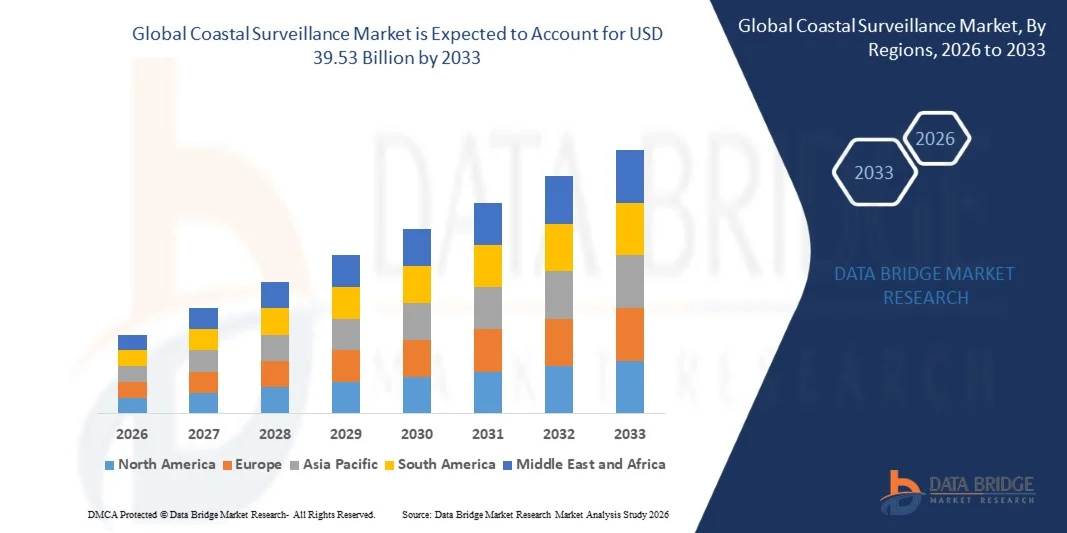
- The global coastal surveillance market size was valued at USD 26.90 billion in 2025 and is expected to reach USD 39.53 billion by 2033, at a CAGR of 4.93% during the forecast period
- The market growth is largely fuelled by the increasing need for maritime security, border protection, and monitoring of illegal activities such as smuggling, piracy, and unauthorized fishing across coastal regions
- Rising investments by governments in advanced radar systems, electro-optic sensors, and integrated coastal monitoring networks are further supporting market expansion
Coastal Surveillance Market Analysis
- The market is experiencing consistent growth due to increasing geopolitical tensions, the need for enhanced maritime domain awareness, and the rising importance of protecting critical coastal infrastructure such as ports, oil terminals, and offshore platforms
- Technological advancements such as integrated radar systems, satellite surveillance, unmanned aerial vehicles, and real-time data analytics are enabling more efficient coastal monitoring, strengthening the operational capabilities of defense and security agencies worldwide
- North America dominated the coastal surveillance market with the largest revenue share in 2025, driven by increasing investments in maritime security, border protection, and monitoring of strategic coastlines
- Asia-Pacific region is expected to witness the highest growth rate in the global coastal surveillance market, driven by rapid urbanization along coastlines, government initiatives to strengthen maritime security, and increasing adoption of UAVs, radar, and sensor-based surveillance technologies
- The National segment held the largest market revenue share in 2025 driven by increasing government initiatives to establish comprehensive surveillance networks across extensive coastlines for improved maritime security and border monitoring. National coastal surveillance systems integrate radar stations, communication infrastructure, and centralized monitoring centers to provide large-scale maritime domain awareness and support coordinated defense operations
Report Scope and Coastal Surveillance Market Segmentation
|
Attributes |
Coastal Surveillance Key Market Insights |
|
Segments Covered |
|
|
Countries Covered |
North America
Europe
Asia-Pacific
Middle East and Africa
South America
|
|
Key Market Players |
• Northrop Grumman (U.S.) |
|
Market Opportunities |
• Increasing Adoption Of AI-Enabled Maritime Surveillance Systems |
|
Value Added Data Infosets |
In addition to the market insights such as market value, growth rate, market segments, geographical coverage, market players, and market scenario, the market report curated by the Data Bridge Market Research team includes in-depth expert analysis, import/export analysis, pricing analysis, production consumption analysis, and pestle analysis. |
Coastal Surveillance Market Trends
“Rising Demand for Advanced Maritime Security and Border Monitoring”
• The growing need to strengthen maritime security and protect coastal borders is significantly shaping the coastal surveillance market, as governments increasingly invest in advanced monitoring technologies. Coastal surveillance systems such as radar, automatic identification systems, electro-optical sensors, and communication networks are being deployed to monitor maritime traffic and detect illegal activities. This trend is encouraging defense agencies to modernize surveillance infrastructure and integrate intelligent monitoring solutions for improved coastal situational awareness
• Increasing concerns regarding illegal fishing, smuggling, piracy, and unauthorized maritime activities are accelerating the adoption of coastal surveillance systems across multiple countries. Governments and naval authorities are implementing integrated surveillance networks capable of providing real-time data and analytics for maritime monitoring. These systems enable authorities to track vessel movement, enhance maritime domain awareness, and respond quickly to potential threats along coastlines and territorial waters
• Technological advancements such as artificial intelligence, satellite communication, and unmanned aerial vehicles are transforming coastal surveillance capabilities. Modern systems are increasingly incorporating AI-based analytics and automation features that improve detection accuracy and enable predictive monitoring of maritime activities. These innovations are helping security agencies enhance operational efficiency while reducing response times and improving overall maritime security management
• For instance, in 2024, several coastal nations including India and Australia expanded their maritime monitoring programs by deploying integrated radar networks and drone-based surveillance solutions across key coastal regions. These initiatives were introduced to strengthen border security and monitor maritime traffic more effectively. The systems were deployed across naval bases, coastal monitoring stations, and port authorities to support coordinated maritime security operations
• While demand for coastal surveillance systems is increasing, sustained market expansion depends on continuous technological innovation, integration of multi-sensor systems, and improved interoperability between defense and security agencies. Governments and technology providers are focusing on developing scalable surveillance platforms that combine radar, satellite data, and AI-driven analytics to enhance coastal monitoring efficiency and long-term security capabilities
Coastal Surveillance Market Dynamics
Driver
“Increasing Government Investments in Maritime Security Infrastructure”
• Rising government investments in maritime security infrastructure are a major driver for the coastal surveillance market. Nations with extensive coastlines are prioritizing the development of advanced surveillance networks to safeguard territorial waters and critical maritime assets. These investments support the deployment of radar stations, communication systems, and command-and-control centers to strengthen coastal monitoring capabilities
• Expanding maritime trade and increasing ship traffic across global shipping routes are influencing the demand for reliable coastal surveillance systems. Monitoring vessel movement and ensuring safe navigation have become critical priorities for port authorities and naval forces. Coastal surveillance technologies help prevent accidents, improve traffic management, and enhance safety across busy maritime corridors and strategic waterways
• Defense and security agencies are actively integrating advanced surveillance technologies through modernization programs and cross-agency collaborations. These initiatives include the deployment of AI-enabled radar systems, satellite-based monitoring platforms, and autonomous maritime drones to enhance detection and tracking capabilities. Such efforts are strengthening coastal defense strategies while improving operational efficiency and coordination among security authorities
• For instance, in 2023, coastal defense authorities in countries such as the U.S. and Japan expanded their coastal monitoring infrastructure by upgrading radar stations and integrating advanced maritime analytics systems. These initiatives were implemented to improve maritime domain awareness and strengthen coastal defense operations against emerging security threats. The upgrades also enhanced real-time monitoring and response capabilities for naval and border protection agencies
• Although increasing investments support market growth, large-scale coastal surveillance projects require significant funding, long-term infrastructure planning, and advanced technological integration. Governments must ensure efficient deployment, system interoperability, and continuous technological upgrades to maintain effective coastal monitoring and defense capabilities
Restraint/Challenge
“High Implementation Cost and Complex Infrastructure Requirements”
• The high cost associated with installing and maintaining coastal surveillance infrastructure remains a major challenge for the market. Establishing radar stations, communication networks, and monitoring centers across vast coastal regions requires significant capital investment. In addition, ongoing maintenance, software upgrades, and skilled personnel contribute to operational expenses for defense agencies and coastal authorities
• Integration complexity between multiple surveillance technologies can also limit system efficiency and deployment speed. Coastal monitoring often requires coordination between radar systems, satellite networks, drones, and command-and-control platforms. Ensuring seamless data integration and communication across these systems can be technically challenging and requires specialized expertise and advanced software solutions
• Geographic and environmental factors further complicate surveillance deployment in certain coastal regions. Harsh weather conditions, remote coastal areas, and difficult terrain can affect equipment installation and system performance. These challenges increase operational costs and may require additional investments in infrastructure reinforcement and weather-resistant technologies
• For instance, in 2024, several Southeast Asian coastal monitoring initiatives experienced delays due to high infrastructure costs and logistical difficulties associated with deploying surveillance equipment across remote island territories. Some maritime security programs faced budget constraints and technical challenges related to integrating radar systems with existing monitoring platforms, slowing project implementation timelines
• Addressing these challenges will require cost-effective technology development, improved integration platforms, and increased collaboration between governments and defense technology providers. Strengthening infrastructure planning, investing in advanced surveillance solutions, and promoting international maritime security cooperation will be essential to support the long-term growth of the coastal surveillance market
Coastal Surveillance Market Scope
The market is segmented on the basis of structure, scale, application, and end user.
• By Structure
On the basis of structure, the coastal surveillance market is segmented into National, Regional and Port. The National segment held the largest market revenue share in 2025 driven by increasing government initiatives to establish comprehensive surveillance networks across extensive coastlines for improved maritime security and border monitoring. National coastal surveillance systems integrate radar stations, communication infrastructure, and centralized monitoring centers to provide large-scale maritime domain awareness and support coordinated defense operations.
The Port segment is expected to witness the fastest growth rate from 2026 to 2033, driven by the growing need to monitor port activities, manage vessel traffic, and enhance security around critical maritime infrastructure. Port-level surveillance systems help authorities track vessel movement, detect suspicious activities, and ensure safe and efficient port operations, particularly in busy commercial shipping hubs.
• By Scale
On the basis of scale, the coastal surveillance market is segmented into Large Scale Surveillance and Moderate Scale Surveillance. The Large Scale Surveillance segment accounted for the largest market revenue share in 2025 due to the increasing deployment of integrated surveillance networks across extensive coastal regions. These systems combine radar, satellite communication, and sensor technologies to monitor vast maritime territories and strengthen national maritime defense strategies.
The Moderate Scale Surveillance segment is expected to witness the fastest growth rate from 2026 to 2033, supported by increasing adoption among smaller coastal regions, island territories, and developing nations seeking cost-effective surveillance solutions. These systems provide efficient monitoring of localized maritime zones while requiring comparatively lower infrastructure investment.
• By Application
On the basis of application, the coastal surveillance market is segmented into Command and Control, Communications, Computers, Intelligence, Surveillance and Reconnaissance and Electronic Warfare. The Intelligence, Surveillance and Reconnaissance segment held the largest market share in 2025 driven by the growing need for real-time monitoring of maritime activities and early detection of security threats. These systems enable authorities to collect and analyze critical data related to vessel movement, maritime traffic, and suspicious activities across coastal areas.
The Command and Control segment is expected to witness the fastest growth rate from 2026 to 2033 as governments invest in advanced control centers and integrated monitoring platforms. These systems support real-time decision making, improved coordination between defense agencies, and effective response to maritime incidents.
• By End User
On the basis of end user, the coastal surveillance market is segmented into Naval, Coast Guard and Others. The Naval segment held the largest market revenue share in 2025 due to increasing naval modernization programs and rising investments in advanced maritime defense technologies. Naval forces rely on coastal surveillance systems to strengthen maritime domain awareness, protect territorial waters, and support national defense operations.
The Coast Guard segment is expected to witness the fastest growth rate from 2026 to 2033 driven by increasing responsibilities related to maritime safety, border protection, and monitoring of illegal activities such as smuggling and unauthorized fishing. Coastal surveillance technologies assist coast guard agencies in improving monitoring capabilities and ensuring effective maritime law enforcement across coastal regions.
Coastal Surveillance Market Regional Analysis
- North America dominated the coastal surveillance market with the largest revenue share in 2025, driven by increasing investments in maritime security, border protection, and monitoring of strategic coastlines
- Authorities in the region prioritize advanced surveillance technologies, including radar systems, sensor networks, and integrated command centers, to ensure situational awareness and safeguard maritime assets
- This widespread adoption is further supported by government funding, advanced technological infrastructure, and the growing need to monitor commercial shipping lanes, establishing coastal surveillance as a critical component of national security
U.S. Coastal Surveillance Market Insight
The U.S. coastal surveillance market captured the largest revenue share in 2025 within North America, fueled by significant government initiatives to enhance maritime domain awareness and protect ports, harbors, and offshore installations. The growing focus on real-time monitoring, early threat detection, and integration of advanced sensor networks drives the adoption of coastal surveillance systems. Furthermore, modernization programs for the navy and coast guard, combined with increased spending on digital command and control centers, are significantly contributing to market growth.
Europe Coastal Surveillance Market Insight
The Europe coastal surveillance market is expected to witness the fastest growth rate from 2026 to 2033, primarily driven by stringent maritime security regulations and rising cross-border monitoring requirements. The increase in port traffic, coupled with heightened security concerns, is fostering the adoption of integrated surveillance solutions. European governments are also investing in advanced radar systems, unmanned aerial surveillance, and intelligent monitoring platforms, supporting growth across national, regional, and port-level applications.
U.K. Coastal Surveillance Market Insight
The U.K. coastal surveillance market is expected to witness significant growth from 2026 to 2033, driven by rising concerns over maritime threats, illegal fishing, and unauthorized vessel entry. The country’s robust maritime infrastructure, coupled with government programs for advanced coastal monitoring, is encouraging the deployment of sensor-based and networked surveillance systems. These initiatives are further supported by technological advancements in radar, communications, and integrated command platforms.
Germany Coastal Surveillance Market Insight
The Germany coastal surveillance market is expected to witness strong growth from 2026 to 2033, fueled by growing awareness of maritime security and the adoption of technologically advanced surveillance solutions. Germany’s focus on safeguarding territorial waters, critical port infrastructure, and offshore energy installations promotes investments in large-scale radar, communication, and reconnaissance systems. Integration with national and regional command centers enhances operational efficiency and responsiveness to maritime incidents.
Asia-Pacific Coastal Surveillance Market Insight
The Asia-Pacific coastal surveillance market is expected to witness the fastest growth rate from 2026 to 2033, driven by increasing maritime trade, expanding naval capabilities, and rising coastal population density in countries such as China, India, and Japan. Government initiatives to modernize ports, strengthen naval defense, and establish smart monitoring networks are accelerating adoption. Furthermore, as APAC emerges as a manufacturing hub for surveillance equipment, affordability and accessibility of advanced coastal monitoring systems are expanding to a wider range of users.
Japan Coastal Surveillance Market Insight
The Japan coastal surveillance market is expected to witness significant growth from 2026 to 2033, supported by the country’s high-tech maritime defense infrastructure, strategic importance of territorial waters, and growing focus on port and coastal monitoring. Integration of radar, communications, and reconnaissance systems with intelligent command centers is enhancing situational awareness, while government programs emphasize early threat detection and response capabilities.
China Coastal Surveillance Market Insight
The China coastal surveillance market accounted for the largest market revenue share in Asia-Pacific in 2025, driven by rapid urbanization, expanding port infrastructure, and a strategic focus on maritime security. China is investing heavily in national and regional surveillance networks, integrating radar, satellite, and sensor technologies for real-time monitoring of coastal waters. The development of smart ports and maritime domain awareness programs, combined with domestic manufacturing of surveillance equipment, are key factors propelling market growth.
Coastal Surveillance Market Share
The Coastal Surveillance industry is primarily led by well-established companies, including:
• Northrop Grumman (U.S.)
• Thales Group (France)
• Terma A/S (Denmark)
• KONGSBERG (Norway)
• Saab AB (Sweden)
• Elbit Systems Ltd. (Israel)
• Indra Sistemas S.A. (Spain)
• Frequentis (Austria)
• Lockheed Martin Corporation (U.S.)
• Raytheon Technologies Corporation (U.S.)
• Selex ES Inc. (Italy)
• CONTROP Precision Technologies Ltd. (Israel)
• HENSOLDT Holding Germany GmbH (Germany)
• Rolta (India)
• Valve Corporation (U.S.)
Latest Developments in Global Coastal Surveillance Market
- In July 2025, Blue Cloud Softech Solutions (BCSSL) secured a USD 9.36 million contract from a U.S. client to develop and implement a customized coastal surveillance system along South America’s coastline over 18 months. The system will integrate sensor networks, real-time monitoring, and automated alert mechanisms to improve maritime safety. This project is expected to enhance situational awareness, support law enforcement operations, and strengthen BCSSL’s presence in the global coastal surveillance market. The initiative also highlights growing investments in advanced surveillance technologies across the Americas
- In May 2025, Odisha Police (India) initiated the procurement of drones for coastal surveillance covering the state’s 480 km coastline. The drone-based aerial monitoring system is designed to provide real-time intelligence, complement marine police stations, and improve response times to maritime incidents. This move demonstrates the increasing adoption of unmanned aerial systems in coastal security and reflects India’s focus on modernizing its maritime monitoring infrastructure. The initiative is likely to drive further investments in drone-based coastal surveillance solutions in the region
- In May 2025, The European Union proposed the establishment of a dedicated “Black Sea Maritime Security Hub” to provide real-time, space-to-seabed monitoring and early-warning capabilities. The hub aims to enhance cross-border maritime situational awareness, support naval and coast guard operations, and enable timely threat detection. By integrating advanced surveillance technologies, the initiative is expected to improve regional security, encourage international collaboration, and boost the adoption of high-tech coastal monitoring systems across Europe
- In February 2025, Saab launched the Coast Control Radar, a next-generation phased-array, software-defined, non-rotating radar for coastal surveillance. The radar provides high-resolution imaging, real-time threat detection, and enhanced monitoring over large maritime areas. This system strengthens Saab’s portfolio in advanced coastal surveillance solutions and addresses the growing need for rapid, automated detection capabilities. Its adoption is expected to support naval operations and improve situational awareness in strategic maritime regions globally
- In February 2025, IAI ELTA unveiled the “C-Catcher (ELM-2025)” airborne maritime surveillance radar at IDEX/NAVDEX, featuring multi-mode AESA technology for patrol aircraft. The system enhances airborne monitoring, improves detection of surface and aerial threats, and offers superior coverage efficiency compared to legacy systems. It is expected to support maritime patrol operations, reduce response times, and meet the increasing demand for versatile airborne surveillance solutions. This launch underscores IAI ELTA’s commitment to innovation in high-performance coastal monitoring technologies
SKU-
Get online access to the report on the World's First Market Intelligence Cloud

- Interactive Data Analysis Dashboard
- Company Analysis Dashboard for high growth potential opportunities
- Research Analyst Access for customization & queries
- Competitor Analysis with Interactive dashboard
- Latest News, Updates & Trend analysis
- Harness the Power of Benchmark Analysis for Comprehensive Competitor Tracking
Research Methodology
Data collection and base year analysis are done using data collection modules with large sample sizes. The stage includes obtaining market information or related data through various sources and strategies. It includes examining and planning all the data acquired from the past in advance. It likewise envelops the examination of information inconsistencies seen across different information sources. The market data is analysed and estimated using market statistical and coherent models. Also, market share analysis and key trend analysis are the major success factors in the market report. To know more, please request an analyst call or drop down your inquiry.
The key research methodology used by DBMR research team is data triangulation which involves data mining, analysis of the impact of data variables on the market and primary (industry expert) validation. Data models include Vendor Positioning Grid, Market Time Line Analysis, Market Overview and Guide, Company Positioning Grid, Patent Analysis, Pricing Analysis, Company Market Share Analysis, Standards of Measurement, Global versus Regional and Vendor Share Analysis. To know more about the research methodology, drop in an inquiry to speak to our industry experts.
Customization Available
Data Bridge Market Research is a leader in advanced formative research. We take pride in servicing our existing and new customers with data and analysis that match and suits their goal. The report can be customized to include price trend analysis of target brands understanding the market for additional countries (ask for the list of countries), clinical trial results data, literature review, refurbished market and product base analysis. Market analysis of target competitors can be analyzed from technology-based analysis to market portfolio strategies. We can add as many competitors that you require data about in the format and data style you are looking for. Our team of analysts can also provide you data in crude raw excel files pivot tables (Fact book) or can assist you in creating presentations from the data sets available in the report.












