




Global Coating Additives Market
Market Size in USD Billion
CAGR :
% 
 USD
11.93 Billion
USD
18.72 Billion
2025
2033
USD
11.93 Billion
USD
18.72 Billion
2025
2033
 Forecast Period Forecast Period |
2026 –2033 |
 Market Size (Base Year) Market Size (Base Year) |
USD 11.93 Billion |
 Market Size (Forecast Year) Market Size (Forecast Year) |
USD 18.72 Billion |
 CAGR CAGR |
% |
| Major Markets Players |
|
Coating Additives Market Size
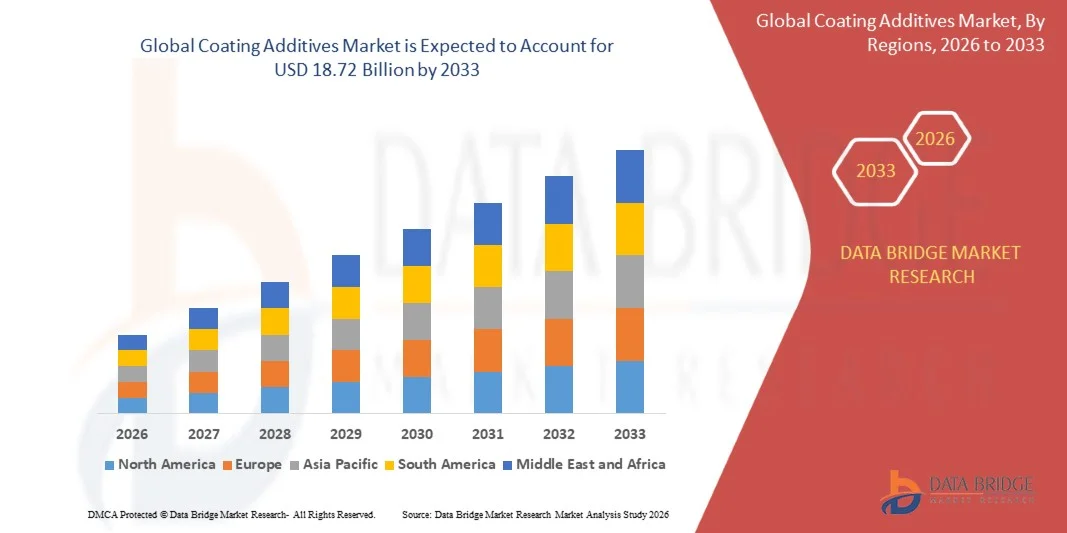
- The global coating additives market size was valued at USD 11.93 billion in 2025 and is expected to reach USD 18.72 billion by 2033, at a CAGR of 5.8% during the forecast period
- The market growth is largely driven by increasing demand for high-performance and sustainable coatings across automotive, construction, and industrial sectors. Technological advancements in additive formulations are enhancing coating durability, gloss, and environmental compliance, thereby stimulating adoption across multiple applications
- Furthermore, growing regulatory pressures to reduce VOC emissions and the rising focus on eco-friendly and water-based coatings are encouraging formulators to incorporate advanced coating additives. These factors are accelerating the uptake of specialty additives, significantly boosting market expansion
Coating Additives Market Analysis
- Coating additives are specialty chemicals used to enhance the performance, durability, and aesthetic properties of coatings. They include rheology modifiers, dispersants, wetting agents, defoamers, and other functional agents that improve application, finish quality, and environmental compliance in architectural, automotive, and industrial coatings
- The escalating demand for coating additives is primarily fueled by rapid urbanization, industrial growth, and increasing consumer preference for durable, high-quality finishes. In addition, the shift toward sustainable and low-emission coatings, coupled with advancements in additive technologies, is driving higher adoption across global markets
- Asia-Pacific dominated the coating additives market with a share of 36.4% in 2025, due to rapid growth in construction activities, expanding automotive production, and increasing demand for high-performance coatings across industrial sectors
- North America is expected to be the fastest growing region in the coating additives market during the forecast period due to increasing demand for high-performance coatings in automotive, aerospace, and industrial applications
- Architecture segment dominated the market with a market share of 54% in 2025, due to rapid urbanization, infrastructure development, and increasing demand for decorative and protective coatings in residential and commercial buildings. Coating additives play a crucial role in enhancing durability, weather resistance, and aesthetic appeal in architectural coatings. Rising construction activities in emerging economies are significantly contributing to segment growth
Report Scope and Coating Additives Market Segmentation
|
Attributes |
Coating Additives Key Market Insights |
|
Segments Covered |
|
|
Countries Covered |
North America
Europe
Asia-Pacific
Middle East and Africa
South America
|
|
Key Market Players |
|
|
Market Opportunities |
|
|
Value Added Data Infosets |
In addition to the insights on market scenarios such as market value, growth rate, segmentation, geographical coverage, and major players, the market reports curated by the Data Bridge Market Research also include import export analysis, production capacity overview, production consumption analysis, price trend analysis, climate change scenario, supply chain analysis, value chain analysis, raw material/consumables overview, vendor selection criteria, PESTLE Analysis, Porter Analysis, and regulatory framework. |
Coating Additives Market Trends
“Rising Adoption of Eco-Friendly and Sustainable Coating Additives”
- A significant trend in the coating additives market is the growing preference for eco-friendly and sustainable additives, driven by increasing regulatory pressure and consumer demand for low-VOC and waterborne coatings. This shift is promoting the development of additives that enhance performance while minimizing environmental impact
- For instance, BASF supplies a range of sustainable dispersants and rheology modifiers that reduce solvent usage and improve coating efficiency, supporting manufacturers in meeting stricter environmental standards. Such solutions are enabling broader adoption of green coatings across automotive, industrial, and architectural applications
- Waterborne and bio-based coating additives are gaining traction as industries aim to reduce hazardous emissions and comply with sustainability goals. These additives offer benefits such as improved adhesion, corrosion resistance, and reduced environmental footprint, positioning them as key enablers of cleaner coating technologies
- The automotive and construction sectors are increasingly integrating eco-friendly additives to achieve durable, high-performance coatings while adhering to environmental certifications. This trend is accelerating innovation in additives that balance sustainability with technical efficiency
- Growth in regulations such as REACH in the U.K. and the U.S. EPA’s VOC guidelines is motivating manufacturers to replace traditional solvent-based additives with safer alternatives. This is shaping the development pipeline toward more environmentally conscious formulations
- The market is witnessing rising investment in R&D for next-generation sustainable coating additives, where companies focus on functional performance enhancements without compromising eco-compatibility. This trend reinforces the long-term shift toward greener, safer coating solutions across industries
Coating Additives Market Dynamics
Driver
“Growing Demand for High-Performance and Durable Coatings”
- The increasing need for coatings that provide superior durability, corrosion resistance, and aesthetic appeal is driving the demand for advanced coating additives. Industries require additives that can enhance film formation, scratch resistance, and longevity under challenging environmental conditions
- For instance, Clariant produces high-performance additives such as anti-settling agents and wetting agents that improve coating consistency and durability for automotive and industrial applications. These additives allow manufacturers to deliver premium-quality coatings that meet rigorous performance expectations
- Rising demand from the automotive, aerospace, and industrial equipment sectors is fueling the adoption of specialty additives that improve adhesion, chemical resistance, and mechanical properties. These functional improvements extend the lifespan of coated products and reduce maintenance costs
- Advances in nanotechnology and polymer chemistry are enabling additives that enhance UV stability, scratch resistance, and corrosion protection, supporting longer-lasting coatings. This is encouraging manufacturers to incorporate multi-functional additives into high-value applications
- Urbanization and industrial infrastructure growth are increasing the need for durable coatings for buildings, bridges, and industrial surfaces, prompting higher consumption of effective coating additives. These factors collectively support market expansion and reinforce demand for performance-oriented solutions
Restraint/Challenge
“Stringent Environmental Regulations and Compliance Requirements”
- The coating additives market faces challenges from strict environmental regulations that limit solvent emissions, hazardous substances, and volatile organic compounds. Compliance with rules such as REACH in Europe and EPA regulations in the U.S. adds complexity to additive formulation and selection
- For instance, Dow Chemical works closely with regulatory bodies to reformulate additives that comply with VOC and heavy-metal restrictions while maintaining coating performance. Such regulatory-driven adjustments increase production costs and require ongoing R&D investments
- Manufacturers must also address international variations in environmental standards, which complicates global product distribution and supply chain management. These compliance demands can slow product launches and increase operational expenditures
- The shift toward waterborne and low-VOC formulations, while environmentally beneficial, requires reformulation of existing additive portfolios, posing technical and financial challenges. Balancing sustainability goals with performance requirements remains a persistent hurdle for market players
- Overall, the stringent regulatory environment continues to shape strategic planning, production processes, and innovation pipelines for coating additive manufacturers. These challenges underscore the importance of developing compliant, high-performing, and cost-effective solutions
Coating Additives Market Scope
The market is segmented on the basis of type, function, formulation, and application.
• By Type
On the basis of type, the coating additives market is segmented into acrylic, fluoropolymers, urethanes, metallic additives, and others. The acrylic segment dominated the largest market revenue share in 2025, driven by its versatile performance characteristics such as improved durability, weather resistance, and cost-effectiveness across multiple coating applications. Acrylic additives are widely preferred in architectural and industrial coatings due to their ability to enhance gloss retention, adhesion, and UV stability. Their compatibility with water-based formulations further supports demand amid rising environmental regulations. In addition, the growing construction and infrastructure activities globally continue to strengthen the consumption of acrylic-based additives in protective and decorative coatings.
The fluoropolymers segment is anticipated to witness the fastest growth rate from 2026 to 2033, fueled by increasing demand for high-performance coatings in extreme environments. Fluoropolymer additives provide superior chemical resistance, low surface energy, and exceptional durability, making them suitable for advanced industrial and automotive applications. Their ability to deliver anti-corrosion and non-stick properties enhances their adoption in specialized coatings. Expanding use in aerospace, electronics, and high-end architectural coatings further contributes to segment growth. Continuous innovation in high-performance materials is expected to accelerate fluoropolymer demand.
• By Function
On the basis of function, the coating additives market is segmented into rheology modifiers, dispersing, wetting agent, impact modifier, and anti-foaming. The rheology modifiers segment dominated the largest market revenue share in 2025, driven by its critical role in controlling viscosity, flow behavior, and application properties of coatings. These additives ensure uniform film formation and prevent issues such as sagging or sedimentation during application. Their importance in both water-based and solvent-based coatings makes them indispensable across industries. Increasing focus on coating performance consistency and quality is further boosting their demand. Growth in industrial coatings also supports widespread usage of rheology modifiers.
The wetting agent segment is expected to witness the fastest CAGR from 2026 to 2033, driven by the rising need for improved substrate wetting and surface coverage. Wetting agents enhance the spreading and adhesion of coatings on various surfaces, improving overall finish quality and durability. Their growing use in high-performance and specialty coatings is contributing to increased adoption. Demand from automotive refinishing and electronics coatings is further accelerating segment expansion. Technological advancements in surface chemistry are also supporting innovation in wetting agent formulations.
• By Formulation
On the basis of formulation, the coating additives market is segmented into water, solvent, and powder based. The water-based segment held the largest market revenue share of 46% in 2025 driven by increasing environmental regulations and the shift toward low-VOC and eco-friendly coating solutions. Water-based formulations offer reduced toxicity, improved safety, and compliance with stringent emission standards. Their growing adoption in architectural and industrial coatings is supported by advancements in performance characteristics. Rising consumer awareness regarding sustainability further strengthens demand. Expansion of green building initiatives is also contributing to segment dominance.
The powder-based segment is expected to witness the fastest growth from 2026 to 2033, driven by its solvent-free nature and high material efficiency. Powder coatings provide excellent durability, corrosion resistance, and minimal waste generation, making them highly attractive for industrial applications. Their increasing use in automotive components, appliances, and metal furniture is boosting additive demand. Technological improvements in powder coating processes are expanding application scope. Sustainability trends and regulatory support are further accelerating adoption of powder-based formulations.
• By Application
On the basis of application, the coating additives market is segmented into automotive, architecture, and industrial. The architectural segment dominated the largest market revenue share of 54% in 2025, driven by rapid urbanization, infrastructure development, and increasing demand for decorative and protective coatings in residential and commercial buildings. Coating additives play a crucial role in enhancing durability, weather resistance, and aesthetic appeal in architectural coatings. Rising construction activities in emerging economies are significantly contributing to segment growth. Demand for energy-efficient and sustainable buildings is further boosting the use of advanced coating solutions. Continuous renovation and maintenance activities also support steady demand.
The automotive segment is anticipated to witness the fastest growth rate from 2026 to 2033, fueled by increasing vehicle production and demand for high-performance coatings. Coating additives are essential in improving scratch resistance, gloss, and corrosion protection in automotive finishes. Growing adoption of electric vehicles and lightweight materials is driving the need for advanced coating technologies. Stringent quality and durability standards in the automotive industry further support additive demand. Innovations in coating formulations for enhanced aesthetics and protection are accelerating segment expansion.
Coating Additives Market Regional Analysis
- Asia-Pacific dominated the coating additives market with the largest revenue share of 36.4% in 2025, driven by rapid growth in construction activities, expanding automotive production, and increasing demand for high-performance coatings across industrial sectors
- The region’s cost-effective manufacturing environment, rising investments in infrastructure development, and strong presence of coating and chemical manufacturers are accelerating market expansion
- Increasing urbanization, supportive government initiatives for industrial growth, and rising adoption of eco-friendly coatings are contributing to higher demand for coating additives across developing economies
China Coating Additives Market Insight
China held the largest share in the Asia-Pacific coating additives market in 2025, owing to its strong position as a global manufacturing hub for chemicals, coatings, and construction materials. The country benefits from large-scale production capabilities, continuous investments in industrial infrastructure, and high demand from automotive and architectural sectors. Government support for domestic manufacturing and exports, along with rapid urban development, further drives consumption of coating additives across multiple industries.
India Coating Additives Market Insight
India is witnessing the fastest growth in the Asia-Pacific region, fueled by increasing construction projects, rising automotive production, and growing demand for decorative and protective coatings. Government initiatives such as infrastructure development programs and “Make in India” are strengthening the domestic manufacturing sector. In addition, expanding middle-class population and increasing real estate activities are boosting demand for high-quality coatings, thereby supporting market growth.
Europe Coating Additives Market Insight
The Europe coating additives market is expanding steadily, supported by stringent environmental regulations, high demand for sustainable coatings, and growing focus on advanced formulation technologies. The region emphasizes low-VOC and water-based coatings, encouraging the use of specialized additives to enhance performance and compliance. Increasing investments in research and innovation for eco-friendly coating solutions are further driving market growth across industries.
Germany Coating Additives Market Insight
Germany’s coating additives market is driven by its strong automotive industry, advanced manufacturing capabilities, and well-established chemical sector. The country focuses on high-performance and sustainable coating technologies, supported by strong R&D infrastructure and industrial collaborations. Demand is particularly strong in automotive coatings, industrial machinery, and high-end architectural applications requiring durability and precision.
U.K. Coating Additives Market Insight
The U.K. market is supported by growing demand for sustainable construction materials, increasing renovation activities, and rising adoption of eco-friendly coatings. The country’s focus on reducing carbon emissions and improving building efficiency is driving the use of advanced coating additives. Strong research initiatives and collaboration between industry and academic institutions are also contributing to innovation in coating formulations.
North America Coating Additives Market Insight
North America is projected to grow at the fastest CAGR from 2026 to 2033, driven by increasing demand for high-performance coatings in automotive, aerospace, and industrial applications. The region benefits from advanced technological capabilities, strong focus on product innovation, and rising adoption of environmentally compliant coatings. Growth in infrastructure modernization and industrial activities is further supporting market expansion.
U.S. Coating Additives Market Insight
The U.S. accounted for the largest share in the North America market in 2025, underpinned by its strong presence of coating manufacturers, advanced R&D capabilities, and high demand from construction and automotive sectors. The country’s emphasis on sustainability, regulatory compliance, and innovation is encouraging the development of advanced coating additives. A well-established distribution network and continuous technological advancements further strengthen the U.S. market position.
Coating Additives Market Share
The coating additives industry is primarily led by well-established companies, including:
- Croda International Plc (U.K.)
- ANGUS Chemical Company (U.S.)
- Eastman Chemical Company (U.S.)
- Dow (U.S.)
- BASF SE (Germany)
- Huntsman International LLC. (U.S.)
- Formosa Plastics Corporation (Taiwan)
- Royal Dutch Shell Plc (Netherlands)
- Eni S.p.A. (Italy)
- Evonik Industries AG (Germany)
- Ineos Group AG (U.K.)
- LANXESS (Germany)
- Nizhnekamskneftekhim (Russia)
- Repsol (Spain)
- SABIC (Saudi Arabia)
- Exxon Mobil Corporation (U.S.)
- TPC Group (U.S.)
- ZEON Corporation (Japan)
- Borealis AG (Austria)
Latest Developments in Global Coating Additives Market
- In March 2026, allnex announced it will showcase advanced additive solutions at Tire Technology 2026, introducing innovations designed to optimize formulation processes, enhance bonding performance, and improve sustainability in tire and industrial coatings. This development emphasizes the increasing market focus on performance-driven and eco-friendly additives. By providing solutions that improve product efficiency and durability, allnex strengthens its position in industrial coatings while helping manufacturers comply with stricter environmental regulations and reduce production waste, thereby accelerating adoption of high-performance additives across industrial sectors
- In February 2026, BASF introduced Near-Zero SVOC technology for interior coatings, offering significantly reduced emissions without compromising coating durability, gloss, or finish quality. This advancement addresses growing regulatory and consumer pressures for healthier indoor environments and low-emission products. By enabling formulators to meet stringent environmental standards while maintaining superior coating performance, this technology positions BASF as a leader in sustainable and high-performance additives, further driving the shift toward eco-friendly solutions in residential and commercial applications
- In June 2025, Evonik Coating Additives launched TEGO Foamex 8051, a highly efficient siloxane-based defoamer designed for waterborne decorative coatings. This innovation allows formulators to achieve smoother finishes, reduce surface defects, and maintain compliance with environmental norms, thereby improving operational efficiency. By enhancing the quality and reliability of coatings while supporting eco-friendly formulations, TEGO Foamex 8051 strengthens market demand for advanced defoamers and high-performance additives in both architectural and industrial sectors
- In November 2025, BASF SE launched a new line of bio-based coating additives, aimed at reducing environmental impact while enhancing product performance. This strategic move broadens BASF’s portfolio of sustainable solutions and positions the company as a leader in eco-friendly coatings. The introduction of bio-based additives is expected to attract environmentally conscious customers, increase adoption in industrial and architectural coatings, and reinforce BASF’s competitive advantage as global demand rises for sustainable, high-performance coating technologies
- In October 2025, Evonik Industries AG unveiled a new innovation center dedicated to advanced coating additive development, designed to accelerate R&D activities and foster collaboration with customers on tailored solutions. This center strengthens Evonik’s focus on product innovation, enabling faster development of high-performance and specialized additives that meet specific industry needs. By enhancing formulation capabilities and advancing sustainable and functional coating solutions, this initiative gives Evonik a strategic edge in a market increasingly driven by performance, customization, and environmental compliance
SKU-
Get online access to the report on the World's First Market Intelligence Cloud

- Interactive Data Analysis Dashboard
- Company Analysis Dashboard for high growth potential opportunities
- Research Analyst Access for customization & queries
- Competitor Analysis with Interactive dashboard
- Latest News, Updates & Trend analysis
- Harness the Power of Benchmark Analysis for Comprehensive Competitor Tracking
Global Coating Additives Market, Supply Chain Analysis and Ecosystem Framework
To support market growth and help clients navigate the impact of geopolitical shifts, DBMR has integrated in-depth supply chain analysis into its Global Coating Additives Market research reports. This addition empowers clients to respond effectively to global changes affecting their industries. The supply chain analysis section includes detailed insights such as Global Coating Additives Market consumption and production by country, price trend analysis, the impact of tariffs and geopolitical developments, and import and export trends by country and HSN code. It also highlights major suppliers with data on production capacity and company profiles, as well as key importers and exporters. In addition to research, DBMR offers specialized supply chain consulting services backed by over a decade of experience, providing solutions like supplier discovery, supplier risk assessment, price trend analysis, impact evaluation of inflation and trade route changes, and comprehensive market trend analysis.
Research Methodology
Data collection and base year analysis are done using data collection modules with large sample sizes. The stage includes obtaining market information or related data through various sources and strategies. It includes examining and planning all the data acquired from the past in advance. It likewise envelops the examination of information inconsistencies seen across different information sources. The market data is analysed and estimated using market statistical and coherent models. Also, market share analysis and key trend analysis are the major success factors in the market report. To know more, please request an analyst call or drop down your inquiry.
The key research methodology used by DBMR research team is data triangulation which involves data mining, analysis of the impact of data variables on the market and primary (industry expert) validation. Data models include Vendor Positioning Grid, Market Time Line Analysis, Market Overview and Guide, Company Positioning Grid, Patent Analysis, Pricing Analysis, Company Market Share Analysis, Standards of Measurement, Global versus Regional and Vendor Share Analysis. To know more about the research methodology, drop in an inquiry to speak to our industry experts.
Customization Available
Data Bridge Market Research is a leader in advanced formative research. We take pride in servicing our existing and new customers with data and analysis that match and suits their goal. The report can be customized to include price trend analysis of target brands understanding the market for additional countries (ask for the list of countries), clinical trial results data, literature review, refurbished market and product base analysis. Market analysis of target competitors can be analyzed from technology-based analysis to market portfolio strategies. We can add as many competitors that you require data about in the format and data style you are looking for. Our team of analysts can also provide you data in crude raw excel files pivot tables (Fact book) or can assist you in creating presentations from the data sets available in the report.












