




Global Coaxial Cable Market
Market Size in USD Billion
CAGR :
% 
 USD
15.02 Billion
USD
21.80 Billion
2025
2033
USD
15.02 Billion
USD
21.80 Billion
2025
2033
 Forecast Period Forecast Period |
2026 - 2033 |
 Market Size (Base Year) Market Size (Base Year) |
USD 15.02 Billion |
 Market Size (Forecast Year) Market Size (Forecast Year) |
USD 21.80 Billion |
 CAGR CAGR |
% |
| Major Markets Players |
|
Coaxial Cable Market Overview
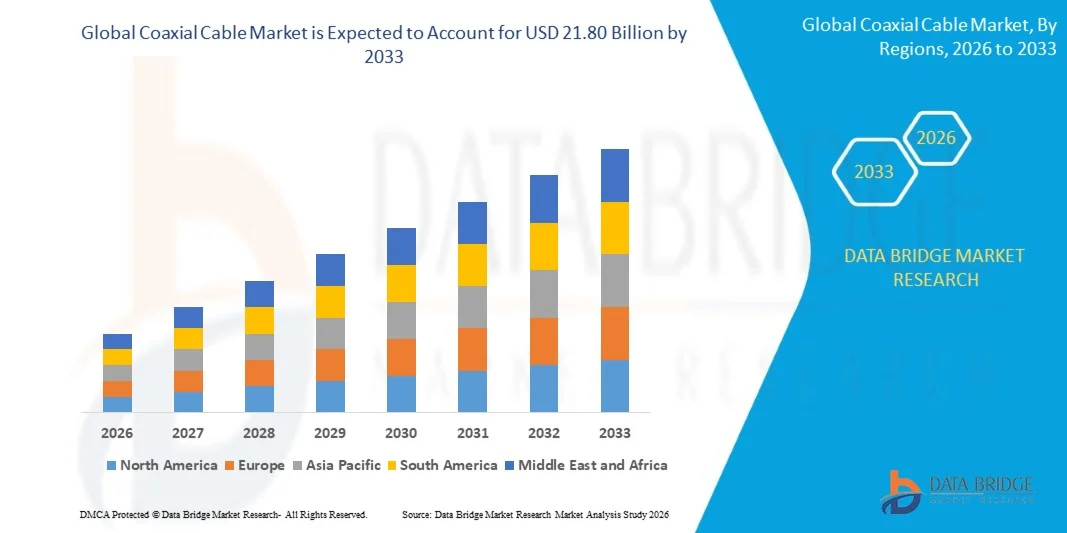
The Coaxial Cable Market was valued at USD 15.02 Billion in 2025 and is projected to reach USD 21.80 Billion by 2033, growing at a CAGR of 4.77% from 2026 to 2033. The market is experiencing consistent growth driven by rising demand for high-speed broadband connectivity, expanding cable television infrastructure, and increasing adoption of hybrid fiber-coax networks across developed and emerging economies. Continuous upgrades in telecom infrastructure and growing consumption of digital video content are further strengthening market expansion across residential, commercial, and industrial applications.
The increasing global shift toward high-bandwidth communication networks, combined with rapid digitalization and growing internet penetration, is significantly driving demand for coaxial cable systems. Telecom operators and internet service providers are increasingly deploying advanced coaxial-based last-mile connectivity solutions to support data-heavy applications such as streaming, cloud computing, and online gaming. In addition, ongoing modernization of legacy communication infrastructure and rising investments in broadband expansion projects are further accelerating market growth across key regions.
Key Market Trends & Insights
- North America dominated the Coaxial Cable Market with the largest revenue share of 45.5% in 2025, supported by highly developed cable television infrastructure, strong broadband penetration, and extensive deployment of hybrid fiber coax networks
- The video distribution segment led the market with a 48% share in 2025, driven by strong demand from cable television and broadcast networks
- Asia-Pacific is expected to be the fastest-growing region at a CAGR of 7.3% from 2026 to 2033, fueled by rapid urbanization, expanding broadband penetration, and strong growth in digital entertainment and internet services
- Internet data transfer is the fastest-growing application type, projected to register a CAGR of 10% from 2026 to 2033, supported by rising global broadband adoption and increasing reliance on high-speed internet services
- The hardline segment dominated the cable type category with a 44% revenue share in 2025, led by its extensive use in long-distance transmission networks and cable television infrastructure
- Cable television industry accounted for 38% of the market in 2025, preferred by widespread reliance on coaxial infrastructure for content distribution and subscriber connectivity
- The RG-6 segment is the fastest-growing cable type category, with a CAGR of 9% from 2026 to 2033, driven by rising broadband penetration and increasing residential internet and video connectivity demand
Market Size & Forecast
- Global Market Value (2025): USD 15.02 Billion
- Expected Market Value (2033): USD 21.80 Billion
- Forecast CAGR (2026–2033): 4.77%
- Leading Region in 2025: North America
- Fastest Growing Region: Asia-Pacific
Report Scope and Coaxial Cable Market Segmentation
|
Attributes |
Coaxial Cable Key Market Insights |
|
Segments Covered |
|
|
Countries Covered |
North America · U.S. · Canada · Mexico Europe · Germany · France · U.K. · Netherlands · Switzerland · Belgium · Russia · Italy · Spain · Turkey · Rest of Europe Asia-Pacific · China · Japan · India · South Korea · Singapore · Malaysia · Australia · Thailand · Indonesia · Philippines · Rest of Asia-Pacific Middle East and Africa · Saudi Arabia · U.A.E. · South Africa · Egypt · Israel · Rest of Middle East and Africa South America · Brazil · Argentina · Rest of South America |
|
Key Market Players |
· Belden Inc. (U.S.) · AWC Allied Wire & Cable, Inc. (U.S.) · Grupo General Cable Sistemas (Spain) · LS Cable & System Ltd. (South Korea) · TE Connectivity (Switzerland) · Coleman Cables & Wire (U.S.) · Nexans (France) · Infinite Electronics International, Inc. (U.S.) · Prysmian Group (Italy) · Alpha Wire (U.S.) · Kingsignal Technology Co., Ltd. (China) · Hengxin Technology Ltd. (China) · Shenyu Communication (China) · Sumitomo Electric Industries Ltd. (Japan) · W. L. Gore & Associates, Inc. (U.S.) · Trigiant Group Ltd. (China) · Habia Cable AB (Sweden) · CommScope (U.S.) |
|
Market Opportunities |
· Expansion of 5G Backhaul and Hybrid Network Deployments · Rising Demand for Digital Broadcasting and Streaming Infrastructure Upgrades · Growth In Industrial and Military RF Communication Applications |
|
Value Added Data Infosets |
In addition to the insights on market scenarios such as market value, growth rate, segmentation, geographical coverage, and major players, the market reports curated by the Data Bridge Market Research also include in-depth expert analysis, geographically represented company-wise production and capacity, network layouts of distributors and partners, detailed and updated price trend analysis and deficit analysis of supply chain and demand. |
Coaxial Cable Market Trends
Trend: Rising Adoption of Hybrid Fiber-Coax Network Infrastructure
The Coaxial Cable market is witnessing a strong trend toward hybrid fiber-coax (HFC) network adoption as telecom operators upgrade legacy broadband systems to support higher bandwidth and improved signal reliability. HFC architecture combines fiber backbone efficiency with coaxial last-mile connectivity, enabling cost-effective network modernization without full infrastructure replacement. This trend is particularly strong in North America and Europe, where established cable TV and broadband networks are being continuously upgraded to support 4K/8K streaming and high-speed internet demand.
Companies such as Comcast Corporation are extensively deploying HFC-based DOCSIS 4.0 upgrades across their broadband infrastructure in the U.S., enhancing multi-gigabit connectivity while maintaining existing coaxial last-mile networks.
Coaxial Cable Market Dynamics
Key Market Driver: Growing Broadband and High-Speed Internet Demand
The increasing global demand for high-speed internet services is a primary driver for the Coaxial Cable market, supported by rapid expansion of streaming platforms, cloud computing, and digital communication services. Telecom operators and internet service providers are upgrading coaxial-based broadband networks to deliver higher data throughput and stable connectivity for residential and enterprise users. Rising smartphone penetration and digital content consumption are further accelerating infrastructure investments in hybrid broadband systems.
Companies such as Charter Communications are expanding Spectrum broadband services across the U.S., leveraging coaxial-based infrastructure upgrades to support multi-gigabit internet speeds and growing consumer bandwidth demand.
Key Restraint/Challenge: Increasing Competition from Fiber Optic Technology Advancements
A major challenge for the Coaxial Cable market is the rapid advancement and adoption of fiber optic technology, which offers significantly higher bandwidth, lower latency, and longer transmission distances compared to coaxial systems. Telecom operators are increasingly shifting toward full-fiber networks (FTTH) in greenfield deployments, limiting long-term coaxial expansion potential in certain regions. This technological shift is intensifying competitive pressure on coaxial cable manufacturers and reducing market share in new infrastructure projects.
Companies such as AT&T Inc. have been accelerating fiber network expansion across the U.S., gradually transitioning customers from legacy coaxial-based systems to fiber-to-the-home architectures to improve network performance and scalability.
Key Market Opportunity: Growth In Industrial and Military RF Communication Applications
The Coaxial Cable market is benefiting from increasing demand in industrial automation, defense systems, aerospace, and RF communication applications where high-frequency signal integrity is critical. Coaxial cables remain essential in radar systems, secure military communications, broadcasting, and mission-critical industrial networks due to their shielding efficiency and durability. Growing defense modernization programs and expansion of industrial IoT infrastructure are further strengthening this opportunity segment.
Companies such as Raytheon Technologies are utilizing high-performance coaxial and RF interconnect solutions in advanced radar and defense communication systems, supporting reliable signal transmission in complex electronic warfare and aerospace environments.
Coaxial Cable Market Scope
The coaxial cable market is segmented on the basis of cable type, application, and end user.
- By Cable Type
On the basis of cable type, the Coaxial Cable Market is segmented into Hardline, RG-6, Triaxial Cable, Radiating, and Others. The Hardline segment dominated the market with the largest share of 44% in 2025, driven by its extensive use in long-distance transmission networks and cable television infrastructure. Its superior shielding capability and low signal loss make it highly suitable for high-frequency applications across urban and industrial communication networks. Strong deployment in backbone broadcasting systems and legacy telecom infrastructure further supports its leadership position. Continuous upgrades in broadband distribution networks across developed regions reinforce sustained demand.
The RG-6 segment is projected to register the fastest growth at a CAGR of 9% from 2026 to 2033, driven by rising broadband penetration and increasing residential internet and video connectivity demand. Its compatibility with high-speed internet and satellite television systems makes it widely preferred in last-mile distribution networks. Expanding digital streaming consumption and fiber-coax hybrid deployments are accelerating adoption across emerging economies. Growing ISP investments in upgraded home connectivity infrastructure further strengthen segment expansion. Increasing demand for cost-effective and efficient indoor cabling solutions continues to drive growth momentum.
- By Application
On the basis of application, the Coaxial Cable Market is segmented into Internet Data Transfer, Video Distribution, and Radio Frequency Transfer. The Video Distribution segment dominated the market with a share of 48% in 2025, supported by strong demand from cable television and broadcast networks. Its ability to deliver stable high-quality signal transmission across large subscriber bases enhances its widespread use. Established cable TV infrastructure in North America and parts of Asia-Pacific continues to sustain high utilization levels. Continuous demand for HD and UHD content distribution further reinforces segment dominance.
The Internet Data Transfer segment is projected to register the fastest growth at a CAGR of 10% from 2026 to 2033, driven by rising global broadband adoption and increasing reliance on high-speed internet services. Expansion of hybrid fiber-coax networks is improving bandwidth efficiency and supporting higher data throughput. Growing cloud usage, remote working trends, and digital service consumption are accelerating infrastructure upgrades. ISPs are increasingly investing in advanced coaxial-based last-mile connectivity solutions. Expanding digital economies across Asia-Pacific and emerging markets further support rapid segment growth.
- By End User
On the basis of end user, the Coaxial Cable Market is segmented into Cable Television Industry, Military and Aerospace, Internet Service Providers, Telephone Network Operators, Communication Equipment Manufacturers, and Others. The Cable Television Industry segment dominated the market with a share of 38% in 2025, driven by widespread reliance on coaxial infrastructure for content distribution and subscriber connectivity. Established cable networks continue to depend on coaxial systems for reliable signal delivery in urban and semi-urban regions. Strong demand for multi-channel broadcasting and premium content services supports sustained usage. Ongoing infrastructure maintenance and upgrades in legacy cable systems further strengthen segment dominance.
The Internet Service Providers segment is projected to register the fastest growth at a CAGR of 8% from 2026 to 2033, driven by rising broadband demand and rapid expansion of high-speed internet services. ISPs are increasingly deploying hybrid fiber-coax architectures to enhance last-mile connectivity performance. Growing demand for low-latency internet services for streaming, gaming, and enterprise applications is accelerating adoption. Expanding digital transformation initiatives across developing regions are further boosting infrastructure investments. Continuous network modernization efforts by telecom operators reinforce strong long-term growth potential.
Coaxial Cable Market Regional Analysis
North America dominated the coaxial cable market and accounted for the largest revenue share of 45.5% in 2025, driven by highly developed cable television infrastructure, strong broadband penetration, and extensive deployment of hybrid fiber coax networks. The region benefits from early adoption of advanced communication technologies and continuous upgrades of legacy telecom systems across residential and commercial sectors. Strong demand for high-speed internet, video streaming, and RF signal distribution is further supporting widespread coaxial cable usage. In addition, the presence of major cable operators, telecom providers, and communication equipment manufacturers reinforces North America’s leadership position in the global market.
U.S. Coaxial Cable Market Insight
The U.S. Coaxial Cable market is experiencing steady growth driven by large-scale broadband expansion, increasing demand for high-definition video distribution, and ongoing upgrades of cable TV infrastructure. Service providers are actively investing in hybrid fiber-coax architectures to improve network bandwidth and last-mile connectivity performance. Strong demand from internet service providers and telecom operators is further accelerating adoption across urban and suburban regions. In addition, rising consumption of streaming services and digital content is supporting continued reliance on coaxial-based distribution networks.
Canada Coaxial Cable Market Insight
The Canada Coaxial Cable market is witnessing stable growth supported by expanding broadband connectivity, increasing digital service consumption, and rising investments in telecom infrastructure modernization. Cable television operators and ISPs are increasingly adopting upgraded coaxial systems to enhance service reliability and data transmission efficiency. Strong demand for high-speed internet in residential and enterprise sectors is further driving market expansion. In addition, growing adoption of hybrid network models and continued focus on improving rural connectivity are supporting long-term market growth in Canada.
Europe Coaxial Cable Market Insight
The Europe Coaxial Cable market is expanding steadily due to strong telecommunications infrastructure, high penetration of cable television services, and increasing demand for broadband internet services. The region benefits from continuous modernization of legacy communication networks and integration of advanced hybrid fiber-coax systems. Enterprises across media, telecom, and broadcasting sectors are increasingly relying on coaxial cables for stable signal transmission. In addition, rising demand for high-quality video distribution and regulatory support for digital connectivity are supporting regional market growth.
U.K. Coaxial Cable Market Insight
The U.K. Coaxial Cable market is growing steadily, driven by strong broadband adoption, high digital media consumption, and increasing investments in network infrastructure upgrades. Telecom operators and ISPs are focusing on enhancing last-mile connectivity through hybrid coaxial-fiber solutions. Demand from cable television providers and streaming platforms is further supporting sustained usage of coaxial infrastructure. In addition, continuous digital transformation across residential and enterprise sectors is reinforcing market expansion in the U.K.
Germany Coaxial Cable Market Insight
The Germany Coaxial Cable market is expanding due to strong industrial communication requirements, advanced broadband infrastructure, and increasing demand for high-quality video and RF signal transmission. Enterprises across manufacturing, automotive, and broadcasting sectors are adopting reliable coaxial systems for stable connectivity. The country’s focus on digital infrastructure development and network modernization is further supporting market growth. In addition, rising integration of hybrid fiber-coax networks is enhancing bandwidth efficiency and strengthening overall adoption in Germany.
Asia-Pacific Coaxial Cable Market Insight
The Asia-Pacific Coaxial Cable market is expected to register the fastest growth with a CAGR of 7.3% from 2026 to 2033, driven by rapid urbanization, expanding broadband penetration, and strong growth in digital entertainment and internet services. Increasing investments in telecom infrastructure and large-scale deployment of hybrid network architectures are significantly boosting demand. Countries such as China, India, Japan, and South Korea are witnessing strong expansion in cable television and broadband services. In addition, rising smartphone usage and digital content consumption are accelerating regional market growth.
Japan Coaxial Cable Market Insight
The Japan Coaxial Cable market is witnessing steady growth supported by advanced telecommunications infrastructure, high-speed broadband adoption, and strong demand for digital broadcasting services. Enterprises are increasingly upgrading legacy systems with hybrid fiber-coax solutions to enhance network efficiency and reliability. The country’s strong focus on technological innovation and high-quality signal transmission is further supporting market expansion. In addition, growing demand for IPTV and digital media services is reinforcing coaxial cable usage across multiple sectors.
China Coaxial Cable Market Insight
The China Coaxial Cable market is growing rapidly due to massive broadband expansion, strong cable television penetration, and continuous investment in telecom infrastructure development. Large-scale deployment of hybrid fiber-coax networks is improving internet speed and connectivity across urban and rural regions. Strong demand from ISPs, broadcasters, and communication service providers is further driving market growth. In addition, rapid digitalization, rising streaming consumption, and expansion of smart city projects are significantly accelerating market adoption in China.
Coaxial Cable Market Share
The coaxial cable industry is primarily led by well-established companies, including:
- Belden Inc. (U.S.)
- AWC Allied Wire & Cable, Inc. (U.S.)
- Grupo General Cable Sistemas (Spain)
- LS Cable & System Ltd. (South Korea)
- TE Connectivity (Switzerland)
- Coleman Cables & Wire (U.S.)
- Nexans (France)
- Infinite Electronics International, Inc. (U.S.)
- Prysmian Group (Italy)
- Alpha Wire (U.S.)
- Kingsignal Technology Co., Ltd. (China)
- Hengxin Technology Ltd. (China)
- Shenyu Communication (China)
- Sumitomo Electric Industries Ltd. (Japan)
- L. Gore & Associates, Inc. (U.S.)
- Trigiant Group Ltd. (China)
- Habia Cable AB (Sweden)
- CommScope (U.S.)
Latest Developments in Coaxial Cable Market
- In July 2024, Prysmian Group completed its acquisition of Encore Wire, significantly reshaping its position in the North American cable ecosystem. The development strengthened Prysmian’s manufacturing scale and distribution depth across communication and low-voltage cable segments that support coaxial-based broadband infrastructure. It enhanced supply chain efficiency and improved its ability to serve growing demand for high-speed connectivity networks in the U.S. market. The acquisition also intensified consolidation trends within the global cable industry, increasing competitive pressure on regional cable producers
- In March 2024, Amphenol Corporation completed its acquisition of PCTEL Inc., expanding its capabilities in RF, antenna, and wireless connectivity solutions closely aligned with coaxial cable applications. The integration strengthened Amphenol’s portfolio in high-frequency signal transmission used across telecom, industrial IoT, and broadband networks. It also improved its position in next-generation communication infrastructure where coaxial and hybrid systems remain critical. This move reinforced innovation in high-performance interconnect solutions supporting data-heavy applications
- In October 2023, CommScope finalized the divestiture of its Home Networks business to Vantiva, marking a strategic shift toward core connectivity and broadband infrastructure markets. The transaction reduced exposure to legacy consumer equipment segments while allowing greater focus on network infrastructure that still relies on coaxial distribution in hybrid deployments. It strengthened CommScope’s alignment with fiber and advanced broadband technologies used in modern communication systems. The move also supported portfolio optimization across high-growth telecom infrastructure segments
- In June 2023, Nexans advanced its strategic expansion in cable and electrification markets through continued investments and targeted portfolio strengthening initiatives across communication and energy infrastructure segments. These developments enhanced its ability to supply advanced cable systems supporting broadband and hybrid fiber-coax networks. The expansion improved its competitiveness in delivering high-performance connectivity solutions for telecom operators and utilities. It also reinforced Nexans’ positioning in long-term digital infrastructure growth driven by global connectivity demand
- In September 2023, Belden Inc. expanded its industrial and broadcast connectivity portfolio through continued acquisition-led growth and product innovation focused on high-reliability signal transmission. The development strengthened its presence in coaxial and RF cable applications used in broadcasting, data centers, and industrial communication systems. It improved its capability to serve mission-critical networks requiring low-loss and high-bandwidth performance. This expansion supported growing global demand for secure and high-performance communication infrastructure across multiple end-use industries
SKU-
Get online access to the report on the World's First Market Intelligence Cloud

- Interactive Data Analysis Dashboard
- Company Analysis Dashboard for high growth potential opportunities
- Research Analyst Access for customization & queries
- Competitor Analysis with Interactive dashboard
- Latest News, Updates & Trend analysis
- Harness the Power of Benchmark Analysis for Comprehensive Competitor Tracking
Global Coaxial Cable Market, Supply Chain Analysis and Ecosystem Framework
To support market growth and help clients navigate the impact of geopolitical shifts, DBMR has integrated in-depth supply chain analysis into its Global Coaxial Cable Market research reports. This addition empowers clients to respond effectively to global changes affecting their industries. The supply chain analysis section includes detailed insights such as Global Coaxial Cable Market consumption and production by country, price trend analysis, the impact of tariffs and geopolitical developments, and import and export trends by country and HSN code. It also highlights major suppliers with data on production capacity and company profiles, as well as key importers and exporters. In addition to research, DBMR offers specialized supply chain consulting services backed by over a decade of experience, providing solutions like supplier discovery, supplier risk assessment, price trend analysis, impact evaluation of inflation and trade route changes, and comprehensive market trend analysis.
Research Methodology
Data collection and base year analysis are done using data collection modules with large sample sizes. The stage includes obtaining market information or related data through various sources and strategies. It includes examining and planning all the data acquired from the past in advance. It likewise envelops the examination of information inconsistencies seen across different information sources. The market data is analysed and estimated using market statistical and coherent models. Also, market share analysis and key trend analysis are the major success factors in the market report. To know more, please request an analyst call or drop down your inquiry.
The key research methodology used by DBMR research team is data triangulation which involves data mining, analysis of the impact of data variables on the market and primary (industry expert) validation. Data models include Vendor Positioning Grid, Market Time Line Analysis, Market Overview and Guide, Company Positioning Grid, Patent Analysis, Pricing Analysis, Company Market Share Analysis, Standards of Measurement, Global versus Regional and Vendor Share Analysis. To know more about the research methodology, drop in an inquiry to speak to our industry experts.
Customization Available
Data Bridge Market Research is a leader in advanced formative research. We take pride in servicing our existing and new customers with data and analysis that match and suits their goal. The report can be customized to include price trend analysis of target brands understanding the market for additional countries (ask for the list of countries), clinical trial results data, literature review, refurbished market and product base analysis. Market analysis of target competitors can be analyzed from technology-based analysis to market portfolio strategies. We can add as many competitors that you require data about in the format and data style you are looking for. Our team of analysts can also provide you data in crude raw excel files pivot tables (Fact book) or can assist you in creating presentations from the data sets available in the report.












