


What is the Coffee Infused Products Market Size and Growth Rate?
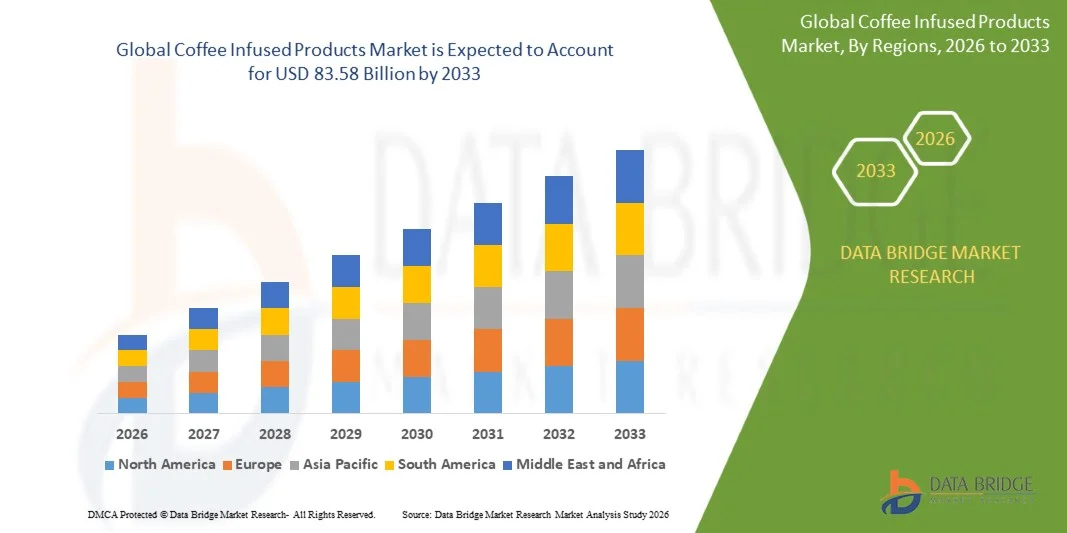
- As per Data Bridge Market Research analysis, the coffee infused products market was valued at USD 45.16 billion in 2025 and is projected to reach USD 83.58 billion by 2033, growing at a CAGR of 8.00% from 2026 to 2033.
- The market is experiencing consistent growth driven by rising consumer demand for coffee-based food, beverage, beauty, and wellness products, increasing preference for natural and functional ingredients, and continuous innovation in coffee-infused product formulations.
- The increasing consumer focus on health, wellness, and premium experiences, combined with growing demand for natural and sustainable ingredients, is compelling manufacturers to expand coffee-infused offerings across food and beverages, cosmetics and personal care, and nutraceuticals. The growing availability of innovative products through online and offline retail channels is further supporting market expansion.
Market Size & Forecast
- Global Market Value (2025): USD 45.16 Billion
- Expected Market Value (2033): USD 83.58 Billion
- Forecast CAGR (2026–2033): 8.00%
- Leading Region in 2025: North America
- Fastest Growing Region: Asia Pacific
What are the Major Takeaways of the Coffee Infused Products Market?
- North America dominated the coffee infused products market with the largest revenue share of 34.52% in 2025, supported by high consumer demand for coffee-based personal-care products, strong beauty and wellness spending, and the presence of established cosmetic brands.
- Asia-Pacific is expected to be the fastest-growing region at a CAGR of 6.24% from 2026 to 2033, fueled by rising disposable incomes, expanding digital commerce, and increasing consumer interest in coffee-based beauty products.
- The flavours segment led the market with a 35% share in 2025, driven by the extensive use of coffee, vanilla, caramel, hazelnut, chocolate, and other flavour combinations across coffee-infused products.
- Nutraceuticals are the fastest-growing additives type, projected to register a CAGR of 9%, reflecting the surge in demand for functional coffee products that provide benefits beyond taste and caffeine.
- The skin care products segment dominated the type category with a 35.77% revenue share in 2025, led by increasing demand for coffee-infused creams, scrubs, masks, serums, and other formulations.
- Food and beverage accounted for 55% of the market share in 2025, preferred by the extensive incorporation of coffee into beverages, confectionery, bakery products, desserts, snacks, and functional food formulations.
- The pharmaceuticals segment is the fastest-growing application category, with a CAGR of 8.5%, driven by increasing interest in caffeine and coffee-derived bioactive compounds for specialized formulations
Report Scope and Coffee Infused Products Market Segmentation
|
Attributes |
Coffee Infused Products Key Market Insights |
|
Segments Covered |
|
|
Countries Covered |
North America
Europe
Asia-Pacific
Middle East and Africa
South America
|
|
Key Market Players |
|
|
Market Opportunities |
|
|
Value Added Data Infosets |
In addition to the insights on market scenarios such as market value, growth rate, segmentation, geographical coverage, and major players, the market reports curated by the Data Bridge Market Research also include in-depth expert analysis, pricing analysis, brand share analysis, consumer survey, demography analysis, supply chain analysis, value chain analysis, raw material/consumables overview, vendor selection criteria, PESTLE Analysis, Porter Analysis, and regulatory framework |
What is the Key Trend in the Coffee Infused Products Market?
- Coffee-infused products are increasingly moving toward multifunctional and premium formulations, as manufacturers combine coffee with natural flavours, functional ingredients, and convenient formats to address consumers’ demand for differentiated food, beverage, and personal-care experiences.
- For instance, in November 2024, Nestlé launched new Nescafé soluble coffee variants with natural caramel and hazelnut flavours that can be prepared with either hot or cold water, demonstrating the industry's shift toward versatile, flavored, and convenient coffee formats
- Cold and ready-to-drink coffee formats are becoming particularly important, as younger consumers increasingly prefer convenient, customizable beverages that can be consumed at home or on the go.
- Coffee is also expanding beyond traditional beverages into beauty and personal-care products, with coffee extracts, caffeine, coffee oils, and upcycled coffee grounds increasingly incorporated into skincare, haircare, scrubs, masks, and other formulations.
- Sustainability and upcycling are emerging as important product-development themes, with manufacturers using spent coffee grounds and coffee-derived ingredients to develop products that support circular-economy positioning and reduce ingredient waste.
- For instance, in April 2025, Nestlé expanded Nescafé Ready-to-Drink coffee into India, MENA, and Brazil, stating that ready-to-drink coffee was the fastest-growing coffee segment globally and that the expansion targeted young consumers seeking convenient cold coffee options.
- Digital and premium channels are supporting wider adoption, as consumers increasingly discover specialized coffee-infused products through e-commerce, social media, specialty retailers, and direct-to-consumer platforms.
What are the Key Drivers of the Coffee Infused Products Market?
- The growing consumer demand for natural, functional, and wellness-oriented products is increasing the incorporation of coffee, caffeine, coffee extracts, and related ingredients into food, beverages, cosmetics, personal care, and nutraceutical products.
- For instance, in July 2024, Starbucks launched its Protein Drink with Coffee in the U.K., combining Arabica coffee with 20 g of protein per 330 ml bottle and no added sugar. The product was designed around consumers’ active lifestyles and was planned for wider EMEA expansion in 2025, demonstrating the growing convergence of coffee, convenience, and functional nutrition.
- Coffee's antioxidant, energizing, exfoliating, and revitalizing properties are encouraging manufacturers to position coffee-derived ingredients as functional components rather than simply flavoring agents.
- The rapid expansion of ready-to-drink and convenient coffee consumption is creating additional demand for innovative coffee-infused beverages that provide portability, customization, and quick consumption.
- Premiumization is further supporting market growth, as consumers increasingly seek specialty coffee experiences, distinctive flavors, sustainable ingredients, and higher-quality formulations across both beverages and coffee-infused personal-care products.
- For instance, in February 2026, Starbucks and PepsiCo announced Starbucks Coffee & Protein RTD beverages containing 22 g of complete protein, 5 g of prebiotic fiber, five vitamins and minerals, and 2 g of sugar per bottle. The launch directly reflects rising demand for coffee products that combine convenience with nutritional and wellness benefits.
- The growth of e-commerce and specialty retail is improving access to niche coffee-infused products, allowing smaller brands to reach consumers beyond traditional supermarkets and physical specialty stores.
Which Factors are Challenging the Growth of the Coffee Infused Products Market?
- Volatility in coffee bean prices and supply availability remains a major challenge, as coffee-infused product manufacturers remain exposed to fluctuations in the cost and availability of their primary coffee-based raw materials.
- For instance, in April 2025, Rabobank forecast Brazil’s 2025/26 coffee production to decline 6.4% to 62.8 million 60-kg bags, mainly because of dry weather in 2024; arabica production was projected to fall 13.6% to around 38 million bags. Such supply disruptions can increase raw-material costs and create sourcing challenges for manufacturers of coffee-infused foods, beverages, cosmetics, and personal-care products.
- Climate change and adverse weather conditions in major coffee-producing regions can disrupt production, creating supply uncertainty and increasing procurement and manufacturing costs for companies using coffee as an ingredient.
- Premium coffee and specialty coffee-infused formulations can carry higher production costs, particularly when manufacturers use high-quality beans, certified ingredients, specialized extracts, sustainable packaging, or additional functional ingredients.
- Product formulation can also be challenging, because manufacturers must maintain coffee aroma, taste, caffeine stability, texture, and shelf life while incorporating additional ingredients into beverages, foods, cosmetics, or personal-care products.
- For instance, in September 2025, Brazilian coffee roasters 3 Corações and Melitta increased coffee prices by 10%–15% because of sharply higher raw-bean costs. Reuters reported that arabica prices had risen more than 20% in 2025 after increasing 70% in 2024, while raw coffee beans account for approximately 40% of the wholesale cost of roast and ground coffee, demonstrating how coffee-input volatility can increase production costs for coffee-infused products.
- Intense competition across established coffee, food, beverage, beauty, and wellness categories makes differentiation increasingly difficult, requiring brands to invest in innovation, branding, sustainable sourcing, and consumer education.
How is the Coffee Infused Products Market Segmented?
The coffee infused products market is segmented on the basis of additives, type, product type, application, and distribution channel.
- By Additives
On the basis of additives, the coffee infused products market is segmented into flavours, artificial sweeteners, acidulants, nutraceuticals, and preservatives. The flavours segment dominated the market with 35% share in 2025, supported by the extensive use of coffee, vanilla, caramel, hazelnut, chocolate, and other flavour combinations across coffee-infused products. Flavouring ingredients help manufacturers differentiate products and improve sensory appeal. The segment is particularly important in beverages, confectionery, bakery products, and personal-care formulations. Increasing consumer interest in premium and distinctive flavour profiles is further supporting product innovation. The widespread availability of flavoured coffee products across retail and food-service channels continues to strengthen this segment's position.
The nutraceuticals segment is projected to be the fastest-growing additive category at 9% CAGR, driven by increasing demand for functional coffee products that provide benefits beyond taste and caffeine. Manufacturers are increasingly combining coffee with vitamins, minerals, botanical extracts, adaptogens, proteins, and other functional ingredients. These formulations appeal to consumers seeking convenient products associated with energy, focus, wellness, and active lifestyles. Functional coffee innovation is also expanding into ready-to-drink beverages, nutritional products, and wellness formulations. Growing consumer awareness of functional ingredients is encouraging manufacturers to move beyond conventional coffee formulations. The increasing overlap between coffee, nutrition, and wellness is therefore expected to accelerate demand for nutraceutical additives.
- By Type
On the basis of type, the coffee infused products market is segmented into hair care products, skin care products, and perfumes & fragrance. The skin care products segment dominated the market with a 35.77% share in 2025, supported by increasing demand for coffee-infused creams, scrubs, masks, serums, and other formulations. Coffee and caffeine are increasingly used in skincare because of their antioxidant, exfoliating, and revitalizing properties. Consumers are also showing greater preference for naturally derived and multifunctional beauty ingredients. The availability of coffee-based skincare products across mass, premium, and specialty channels is expanding the segment's consumer base. Increasing interest in clean beauty and ingredient transparency is providing further support to coffee-infused skincare demand.
The hair care products segment is projected to be the fastest-growing type at a 6.3% CAGR from 2026 to 2033, reflecting rising interest in caffeine-based shampoos, conditioners, scalp treatments, serums, and hair masks. Coffee-derived ingredients are increasingly incorporated into formulations positioned around scalp care and hair-strengthening benefits. Changing lifestyles and growing consumer awareness of natural haircare ingredients are supporting demand for coffee-based products. Brands are expanding their portfolios to address concerns such as hair fall, scalp health, dryness, and damaged hair. The growing popularity of functional beauty products is also encouraging consumers to seek products combining cosmetic and perceived wellness benefits. Continued product innovation and expanding availability through online and specialty channels are expected to maintain the segment's rapid growth.
- By Product Type
On the basis of product type, the coffee infused products market is segmented into whole-bean, ground coffee, instant coffee, and coffee pods and capsules. The ground coffee segment dominated the market with 35% share in 2025, supported by its established consumer base and widespread use across households, cafés, restaurants, and specialty coffee applications. Ground coffee provides consumers with flexibility across brewing methods and allows greater control over coffee strength and flavour. The segment benefits from continuing interest in freshly prepared and premium coffee experiences. Growth in home brewing and specialty coffee consumption is further supporting demand. Its broad availability through supermarkets, specialty retailers, convenience stores, and online platforms also strengthens its market position. Established consumer familiarity makes ground coffee one of the most important formats within the market.
The coffee pods and capsules segment is projected to be the fastest-growing product type at 9% CAGR during forecast period, driven by rising demand for convenient, consistent, and portion-controlled coffee preparation. Pods and capsules allow consumers to prepare coffee quickly while reducing preparation complexity. Manufacturers are expanding capsule portfolios with premium blends, specialty coffees, flavoured varieties, and single-origin options. Increasing penetration of capsule-based coffee machines is supporting recurring demand for compatible products. The format is particularly attractive to urban households and consumers seeking premium coffee experiences at home. E-commerce is also improving consumer access to a wider selection of pods and capsules, supporting the segment's continued expansion.
- By Application
On the basis of application, the coffee infused products market is segmented into food and beverage, cosmetics, personal care, and pharmaceuticals. The food and beverage segment dominated the market with 55% share in 2025, owing to the extensive incorporation of coffee into beverages, confectionery, bakery products, desserts, snacks, and functional food formulations. Coffee provides both flavour and functional characteristics, making it suitable for a wide variety of consumer products. The expansion of ready-to-drink coffee and cold coffee is further increasing the use of coffee ingredients. Manufacturers are also combining coffee with proteins, vitamins, botanical ingredients, and other functional components. Rising demand for convenient and premium food and beverage products continues to support this segment. Strong consumer familiarity with coffee also provides manufacturers with a broad base for introducing innovative coffee-infused products.
The pharmaceuticals segment is projected to be the fastest-growing application at 8.5% CAGR during forecast period, supported by increasing interest in caffeine and coffee-derived bioactive compounds for specialized formulations. Caffeine already has established applications in pharmaceutical products because of its stimulant properties. Research into coffee-derived compounds is also increasing interest in their antioxidant and other biological characteristics. The growing convergence between functional foods, nutraceuticals, and health-oriented products is creating additional opportunities for coffee-derived ingredients. Manufacturers are increasingly exploring formulations designed around specific functional characteristics rather than coffee flavour alone. However, pharmaceutical applications require greater regulatory and formulation expertise than food and cosmetic products. Increasing research and innovation in coffee-derived functional ingredients is expected to support this segment's growth.
- By Distribution Channel
On the basis of distribution channel, the coffee infused products market is segmented into supermarkets/hypermarkets, specialty stores, convenience stores, and others. The supermarkets/hypermarkets segment dominated the market with 40% share in 2025, supported by broad product availability, extensive retail networks, and high consumer traffic. These outlets provide consumers with convenient access to packaged coffee, beverages, food products, cosmetics, and personal-care products. Large retailers also offer manufacturers substantial shelf visibility and geographic reach. Promotional campaigns, discounts, private-label offerings, and seasonal displays further encourage purchases through these channels. Supermarkets and hypermarkets are particularly important for mass-market products that depend on high-volume distribution. Their established infrastructure and ability to offer multiple brands and formats continue to support their leading position.
The specialty stores segment is projected to be the fastest-growing distribution channel at 7.5% CAGR during forecast period, supported by rising consumer interest in premium coffee, specialty formulations, natural ingredients, and differentiated products. Specialty retailers provide manufacturers with opportunities to communicate detailed product attributes and establish premium positioning. These stores are particularly relevant for specialty coffee, natural cosmetics, wellness products, and premium coffee-infused formulations. Increasing consumer interest in ingredient transparency and product origin is also benefiting specialized retail environments. Specialty coffee shops, beauty stores, wellness retailers, and niche outlets are creating additional consumer touchpoints for coffee-infused products.
Which Region Holds the Largest Share of the Coffee Infused Products Market?
- North America dominated the coffee infused products market with the largest revenue share of 34.52% in 2025, supported by high consumer demand for coffee-based personal-care products, strong beauty and wellness spending, and the presence of established cosmetic brands.
- The region also benefits from high consumer awareness of functional and natural ingredients, strong retail and e-commerce networks, and the presence of established coffee and personal-care brands. Increasing demand for innovative coffee-based formulations, wellness-oriented products, and convenient consumption formats continues to strengthen North America's leadership position in the global market.
U.S. Coffee Infused Products Market Insight
The U.S. coffee infused products market is witnessing strong growth due to rising consumer demand for innovative coffee-based food, beverage, beauty, and personal care products. The country’s mature coffee culture, established food and beverage industry, and strong consumer spending on premium products are creating favorable conditions for market expansion. Increasing awareness of functional ingredients and the perceived antioxidant, energizing, and skin-revitalizing properties of coffee is further supporting product adoption. The expansion of specialty retail, supermarkets, and e-commerce platforms is also improving product accessibility and accelerating market penetration across the U.S.
Asia-Pacific Coffee Infused Products Market Insight
The Asia-Pacific coffee infused products market is expected to witness rapid growth, driven by increasing coffee consumption, expanding beauty and personal care industries, and rising consumer awareness of coffee-based products across countries such as China, India, and Japan. Rapid urbanization and changing lifestyles are increasing demand for convenient, functional, and premium coffee-infused products across food, beverage, cosmetics, and personal care applications. Growing consumer preference for natural and plant-based ingredients is also encouraging manufacturers to incorporate coffee extracts and derivatives into innovative formulations.. Increasing product launches and investments by domestic and international brands are further accelerating regional market development.
Japan Coffee Infused Products Market Insight
The Japan coffee infused products market is witnessing consistent growth due to rising consumer interest in premium coffee products, natural ingredients, and innovative beauty and personal care formulations. Japan’s sophisticated consumer market and strong preference for high-quality products are encouraging manufacturers to develop specialized coffee-infused skincare, hair care, fragrance, and food and beverage offerings. Consumers are increasingly attracted to multifunctional products that combine convenience with wellness and cosmetic benefits. The continued development of premium retail channels, specialty stores, and online shopping platforms is further contributing to market growth in Japan.
China Coffee Infused Products Market Insight
The China coffee infused products market is growing rapidly, driven by increasing coffee consumption, expanding urban populations, and rising consumer interest in innovative food, beverage, cosmetics, and personal care products. The rapid development of China’s coffee culture, particularly among younger urban consumers, is creating opportunities for manufacturers to introduce new coffee-based formulations and consumption formats. Growing adoption of premium, natural, and functional ingredient-based products is significantly boosting market demand across multiple applications. Rising disposable incomes, changing lifestyle preferences, and increasing awareness of coffee’s functional and cosmetic benefits are positioning China as a key growth market globally.
U.K. Coffee Infused Products Market Insight
The U.K. coffee infused products market is experiencing steady growth, supported by rising consumer demand for premium coffee products, natural cosmetics, and innovative personal care formulations. The country’s established coffee culture and strong demand for specialty and premium products are encouraging manufacturers to diversify coffee-infused offerings beyond traditional beverages. Increasing preference for functional, sustainable, and naturally derived ingredients is contributing to the development of coffee-infused skincare, hair care, food, and beverage products.. Growing interest in wellness, premiumization, and multifunctional products is expected to create further opportunities for coffee-infused product manufacturers in the U.K.
Germany Coffee Infused Products Market Insight
The Germany coffee infused products market is expanding steadily due to the country’s strong food and beverage industry, growing demand for natural ingredients, and increasing adoption of innovative cosmetics and personal care products. Germany’s well-established consumer goods sector provides a favorable environment for manufacturers developing coffee-based formulations across food, beverages, skincare, and hair care. Consumers are increasingly seeking functional, premium, sustainable, and naturally derived products incorporating coffee-based ingredients across various applications. Continuous product innovation, established retail networks, and increasing interest in wellness-oriented formulations are further driving market growth in Germany.
Which are the Top Companies in Coffee Infused Products Market?
The coffee infused products industry is primarily led by well-established companies, including:
- Nestlé (Switzerland)
- Starbucks Coffee Company (U.S.)
- Tchibo GmbH (Germany)
- LUIGI LAVAZZA SPA (Italy)
- illycaffè S.p.A. (Italy)
- UCC UESHIMA COFFEE CO., LTD. (Japan)
- R. Torre & Company (U.S.)
- Death Wish Coffee (U.S.)
- Four Sigmatic (U.S.)
- Chamberlain Coffee Inc (U.S.)
- Counter Culture Coffee (U.S.)
- Black Rifle Coffee Company (U.S.)
- Dutch Bros Coffee (U.S.)
- Nero Holdings Ltd (U.K.)
- VERVE COFFEE ROASTERS (U.S.)
- Frank Body (Australia)
- UpCircle Beauty (U.K.)
- PEP TECHNOLOGIES PVT. LTD. (India)
- Juicy Chemistry (India)
- Dr. Squatch, LLC (U.S.)
What are Latest Developments in Coffee Infused Products Market?
- In September 2025, Starbucks announced the introduction of Protein Lattes and Protein Cold Foam as part of its expanded health and wellness-focused beverage portfolio. The new offerings combine Starbucks coffee beverages with protein-enhanced components, allowing customers to add functional nutrition to familiar coffee formats. The Protein Cold Foam was designed as a new topping option for cold beverages, while Protein Lattes extended the concept into hot and iced coffee. The launch reflects the growing integration of functional nutrition with everyday coffee consumption and Starbucks’ efforts to develop beverages aligned with evolving wellness preferences.
- In March 2024, Indian D2C beverage brand Bevzilla introduced The Beauty Coffee, a coffee product formulated with marine collagen, biotin, and vitamin E. The product was positioned to combine everyday coffee consumption with beauty and wellness benefits, targeting consumers interested in convenient self-care solutions. The formulation uses Arabica coffee and was offered in multiple flavors, while the addition of collagen and biotin extended coffee into the functional beauty beverage category. The launch demonstrates the expansion of coffee-infused products beyond conventional beverages toward products designed around wellness, beauty, and multifunctional consumption.
- In October 2022, Indian personal-care brand mCaffeine announced its largest body-care launch, introducing nine new coffee-based products. The portfolio included Coffee Shower Oil Body Wash, Hydrating Coffee Body Serum, Coffee Body Shimmer, Coffee Whipped Cream Body Wash, Coffee Bath Bomb, Coffee Bathing Shower Jelly, Coffee Bath Salt, an All-in-One Coffee Body Mask, and assorted coffee bathing soaps. The expansion broadened the application of coffee from facial skincare into full-body personal care and shower products. The launch also reinforced the trend toward coffee as a multifunctional beauty ingredient used in cleansing, exfoliation, hydration, and body-care formulations.
- In February 2023, Rage Coffee and Keventers collaborated to launch a new Hazelnut Cold Coffee, combining Rage Coffee’s caffeine-focused beverage expertise with Keventers’ milkshake portfolio. The new beverage was introduced in bottled formats and made available through Keventers outlets across major Indian cities. The collaboration highlighted the growing use of flavor innovation and brand partnerships to develop differentiated coffee beverages for younger and convenience-oriented consumers. It also demonstrated how coffee brands are extending their portfolios through ready-to-drink and indulgent formats rather than relying only on traditional hot coffee products.
- In August 2021, SUGAR Cosmetics launched its Coffee Culture skincare range, introducing four coffee-focused products: Coffee Culture Eye Firming Cream, Pore Purifying Mask, Brightening Serum, and Lip Scrub. The products incorporated coffee-derived ingredients such as coffee seed oil and green coffee extract alongside other skincare ingredients. The launch expanded coffee’s role from a beverage ingredient into targeted skincare applications focused on cleansing, hydration, brightening, and under-eye care. This development highlighted the increasing convergence between coffee culture and beauty products and supported the broader diversification of coffee-infused products into personal-care applications.

- Interactive Data Analysis Dashboard
- Company Analysis Dashboard for high growth potential opportunities
- Research Analyst Access for customization & queries
- Competitor Analysis with Interactive dashboard
- Latest News, Updates & Trend analysis
- Harness the Power of Benchmark Analysis for Comprehensive Competitor Tracking
Global Coffee Infused Products Market, Supply Chain Analysis and Ecosystem Framework
To support market growth and help clients navigate the impact of geopolitical shifts, DBMR has integrated in-depth supply chain analysis into its Global Coffee Infused Products Market research reports. This addition empowers clients to respond effectively to global changes affecting their industries. The supply chain analysis section includes detailed insights such as Global Coffee Infused Products Market consumption and production by country, price trend analysis, the impact of tariffs and geopolitical developments, and import and export trends by country and HSN code. It also highlights major suppliers with data on production capacity and company profiles, as well as key importers and exporters. In addition to research, DBMR offers specialized supply chain consulting services backed by over a decade of experience, providing solutions like supplier discovery, supplier risk assessment, price trend analysis, impact evaluation of inflation and trade route changes, and comprehensive market trend analysis.
Data collection and base year analysis are done using data collection modules with large sample sizes. The stage includes obtaining market information or related data through various sources and strategies. It includes examining and planning all the data acquired from the past in advance. It likewise envelops the examination of information inconsistencies seen across different information sources. The market data is analysed and estimated using market statistical and coherent models. Also, market share analysis and key trend analysis are the major success factors in the market report. To know more, please request an analyst call or drop down your inquiry.
The key research methodology used by DBMR research team is data triangulation which involves data mining, analysis of the impact of data variables on the market and primary (industry expert) validation. Data models include Vendor Positioning Grid, Market Time Line Analysis, Market Overview and Guide, Company Positioning Grid, Patent Analysis, Pricing Analysis, Company Market Share Analysis, Standards of Measurement, Global versus Regional and Vendor Share Analysis. To know more about the research methodology, drop in an inquiry to speak to our industry experts.
Data Bridge Market Research is a leader in advanced formative research. We take pride in servicing our existing and new customers with data and analysis that match and suits their goal. The report can be customized to include price trend analysis of target brands understanding the market for additional countries (ask for the list of countries), clinical trial results data, literature review, refurbished market and product base analysis. Market analysis of target competitors can be analyzed from technology-based analysis to market portfolio strategies. We can add as many competitors that you require data about in the format and data style you are looking for. Our team of analysts can also provide you data in crude raw excel files pivot tables (Fact book) or can assist you in creating presentations from the data sets available in the report.













