




Global Cold Chain Market
Market Size in USD Billion
CAGR :
% 
 USD
249.53 Billion
USD
508.26 Billion
2025
2033
USD
249.53 Billion
USD
508.26 Billion
2025
2033
 Forecast Period Forecast Period |
2026 –2033 |
 Market Size (Base Year) Market Size (Base Year) |
USD 249.53 Billion |
 Market Size (Forecast Year) Market Size (Forecast Year) |
USD 508.26 Billion |
 CAGR CAGR |
% |
| Major Markets Players |
|
What is the Global Cold Chain Market Size and Growth Rate?
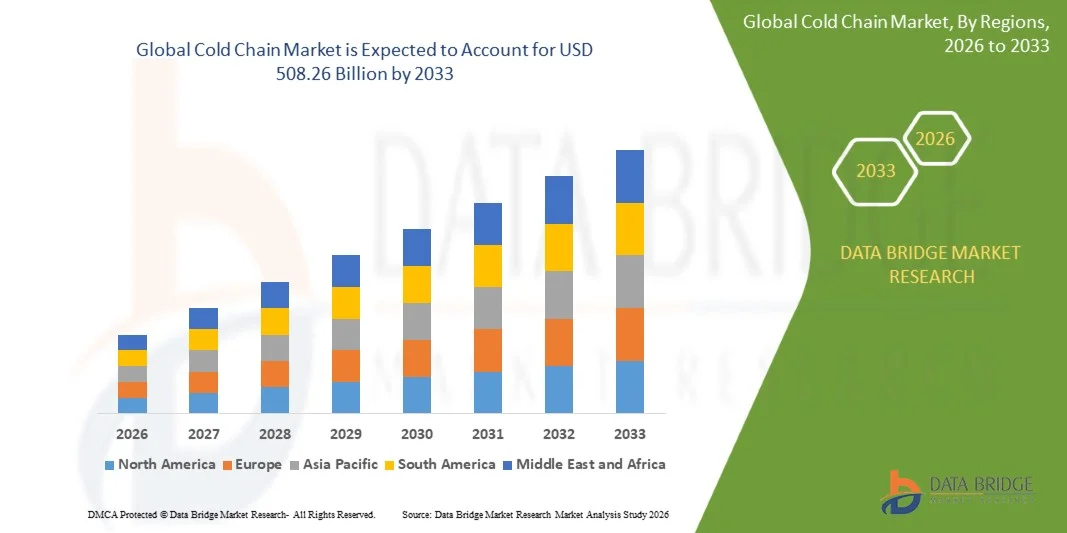
- The global cold chain market size was valued at USD 249.53 billion in 2025 and is expected to reach USD 508.26 billion by 2033, at a CAGR of 9.30% during the forecast period
- The increasing penetration of connected devices and the automation of refrigerated warehouses around the world are expected to drive industry growth during the forecast period. The growing number of organized retail stores in emerging economies is going to drive up demand for cold chain solutions
What are the Major Takeaways of Cold Chain Market?
- Government efforts to reduce food waste, and multinational company expansion of retail chains are expected to boost industry growth over the forecast period. The increased demand for perishable products and the need for quick delivery associated with the e-commerce-based food and beverage delivery market has resulted in a significant increase in cold chain operations
- However, cold chain service providers are finding it difficult to reduce their operational costs as energy prices increase. Furthermore, high energy and real estate costs are such asly to make the configuration and operation process difficult. A lack of skilled professionals is also a major hindrance to the market's growth
- Europe dominated the cold chain market with a 39.8% revenue share in 2025, driven by strong demand for temperature-controlled logistics across food, beverage, and pharmaceutical industries
- Asia-Pacific is projected to register the fastest CAGR of 10.69% from 2026 to 2033, driven by rapid semiconductor expansion, strong electronics manufacturing ecosystems, 5G deployment, and rising adoption of embedded systems across China, Japan, India, South Korea, and Southeast Asia
- The Conventional Refrigeration segment dominated the market with a 61.3% share in 2025, as it remains the backbone of cold storage and transportation systems across food, pharmaceutical, and logistics industries
Report Scope and Cold Chain Market Segmentation
|
Attributes |
Cold Chain Key Market Insights |
|
Segments Covered |
|
|
Countries Covered |
North America
Europe
Asia-Pacific
Middle East and Africa
South America
|
|
Key Market Players |
|
|
Market Opportunities |
|
|
Value Added Data Infosets |
In addition to the insights on market scenarios such as market value, growth rate, segmentation, geographical coverage, and major players, the market reports curated by the Data Bridge Market Research also include in-depth expert analysis, pricing analysis, brand share analysis, consumer survey, demography analysis, supply chain analysis, value chain analysis, raw material/consumables overview, vendor selection criteria, PESTLE Analysis, Porter Analysis, and regulatory framework. |
What is the Key Trend in the Cold Chain Market?
“Increasing Shift Toward Smart, Connected, and Temperature-Controlled Cold Chain Solutions”
- The cold chain market is witnessing strong adoption of IoT-enabled sensors, real-time monitoring systems, and GPS-integrated tracking technologies designed to ensure precise temperature control and product integrity across the supply chain
- Manufacturers and logistics providers are introducing cloud-based platforms, AI-driven analytics, and automated alert systems that offer real-time visibility, predictive maintenance, and enhanced decision-making capabilities
- Growing demand for energy-efficient, modular, and scalable cold storage and transportation solutions is driving adoption across food & beverage, pharmaceuticals, and e-commerce sectors
- For instance, companies such as Americold, Lineage Logistics, Nichirei, and VersaCold are investing in smart warehouses, automation technologies, and digital cold chain infrastructure to improve operational efficiency
- Increasing need for compliance with stringent food safety regulations and pharmaceutical standards is accelerating the shift toward digitally integrated and traceable cold chain systems
- As global trade and demand for perishable goods expand, Cold Chains will remain essential for ensuring product quality, reducing waste, and enabling efficient temperature-controlled logistics
What are the Key Drivers of Cold Chain Market?
- Rising demand for perishable food products, frozen goods, and temperature-sensitive pharmaceuticals is significantly boosting the need for advanced cold storage and transportation infrastructure
- For instance, in 2025, leading companies such as Lineage Logistics, Americold, and Burris Logistics expanded their cold storage capacities and invested in automation technologies to enhance efficiency and scalability
- Growing expansion of e-commerce, online grocery delivery, and global food trade is increasing reliance on efficient cold chain logistics across the U.S., Europe, and Asia-Pacific
- Advancements in refrigeration technologies, energy-efficient systems, and real-time monitoring solutions have improved operational reliability and reduced energy consumption
- Rising demand for vaccines, biologics, and specialty drugs requiring strict temperature control is driving adoption of advanced cold chain systems in the healthcare sector
- Supported by increasing investments in logistics infrastructure, food safety standards, and supply chain digitization, the cold chain market is expected to witness strong long-term growth
Which Factor is Challenging the Growth of the Cold Chain Market?
- High capital investment and operational costs associated with refrigerated storage facilities, transport equipment, and energy consumption restrict adoption, particularly among small and mid-sized enterprises
- For instance, during 2024–2025, rising energy prices, fuel costs, and supply chain disruptions increased overall operational expenses for cold chain service providers globally
- Complexity in maintaining consistent temperature conditions across long-distance transportation and multiple handling points increases the risk of product spoilage and losses
- Limited infrastructure in emerging markets, including inadequate cold storage facilities and inefficient transportation networks, slows market expansion
- Regulatory compliance requirements, including strict food safety and pharmaceutical guidelines, increase operational complexity and cost burden for logistics providers
- To address these challenges, companies are focusing on energy-efficient technologies, automation, renewable-powered cold storage, and digital tracking solutions to improve efficiency and expand global adoption of Cold Chains
How is the Cold Chain Market Segmented?
The market is segmented on the basis of temperature control, type, temperature type, application, and technology.
• By Temperature Control
On the basis of temperature control, the cold chain market is segmented into Conventional Refrigeration and Packaging Material. The Conventional Refrigeration segment dominated the market with a 61.3% share in 2025, as it remains the backbone of cold storage and transportation systems across food, pharmaceutical, and logistics industries. These systems provide consistent cooling, scalability, and reliability for large-scale warehousing and long-distance transportation. Their widespread adoption is driven by established infrastructure, cost efficiency at scale, and compatibility with various perishable goods.
The Packaging Material segment is expected to grow at the fastest CAGR from 2026 to 2033, driven by increasing demand for advanced insulated packaging, phase change materials, and sustainable solutions for last-mile delivery. Growth in e-commerce and pharmaceutical distribution is further accelerating innovation in temperature-controlled packaging solutions.
• By Type
On the basis of type, the cold chain market is segmented into Refrigerated Storage and Refrigerated Transport. The Refrigerated Storage segment dominated the market with a 54.7% share in 2025, supported by rising demand for large-scale cold warehouses, distribution centers, and food storage facilities. Increasing consumption of frozen food, dairy products, and temperature-sensitive pharmaceuticals has significantly boosted investments in cold storage infrastructure globally. These facilities ensure long-term preservation, bulk handling, and inventory management efficiency.
The Refrigerated Transport segment is projected to grow at the fastest CAGR from 2026 to 2033, driven by the expansion of global trade, online grocery delivery, and pharmaceutical logistics. Rising need for efficient last-mile delivery and real-time tracking is further fueling adoption of advanced refrigerated transport solutions.
• By Temperature Type
On the basis of temperature type, the cold chain market is segmented into Chilled and Frozen. The Frozen segment dominated the market with a 58.2% share in 2025, driven by increasing consumption of frozen food products such as ready-to-eat meals, meat, seafood, and ice cream. Frozen storage ensures extended shelf life and minimizes microbial growth, making it essential for long-distance transportation and export of perishable goods.
The Chilled segment is expected to grow at the fastest CAGR from 2026 to 2033, supported by rising demand for fresh food products, dairy items, and short shelf-life pharmaceuticals. Increasing consumer preference for fresh and minimally processed food is accelerating demand for chilled cold chain solutions.
• By Application
On the basis of application, the cold chain market is segmented into Fruits and Vegetables, Bakery and Confectionery, Pharmaceuticals, Dairy and Frozen Desserts, Fish, Meat, and Seafood Products, and Others. The Dairy and Frozen Desserts segment dominated the market with a 29.6% share in 2025, driven by high consumption of milk products, ice cream, and frozen desserts requiring strict temperature control. Consistent refrigeration is essential to maintain product quality, safety, and shelf life.
The Pharmaceuticals segment is expected to grow at the fastest CAGR from 2026 to 2033, propelled by increasing demand for vaccines, biologics, and temperature-sensitive drugs. Strict regulatory requirements and growing healthcare needs are significantly boosting cold chain adoption in this segment.
• By Technology
On the basis of technology, the cold chain market is segmented into Blast Freezing, Vapour Compression, Programmable Logic Controller (PLC), Evaporating Cooling, Cryogenic Systems, and Others. The Vapour Compression segment dominated the market with a 46.5% share in 2025, as it is the most widely used refrigeration technology due to its efficiency, reliability, and cost-effectiveness across storage and transport systems. It supports a wide range of applications from small-scale units to large industrial cold storage facilities.
The Cryogenic Systems segment is expected to grow at the fastest CAGR from 2026 to 2033, driven by increasing demand for rapid freezing, improved product quality, and reduced dehydration in food processing. Adoption is rising across high-value food and pharmaceutical applications requiring ultra-low temperatures and precise control.
Which Region Holds the Largest Share of the Cold Chain Market?
- Europe dominated the cold chain market with a 39.8% revenue share in 2025, driven by strong demand for temperature-controlled logistics across food, beverage, and pharmaceutical industries. The region benefits from well-established cold storage infrastructure, stringent food safety regulations, and advanced transportation networks across countries such as Germany, France, the U.K., and the Netherlands. High consumption of frozen food, dairy products, and biologics continues to fuel demand for efficient cold chain solutions across retail, healthcare, and export-oriented industries
- Leading companies in Europe are investing in automated warehouses, energy-efficient refrigeration systems, and digital monitoring platforms, strengthening the region’s technological edge. Continuous focus on sustainability, carbon reduction, and smart logistics is driving long-term market growth
- Strong regulatory frameworks, high-quality standards, and advanced logistics ecosystems further reinforce Europe’s leadership in the global cold chain market
Asia-Pacific Cold Chain Market
Asia-Pacific is projected to register the fastest CAGR of 6.69% from 2026 to 2033, driven by rapid urbanization, rising disposable income, and increasing demand for processed and perishable food products across China, India, Japan, South Korea, and Southeast Asia. Expanding pharmaceutical industry, growth in e-commerce grocery delivery, and increasing investments in logistics infrastructure are significantly boosting demand for cold chain solutions. Rising need for efficient storage and transportation of vaccines, biologics, and temperature-sensitive goods is further accelerating market growth across the region.
China Cold Chain Market Insight
China is the largest contributor to Asia-Pacific due to its massive food production, expanding pharmaceutical sector, and strong government support for cold chain infrastructure development. Increasing consumption of frozen food, rapid growth in online grocery platforms, and rising exports of perishable goods are driving demand for advanced cold storage and transportation systems. Continuous investments in logistics modernization and smart supply chains further enhance market growth.
Japan Cold Chain Market Insight
Japan shows steady growth supported by high demand for premium food products, advanced refrigeration technologies, and strong focus on food safety and quality. The country’s well-developed logistics infrastructure and increasing need for efficient pharmaceutical distribution contribute to sustained adoption of cold chain solutions. Rising innovation in automation and energy-efficient systems further strengthens market expansion.
India Cold Chain Market Insight
India is emerging as a major growth hub, driven by increasing agricultural production, rising demand for processed food, and government initiatives supporting cold storage infrastructure. Expansion of organized retail, growth in e-commerce grocery delivery, and increasing pharmaceutical manufacturing are boosting demand for cold chain logistics. Investments in warehousing, transportation, and supply chain digitization continue to accelerate market penetration.
South Korea Cold Chain Market Insight
South Korea contributes significantly due to strong demand for high-quality food products, advanced pharmaceutical logistics, and growing e-commerce sector. Increasing adoption of automated cold storage facilities, smart logistics solutions, and energy-efficient refrigeration systems is driving market growth. Technological advancements and strong infrastructure support long-term expansion of the cold chain market.
Which are the Top Companies in Cold Chain Market?
The cold chain industry is primarily led by well-established companies, including:
- Americold (U.S.)
- Preferred Freezer Services (U.S.)
- Burris Logistics (U.S.)
- Lineage Logistics Holdings, LLC (U.S.)
- NICHIREI CORPORATION (Japan)
- Swire Cold Storage Ltd (Hong Kong)
- AGRO Merchants Group (U.S.)
- Cloverleaf Cold Storage (U.S.)
- Kloosterboer (Netherlands)
- Interstate Cold Storage, Inc (U.S.)
- Hanson Logistics (U.S.)
- HENNINGSEN COLD STORAGE CO. (U.S.)
- Trenton Cold Storage (Canada)
- A.B. Oxford Cold Storage Pty. Ltd. (Australia)
- VersaCold Logistics Services (Canada)
What are the Recent Developments in Global Cold Chain Market?
- In October 2025, Carrier Transicold showcased its latest container refrigeration innovations at Intermodal Europe 2025, highlighting the OptimaLINE system and EverFRESH® controlled-atmosphere technology to enhance cargo quality, reduce energy consumption, and improve operational flexibility, thereby strengthening efficiency and sustainability in cold chain transportation
- In July 2025, Maersk launched a new packing and cold chain logistics center in Olmos, Peru, strategically designed to support the country’s rapidly growing agro-export sector and streamline fruit export operations, thereby enhancing regional supply chain efficiency and global trade capabilities
- In June 2025, DP World inaugurated a temperature-controlled warehouse in Taloja, Navi Mumbai, India, aimed at strengthening its cold chain logistics infrastructure and supporting the storage and distribution of perishable goods, thereby boosting cold chain capacity and regional logistics efficiency
- In November 2024, Lineage, Inc. acquired the assets of Coldpoint in Kansas City to expand its cold storage and transportation network, integrate a 621,000-square-foot facility with intermodal capabilities, and enhance connectivity to major U.S. ports, thereby reinforcing its logistics footprint and service capabilities
- In November 2024, CJ Logistics America opened a 270,000-square-foot advanced cold storage facility in Georgia, U.S., equipped with modern refrigeration and blast freezing systems to support diverse product storage needs, thereby strengthening its position in delivering high-quality cold chain solutions
SKU-
Get online access to the report on the World's First Market Intelligence Cloud

- Interactive Data Analysis Dashboard
- Company Analysis Dashboard for high growth potential opportunities
- Research Analyst Access for customization & queries
- Competitor Analysis with Interactive dashboard
- Latest News, Updates & Trend analysis
- Harness the Power of Benchmark Analysis for Comprehensive Competitor Tracking
Global Cold Chain Market, Supply Chain Analysis and Ecosystem Framework
To support market growth and help clients navigate the impact of geopolitical shifts, DBMR has integrated in-depth supply chain analysis into its Global Cold Chain Market research reports. This addition empowers clients to respond effectively to global changes affecting their industries. The supply chain analysis section includes detailed insights such as Global Cold Chain Market consumption and production by country, price trend analysis, the impact of tariffs and geopolitical developments, and import and export trends by country and HSN code. It also highlights major suppliers with data on production capacity and company profiles, as well as key importers and exporters. In addition to research, DBMR offers specialized supply chain consulting services backed by over a decade of experience, providing solutions like supplier discovery, supplier risk assessment, price trend analysis, impact evaluation of inflation and trade route changes, and comprehensive market trend analysis.
Research Methodology
Data collection and base year analysis are done using data collection modules with large sample sizes. The stage includes obtaining market information or related data through various sources and strategies. It includes examining and planning all the data acquired from the past in advance. It likewise envelops the examination of information inconsistencies seen across different information sources. The market data is analysed and estimated using market statistical and coherent models. Also, market share analysis and key trend analysis are the major success factors in the market report. To know more, please request an analyst call or drop down your inquiry.
The key research methodology used by DBMR research team is data triangulation which involves data mining, analysis of the impact of data variables on the market and primary (industry expert) validation. Data models include Vendor Positioning Grid, Market Time Line Analysis, Market Overview and Guide, Company Positioning Grid, Patent Analysis, Pricing Analysis, Company Market Share Analysis, Standards of Measurement, Global versus Regional and Vendor Share Analysis. To know more about the research methodology, drop in an inquiry to speak to our industry experts.
Customization Available
Data Bridge Market Research is a leader in advanced formative research. We take pride in servicing our existing and new customers with data and analysis that match and suits their goal. The report can be customized to include price trend analysis of target brands understanding the market for additional countries (ask for the list of countries), clinical trial results data, literature review, refurbished market and product base analysis. Market analysis of target competitors can be analyzed from technology-based analysis to market portfolio strategies. We can add as many competitors that you require data about in the format and data style you are looking for. Our team of analysts can also provide you data in crude raw excel files pivot tables (Fact book) or can assist you in creating presentations from the data sets available in the report.












