Global Collateral Ligament Stabilizer System Market
Market Size in USD Billion
CAGR :
% 
 USD
2.33 Billion
USD
3.91 Billion
2025
2033
USD
2.33 Billion
USD
3.91 Billion
2025
2033
 Forecast Period Forecast Period |
2026 –2033 |
 Market Size (Base Year) Market Size (Base Year) |
USD 2.33 Billion |
 Market Size (Forecast Year) Market Size (Forecast Year) |
USD 3.91 Billion |
 CAGR CAGR |
% |
| Major Markets Players |
|
Collateral Ligament Stabilizer System Market Size
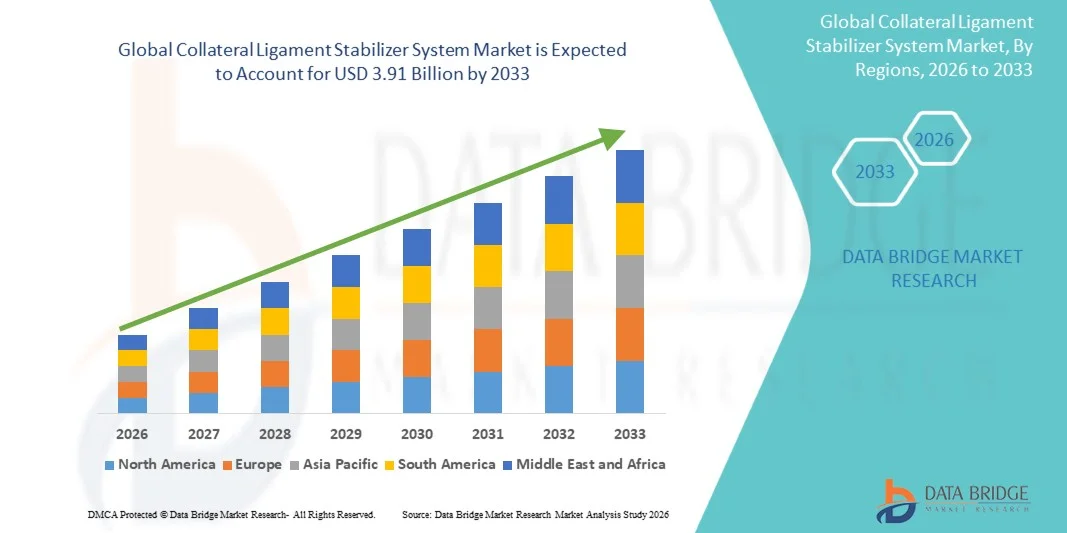
- The global collateral ligament stabilizer system market size was valued at USD 2.33 billion in 2025and is expected to reach USD 3.91 billion by 2033, at a CAGR of 6.70% during the forecast period
- The market growth is primarily driven by the increasing prevalence of ligament injuries associated with sports activities, road accidents, and degenerative orthopedic conditions, alongside the growing demand for advanced orthopedic stabilization and reconstruction procedures across healthcare settings
- In addition, continuous advancements in minimally invasive surgical techniques, biomaterial technologies, and patient-specific orthopedic solutions are enhancing treatment outcomes and recovery times. Rising awareness regarding early ligament injury management and the expanding adoption of sports medicine and trauma care solutions are further accelerating the demand for collateral ligament stabilizer systems globally
Collateral Ligament Stabilizer System Market Analysis
- Collateral ligament stabilizer systems, used for the diagnosis, treatment, and stabilization of medial and lateral collateral ligament injuries, are increasingly important in orthopedic and sports medicine applications due to their effectiveness in restoring joint stability, improving mobility, and supporting faster rehabilitation outcomes
- The increasing demand for collateral ligament stabilizer systems is mainly driven by the growing prevalence of sports injuries, rising incidence of ligament damage caused by trauma and accidents, and the expanding adoption of advanced orthopedic treatment procedures across hospitals and specialty clinics worldwide
- North America dominated the collateral ligament stabilizer system market with the largest revenue share of 39.8% in 2025, supported by advanced healthcare infrastructure, rising sports participation, and the strong presence of leading orthopedic device manufacturers, while the U.S. continues to witness significant growth in ligament reconstruction and stabilization procedures driven by increasing awareness regarding early injury diagnosis and treatment
- Asia-Pacific is expected to be the fastest growing region in the collateral ligament stabilizer system market during the forecast period due to rising healthcare investments, improving access to orthopedic care, increasing participation in sports activities, and growing awareness regarding ligament injury management across emerging economies
- Medial collateral ligament segment dominated the collateral ligament stabilizer system market with a market share of 46.7% in 2025, driven by the high occurrence of medial knee ligament injuries, increasing demand for minimally invasive treatment options, and the growing number of sports medicine and rehabilitation procedures globally
Report Scope and Collateral Ligament Stabilizer System Market Segmentation
|
Attributes |
Collateral Ligament Stabilizer System Key Market Insights |
|
Segments Covered |
|
|
Countries Covered |
North America · U.S. · Canada · Mexico Europe · Germany · France · U.K. · Netherlands · Switzerland · Belgium · Russia · Italy · Spain · Turkey · Rest of Europe Asia-Pacific · China · Japan · India · South Korea · Singapore · Malaysia · Australia · Thailand · Indonesia · Philippines · Rest of Asia-Pacific Middle East and Africa · Saudi Arabia · U.A.E. · South Africa · Egypt · Israel · Rest of Middle East and Africa South America · Brazil · Argentina · Rest of South America |
|
Key Market Players |
|
|
Market Opportunities |
· Growing adoption of biologic-enhanced ligament repair and regenerative orthopedic therapies · Increasing expansion of outpatient orthopedic and ambulatory surgical centers |
|
Value Added Data Infosets |
In addition to the insights on market scenarios such as market value, growth rate, segmentation, geographical coverage, and major players, the market reports curated by the Data Bridge Market Research also include in-depth expert analysis, patient epidemiology, pipeline analysis, pricing analysis, and regulatory framework |
Collateral Ligament Stabilizer System Market Trends
“Advancement in Biomechanical and Patient-Specific Stabilization Technologies”
- A significant and accelerating trend in the global collateral ligament stabilizer system market is the integration of advanced biomechanical designs and patient-specific orthopedic solutions that improve joint stability, healing efficiency, and post-surgical functional outcomes across ligament reconstruction procedures
- For instance, modern stabilizer systems are increasingly being designed with anatomically contoured braces and adjustable tension mechanisms to better replicate natural ligament movement and improve recovery outcomes in medial and lateral collateral ligament injuries
- The use of advanced biomaterials and smart orthopedic components is enabling improved durability, flexibility, and biocompatibility in stabilizer systems, while also reducing post-operative complications and enhancing long-term joint performance in patients undergoing ligament repair
- This trend towards more customized, high-precision, and functionally adaptive stabilizer systems is reshaping clinical expectations in sports medicine and orthopedic care, with companies such as DJO Global and Össur focusing on anatomically optimized and performance-driven ligament support solutions
- The increasing use of digital rehabilitation monitoring tools alongside stabilizer systems is enabling physicians to track patient recovery progress in real time and optimize post-surgical treatment outcomes through data-driven rehabilitation planning
- The demand for advanced collateral ligament stabilizer systems is growing rapidly across sports medicine and trauma care segments, as healthcare providers increasingly prioritize faster rehabilitation, improved surgical outcomes, and long-term joint stability
Collateral Ligament Stabilizer System Market Dynamics
Driver
“Rising Incidence of Sports Injuries and Expanding Orthopedic Procedures”
- The increasing prevalence of sports-related injuries and trauma cases, coupled with the rising volume of orthopedic reconstruction procedures, is a significant driver for the growing demand for collateral ligament stabilizer systems globally
- For instance, in April 2025, Zimmer Biomet Holdings, Inc. expanded its orthopedic support portfolio with enhanced ligament stabilization technologies aimed at improving surgical precision and post-operative recovery outcomes in joint reconstruction procedures
- As participation in sports and physical activities increases globally, the incidence of medial and lateral collateral ligament injuries continues to rise, creating strong demand for effective stabilization devices used during and after surgical repair procedures
- Furthermore, the growing awareness among patients and healthcare providers regarding early intervention and advanced orthopedic care is making stabilizer systems a critical component in ligament injury management and rehabilitation strategies
- The increasing adoption of minimally invasive surgeries and advanced rehabilitation protocols is further propelling the use of collateral ligament stabilizer systems in both hospital and outpatient orthopedic care settings
- The expanding geriatric population with higher susceptibility to degenerative ligament injuries is also contributing to sustained demand for stabilizer systems in long-term joint support and mobility restoration applications
Restraint/Challenge
“High Treatment Costs and Limited Access to Advanced Orthopedic Care”
- Concerns surrounding the high cost of advanced ligament stabilization procedures and limited accessibility to specialized orthopedic care in developing regions pose a significant challenge to broader market penetration
- For instance, in many low- and middle-income countries, the lack of advanced surgical infrastructure and trained orthopedic specialists restricts the widespread adoption of modern collateral ligament stabilizer systems despite growing injury prevalence
- The relatively high cost of surgical implants, rehabilitation support systems, and post-operative care associated with ligament stabilization procedures can also limit adoption among price-sensitive patient populations
- While leading companies are developing cost-efficient stabilization solutions, the overall expense of comprehensive ligament repair treatment still remains a barrier for widespread use, particularly in non-urban healthcare settings
- Addressing these challenges through improved healthcare infrastructure, increased insurance coverage, and development of affordable orthopedic stabilization technologies will be crucial for sustained market growth
- The variability in regulatory approval processes across different regions further slows product commercialization and delays patient access to advanced ligament stabilizer systems in emerging markets
Collateral Ligament Stabilizer System Market Scope
The market is segmented on the basis of ligament type, imaging test, treatment, injury type, and end user.
- By Ligament Type
On the basis of ligament type, the market is segmented into medial collateral ligament and lateral collateral ligament. The medial collateral ligament (MCL) segment dominated the market with the largest revenue share of 46.7% in 2025, driven by the higher incidence of MCL injuries, particularly among athletes and individuals involved in high-impact physical activities. MCL injuries are more commonly diagnosed compared to lateral ligament injuries due to valgus stress mechanisms in sports such as football, skiing, and basketball. The segment also benefits from well-established treatment protocols and high adoption of stabilizer systems in both surgical and non-surgical recovery pathways. Increasing awareness regarding early diagnosis and rehabilitation further supports its dominance in orthopedic practice. Hospitals and sports medicine centers frequently prioritize MCL stabilization due to its critical role in knee joint stability and mobility restoration. Growing clinical preference for structured rehabilitation solutions is also reinforcing its leading market share.
The lateral collateral ligament (LCL) segment is expected to witness the fastest growth rate of 18.9% from 2026 to 2033, driven by rising recognition of LCL injuries, which were historically underdiagnosed compared to MCL conditions. Increasing participation in extreme sports and high-energy trauma cases is contributing to a higher detection rate of LCL injuries requiring specialized stabilization systems. Advancements in imaging techniques and diagnostic accuracy are improving early identification of lateral ligament damage, supporting faster treatment adoption. In addition, the growing availability of customized stabilizer systems designed specifically for complex knee instability cases is boosting demand. Orthopedic specialists are increasingly focusing on multi-ligament injury management, further accelerating growth. Expanding rehabilitation programs targeting complete knee stability restoration are also driving this segment forward.
- By Imaging Test
On the basis of imaging test, the market is segmented into magnetic resonance imaging, valgus stress test, and X-rays. The magnetic resonance imaging (MRI) segment dominated the market with the largest revenue share of 62.4% in 2025, driven by its superior accuracy in detecting soft tissue and ligament injuries. MRI provides high-resolution visualization of ligament tears, making it the gold standard for diagnosing medial and lateral collateral ligament damage. Its ability to assess injury severity and associated joint complications significantly supports surgical planning and treatment decisions. Increasing adoption of advanced diagnostic imaging in hospitals and orthopedic clinics further strengthens its dominance. MRI is widely preferred in sports injury cases due to its non-invasive nature and precise diagnostic capability. Growing investments in imaging infrastructure across healthcare systems are also contributing to its leading position.
The valgus stress test segment is expected to witness the fastest growth rate of 16.8% from 2026 to 2033, driven by its increasing use as a quick and cost-effective clinical assessment tool for ligament instability. This test is widely used in initial screening of MCL injuries, especially in emergency and sports medicine settings. Its simplicity and ability to provide immediate functional assessment make it highly valuable in early-stage diagnosis. Increasing integration of physical examination protocols in outpatient and athletic injury clinics is supporting adoption. Physicians are increasingly combining valgus stress testing with imaging methods for improved diagnostic accuracy. Growing emphasis on rapid injury assessment in field sports environments is further accelerating demand.
- By Treatment
On the basis of treatment, the market is segmented into surgical treatment and non-surgical treatment. The non-surgical treatment segment dominated the market with the largest revenue share of 54.1% in 2025, driven by the high prevalence of Grade I and Grade II ligament injuries that often respond well to conservative management. Non-surgical approaches such as bracing, physiotherapy, and activity modification are widely preferred due to lower cost and reduced recovery time. Increasing awareness of early rehabilitation protocols is further strengthening this segment’s dominance. Many patients, especially in sports medicine, opt for conservative treatment before considering surgical intervention. The availability of advanced stabilizer braces and support systems is improving treatment outcomes without invasive procedures. Growing preference for outpatient-based recovery is also contributing to its leading position.
The surgical treatment segment is expected to witness the fastest growth rate of 19.6% from 2026 to 2033, driven by rising cases of severe Grade III ligament injuries requiring reconstruction. Increasing advancements in arthroscopic and minimally invasive surgical techniques are improving success rates and reducing recovery times. Surgeons are increasingly adopting stabilizer systems during and after ligament reconstruction procedures for enhanced joint stability. Rising sports injuries and trauma cases are also contributing to higher surgical intervention rates. Improved healthcare infrastructure and access to orthopedic specialists are supporting growth in developed and emerging regions. Growing demand for long-term joint stability restoration is further accelerating this segment.
- By Injury Type
On the basis of injury type, the market is segmented into Grade I, Grade II, and Grade III. The Grade II segment dominated the market with the largest revenue share of 48.3% in 2025, driven by its high occurrence rate in sports-related injuries and moderate trauma cases. Grade II injuries involve partial ligament tears that often require structured stabilization and rehabilitation support. This injury category represents a major share of clinically treated ligament conditions globally. Increasing participation in competitive sports and physical fitness activities is contributing to sustained incidence rates. Treatment typically involves a combination of bracing, physiotherapy, and controlled mobility, boosting demand for stabilizer systems. Growing awareness of preventing progression to severe ligament damage further strengthens its dominance.
The Grade III segment is expected to witness the fastest growth rate of 20.4% from 2026 to 2033, driven by rising high-impact trauma cases and complex ligament rupture injuries. Grade III injuries often require surgical reconstruction and advanced stabilizer system support during recovery. Increasing road accidents and extreme sports participation are key contributors to this segment’s growth. Improved diagnostic capabilities are enabling faster identification of complete ligament tears requiring intensive treatment. Surgeons are increasingly relying on advanced stabilization systems for post-operative rehabilitation. Rising demand for long-term functional restoration and joint stability is further accelerating this segment.
- By End User
On the basis of end user, the market is segmented into hospitals, orthopedic clinics, and others. The hospitals segment dominated the market with the largest revenue share of 61.5% in 2025, driven by the availability of advanced surgical infrastructure and multidisciplinary orthopedic care. Hospitals are the primary centers for diagnosing and treating moderate to severe ligament injuries requiring surgical intervention. The presence of skilled orthopedic surgeons and advanced imaging facilities supports their dominance. Increasing hospital admissions for sports injuries and trauma cases is further strengthening demand for stabilizer systems. Hospitals also benefit from integrated rehabilitation services, ensuring comprehensive patient care. Strong reimbursement frameworks in developed healthcare systems further reinforce their leading position.
The orthopedic clinics segment is expected to witness the fastest growth rate of 18.7% from 2026 to 2033, driven by rising preference for specialized and outpatient orthopedic care. These clinics are increasingly offering focused ligament injury diagnosis, treatment, and rehabilitation services. Growing demand for minimally invasive procedures and faster recovery pathways is supporting adoption in clinic-based settings. Patients are increasingly opting for specialized orthopedic consultations outside hospital environments. Expansion of private orthopedic practice networks is further accelerating growth. Improved accessibility and reduced waiting times are also contributing to increasing patient preference for orthopedic clinics.
Collateral Ligament Stabilizer System Market Regional Analysis
- North America dominated the collateral ligament stabilizer system market with the largest revenue share of 39.8% in 2025, supported by advanced healthcare infrastructure, rising sports participation, and the strong presence of leading orthopedic device manufacturers
- Consumers and healthcare providers in the region highly value early diagnosis, advanced surgical interventions, and the availability of technologically advanced stabilizer systems that improve recovery outcomes in medial and lateral collateral ligament injuries
- This widespread adoption is further supported by high healthcare expenditure, strong presence of leading orthopedic device manufacturers, and increasing participation in professional and recreational sports activities, establishing collateral ligament stabilizer systems as a standard solution in sports medicine and trauma care
U.S. Collateral Ligament Stabilizer System Market Insight
The U.S. collateral ligament stabilizer system market captured the largest revenue share of 82% in 2025 within North America, driven by a high burden of sports-related ligament injuries and advanced orthopedic treatment adoption. Patients and healthcare providers are increasingly prioritizing early intervention through stabilizer systems to improve post-injury joint stability and recovery outcomes. The growing preference for minimally invasive ligament repair procedures, combined with strong demand for post-surgical rehabilitation support, further propels market growth. Moreover, the increasing integration of advanced orthopedic technologies, including arthroscopic surgeries and biomechanical stabilizers, is significantly contributing to the market’s expansion.
Europe Collateral Ligament Stabilizer System Market Insight
The Europe collateral ligament stabilizer system market is projected to expand at a substantial CAGR throughout the forecast period, primarily driven by rising sports injury cases and strong healthcare infrastructure. The increase in participation in recreational and professional sports, coupled with growing awareness of early ligament injury treatment, is fostering adoption of stabilizer systems. European consumers are also increasingly focused on advanced orthopedic care solutions that enhance recovery and mobility outcomes. The region is witnessing steady growth across hospitals, orthopedic clinics, and rehabilitation centers, with stabilizer systems widely used in both surgical and non-surgical treatment pathways.
U.K. Collateral Ligament Stabilizer System Market Insight
The U.K. collateral ligament stabilizer system market is anticipated to grow at a noteworthy CAGR during the forecast period, driven by increasing sports participation and rising cases of knee ligament injuries. In addition, growing awareness regarding advanced orthopedic rehabilitation solutions is encouraging adoption of stabilizer systems among both hospitals and specialty clinics. The U.K.’s strong focus on sports medicine and trauma care is further supporting market expansion. Moreover, demand for cost-effective, outpatient-based treatment solutions is contributing to the increased use of non-surgical stabilizer systems across healthcare facilities.
Germany Collateral Ligament Stabilizer System Market Insight
The Germany collateral ligament stabilizer system market is expected to expand at a considerable CAGR during the forecast period, fueled by increasing focus on advanced orthopedic care and rehabilitation technologies. Germany’s strong healthcare infrastructure and emphasis on precision medical treatment are promoting the adoption of ligament stabilizer systems. Rising awareness regarding sports injury management and post-surgical recovery optimization is further supporting market growth. In addition, the integration of biomechanically advanced stabilizers in orthopedic treatment protocols aligns with Germany’s preference for high-quality and innovation-driven medical solutions.
Asia-Pacific Collateral Ligament Stabilizer System Market Insight
The Asia-Pacific collateral ligament stabilizer system market is poised to grow at the fastest CAGR of 22% during the forecast period of 2026 to 2033, driven by rising sports participation, increasing trauma cases, and improving healthcare access in countries such as China, Japan, and India. The region’s growing inclination toward orthopedic treatment modernization and rehabilitation services is accelerating adoption of stabilizer systems. Furthermore, government initiatives supporting healthcare infrastructure development and medical device accessibility are expanding market penetration. As APAC emerges as a growing hub for affordable orthopedic care solutions, demand for stabilizer systems is rapidly increasing across both urban and semi-urban regions.
Japan Collateral Ligament Stabilizer System Market Insight
The Japan collateral ligament stabilizer system market is gaining momentum due to its advanced healthcare system, aging population, and strong focus on precision medical treatments. The country’s increasing number of sports injuries and orthopedic procedures is driving demand for effective ligament stabilization solutions. Integration of stabilizer systems with minimally invasive surgical techniques is further enhancing adoption in hospitals and specialty clinics. Moreover, Japan’s emphasis on rehabilitation efficiency and long-term mobility restoration is supporting steady market growth across both surgical and non-surgical applications.
India Collateral Ligament Stabilizer System Market Insight
The India collateral ligament stabilizer system market accounted for the largest market revenue share in Asia-Pacific in 2025, attributed to rapid urbanization, rising sports participation, and increasing awareness of orthopedic care. India is witnessing growing demand for cost-effective stabilizer systems across hospitals, orthopedic clinics, and rehabilitation centers. The expansion of healthcare infrastructure and rising availability of advanced orthopedic treatments are key factors propelling the market. In addition, government initiatives promoting healthcare accessibility and the development of domestic medical device manufacturing are further supporting widespread adoption of ligament stabilizer systems.
Collateral Ligament Stabilizer System Market Share
The Collateral Ligament Stabilizer System industry is primarily led by well-established companies, including:
- DonJoy (U.S.)
- Aircast (U.S.)
- Exos (U.S.)
- Chattanooga (U.S.)
- Compex (U.S.)
- ProCare (U.S.)
- Dr. Comfort (U.S.)
- Össur hf. (Iceland)
- Breg, Inc. (U.S.)
- Össur Americas (U.S.)
- Zimmer Biomet (U.S.)
- Stryker (U.S.)
- Smith & Nephew (U.K.)
- Arthrex, Inc. (U.S.)
- Enovis Corporation (U.S.)
- DJO, LLC (U.S.)
- Ottobock SE & Co. KGaA (Germany)
- medi GmbH & Co. KG (Germany)
- Bauerfeind AG (Germany)
- OrthoPediatrics Corp. (U.S.)
What are the Recent Developments in Global Collateral Ligament Stabilizer System Market?
- In March 2025, Stryker Corporation announced the expansion of its orthopedic stabilization portfolio through the acquisition of OrthoFix Holdings, aimed at strengthening its extremities and joint support segment, including advanced ligament stabilization systems used in trauma and sports injury reconstruction procedures. This development enhances Stryker’s capabilities in delivering innovative solutions for collateral ligament repair and post-surgical stabilization across global markets
- In February 2025, Zimmer Biomet Holdings secured a significant investment to accelerate the development of next-generation orthopedic and ligament stabilization systems, focusing on improving biomechanical performance, surgical precision, and recovery outcomes in ligament reconstruction procedures. The initiative supports advancements in collateral ligament stabilizer technologies used in sports medicine and trauma care
- In January 2024, Enovis Corporation completed the acquisition of LimaCorporate, strengthening its orthopedic solutions portfolio with advanced 3D-printed implant technologies used in joint reconstruction and ligament stabilization procedures. The integration enhances innovation in patient-specific stabilizer systems for collateral ligament repair and complex knee injuries
- In June 2023, DJO Global launched an advanced smart knee stabilization brace integrated with motion-sensing and digital monitoring capabilities, designed to support rehabilitation in medial and lateral collateral ligament injuries. The device enables real-time tracking of joint movement, improving recovery efficiency and post-surgical outcomes in orthopedic care
- In April 2022, Arthrex Inc. announced a collaboration with Mayo Clinic to develop bio-enhanced ligament repair technologies, focusing on improving healing outcomes in collateral ligament reconstruction procedures. The initiative aims to advance tissue integration and long-term joint stability in sports medicine and orthopedic trauma cases
SKU-
Get online access to the report on the World's First Market Intelligence Cloud

- Interactive Data Analysis Dashboard
- Company Analysis Dashboard for high growth potential opportunities
- Research Analyst Access for customization & queries
- Competitor Analysis with Interactive dashboard
- Latest News, Updates & Trend analysis
- Harness the Power of Benchmark Analysis for Comprehensive Competitor Tracking
Research Methodology
Data collection and base year analysis are done using data collection modules with large sample sizes. The stage includes obtaining market information or related data through various sources and strategies. It includes examining and planning all the data acquired from the past in advance. It likewise envelops the examination of information inconsistencies seen across different information sources. The market data is analysed and estimated using market statistical and coherent models. Also, market share analysis and key trend analysis are the major success factors in the market report. To know more, please request an analyst call or drop down your inquiry.
The key research methodology used by DBMR research team is data triangulation which involves data mining, analysis of the impact of data variables on the market and primary (industry expert) validation. Data models include Vendor Positioning Grid, Market Time Line Analysis, Market Overview and Guide, Company Positioning Grid, Patent Analysis, Pricing Analysis, Company Market Share Analysis, Standards of Measurement, Global versus Regional and Vendor Share Analysis. To know more about the research methodology, drop in an inquiry to speak to our industry experts.
Customization Available
Data Bridge Market Research is a leader in advanced formative research. We take pride in servicing our existing and new customers with data and analysis that match and suits their goal. The report can be customized to include price trend analysis of target brands understanding the market for additional countries (ask for the list of countries), clinical trial results data, literature review, refurbished market and product base analysis. Market analysis of target competitors can be analyzed from technology-based analysis to market portfolio strategies. We can add as many competitors that you require data about in the format and data style you are looking for. Our team of analysts can also provide you data in crude raw excel files pivot tables (Fact book) or can assist you in creating presentations from the data sets available in the report.