Global Combat Management System Market
Market Size in USD Million
CAGR :
% 
 USD
895.42 Million
USD
1,170.01 Million
2025
2033
USD
895.42 Million
USD
1,170.01 Million
2025
2033
 Forecast Period Forecast Period |
2026 –2033 |
 Market Size (Base Year) Market Size (Base Year) |
USD 895.42 Million |
 Market Size (Forecast Year) Market Size (Forecast Year) |
USD 1,170.01 Million |
 CAGR CAGR |
% |
| Major Markets Players |
|
Combat Management System Market Size
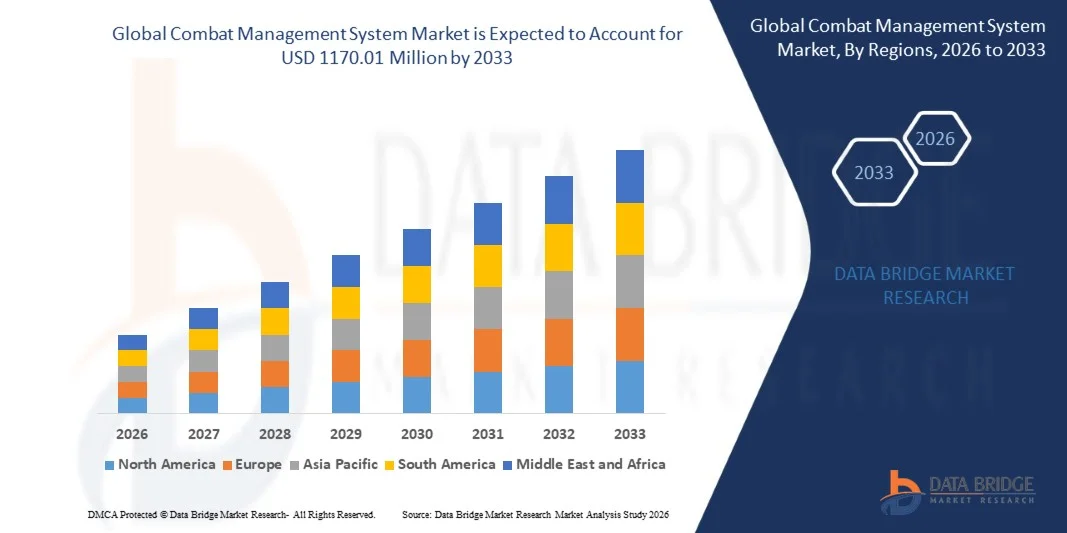
- The global combat management system market size was valued at USD 895.42 million in 2025 and is expected to reach USD 1170.01 million by 2033, at a CAGR of 3.40% during the forecast period
- The market growth is largely fueled by rising investments in naval modernization programs and the increasing integration of advanced sub-systems, such as situational awareness, weapon management, and unmanned vehicle control, across surface and underwater platforms
- Furthermore, growing demand from defense organizations for real-time data fusion, enhanced situational awareness, and interoperable command and control systems is establishing combat management systems as a critical component of modern naval operations. These factors are accelerating adoption of advanced CMS solutions, thereby significantly boosting the market’s growth
Combat Management System Market Analysis
- Combat management systems, providing integrated command, control, and monitoring of sensors, weapons, and platforms, are increasingly vital for naval operations due to their ability to enhance operational efficiency, situational awareness, and decision-making across multiple maritime domains
- The escalating demand for CMS is primarily driven by fleet modernization, rising defense budgets, technological advancements in AI-enabled and networked CMS platforms, and increasing geopolitical tensions that require advanced naval capabilities
- North America dominated the combat management system market with a share of 37.94% in 2025, due to significant naval modernization programs, high defense spending, and the adoption of advanced maritime technologies
- Asia-Pacific is expected to be the fastest growing region in the combat management system market during the forecast period due to rising defense spending, naval expansion, and geopolitical tensions in countries such as China, India, and Japan
- Hardware segment dominated the market with a market share of 61.9% in 2025, due to the extensive deployment of consoles, processors, display units, sensors, and communication interfaces required for real-time combat operations. Naval platforms rely heavily on ruggedized hardware architectures to ensure reliability in harsh maritime environments and to support high-speed data processing during mission-critical scenarios
Report Scope and Combat Management System Market Segmentation
|
Attributes |
Combat Management System Key Market Insights |
|
Segments Covered |
|
|
Countries Covered |
North America
Europe
Asia-Pacific
Middle East and Africa
South America
|
|
Key Market Players |
|
|
Market Opportunities |
|
|
Value Added Data Infosets |
In addition to the market insights such as market value, growth rate, market segments, geographical coverage, market players, and market scenario, the market report curated by the Data Bridge Market Research team includes in-depth expert analysis, import/export analysis, pricing analysis, production consumption analysis, and pestle analysis. |
Combat Management System Market Trends
“Increasing Integration of AI and Autonomous Sub-Systems in Naval Platforms”
- A significant trend in the combat management system market is the growing integration of artificial intelligence (AI) and autonomous sub-systems within naval platforms, driven by the need for faster decision-making, threat assessment, and mission efficiency. This integration enhances operational effectiveness and situational awareness for modern navies across various classes of warships
- For instance, Lockheed Martin has implemented AI-powered decision support modules in its Aegis Combat System, improving real-time threat detection and response capabilities for the U.S. Navy. Such adoption demonstrates the shift toward smarter, faster, and more automated naval combat systems
- The increasing deployment of unmanned surface and underwater vehicles integrated with CMS platforms is expanding operational coverage and reducing human exposure to high-risk scenarios. AI algorithms facilitate autonomous mission planning, target tracking, and weapon deployment
- Naval forces are upgrading legacy combat management systems with modular architectures that support AI-driven sensor fusion, enabling seamless coordination between radar, sonar, and electronic warfare systems. This trend positions CMS as the core operational backbone of modern naval operations
- The integration of predictive analytics within CMS platforms allows naval operators to anticipate threats and optimize resource allocation, improving overall mission efficiency. This capability is critical for maintaining strategic advantage in high-intensity maritime environments
- The market is witnessing the rise of collaborative systems that connect multiple vessels and shore-based command centers via AI-assisted networking. This connectivity is reinforcing coordinated defense strategies and situational intelligence sharing across fleets
Combat Management System Market Dynamics
Driver
“Rising Defense Spending and Naval Modernization Programs”
- Increasing defense budgets and ongoing naval modernization programs are driving the adoption of advanced combat management systems globally. Countries are investing in next-generation warships equipped with AI-enabled CMS to enhance maritime security and operational readiness
- For instance, Thales Group has supplied its TACTICOS CMS to several navies, including the Royal Netherlands Navy and the Philippine Navy, supporting fleet modernization and improved mission coordination. Such implementations illustrate the strong alignment of CMS adoption with defense modernization initiatives
- The growing emphasis on network-centric warfare and multi-domain operations is accelerating CMS integration across surface combatants, submarines, and amphibious vessels. Advanced CMS platforms enable interoperability with allied naval forces and joint military operations
- Emerging naval powers are prioritizing CMS upgrades as part of strategic deterrence initiatives, ensuring readiness against evolving maritime threats. This demand is contributing to sustained market growth and vendor expansion
- The increasing adoption of automated command, control, and decision-support systems within naval fleets is driving procurement of sophisticated CMS platforms. Enhanced automation reduces decision latency and improves operational accuracy
Restraint/Challenge
“High Development Costs and System Complexity”
- The combat management system market faces challenges due to the high costs associated with developing, integrating, and maintaining complex CMS architectures. Advanced software algorithms, sensor fusion, and secure communication networks increase development difficulty and overall program budgets
- For instance, BAE Systems invests heavily in R&D to deliver its CMS solutions, such as the INCHCAPE and COMMAND CMS for allied navies, which require significant resources to ensure system reliability and interoperability. These investment demands contribute to elevated costs and longer deployment timelines
- Integrating AI and autonomous modules into legacy naval platforms presents engineering and compatibility challenges that require specialized expertise. Such complexities can delay commissioning and increase lifecycle expenses
- The need to comply with stringent defense standards for cybersecurity, system redundancy, and mission-critical reliability adds to design and production constraints. Manufacturers must balance performance, safety, and cost efficiency to meet military specifications
- Scaling CMS production while maintaining high performance and adaptability across different naval platforms remains a significant hurdle. These challenges collectively necessitate careful program management and technology investment to sustain market growth
Combat Management System Market Scope
The market is segmented on the basis of components, sub-systems, and platforms.
• By Components
On the basis of components, the combat management system market is segmented into software and hardware. The hardware segment dominated the market with the largest revenue share of 61.9% in 2025, driven by the extensive deployment of consoles, processors, display units, sensors, and communication interfaces required for real-time combat operations. Naval platforms rely heavily on ruggedized hardware architectures to ensure reliability in harsh maritime environments and to support high-speed data processing during mission-critical scenarios. Continuous modernization of naval fleets and upgrades of legacy combat systems further strengthen demand for advanced processing units and integrated electronic modules. The complexity of multi-sensor integration and weapon control applications also reinforces the significance of hardware infrastructure in ensuring seamless command and control functionality.
The software segment is anticipated to witness the fastest growth rate from 2026 to 2033, fueled by increasing emphasis on open-architecture systems and software-defined capabilities. Modern naval forces are prioritizing scalable software frameworks that enable rapid updates, interoperability, and integration of new sensors and weapons without extensive hardware replacement. Advanced analytics, artificial intelligence-based threat evaluation, and decision-support algorithms are being embedded into combat management software to enhance operational efficiency. Rising demand for cybersecurity, simulation-based training modules, and real-time data fusion capabilities is further accelerating the expansion of the software segment across next-generation naval platforms.
• By Sub-Systems
On the basis of sub-systems, the combat management system market is segmented into self-defence management system, track management system, situational awareness system, unmanned vehicle control system, display system, identification system, and weapon management system. The situational awareness system segment dominated the market in 2025, driven by the growing need for integrated real-time monitoring of air, surface, and subsurface threats. These systems consolidate data from multiple radars, sonars, and surveillance assets to provide commanders with a unified operational picture, enabling faster and more accurate decision-making. Increasing geopolitical tensions and complex maritime security challenges are compelling naval forces to invest in enhanced surveillance and data fusion capabilities. The rising deployment of multi-domain operations further supports demand for advanced situational awareness modules within combat management architectures.
The unmanned vehicle control system segment is expected to witness the fastest growth from 2026 to 2033, propelled by expanding integration of unmanned surface vehicles, unmanned underwater vehicles, and aerial drones in naval missions. Naval operators are leveraging unmanned platforms for reconnaissance, mine countermeasures, and intelligence gathering, necessitating seamless command and control integration within the combat management framework. Growing emphasis on force multiplication and reduced risk to personnel is accelerating adoption of these control systems. Continuous advancements in autonomous navigation and secure communication technologies are further driving rapid expansion of this segment.
• By Platforms
On the basis of platforms, the combat management system market is segmented into destroyers, frigates, submarines, amphibious ships, corvettes, fast attack craft, and aircraft carriers. The destroyers segment dominated the market with the largest revenue share in 2025, supported by their role as primary air-defense and multi-mission warships equipped with advanced sensors and weapon systems. Destroyers require highly sophisticated combat management solutions to coordinate missile defense, anti-submarine warfare, and surface combat operations simultaneously. Ongoing fleet modernization programs and increasing procurement of next-generation guided-missile destroyers across major naval powers are reinforcing segment dominance. The high integration complexity and technological sophistication of these vessels further elevate demand for advanced combat management architectures.
The submarines segment is projected to register the fastest growth rate from 2026 to 2033, driven by rising investments in stealth capabilities and underwater dominance. Modern submarines depend on highly secure and compact combat management systems to process sonar data, manage torpedoes, and ensure covert operational coordination. Growing geopolitical tensions and emphasis on maritime deterrence strategies are prompting nations to expand and upgrade submarine fleets. Advancements in acoustic sensors, secure communication networks, and integrated fire-control systems are accelerating the adoption of next-generation combat management solutions in this platform category.
Combat Management System Market Regional Analysis
- North America dominated the combat management system market with the largest revenue share of 37.94% in 2025, driven by significant naval modernization programs, high defense spending, and the adoption of advanced maritime technologies
- The region’s naval forces prioritize real-time situational awareness, multi-sensor integration, and advanced hardware-software platforms to enhance operational readiness and fleet capability
- This dominance is further supported by established defense contractors, robust R&D infrastructure, and continuous upgrades of legacy systems, positioning North America as a leading market for both hardware and software combat management solutions
U.S. Combat Management System Market Insight
The U.S. combat management system market captured the largest revenue share in 2025 within North America, fueled by the ongoing procurement of destroyers, frigates, and amphibious ships equipped with next-generation command and control systems. U.S. naval forces are increasingly investing in software-defined solutions, situational awareness modules, and unmanned vehicle integration to ensure operational superiority. The demand for integrated multi-domain platforms and real-time threat monitoring drives growth, while domestic defense contractors, such as Lockheed Martin and Northrop Grumman, continue to expand their combat management portfolios.
Europe Combat Management System Market Insight
The Europe combat management system market is projected to expand at a substantial CAGR throughout the forecast period, driven by modernization of naval fleets, stringent security requirements, and rising defense budgets. European navies are adopting advanced sub-systems, including situational awareness, weapon management, and unmanned vehicle control systems, to enhance mission readiness. Increased focus on interoperability, multi-mission capabilities, and integration of advanced sensors and analytics is fostering adoption across destroyers, frigates, and corvettes.
U.K. Combat Management System Market Insight
The U.K. combat management system market is anticipated to grow at a noteworthy CAGR during the forecast period, driven by ongoing naval upgrades and the adoption of integrated command and control solutions. The Royal Navy’s emphasis on operational efficiency, situational awareness, and unmanned systems is fueling demand. In addition, the U.K.’s strong defense infrastructure, collaboration with domestic and international defense contractors, and focus on technological innovation are expected to sustain market growth.
Germany Combat Management System Market Insight
The Germany combat management system market is expected to expand at a considerable CAGR during the forecast period, supported by modernization of the German Navy and rising investments in advanced sensor and weapon integration systems. Germany’s well-established defense manufacturing base and emphasis on high-precision, secure, and eco-conscious technologies are promoting adoption across frigates, corvettes, and submarines. Integration with network-centric warfare systems and multi-domain platforms is becoming increasingly prevalent.
Asia-Pacific Combat Management System Market Insight
The Asia-Pacific combat management system market is poised to grow at the fastest CAGR during the forecast period of 2026 to 2033, driven by rising defense spending, naval expansion, and geopolitical tensions in countries such as China, India, and Japan. The region is focusing on fleet modernization, unmanned vehicle integration, and indigenous development of advanced combat management solutions. Increased production capabilities, government support, and strategic procurement are expanding market accessibility across diverse naval platforms.
Japan Combat Management System Market Insight
The Japan combat management system market is gaining momentum due to the country’s advanced maritime technology adoption, fleet modernization programs, and focus on coastal and multi-domain defense. Japanese naval forces prioritize situational awareness, automated weapon systems, and seamless integration of unmanned vehicles to strengthen defense capabilities. Strategic collaboration with domestic and international technology providers is fueling growth across destroyers, frigates, and submarines.
China Combat Management System Market Insight
The China combat management system market accounted for the largest market revenue share in Asia-Pacific in 2025, attributed to substantial investments in fleet expansion, indigenous shipbuilding, and deployment of advanced sub-systems. China is focusing on modern destroyers, submarines, and amphibious ships equipped with integrated combat management platforms. The government’s push for technological self-reliance, development of domestic software and hardware solutions, and rapid adoption of unmanned systems are key factors driving market growth.
Combat Management System Market Share
The combat management system industry is primarily led by well-established companies, including:
- BAE Systems (U.K.)
- Lockheed Martin Corporation (U.S.)
- Raytheon Company (U.S.)
- Saab AB (Sweden)
- Terma A/S (Denmark)
- Hanwha Corporation (South Korea)
- Bharat Electronics Limited (BEL) (India)
- ASELSAN (Turkey)
- Tata Advanced Systems Limited (India)
- The Atlas Elektronik Group (Germany)
- Atos SE (France)
- ECA Group (France)
Latest Developments in Global Combat Management System Market
- In December 2023, under the AUKUS initiative, Australia and the U.K. announced the integration of the AN/BYG-1 combat management system on the SSN-A fast attack submarine. This upgrade, which includes vertical launching capabilities, is expected to enhance operational flexibility and combat readiness, driving demand for advanced submarine CMS platforms in the Asia-Pacific and European defense markets. The move highlights increasing investment in next-generation underwater combat systems and strengthens strategic collaboration in high-tech naval solutions
- In December 2023, the Royal Navy of New Zealand introduced the HMNZS Te Mana frigate equipped with the CMS 330. Lockheed Martin’s delivery of this system reinforces its long-term partnership with the Royal Navy and demonstrates the market’s emphasis on advanced, integrated solutions capable of providing superior protection against modern warfare threats. This development is likely to stimulate demand for upgraded frigate CMS across smaller yet technologically advanced navies
- In October 2023, Japan announced a research project to develop an advanced combat management system with scalable capabilities and AI integration, starting in FY 2024 and targeting testing by FY 2028. This initiative underlines Japan’s focus on next-generation naval technologies and is expected to drive growth in AI-enabled CMS solutions, influencing regional defense procurement trends and fostering innovation in situational awareness and automated decision-making systems
- In October 2023, Thales signed a contract with Polska Grupa Zbrojeniowa (PGZ) to deliver the TACTICOS integrated combat management system, along with sonars, air-surveillance and fire-control radars, and 360° infrared sensors, for the MIECZNIK Frigate program of the Polish Navy. This contract demonstrates growing European demand for integrated multi-functional CMS platforms and is expected to positively impact the regional market for high-end naval electronics and sensor systems
- In September 2023, the U.S. Navy awarded Lockheed Martin USD 23 million to begin development of the Integrated Combat System (ICS), which aims to connect the Navy’s and U.S. Coast Guard’s surface fleets. This program underscores the market shift toward highly networked and interoperable CMS solutions and is likely to accelerate adoption of integrated systems engineering and software-driven combat solutions across North American naval platforms
SKU-
Get online access to the report on the World's First Market Intelligence Cloud

- Interactive Data Analysis Dashboard
- Company Analysis Dashboard for high growth potential opportunities
- Research Analyst Access for customization & queries
- Competitor Analysis with Interactive dashboard
- Latest News, Updates & Trend analysis
- Harness the Power of Benchmark Analysis for Comprehensive Competitor Tracking
Research Methodology
Data collection and base year analysis are done using data collection modules with large sample sizes. The stage includes obtaining market information or related data through various sources and strategies. It includes examining and planning all the data acquired from the past in advance. It likewise envelops the examination of information inconsistencies seen across different information sources. The market data is analysed and estimated using market statistical and coherent models. Also, market share analysis and key trend analysis are the major success factors in the market report. To know more, please request an analyst call or drop down your inquiry.
The key research methodology used by DBMR research team is data triangulation which involves data mining, analysis of the impact of data variables on the market and primary (industry expert) validation. Data models include Vendor Positioning Grid, Market Time Line Analysis, Market Overview and Guide, Company Positioning Grid, Patent Analysis, Pricing Analysis, Company Market Share Analysis, Standards of Measurement, Global versus Regional and Vendor Share Analysis. To know more about the research methodology, drop in an inquiry to speak to our industry experts.
Customization Available
Data Bridge Market Research is a leader in advanced formative research. We take pride in servicing our existing and new customers with data and analysis that match and suits their goal. The report can be customized to include price trend analysis of target brands understanding the market for additional countries (ask for the list of countries), clinical trial results data, literature review, refurbished market and product base analysis. Market analysis of target competitors can be analyzed from technology-based analysis to market portfolio strategies. We can add as many competitors that you require data about in the format and data style you are looking for. Our team of analysts can also provide you data in crude raw excel files pivot tables (Fact book) or can assist you in creating presentations from the data sets available in the report.