


Commerce Artificial Intelligence Market Overview
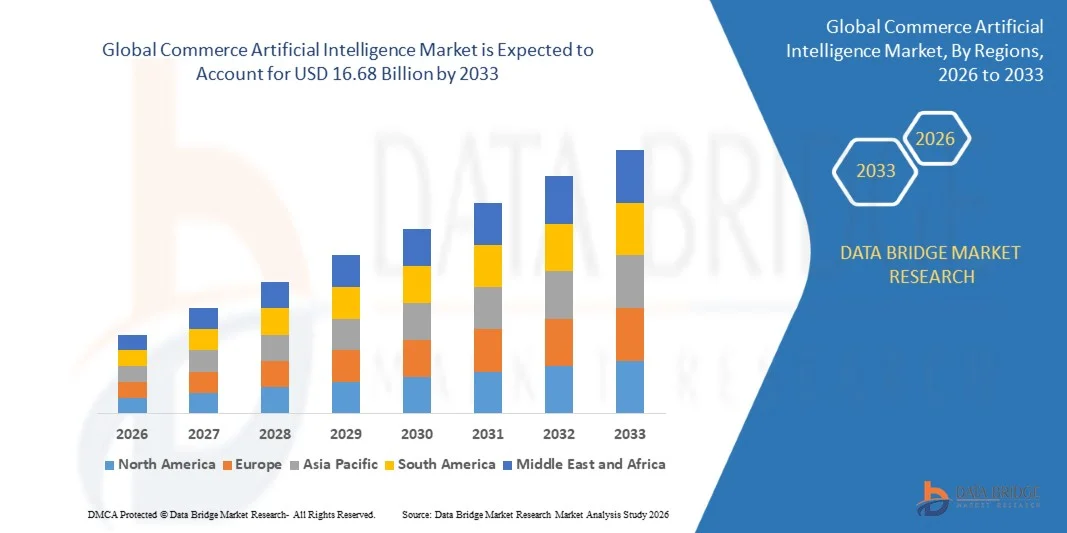
As per Data Bridge Market Research analysis the Commerce Artificial Intelligence Market was valued at USD 9.10 billion in 2025 and is projected to reach USD 16.68 billion by 2033, growing at a CAGR of 7.87% from 2026 to 2033. The market is experiencing steady growth driven by rising adoption of AI-enabled personalization, demand forecasting, dynamic pricing, customer service automation, and fraud detection solutions across retail, e-commerce, wholesale, and omnichannel commerce environments.
The increasing volume of digital transactions, expanding online product catalogs, and growing consumer expectations for relevant and seamless shopping experiences are compelling merchants to deploy machine learning, natural language processing, computer vision, and generative AI tools. These platforms help businesses analyze customer behavior, optimize inventory allocation, automate product recommendations, and improve conversion rates across digital and physical sales channels. AI-enabled commerce systems are also supporting retailers in reducing stockouts, managing returns, and improving supply chain responsiveness, while conversational shopping assistants and intelligent search capabilities are strengthening customer engagement and operational efficiency.
Key Market Trends & Insights
- North America dominated the commerce artificial intelligence market with the largest revenue share of 41.6% in 2025, supported by strong penetration of advanced ecommerce platforms, early adoption of AI technologies, high cloud computing usage, and the presence of leading technology providers such as Amazon, Microsoft, Google, and IBM driving innovation across retail and digital commerce ecosystems.
- Asia-Pacific is expected to be the fastest-growing region, recording a CAGR of 11.9% from 2026 to 2033. Growth is driven by rapid ecommerce expansion, increasing smartphone penetration, rising digital payment adoption, strong government support for digital transformation, and growing deployment of AI solutions across retail, logistics, and customer engagement platforms.
- The Software segment held the largest market revenue share of approximately 52.4% in 2025 driven by the increasing deployment of AI-powered ecommerce platforms, recommendation engines, chatbots, and predictive analytics tools across retail and online commerce ecosystems. Software solutions are preferred due to their scalability, faster deployment, and ability to integrate with existing digital commerce infrastructure. These solutions also enable real-time personalization, dynamic pricing, and customer behavior tracking, which significantly improve conversion rates. In addition, continuous advancements in cloud-based AI platforms are further strengthening adoption across global retailers.
- The services segment is projected to register the fastest growth at a CAGR of 19.6% from 2026 to 2033, driven by rising demand for AI implementation, system integration, consulting, and managed services supporting enterprise-level digital transformation initiatives. Increasing complexity of AI deployment in commerce platforms is encouraging businesses to rely on specialized service providers. Moreover, ongoing need for model optimization, maintenance, and data management is boosting long-term service contracts. Growing adoption among SMEs is also accelerating demand for cost-effective AI service models.
- The Ecommerce segment held the largest market revenue share of approximately 67.9% in 2025 driven by rapid digital adoption, increasing online shopping penetration, and widespread use of AI for personalization, pricing optimization, and customer engagement. AI tools are widely used to analyze consumer behavior, optimize product listings, and improve digital marketing effectiveness. The integration of AI with mobile commerce and omnichannel retail platforms is further strengthening ecommerce dominance. In addition, rising use of generative AI in product descriptions and customer support is enhancing efficiency.
- The In-Store segment is projected to register the fastest growth at a CAGR of 18.3% from 2026 to 2033, driven by growing deployment of AI-enabled smart shelves, cashier-less checkout systems, and real-time customer behavior analytics in physical retail environments. Retailers are increasingly investing in AI-powered surveillance and heat mapping systems to optimize store layouts and product placement. Integration of computer vision and sensor-based analytics is also improving inventory accuracy. Furthermore, hybrid retail models combining online and offline experiences are accelerating in-store AI adoption.
- The Product Recommendation segment held the largest market revenue share of approximately 21.5% in 2025 driven by strong adoption of AI-driven personalization engines that enhance conversion rates and customer engagement across ecommerce platforms. These systems analyze browsing history, purchase behavior, and demographic data to deliver highly targeted product suggestions. Increasing reliance on real-time personalization is further boosting segment dominance. In addition, integration with social media platforms is expanding recommendation capabilities.
- The warehouse automation segment is projected to register the fastest growth at a CAGR of 22.4% from 2026 to 2033, driven by increasing use of AI-powered robotics, predictive inventory systems, and automated fulfillment solutions in large-scale retail and logistics operations. Rising ecommerce order volumes are pushing retailers to adopt intelligent warehouse management systems. AI-enabled forecasting tools are improving inventory planning and reducing operational costs. Furthermore, integration of autonomous mobile robots is significantly enhancing fulfillment speed and accuracy.
- The Large Enterprises segment held the largest market revenue share of approximately 71.2% in 2025 driven by high investment capacity, early adoption of advanced AI systems, and strong digital infrastructure supporting omnichannel commerce operations. These organizations are leveraging AI for large-scale customer analytics and supply chain optimization. They also benefit from in-house data ecosystems that improve AI training efficiency. In addition, enterprise-level integration of AI with ERP and CRM systems is strengthening adoption.
- The SMEs segment is projected to register the fastest growth at a CAGR of 20.1% from 2026 to 2033, driven by increasing availability of cloud-based AI solutions, lower deployment costs, and rising adoption of digital commerce tools among small retailers. Affordable subscription-based AI models are enabling wider accessibility. SMEs are increasingly using AI for marketing automation and customer engagement. Growing digital transformation in emerging economies is also accelerating segment expansion.
- The Machine Learning segment held the largest market revenue share of approximately 45.8% in 2025 driven by widespread use in recommendation systems, customer segmentation, and predictive analytics across ecommerce platforms. Machine learning models are extensively used for demand forecasting and pricing optimization. Their ability to process large datasets efficiently makes them highly suitable for commerce applications. Continuous algorithm improvements are further strengthening adoption.
- The natural language processing (NLP) segment is projected to register the fastest growth at a CAGR of 21.7% from 2026 to 2033, driven by increasing adoption of chatbots, voice assistants, and AI-driven customer interaction tools. NLP enables real-time customer query resolution and personalized communication at scale. Growing use of conversational commerce across messaging apps is further accelerating demand. In addition, advancements in generative AI are enhancing language understanding and response accuracy.
- The Cloud-Hosting segment held the largest market revenue share of approximately 74.3% in 2025 driven by scalability, lower upfront costs, and ease of integration with ecommerce platforms and AI APIs. Cloud solutions enable rapid deployment of AI tools across multiple regions. They also support continuous updates and model improvements without operational disruption. Increasing adoption of SaaS-based AI platforms is further boosting segment dominance.
- The On-Premise segment is projected to register the fastest growth at a CAGR of 16.9% from 2026 to 2033, driven by rising demand for data security, customization, and control among large retail and BFSI organizations. Enterprises with strict compliance requirements prefer on-premise deployment. It also allows better control over sensitive customer data and proprietary algorithms. Hybrid deployment models are further supporting gradual growth of this segment.
- The Retail segment held the largest market revenue share of approximately 38.7% in 2025 driven by strong adoption of AI for personalization, pricing optimization, and customer experience enhancement. Retailers are increasingly deploying AI across marketing, inventory management, and customer engagement workflows. The rise of omnichannel retailing is further strengthening adoption. In addition, AI-powered recommendation systems are significantly improving sales conversion rates.
- The logistics segment is projected to register the fastest growth at a CAGR of 23.1% from 2026 to 2033, driven by increasing deployment of AI in route optimization, demand forecasting, warehouse automation, and last-mile delivery management. Growing ecommerce penetration is increasing pressure on logistics efficiency. AI-enabled predictive analytics is improving supply chain visibility and reducing delivery delays. Furthermore, integration of autonomous delivery systems is accelerating innovation in the segment.
Market Size & Forecast
- Global Market Value (2025): USD 9.10 Billion
- Expected Market Value (2033): USD 16.68 Billion
- Forecast CAGR (2026–2033): 7.87%
- Leading Region in 2025: North America
- Fastest Growing Region: Asia-Pacific
Report Scope and Commerce Artificial Intelligence Market Segmentation
|
Attributes |
Commerce Artificial Intelligence Key Market Insights |
|
Segments Covered |
· By Offering: Hardware, Software, and Services · By Platform: Ecommerce and In-Store · By Application: Customer Relationship Management, Internet of Things (IoT), Supply Chain Analysis, Virtual Personal Assistants, Fake Review Analysis, Merchandising, Warehouse Automation, Product Recommendation, Customer Service, Ecommerce Marketing, Product Catalogue Optimization, and Fleet Management · By Organization Size: Large enterprises, and Small and medium-sized enterprises (SMEs) · By Technology: Deep Learning, Machine Learning, Natural Language Processing (NLP), and Others · By Implementation: Cloud-Hosting and On-Premise · By End User: Retail, Electronics, Food and Beverages, Fashion, Logistics, and BFSI |
|
Countries Covered |
North America · U.S. · Canada · Mexico Europe · Germany · France · U.K. · Netherlands · Switzerland · Belgium · Russia · Italy · Spain · Turkey · Rest of Europe Asia-Pacific · China · Japan · India · South Korea · Singapore · Malaysia · Australia · Thailand · Indonesia · Philippines · Rest of Asia-Pacific Middle East and Africa · Saudi Arabia · U.A.E. · South Africa · Egypt · Israel · Rest of Middle East and Africa South America · Brazil · Argentina · Rest of South America |
|
Key Market Players |
Top 15 Companies |
|
Market Opportunities |
• Expansion Of AI-Powered Hyper-Personalization And Conversational Commerce |
|
Value Added Data Infosets |
In addition to the market insights such as market value, growth rate, market segments, geographical coverage, market players, and market scenario, the market report curated by the Data Bridge Market Research team includes in-depth expert analysis, import/export analysis, pricing analysis, production consumption analysis, and pestle analysis. |
Commerce Artificial Intelligence Market Trends
Trend: Expansion Of Agentic Commerce And AI-Powered Hyper-Personalization
Commerce enterprises are increasingly adopting artificial intelligence to deliver personalized product discovery, conversational shopping, dynamic promotions, and automated customer support across websites, marketplaces, mobile applications, and physical stores. Traditional rule-based recommendation engines and manual merchandising processes are being replaced by AI systems that evaluate browsing behavior, transaction history, product availability, and real-time customer intent to provide more relevant shopping journeys. Industry surveys indicate that 81% of customers prefer companies that provide personalized experiences, reinforcing the importance of AI-enabled engagement strategies for retailers and direct-to-consumer brands.
The emergence of agentic commerce is further transforming how consumers search, compare, and purchase products. AI agents can assist with multistep activities such as identifying products, comparing prices, applying loyalty benefits, managing returns, and completing transactions within defined customer preferences. Industry estimates indicate that AI agents could mediate between USD 3 trillion and USD 5 trillion in global consumer commerce by 2030, highlighting the long-term commercial potential of autonomous shopping and intelligent commerce platforms.
Retailers are also integrating generative AI into product-content creation, customer service, and campaign management to improve speed and consistency across large product catalogs. In 2025, 75% of retailers identified AI agents as essential for maintaining competitiveness, while 76% planned to increase AI investments. Customer service, including order tracking and returns management, emerged as a leading AI-agent use case, demonstrating the growing operational role of commerce AI.
Commerce Artificial Intelligence Market Dynamics
Key Market Driver: Rising Demand For Intelligent Customer Engagement And Commerce Automation
Retailers, marketplaces, and B2B commerce organizations are facing increasing pressure to improve conversion rates, reduce customer acquisition costs, and provide consistent experiences across rapidly expanding digital channels. The growth of online product assortments and fragmented consumer journeys makes manual merchandising, pricing, and service processes increasingly inefficient, creating strong demand for AI-driven recommendation engines, intelligent search, chatbots, and marketing automation platforms.
Commerce organizations are deploying AI to automate product recommendations, customer segmentation, content generation, and service interactions while improving the relevance of customer communications. For instance, AI systems can identify likely purchase intent from browsing and purchase data, recommend complementary products, and personalize offers based on inventory levels and customer value. In 2025, almost half of e-commerce businesses had integrated AI into their operations, while adoption reached 61% among B2B e-tailers, particularly for personalization, content generation, and customer service.
AI is also strengthening demand forecasting and inventory planning by helping merchants predict product demand, optimize replenishment cycles, and reduce stockouts across omnichannel networks. This capability is increasingly important for retailers managing seasonal demand volatility and high return volumes. In 2025, 43% of retailers were piloting autonomous AI agents for operations including customer service, marketing, and inventory management, indicating broader adoption beyond front-end shopping experiences.
Key Restraint/Challenge: Data Privacy Risks And Complex Integration With Legacy Commerce Systems
Commerce AI deployments depend on access to high-quality customer, product, pricing, and transaction data, yet many retailers operate fragmented technology environments with separate e-commerce, customer relationship management, enterprise resource planning, and point-of-sale systems. Inconsistent product information, incomplete customer profiles, and siloed inventory data can reduce recommendation accuracy and limit the effectiveness of automated decision-making systems.
In addition, increasing use of customer data for personalization creates concerns related to privacy, consent management, algorithmic bias, and compliance with data protection regulations. Retailers must ensure that AI-generated offers, pricing decisions, and customer interactions remain transparent, secure, and aligned with brand policies. The need to protect payment data and prevent fraudulent transactions can further increase implementation costs, particularly for small and medium-sized merchants with limited internal AI expertise.
The transition from AI experimentation to enterprise-scale deployment also remains challenging. While adoption is expanding, retailers must invest in cloud infrastructure, data governance, workforce training, and continuous model monitoring to achieve measurable returns. This complexity can delay deployment timelines and create uncertainty around the performance of AI systems in rapidly changing demand environments.
Key Market Opportunity: AI-Enabled Demand Forecasting, Dynamic Pricing, And B2B Commerce Intelligence
The growing complexity of omnichannel retail and B2B purchasing is creating significant opportunities for AI platforms that optimize demand forecasting, pricing, inventory allocation, and account-specific product recommendations. AI-enabled forecasting tools can process sales history, seasonality, promotions, weather patterns, and regional demand signals to support more accurate replenishment decisions and improve inventory utilization across warehouses and stores.
Retailers are increasingly exploring dynamic pricing solutions that assess competitor activity, inventory levels, demand elasticity, and customer behavior to improve margin management and promotional effectiveness. In B2B commerce, AI can support personalized catalogs, contract pricing, quote generation, and self-service ordering, helping suppliers provide consumer-grade buying experiences to business customers. Digital commerce continues to expand at an estimated 5% to 7% annually, with marketplaces serving as a major growth channel and increasing the need for AI-enabled pricing, assortment, and fulfillment intelligence.
In addition, AI-powered commerce platforms are creating opportunities in cross-border selling, social commerce, and retail media by helping merchants localize content, identify high-value audiences, and automate campaign optimization. As organizations move from isolated pilots to integrated AI commerce strategies, demand is expected to rise for solutions that combine personalization, customer service automation, fraud prevention, and supply chain intelligence within a unified commerce ecosystem.
Commerce Artificial Intelligence Market Scope
The market is segmented on the basis of offering, platform, application, organization size, technology, implementation, and end user.
- By Offering
On the basis of offering, the commerce artificial intelligence market is segmented into hardware, software, and services. The Software segment held the largest market revenue share of approximately 52.4% in 2025 driven by the increasing deployment of AI-powered ecommerce platforms, recommendation engines, chatbots, and predictive analytics tools across retail and online commerce ecosystems. Software solutions are preferred due to their scalability, faster deployment, and ability to integrate with existing digital commerce infrastructure. These solutions also enable real-time personalization, dynamic pricing, and customer behavior tracking, which significantly improve conversion rates. In addition, continuous advancements in cloud-based AI platforms are further strengthening adoption across global retailers.
The services segment is projected to register the fastest growth at a CAGR of 19.6% from 2026 to 2033, driven by rising demand for AI implementation, system integration, consulting, and managed services supporting enterprise-level digital transformation initiatives. Increasing complexity of AI deployment in commerce platforms is encouraging businesses to rely on specialized service providers. Moreover, ongoing need for model optimization, maintenance, and data management is boosting long-term service contracts. Growing adoption among SMEs is also accelerating demand for cost-effective AI service models.
- By Platform
On the basis of platform, the market is segmented into ecommerce and in-store. The Ecommerce segment held the largest market revenue share of approximately 67.9% in 2025 driven by rapid digital adoption, increasing online shopping penetration, and widespread use of AI for personalization, pricing optimization, and customer engagement. AI tools are widely used to analyze consumer behavior, optimize product listings, and improve digital marketing effectiveness. The integration of AI with mobile commerce and omnichannel retail platforms is further strengthening ecommerce dominance. In addition, rising use of generative AI in product descriptions and customer support is enhancing efficiency.
The In-Store segment is projected to register the fastest growth at a CAGR of 18.3% from 2026 to 2033, driven by growing deployment of AI-enabled smart shelves, cashier-less checkout systems, and real-time customer behavior analytics in physical retail environments. Retailers are increasingly investing in AI-powered surveillance and heat mapping systems to optimize store layouts and product placement. Integration of computer vision and sensor-based analytics is also improving inventory accuracy. Furthermore, hybrid retail models combining online and offline experiences are accelerating in-store AI adoption.
- By Application
On the basis of application, the market is segmented into customer relationship management, IoT, supply chain analysis, virtual personal assistants, fake review analysis, merchandising, warehouse automation, product recommendation, customer service, ecommerce marketing, product catalogue optimization, and fleet management. The Product Recommendation segment held the largest market revenue share of approximately 21.5% in 2025 driven by strong adoption of AI-driven personalization engines that enhance conversion rates and customer engagement across ecommerce platforms. These systems analyze browsing history, purchase behavior, and demographic data to deliver highly targeted product suggestions. Increasing reliance on real-time personalization is further boosting segment dominance. In addition, integration with social media platforms is expanding recommendation capabilities.
The warehouse automation segment is projected to register the fastest growth at a CAGR of 22.4% from 2026 to 2033, driven by increasing use of AI-powered robotics, predictive inventory systems, and automated fulfillment solutions in large-scale retail and logistics operations. Rising ecommerce order volumes are pushing retailers to adopt intelligent warehouse management systems. AI-enabled forecasting tools are improving inventory planning and reducing operational costs. Furthermore, integration of autonomous mobile robots is significantly enhancing fulfillment speed and accuracy.
- By Organization Size
On the basis of organization size, the market is segmented into large enterprises and small and medium-sized enterprises (SMEs). The Large Enterprises segment held the largest market revenue share of approximately 71.2% in 2025 driven by high investment capacity, early adoption of advanced AI systems, and strong digital infrastructure supporting omnichannel commerce operations. These organizations are leveraging AI for large-scale customer analytics and supply chain optimization. They also benefit from in-house data ecosystems that improve AI training efficiency. In addition, enterprise-level integration of AI with ERP and CRM systems is strengthening adoption.
The SMEs segment is projected to register the fastest growth at a CAGR of 20.1% from 2026 to 2033, driven by increasing availability of cloud-based AI solutions, lower deployment costs, and rising adoption of digital commerce tools among small retailers. Affordable subscription-based AI models are enabling wider accessibility. SMEs are increasingly using AI for marketing automation and customer engagement. Growing digital transformation in emerging economies is also accelerating segment expansion.
- By Technology
On the basis of technology, the market is segmented into deep learning, machine learning, natural language processing (NLP), and others. The Machine Learning segment held the largest market revenue share of approximately 45.8% in 2025 driven by widespread use in recommendation systems, customer segmentation, and predictive analytics across ecommerce platforms. Machine learning models are extensively used for demand forecasting and pricing optimization. Their ability to process large datasets efficiently makes them highly suitable for commerce applications. Continuous algorithm improvements are further strengthening adoption.
The natural language processing (NLP) segment is projected to register the fastest growth at a CAGR of 21.7% from 2026 to 2033, driven by increasing adoption of chatbots, voice assistants, and AI-driven customer interaction tools. NLP enables real-time customer query resolution and personalized communication at scale. Growing use of conversational commerce across messaging apps is further accelerating demand. In addition, advancements in generative AI are enhancing language understanding and response accuracy.
- By Implementation
On the basis of implementation, the market is segmented into cloud-hosting and on-premise. The Cloud-Hosting segment held the largest market revenue share of approximately 74.3% in 2025 driven by scalability, lower upfront costs, and ease of integration with ecommerce platforms and AI APIs. Cloud solutions enable rapid deployment of AI tools across multiple regions. They also support continuous updates and model improvements without operational disruption. Increasing adoption of SaaS-based AI platforms is further boosting segment dominance.
The On-Premise segment is projected to register the fastest growth at a CAGR of 16.9% from 2026 to 2033, driven by rising demand for data security, customization, and control among large retail and BFSI organizations. Enterprises with strict compliance requirements prefer on-premise deployment. It also allows better control over sensitive customer data and proprietary algorithms. Hybrid deployment models are further supporting gradual growth of this segment.
- By End User
On the basis of end user, the market is segmented into retail, electronics, food and beverages, fashion, logistics, and BFSI. The Retail segment held the largest market revenue share of approximately 38.7% in 2025 driven by strong adoption of AI for personalization, pricing optimization, and customer experience enhancement. Retailers are increasingly deploying AI across marketing, inventory management, and customer engagement workflows. The rise of omnichannel retailing is further strengthening adoption. In addition, AI-powered recommendation systems are significantly improving sales conversion rates.
The logistics segment is projected to register the fastest growth at a CAGR of 23.1% from 2026 to 2033, driven by increasing deployment of AI in route optimization, demand forecasting, warehouse automation, and last-mile delivery management. Growing ecommerce penetration is increasing pressure on logistics efficiency. AI-enabled predictive analytics is improving supply chain visibility and reducing delivery delays. Furthermore, integration of autonomous delivery systems is accelerating innovation in the segment.
Commerce Artificial Intelligence Market Regional Analysis
North America Commerce Artificial Intelligence Market Insight
North America dominated the commerce artificial intelligence market with the largest revenue share of 41.6% in 2025, supported by rapid digital transformation across retail and ecommerce ecosystems, strong penetration of cloud-based AI platforms, and high adoption of advanced analytics solutions. Businesses in the region are increasingly leveraging AI for personalization, predictive analytics, customer behavior tracking, and automated marketing optimization. The presence of major technology providers, coupled with high consumer demand for seamless omnichannel shopping experiences, is further strengthening market expansion across both online and offline retail environments.
U.S. Commerce Artificial Intelligence Market Insight
The U.S. commerce artificial intelligence market captured the largest revenue share in 2025 within North America, fueled by widespread adoption of ecommerce platforms, strong investment in generative AI technologies, and increasing integration of AI-driven recommendation engines across retail operations. Companies are prioritizing intelligent automation for pricing optimization, supply chain forecasting, and customer engagement. The growing use of AI chatbots, voice assistants, and personalized shopping tools is further enhancing customer experience. In addition, strong presence of leading AI and cloud service providers is accelerating innovation and deployment across industries.
Europe Commerce Artificial Intelligence Market Insight
The Europe commerce artificial intelligence market is expected to witness the fastest growth rate from 2026 to 2033, primarily driven by increasing digital retail adoption, rising investment in AI-enabled customer analytics, and strong regulatory focus on data-driven transparency. Retailers across the region are increasingly deploying AI for demand forecasting, fraud detection, and customer personalization. Growth is also supported by expanding ecommerce penetration and increasing demand for intelligent automation in logistics and supply chain operations. The rise of omnichannel retail strategies is further boosting AI adoption across European markets.
U.K. Commerce Artificial Intelligence Market Insight
The U.K. commerce artificial intelligence market is expected to witness strong growth from 2026 to 2033, driven by rapid expansion of ecommerce platforms, increasing adoption of AI-based marketing tools, and strong demand for automated customer engagement solutions. Retailers are integrating AI into digital payment systems, product recommendation engines, and customer service platforms. Rising consumer expectations for personalized shopping experiences and faster delivery services are further supporting adoption. In addition, strong fintech and retail technology ecosystems are accelerating innovation in AI-driven commerce solutions.
Germany Commerce Artificial Intelligence Market Insight
The Germany commerce artificial intelligence market is expected to witness significant growth from 2026 to 2033, fueled by increasing digitalization of retail operations, strong industrial automation capabilities, and rising adoption of AI for supply chain optimization. German retailers are focusing on AI-powered demand forecasting, inventory management, and customer analytics to improve operational efficiency. Emphasis on data security and regulatory compliance is encouraging deployment of secure AI systems. Furthermore, integration of AI with smart retail infrastructure and IoT-enabled systems is strengthening market growth.
Asia-Pacific Commerce Artificial Intelligence Market Insight
The Asia-Pacific commerce artificial intelligence market is expected to witness the fastest growth rate from 2026 to 2033, supported by rapid ecommerce expansion, increasing smartphone penetration, and growing adoption of digital payment systems. Countries such as China, India, Japan, and South Korea are driving large-scale implementation of AI in retail personalization, logistics optimization, and customer engagement. Government initiatives promoting digital economy transformation and smart retail development are further accelerating adoption. In addition, the region’s strong manufacturing base for AI-enabled devices is improving affordability and accessibility.
Japan Commerce Artificial Intelligence Market Insight
The Japan commerce artificial intelligence market is expected to witness strong growth from 2026 to 2033 due to high technological advancement, strong adoption of automation, and increasing demand for intelligent retail systems. Japanese retailers are deploying AI for customer service automation, demand forecasting, and personalized shopping experiences. Integration of AI with robotics and IoT-enabled retail infrastructure is also expanding. In addition, Japan’s aging population is driving demand for simplified digital shopping solutions and voice-enabled commerce interfaces, enhancing market penetration.
China Commerce Artificial Intelligence Market Insight
The China commerce artificial intelligence market accounted for the largest market revenue share in Asia-Pacific in 2025, attributed to the rapid expansion of ecommerce platforms, strong digital ecosystem development, and high adoption of AI-driven retail technologies. Chinese companies are extensively using AI for product recommendations, dynamic pricing, supply chain optimization, and customer engagement. Strong government support for AI innovation and smart city initiatives is further boosting adoption. In addition, the presence of large domestic tech players is accelerating large-scale commercialization of commerce AI solutions.
Commerce Artificial Intelligence Market Share
The Commerce Artificial Intelligence industry is primarily led by well-established companies, including:
• Huawei Technologies Co., Ltd. (CN)
• SAMSUNG (KR)
• Qualcomm Technologies (U.S.)
• NVIDIA Corporation (U.S.)
• Hewlett Packard Enterprise Development LP (U.S.)
• Cisco Systems, Inc. (U.S.)
• IBM (U.S.)
• Amazon Web Services Inc. (U.S.)
• Oracle (U.S.)
• Google LLC (U.S.)
• Broadcom (U.S.)
• Descartes Labs, Inc. (U.S.)
• Wipro Limited (IN)
• Deere & Company (U.S.)
• Apple Inc. (U.S.)
• Microsoft (U.S.)
• MediaTek Inc. (TW)
• ANKI (U.S.)
• SoundHound Inc. (U.S.)
Latest Developments in Commerce Artificial Intelligence Market
- In October 2025, Microsoft (U.S.) expanded its strategic partnership with SAP (DE) to integrate advanced artificial intelligence capabilities into enterprise resource planning systems. The development focuses on enhancing real-time data processing, predictive analytics, and automated decision-making within enterprise workflows. This integration is expected to improve operational efficiency for businesses while strengthening Microsoft’s position in enterprise AI solutions and accelerating AI-driven digital transformation across industries.
- In September 2025, Google (U.S.) launched an AI-powered analytics tool designed specifically for small and medium-sized enterprises. The solution leverages machine learning to analyze consumer behavior, optimize marketing campaigns, and generate actionable business insights. This initiative aims to democratize access to advanced AI technologies, enabling smaller businesses to improve competitiveness and digital decision-making capabilities. It is expected to significantly expand AI adoption across the SME segment of the commerce ecosystem.
- In August 2025, Amazon (U.S.) introduced a new AI-driven inventory management system powered by machine learning algorithms to forecast stock levels and optimize supply chain operations. The solution enhances demand prediction accuracy, reduces inventory holding costs, and improves delivery efficiency across its global logistics network. This development strengthens Amazon’s operational efficiency and reinforces its leadership in AI-enabled ecommerce and intelligent supply chain management systems.

- Interactive Data Analysis Dashboard
- Company Analysis Dashboard for high growth potential opportunities
- Research Analyst Access for customization & queries
- Competitor Analysis with Interactive dashboard
- Latest News, Updates & Trend analysis
- Harness the Power of Benchmark Analysis for Comprehensive Competitor Tracking
Data collection and base year analysis are done using data collection modules with large sample sizes. The stage includes obtaining market information or related data through various sources and strategies. It includes examining and planning all the data acquired from the past in advance. It likewise envelops the examination of information inconsistencies seen across different information sources. The market data is analysed and estimated using market statistical and coherent models. Also, market share analysis and key trend analysis are the major success factors in the market report. To know more, please request an analyst call or drop down your inquiry.
The key research methodology used by DBMR research team is data triangulation which involves data mining, analysis of the impact of data variables on the market and primary (industry expert) validation. Data models include Vendor Positioning Grid, Market Time Line Analysis, Market Overview and Guide, Company Positioning Grid, Patent Analysis, Pricing Analysis, Company Market Share Analysis, Standards of Measurement, Global versus Regional and Vendor Share Analysis. To know more about the research methodology, drop in an inquiry to speak to our industry experts.
Data Bridge Market Research is a leader in advanced formative research. We take pride in servicing our existing and new customers with data and analysis that match and suits their goal. The report can be customized to include price trend analysis of target brands understanding the market for additional countries (ask for the list of countries), clinical trial results data, literature review, refurbished market and product base analysis. Market analysis of target competitors can be analyzed from technology-based analysis to market portfolio strategies. We can add as many competitors that you require data about in the format and data style you are looking for. Our team of analysts can also provide you data in crude raw excel files pivot tables (Fact book) or can assist you in creating presentations from the data sets available in the report.













