

Global Commercial Cleaning Equipment Market
Market Size in USD Billion
CAGR :
% 
 USD
135.51 Billion
USD
211.14 Billion
2025
2033
USD
135.51 Billion
USD
211.14 Billion
2025
2033
 Forecast Period Forecast Period |
2026 - 2033 |
 Market Size (Base Year) Market Size (Base Year) |
USD 135.51 Billion |
 Market Size (Forecast Year) Market Size (Forecast Year) |
USD 211.14 Billion |
 CAGR CAGR |
% |
| Major Markets Players |
|
Commercial Cleaning Equipment Market Overview
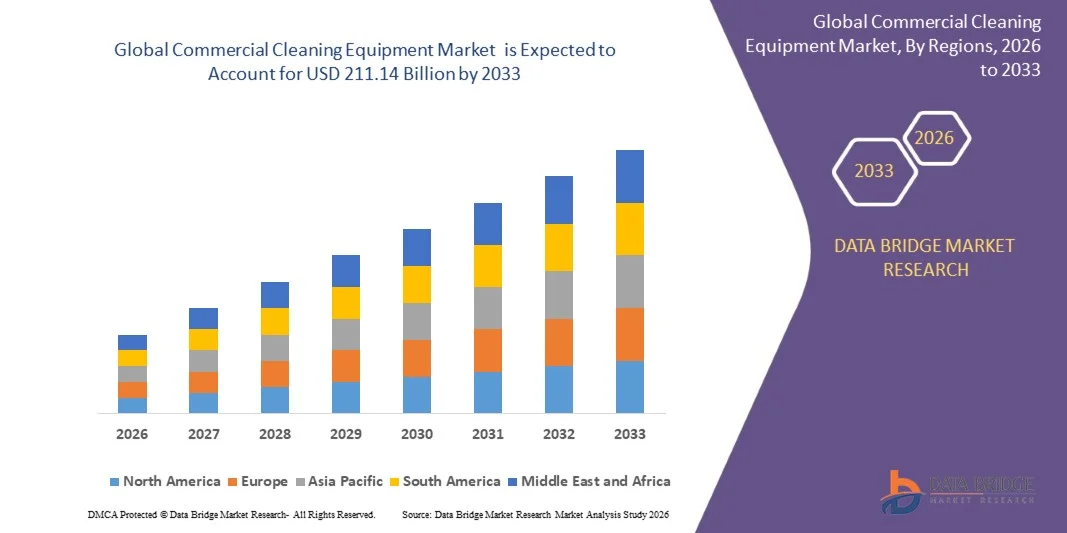
The Commercial Cleaning Equipment Market was valued at USD 135.51 billion in 2025 and is projected to reach USD 211.14 billion by 2033, growing at a CAGR of 5.70% from 2026 to 2033. The market is experiencing steady growth driven by increasing demand for hygiene and sanitation across commercial spaces, rising adoption of automated and energy-efficient cleaning solutions, and expanding applications across healthcare, hospitality, retail, and industrial sectors.
The growing emphasis on infection control and workplace cleanliness, particularly after heightened global awareness of public health standards, is compelling organizations to invest in advanced cleaning equipment such as floor scrubbers, vacuum systems, and high-pressure washers. In addition, rapid urbanization, expansion of commercial infrastructure, and the shift toward smart and autonomous cleaning technologies are further accelerating market adoption across both developed and emerging economies.
Key Market Trends & Insights
- North America dominated the commercial cleaning equipment market with the largest revenue share of approximately 36.8% in 2025, supported by strong demand for advanced sanitation solutions across corporate, healthcare, retail, and industrial facilities.
- Asia-Pacific is expected to be the fastest-growing region, recording a CAGR of 6.8% from 2026 to 2033. Growth is driven by rapid urbanization, expanding commercial infrastructure, increasing awareness of hygiene standards, and rising adoption of cost-effective automated cleaning solutions in countries such as China, India, and Southeast Asia.
- The Mechanical Equipment segment held the largest market revenue share of approximately 71.3% in 2025, driven by increasing adoption of automated scrubbers, vacuum systems, and floor cleaning machines across large commercial facilities. Mechanical systems are widely preferred due to higher efficiency, reduced labor dependency, and consistent cleaning performance in high-traffic environments such as malls, hospitals, airports, and industrial complexes.
- The Manual Equipment segment is projected to register steady growth at a CAGR of 4.2% from 2026 to 2033, driven by low-cost adoption in small-scale commercial spaces and developing regions where affordability and basic cleaning needs remain key priorities. Manual tools such as mops, brushes, and wipers continue to be widely used in cost-sensitive markets and small establishments. These solutions remain essential for localized cleaning tasks where automated systems are not economically viable or operationally necessary.
- The Surface Cleaners segment held the largest market revenue share of approximately 46.5% in 2025, driven by widespread usage in floor maintenance, industrial cleaning, and institutional sanitation applications. Surface cleaning equipment is extensively used across corporate offices, hospitals, and retail environments due to its versatility, durability, and operational efficiency.
- The Glass Cleaners Fabric Cleaners segment is projected to register the fastest growth at a CAGR of 6.8% from 2026 to 2033, driven by rising demand for specialized cleaning solutions in hospitality, commercial buildings, and premium retail spaces where aesthetic maintenance and hygiene standards are critical. Increasing construction of glass-intensive modern infrastructure is also supporting segment growth.
- The B2B segment held the largest market revenue share of approximately 52.7% in 2025, driven by bulk procurement from facility management companies, hospitals, and industrial cleaning service providers. Large-scale contracts and long-term maintenance agreements are key factors supporting segment dominance.
- The E-Commerce segment is projected to register the fastest growth at a CAGR of 9.1% from 2026 to 2033, driven by increasing digital procurement trends, easy product comparison, and rising availability of commercial-grade cleaning equipment on online platforms. Online distribution channels are also expanding access for small and mid-sized enterprises.
- The Floors segment held the largest market revenue share of approximately 38.9% in 2025, driven by extensive use of floor scrubbers, polishers, and vacuum systems in commercial and institutional environments. Floor cleaning remains a core requirement across all large-scale facilities, ensuring continuous demand for specialized equipment.
- The Bathrooms segment is projected to register the fastest growth at a CAGR of 7.5% from 2026 to 2033, driven by increasing hygiene standards in healthcare, hospitality, and corporate sectors, along with stricter sanitation regulations in public facilities.
- The Hospitals segment held the largest market revenue share of approximately 27.6% in 2025, driven by strict infection control requirements, high sanitation standards, and continuous cleaning needs in healthcare environments.
- The Hotels segment is projected to register the fastest growth at a CAGR of 8.3% from 2026 to 2033, driven by rising global tourism, increasing focus on guest hygiene standards, and adoption of advanced cleaning equipment to maintain premium service quality.
Market Size & Forecast
- Global Market Value (2025): USD 135.51 Billion
- Expected Market Value (2033): USD 211.14 Billion
- Forecast CAGR (2026–2033): 5.70%
- Leading Region in 2025: North America
- Fastest Growing Region: Asia-Pacific
Report Scope and Commercial Cleaning Equipment Market Segmentation
|
Attributes |
Commercial Cleaning Equipment Key Market Insights |
|
Segments Covered |
|
|
Countries Covered |
North America
Europe
Asia-Pacific
Middle East and Africa
South America
|
|
Key Market Players |
• Diversey (U.S.) |
|
Market Opportunities |
|
|
Value Added Data Infosets |
In addition to the insights on market scenarios such as market value, growth rate, segmentation, geographical coverage, and major players, the market reports curated by the Data Bridge Market Research also include in-depth expert analysis, pricing analysis, brand share analysis, consumer survey, demography analysis, supply chain analysis, value chain analysis, raw material/consumables overview, vendor selection criteria, PESTLE Analysis, Porter Analysis, and regulatory framework. |
Commercial Cleaning Equipment Market Trends
Trend: Growth In Automation, Smart Cleaning Systems, And Sustainable Hygiene Solutions
Increasing demand for energy-efficient, automated, and environmentally sustainable cleaning technologies across commercial, industrial, and institutional sectors. Traditional manual cleaning systems are increasingly being replaced by mechanized and robotic solutions due to rising labor costs, stricter hygiene standards, and the need for consistent cleaning performance in high-traffic environments such as airports, hospitals, and shopping complexes.
In modern commercial facilities, manufacturers are integrating robotic floor scrubbers and AI-enabled vacuum systems, For instance in large airports and metro stations, to reduce operational downtime and improve cleaning efficiency while minimizing human intervention. In industrial and healthcare environments, high-pressure cleaning systems and automated disinfection units are being used to ensure compliance with stringent sanitation protocols and reduce infection risks.
The rapid expansion of smart buildings, hospitality infrastructure, and retail chains is also increasing demand for connected cleaning systems capable of real-time monitoring, predictive maintenance, and optimized resource usage. In addition, healthcare and pharmaceutical sectors continue to rely on advanced disinfection technologies, such as UV-based cleaning systems used in hospitals in the U.S. and Europe, due to their ability to reduce pathogen transmission and improve sanitation efficiency. Growing industry validation through pilot deployments in 2025 across commercial office complexes in Singapore and Germany integrating IoT-enabled cleaning robots is showing efficiency improvements of nearly 20–25% in cleaning cycle optimization and labor cost reduction.
Commercial Cleaning Equipment Market Dynamics
Key Market Driver: Rising Demand For Automated Hygiene And Facility Management Solutions
Industries worldwide are facing increasing pressure to maintain high hygiene standards, reduce operational costs, and improve workplace safety, driving strong demand for automated commercial cleaning equipment. Expanding commercial infrastructure such as malls, hospitals, airports, and corporate offices is generating continuous demand for high-efficiency cleaning systems capable of handling large-scale sanitation requirements.
Facility management companies are increasingly deploying automated scrubbers, robotic vacuum cleaners, and smart sanitation systems to reduce dependency on manual labor and improve consistency in cleaning operations. For instance, large hospital networks in North America and Europe are adopting automated disinfection systems integrated with scheduling software to ensure continuous infection control and compliance with healthcare hygiene regulations.
Similarly, the hospitality and retail sectors are investing in advanced cleaning technologies to enhance customer experience and maintain brand reputation. Real-world deployments in 2024 across major U.K. hotel chains integrating autonomous floor cleaning robots demonstrated reductions in cleaning time of around 15–20% while improving operational efficiency and staff allocation.
Key Restraint/Challenge: High Initial Investment And Maintenance Complexity
Commercial cleaning equipment, particularly automated and robotic systems, involves high initial capital investment, limiting adoption among small and medium-sized enterprises. Advanced systems require significant upfront costs, along with ongoing expenses for maintenance, software updates, and skilled operators, which increases total cost of ownership.
In addition, integration challenges with existing facility management systems and the need for regular technical servicing create operational barriers for end-users. Smaller commercial establishments often continue to rely on manual cleaning methods due to budget constraints and limited technical expertise.
Industry studies indicate that robotic cleaning systems can cost 3–5 times more than conventional manual equipment, with maintenance expenses accounting for up to 12–18% of total annual operating costs, significantly impacting adoption in cost-sensitive markets and developing economies.
Key Market Opportunity: Expansion Of Smart Infrastructure And Sustainable Cleaning Technologies
Modern smart cities, green buildings, and digitally connected commercial spaces increasingly require intelligent cleaning solutions that combine automation, sustainability, and real-time monitoring. Growing emphasis on energy efficiency and environmental compliance is encouraging adoption of water-saving and chemical-reducing cleaning systems across commercial facilities.
Commercial operators are increasingly deploying IoT-enabled cleaning equipment, For instance in smart office complexes and airports, to track cleaning performance, optimize resource usage, and reduce operational downtime. In the healthcare and food service industries, demand for eco-friendly disinfecting systems and low-emission cleaning machines is accelerating due to stricter environmental and safety regulations.
In addition, advancements in robotics, sensor technology, and AI-driven facility management platforms are improving cleaning precision and operational efficiency. Pilot implementations in 2025 across smart commercial buildings in Japan and South Korea integrating autonomous cleaning fleets reported improvements of around 18–22% in cleaning efficiency and significant reductions in water and chemical consumption.
Commercial Cleaning Equipment Market Scope
The market is segmented on the basis of type, product, distribution channel, application, and end-user.
• By Type
On the basis of type, the commercial cleaning equipment market is segmented into Mechanical Equipment and Manual Equipment. The Mechanical Equipment segment held the largest market revenue share of approximately 71.3% in 2025, driven by increasing adoption of automated scrubbers, vacuum systems, and floor cleaning machines across large commercial facilities. Mechanical systems are widely preferred due to higher efficiency, reduced labor dependency, and consistent cleaning performance in high-traffic environments such as malls, hospitals, airports, and industrial complexes.
The Manual Equipment segment is projected to register steady growth at a CAGR of 4.2% from 2026 to 2033, driven by low-cost adoption in small-scale commercial spaces and developing regions where affordability and basic cleaning needs remain key priorities. Manual tools such as mops, brushes, and wipers continue to be widely used in cost-sensitive markets and small establishments. These solutions remain essential for localized cleaning tasks where automated systems are not economically viable or operationally necessary.
• By Product
On the basis of product, the market is segmented into Surface Cleaners, Metal Surface Cleaners, and Glass Cleaners Fabric Cleaners. The Surface Cleaners segment held the largest market revenue share of approximately 46.5% in 2025, driven by widespread usage in floor maintenance, industrial cleaning, and institutional sanitation applications. Surface cleaning equipment is extensively used across corporate offices, hospitals, and retail environments due to its versatility, durability, and operational efficiency.
The Glass Cleaners Fabric Cleaners segment is projected to register the fastest growth at a CAGR of 6.8% from 2026 to 2033, driven by rising demand for specialized cleaning solutions in hospitality, commercial buildings, and premium retail spaces where aesthetic maintenance and hygiene standards are critical. Increasing construction of glass-intensive modern infrastructure is also supporting segment growth.
• By Distribution Channel
On the basis of distribution channel, the market is segmented into B2B, Third Party Distribution, Specialty Stores, E-Commerce, and Others. The B2B segment held the largest market revenue share of approximately 52.7% in 2025, driven by bulk procurement from facility management companies, hospitals, and industrial cleaning service providers. Large-scale contracts and long-term maintenance agreements are key factors supporting segment dominance.
The E-Commerce segment is projected to register the fastest growth at a CAGR of 9.1% from 2026 to 2033, driven by increasing digital procurement trends, easy product comparison, and rising availability of commercial-grade cleaning equipment on online platforms. Online distribution channels are also expanding access for small and mid-sized enterprises.
• By Application
On the basis of application, the market is segmented into Carpets, Floors, Bathrooms, Ceilings, Furniture, Table Frames, and Others. The Floors segment held the largest market revenue share of approximately 38.9% in 2025, driven by extensive use of floor scrubbers, polishers, and vacuum systems in commercial and institutional environments. Floor cleaning remains a core requirement across all large-scale facilities, ensuring continuous demand for specialized equipment.
The Bathrooms segment is projected to register the fastest growth at a CAGR of 7.5% from 2026 to 2033, driven by increasing hygiene standards in healthcare, hospitality, and corporate sectors, along with stricter sanitation regulations in public facilities.
• By End-User
On the basis of end-user, the market is segmented into Corporate Offices, Power Station, Schools/University, Embassy, Retail Shops, Hospitals, Hotels, Restaurants and Bars, and Others. The Hospitals segment held the largest market revenue share of approximately 27.6% in 2025, driven by strict infection control requirements, high sanitation standards, and continuous cleaning needs in healthcare environments.
The Hotels segment is projected to register the fastest growth at a CAGR of 8.3% from 2026 to 2033, driven by rising global tourism, increasing focus on guest hygiene standards, and adoption of advanced cleaning equipment to maintain premium service quality.
Commercial Cleaning Equipment Market Regional Analysis
North America Commercial Cleaning Equipment Market Insight
North America dominated the commercial cleaning equipment market with the largest revenue share of approximately 36.8% in 2025, supported by strong demand for advanced sanitation solutions across corporate, healthcare, retail, and industrial facilities. The region benefits from high adoption of automated cleaning technologies, strict hygiene regulations, and strong awareness of workplace cleanliness standards. Increasing use of robotic scrubbers, industrial vacuum systems, and IoT-enabled cleaning equipment is further strengthening market growth. High disposable income, developed infrastructure, and early adoption of smart facility management systems are also driving regional expansion.
U.S. Commercial Cleaning Equipment Market Insight
The U.S. commercial cleaning equipment market captured the largest revenue share of approximately 31.2% in 2025 within North America, driven by rapid adoption of automation in facility management and rising demand for high-efficiency cleaning systems. Strong growth in healthcare infrastructure, commercial office spaces, and retail chains is significantly boosting equipment usage. Increasing preference for smart cleaning technologies integrated with AI-based monitoring systems is further accelerating market expansion. In addition, growing outsourcing of cleaning services and facility management contracts is supporting consistent demand for advanced cleaning machinery. Large-scale deployment of robotic floor cleaners in airports, malls, and warehouses is further enhancing operational efficiency and reducing labor dependency. Rising hygiene awareness post-pandemic continues to reinforce long-term adoption of commercial cleaning technologies.
Europe Commercial Cleaning Equipment Market Insight
The Europe commercial cleaning equipment market is expected to witness the fastest growth rate from 2026 to 2033, primarily driven by strict hygiene regulations, sustainability initiatives, and rising demand for automated cleaning solutions. Increasing focus on green cleaning technologies and energy-efficient equipment is supporting market expansion across the region. Growth is also driven by rising commercial construction activities and modernization of public infrastructure. European countries are increasingly adopting robotic and sensor-based cleaning systems in hospitals, airports, and corporate buildings. Strong emphasis on worker safety, reduced chemical usage, and compliance with environmental regulations is accelerating demand for advanced cleaning solutions. Expanding service sector industries are further supporting long-term market growth.
U.K. Commercial Cleaning Equipment Market Insight
The U.K. commercial cleaning equipment market is expected to witness strong growth from 2026 to 2033, driven by increasing adoption of smart building technologies and rising hygiene expectations in commercial spaces. Growing demand for automated cleaning systems in offices, hotels, and retail environments is further supporting market expansion. In addition, concerns related to public hygiene and workplace safety are encouraging investments in advanced cleaning equipment. Expansion of facility management services and increasing penetration of e-commerce procurement channels are also contributing to market growth. Rising focus on sustainability is further boosting demand for energy-efficient cleaning solutions.
Germany Commercial Cleaning Equipment Market Insight
The Germany commercial cleaning equipment market is expected to witness strong growth from 2026 to 2033, fueled by increasing adoption of technologically advanced cleaning systems and strict environmental regulations. Germany’s strong industrial base and focus on efficiency and sustainability are supporting demand for automated cleaning equipment. Rising use of robotics in industrial and commercial cleaning applications is further accelerating market growth. Integration of IoT-enabled monitoring and smart maintenance systems is enhancing operational efficiency. Increasing investments in green building infrastructure are also boosting adoption of eco-friendly cleaning technologies.
Asia-Pacific Commercial Cleaning Equipment Market Insight
The Asia-Pacific commercial cleaning equipment market is expected to witness the fastest growth rate from 2026 to 2033, supported by rapid urbanization, expanding commercial infrastructure, and rising awareness of hygiene standards. Increasing construction of malls, airports, hospitals, and corporate offices is driving strong demand for cleaning equipment. Growing adoption of automation and cost-effective cleaning solutions in emerging economies such as China, India, and Southeast Asia is further supporting market expansion. Government initiatives promoting smart cities and infrastructure modernization are also boosting demand. Rising outsourcing of facility management services is strengthening regional growth.
Japan Commercial Cleaning Equipment Market Insight
The Japan commercial cleaning equipment market is expected to witness steady growth from 2026 to 2033 due to high hygiene standards, technological advancement, and increasing adoption of robotics. Japan’s aging population is also contributing to demand for automated and easy-to-operate cleaning systems across commercial and residential spaces. Integration of AI-based robotic cleaners in offices, hospitals, and transportation hubs is further accelerating market adoption. Strong focus on precision, efficiency, and space optimization is driving demand for compact and high-performance cleaning equipment. Increasing investment in smart infrastructure is also supporting market growth.
China Commercial Cleaning Equipment Market Insight
The China commercial cleaning equipment market accounted for the largest revenue share in Asia-Pacific in 2025, driven by rapid urbanization, strong industrial growth, and expansion of commercial infrastructure. Rising adoption of smart cleaning technologies in large-scale facilities such as malls, airports, and manufacturing units is further supporting market growth. Government initiatives promoting smart cities and infrastructure modernization are significantly boosting demand for automated cleaning systems. Presence of strong domestic manufacturers and cost-effective equipment availability is enhancing market penetration. Increasing focus on hygiene standards across public and private sectors is further driving sustained market expansion.
Commercial Cleaning Equipment Market Share
The Commercial Cleaning Equipment industry is primarily led by well-established companies, including:
- Diversey Holdings, Ltd. (U.S.)
- Evonik Industries AG (Germany)
- BASF SE (Germany)
- Stepan Company (U.S.)
- Dow (U.S.)
- Ecolab Inc. (U.S.)
- Clariant AG (Switzerland)
- Procter & Gamble (U.S.)
- Solvay (Belgium)
- Pilot Chemical Corp. (U.S.)
- DuPont (U.S.)
- Novozyme (Denmark)
- Tremco Incorporated (U.S.)
- National Chemical Laboratory (NCL)
- Nyco Products Company (U.S.)
- 3M (U.S.)
- Trans Gulf Industries (U.S.)
SKU-
Get online access to the report on the World's First Market Intelligence Cloud

- Interactive Data Analysis Dashboard
- Company Analysis Dashboard for high growth potential opportunities
- Research Analyst Access for customization & queries
- Competitor Analysis with Interactive dashboard
- Latest News, Updates & Trend analysis
- Harness the Power of Benchmark Analysis for Comprehensive Competitor Tracking
Research Methodology
Data collection and base year analysis are done using data collection modules with large sample sizes. The stage includes obtaining market information or related data through various sources and strategies. It includes examining and planning all the data acquired from the past in advance. It likewise envelops the examination of information inconsistencies seen across different information sources. The market data is analysed and estimated using market statistical and coherent models. Also, market share analysis and key trend analysis are the major success factors in the market report. To know more, please request an analyst call or drop down your inquiry.
The key research methodology used by DBMR research team is data triangulation which involves data mining, analysis of the impact of data variables on the market and primary (industry expert) validation. Data models include Vendor Positioning Grid, Market Time Line Analysis, Market Overview and Guide, Company Positioning Grid, Patent Analysis, Pricing Analysis, Company Market Share Analysis, Standards of Measurement, Global versus Regional and Vendor Share Analysis. To know more about the research methodology, drop in an inquiry to speak to our industry experts.
Customization Available
Data Bridge Market Research is a leader in advanced formative research. We take pride in servicing our existing and new customers with data and analysis that match and suits their goal. The report can be customized to include price trend analysis of target brands understanding the market for additional countries (ask for the list of countries), clinical trial results data, literature review, refurbished market and product base analysis. Market analysis of target competitors can be analyzed from technology-based analysis to market portfolio strategies. We can add as many competitors that you require data about in the format and data style you are looking for. Our team of analysts can also provide you data in crude raw excel files pivot tables (Fact book) or can assist you in creating presentations from the data sets available in the report.