




Global Commercial Seaweeds Market
Market Size in USD Billion
CAGR :
% 
 USD
20.29 Billion
USD
35.65 Billion
2025
2033
USD
20.29 Billion
USD
35.65 Billion
2025
2033
 Forecast Period Forecast Period |
2026 –2033 |
 Market Size (Base Year) Market Size (Base Year) |
USD 20.29 Billion |
 Market Size (Forecast Year) Market Size (Forecast Year) |
USD 35.65 Billion |
 CAGR CAGR |
% |
| Major Markets Players |
|
What is the Global Commercial Seaweed Market Size and Growth Rate?
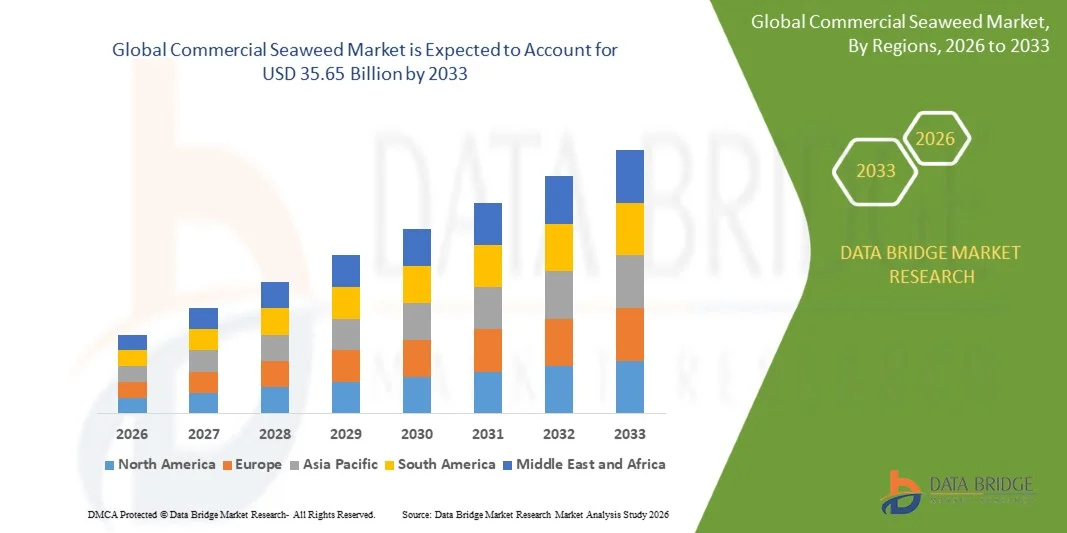
- The global commercial seaweed market size was valued at USD 20.29 billion in 2025 and is expected to reach USD 35.65 billion by 2033, at a CAGR of 7.30% during the forecast period
- Commercial seaweed is essential to fulfil the consumers' nutrition demand and reduce a certain disease's risk. Commercial seaweed helps to provide better yield quality and quantity in the agriculture sector, and fulfil the increasing demand for hydrocolloids in food & beverages industry as well as the cosmetics & personal care industry
- Recent studies have also shown that commercial seaweed can fight against the COVID-19 virus, and it has a better effect than the existing vaccine. Thus, commercial seaweed is one of the important parameters. Many companies are expanding their manufacturing facilities to fulfil the higher demand for commercial seaweed products
What are the Major Takeaways of Commercial Seaweed Market?
- Commercial seaweed market is gaining significant growth due to increase in adoption of seaweed for hydrocolloids, high nutritional value and health benefits of the seaweeds, and increasing demand for seaweed in various industries such as pharmaceuticals, personal care, agriculture, domestic, animal feed food & beverages & others worldwide
- However, environmental risk associated with the seaweed and the high amount of iodine and heavy metals present in it are expected to restrain the market growth of commercial seaweeds during the forecasted period
- Asia-Pacific dominated the commercial seaweed market with a 46.80% revenue share in 2025, driven by large-scale seaweed cultivation, favorable coastal conditions, and strong consumption across food, pharmaceutical, and agricultural industries in countries such as China, Indonesia, Japan, and South Korea
- North America is expected to register the fastest CAGR of 9.21% from 2026 to 2033, driven by increasing demand for plant-based, sustainable, and functional ingredients across food, pharmaceuticals, and cosmetics industries in the U.S. and Canada
- The Red Seaweed segment dominated the market with a 45.6% share in 2025, as it is widely used for extracting carrageenan and agar, which are essential hydrocolloids in food processing, pharmaceuticals, and cosmetics
Report Scope and Commercial Seaweed Market Segmentation
|
Attributes |
Commercial Seaweed Key Market Insights |
|
Segments Covered |
|
|
Countries Covered |
North America
Europe
Asia-Pacific
Middle East and Africa
South America
|
|
Key Market Players |
|
|
Market Opportunities |
|
|
Value Added Data Infosets |
In addition to the insights on market scenarios such as market value, growth rate, segmentation, geographical coverage, and major players, the market reports curated by the Data Bridge Market Research also include in-depth expert analysis, pricing analysis, brand share analysis, consumer survey, demography analysis, supply chain analysis, value chain analysis, raw material/consumables overview, vendor selection criteria, PESTLE Analysis, Porter Analysis, and regulatory framework. |
What is the Key Trend in the Commercial Seaweed Market?
“Increasing Shift Toward Sustainable, Functional, and Value-Added Commercial Seaweed Products”
- The commercial seaweed market is witnessing strong adoption of sustainably cultivated and processed seaweed products driven by rising environmental concerns and demand for eco-friendly raw materials
- Manufacturers are introducing high-value seaweed extracts such as hydrocolloids (agar, carrageenan, and alginate) and bioactive compounds for use in food, pharmaceuticals, cosmetics, and agriculture
- Growing demand for plant-based, nutrient-rich, and functional food ingredients is driving usage across food processing, nutraceuticals, and dietary supplement industries
- For instance, companies such as Cargill, DuPont, and Ocean Rainforest are expanding their seaweed-based ingredient portfolios for food stabilization, plant-based alternatives, and sustainable packaging solutions
- Increasing need for natural thickeners, stabilizers, and clean-label ingredients is accelerating the shift toward seaweed-derived products
- As sustainability and bio-based innovation gain importance, Commercial Seaweed will remain vital for green materials, food security, and industrial applications
What are the Key Drivers of Commercial Seaweed Market?
- Rising demand for natural, organic, and plant-based ingredients across food, cosmetics, and pharmaceutical industries is driving adoption of seaweed-based products
- For instance, in 2025, leading companies such as Cargill and The Seaweed Company expanded investments in sustainable seaweed farming and ingredient innovation to meet global demand
- Growing adoption of seaweed in fertilizers, animal feed, and bio-stimulants is boosting demand across agriculture and aquaculture sectors globally
- Advancements in seaweed cultivation technologies, offshore farming, and processing techniques have improved yield, quality, and scalability
- Rising use of seaweed in biodegradable packaging, biofuels, and carbon capture applications is creating new growth opportunities
- Supported by increasing investments in blue economy initiatives and sustainable food systems, the Commercial Seaweed market is expected to witness strong long-term growth
Which Factor is Challenging the Growth of the Commercial Seaweed Market?
- High costs associated with large-scale seaweed farming infrastructure, processing technologies, and supply chain logistics restrict adoption in developing regions
- For instance, during 2024–2025, climate variability, ocean pollution, and regulatory challenges affected seaweed cultivation output in key producing regions
- Complexity in maintaining consistent quality, species variation, and seasonal dependency increases operational challenges for manufacturers
- Limited awareness regarding the benefits and applications of seaweed-based products in emerging markets slows adoption
- Competition from synthetic additives and alternative plant-based ingredients creates pricing pressure and affects market penetration
- To address these challenges, companies are focusing on sustainable farming practices, advanced processing technologies, and strategic partnerships to increase global adoption of commercial seaweed
How is the Commercial Seaweed Market Segmented?
The market is segmented on the basis of product, form, cultivation, and end user.
• By Product
On the basis of product, the commercial seaweed market is segmented into Red Seaweed, Green Seaweed, and Brown Seaweed. The Red Seaweed segment dominated the market with a 45.6% share in 2025, as it is widely used for extracting carrageenan and agar, which are essential hydrocolloids in food processing, pharmaceuticals, and cosmetics. Its high gel-forming properties, stability, and widespread application in dairy, bakery, and processed foods drive strong demand globally. In addition, increasing adoption in plant-based food formulations and clean-label ingredients further strengthens its dominance.
The Brown Seaweed segment is expected to grow at the fastest CAGR from 2026 to 2033, driven by rising demand for alginates, bio-stimulants, and functional ingredients used in agriculture, pharmaceuticals, and industrial applications. Growing use in sustainable packaging, biofuels, and carbon sequestration initiatives is further accelerating demand. Increasing research into its bioactive compounds and health benefits is expected to expand its commercial potential significantly.
• By Form
On the basis of form, the market is segmented into Liquid, Powdered, and Flakes. The Powdered segment dominated the market with a 42.3% share in 2025, owing to its ease of storage, longer shelf life, and versatility across multiple applications including food processing, nutraceuticals, and cosmetics. Powdered seaweed is widely used in seasoning blends, dietary supplements, and functional food formulations due to its convenience and uniform composition. Its compatibility with industrial processing systems further supports large-scale adoption across global markets.
The Liquid segment is expected to grow at the fastest CAGR from 2026 to 2033, driven by increasing demand in agriculture as bio-fertilizers and plant growth stimulants. Liquid formulations offer faster absorption, easy application, and enhanced effectiveness, making them ideal for modern farming practices. Rising adoption in organic farming and sustainable agriculture, along with increasing demand for eco-friendly crop inputs, is expected to significantly boost segment growth over the forecast period.
• By Cultivation
On the basis of cultivation, the commercial seaweed market is segmented into Onshore Cultivation, Offshore Cultivation, Nearshore Cultivation, IMTA Cultivation, and Saline Aquaculture. The Nearshore Cultivation segment dominated the market with a 38.7% share in 2025, as it offers a balance between cost efficiency, ease of access, and favorable growing conditions. It is widely practiced in major seaweed-producing regions due to lower infrastructure requirements and ease of maintenance, supporting consistent production volumes.
The Offshore Cultivation segment is expected to grow at the fastest CAGR from 2026 to 2033, driven by increasing demand for large-scale, sustainable seaweed farming. Offshore systems provide higher yields, reduced environmental impact, and better scalability. Technological advancements in marine farming infrastructure and rising investments in blue economy initiatives are accelerating adoption. In addition, offshore cultivation supports carbon capture and biodiversity, making it highly attractive for long-term sustainable production strategies.
• By End User
On the basis of end user, the market is segmented into Food & Beverages, Pharmaceuticals, Agriculture, Animal Feed, Cosmetics & Personal Care, Biofuels, and Others. The Food & Beverages segment dominated the market with a 41.8% share in 2025, driven by extensive use of seaweed in thickeners, stabilizers, and functional ingredients in processed foods, dairy products, and plant-based alternatives. Increasing consumer preference for natural, clean-label, and nutrient-rich ingredients continues to boost demand across global food industries.
The Agriculture segment is expected to grow at the fastest CAGR from 2026 to 2033, fueled by rising adoption of seaweed-based fertilizers, bio-stimulants, and soil conditioners. These products enhance crop yield, improve soil health, and support sustainable farming practices. Growing focus on organic agriculture, environmental sustainability, and reduction of chemical inputs is further driving demand, positioning agriculture as a key high-growth segment in the Commercial Seaweed market.
Which Region Holds the Largest Share of the Commercial Seaweed Market?
- Asia-Pacific dominated the commercial seaweed market with a 46.80% revenue share in 2025, driven by large-scale seaweed cultivation, favorable coastal conditions, and strong consumption across food, pharmaceutical, and agricultural industries in countries such as China, Indonesia, Japan, and South Korea. High production of red and brown seaweed for hydrocolloids such as agar, carrageenan, and alginate continue to fuel market demand. Expanding aquaculture activities, rising demand for plant-based food ingredients, and increasing use of seaweed in fertilizers and animal feed further strengthen regional dominance
- Leading companies in Asia-Pacific are investing in advanced seaweed farming techniques, offshore cultivation systems, and value-added processing technologies to enhance yield, quality, and export competitiveness. Government support for marine farming, blue economy initiatives, and sustainable aquaculture development is accelerating market growth across the region
- Strong supply chain networks, low production costs, abundant marine resources, and growing export demand for seaweed-based products further reinforce Asia-Pacific’s leadership in the global market
China Commercial Seaweed Market Insight
China is the largest contributor in Asia-Pacific, supported by extensive seaweed farming infrastructure, high domestic consumption, and strong export capabilities. The country leads in the production of kelp, nori, and other commercial seaweed varieties used in food processing and industrial applications. Government-backed marine farming initiatives, technological advancements, and large-scale aquaculture operations continue to drive market expansion.
Japan Commercial Seaweed Market Insight
Japan shows steady growth driven by high consumption of seaweed in traditional diets, advanced processing capabilities, and strong demand for premium-quality products. Increasing use in functional foods, nutraceuticals, and cosmetics further supports market growth. Innovation in seaweed-based ingredients and focus on quality standards enhance Japan’s competitive position.
India Commercial Seaweed Market Insight
India is emerging as a high-growth market due to rising awareness of seaweed benefits, expanding coastal cultivation, and government initiatives promoting seaweed farming. Increasing demand in agriculture as bio-fertilizers and in food processing industries is accelerating adoption. Growing investments in marine biotechnology and aquaculture infrastructure further boost market penetration.
South Korea Commercial Seaweed Market Insight
South Korea contributes significantly due to strong consumption of seaweed-based food products and advanced aquaculture practices. High production of nori and other edible seaweeds, along with increasing exports, supports market growth. Technological advancements and focus on value-added products strengthen its position in the global market.
North America Commercial Seaweed Market
North America is expected to register the fastest CAGR of 9.21% from 2026 to 2033, driven by increasing demand for plant-based, sustainable, and functional ingredients across food, pharmaceuticals, and cosmetics industries in the U.S. and Canada. Rising awareness regarding the nutritional benefits of seaweed and its applications in clean-label products is boosting market demand. Companies in North America are focusing on sustainable seaweed cultivation, product innovation, and expanding applications in bio-packaging, biofuels, and agricultural bio-stimulants. Growing investments in research, marine biotechnology, and alternative protein sources are further accelerating market growth. Increasing focus on environmental sustainability, carbon sequestration, and ocean-based farming solutions is supporting long-term expansion of the Commercial Seaweed market in the region
U.S. Commercial Seaweed Market Insight
The U.S. is the largest contributor in North America, driven by rising demand for seaweed-based food products, dietary supplements, and sustainable raw materials. Growing adoption of seaweed in plant-based diets, functional foods, and eco-friendly packaging solutions is boosting market growth. Presence of innovative startups, strong R&D capabilities, and increasing investment in ocean farming technologies further support expansion.
Canada Commercial Seaweed Market Insight
Canada contributes significantly to regional growth, supported by expanding seaweed aquaculture along coastal regions and rising demand for organic and natural products. Increasing use of seaweed in agriculture, animal feed, and nutraceuticals is driving adoption. Government support, sustainable farming practices, and growing export opportunities further strengthen the market outlook.
Which are the Top Companies in Commercial Seaweed Market?
The commercial seaweed industry is primarily led by well-established companies, including:
- Cargill, Incorporated (U.S.)
- DuPont (U.S.)
- Marcel Carrageenan (Philippines)
- AtSeNova (India)
- Beijing Leili Agricultural Co., Ltd (China)
- Pacific Harvest (New Zealand)
- Irish Seaweed (Ireland)
- Ocean Rainforest (Faroe Islands)
- Indigrow Ltd (U.K.)
- Seaweed Solutions AS (Norway)
- Maine Coast Sea Vegetables (U.S.)
- Kelp Industries Pty Ltd (South Africa)
- Organic Irish Seaweed - Emerald Isle (Ireland)
- Green Ocean Farming UK (U.K.)
- Nantong Xinlang Seaweed & Foods Co., Ltd (China)
- The Seaweed Company (Netherlands)
- Cascadia Seaweed (Canada)
- KwangcheonKim (South Korea)
What are the Recent Developments in Global Commercial Seaweed Market?
- In October 2025, leading seaweed scientists from Malaysia and the U.K. collaborated with government officials and over 50 stakeholders to develop a new biosecurity management pathway for the seaweed industry, aiming to improve regulatory frameworks, disease control, and sustainable cultivation practices, thereby strengthening long-term industry resilience and global market confidence
- In September 2025, GreenWave introduced the Kelp CoLab, a 10-month R&D initiative in partnership with Unilever Foundry to enhance the application of kelp in personal care products, fostering collaboration among brands, suppliers, and sustainability experts, ultimately accelerating innovation and commercialization of seaweed-based solutions
- In August 2025, biotech startup Seadling established its second processing facility in Malaysia to scale production of fermented seaweed-based functional ingredients for human and pet nutrition, following a successful seed funding round, thereby enhancing production capacity and supporting rising global demand for value-added marine ingredients
- In August 2025, BPH Global secured trade financing to expand its seaweed operations in Indonesia, including the development of a new processing warehouse in Makassar, South Sulawesi, aimed at increasing procurement capacity, strengthening supply chain efficiency, and boosting export potential, thereby improving sustainability and traceability across the value chain
- In February 2025, Ocean Rainforest acquired a majority stake in Mexican seaweed producer Alamarsa, integrating advanced extraction expertise with open-ocean farming technologies to expand sustainable seaweed product offerings and strengthen market presence in North America, thereby enhancing global competitiveness and innovation in the commercial seaweed market
SKU-
Get online access to the report on the World's First Market Intelligence Cloud

- Interactive Data Analysis Dashboard
- Company Analysis Dashboard for high growth potential opportunities
- Research Analyst Access for customization & queries
- Competitor Analysis with Interactive dashboard
- Latest News, Updates & Trend analysis
- Harness the Power of Benchmark Analysis for Comprehensive Competitor Tracking
Global Commercial Seaweeds Market, Supply Chain Analysis and Ecosystem Framework
To support market growth and help clients navigate the impact of geopolitical shifts, DBMR has integrated in-depth supply chain analysis into its Global Commercial Seaweeds Market research reports. This addition empowers clients to respond effectively to global changes affecting their industries. The supply chain analysis section includes detailed insights such as Global Commercial Seaweeds Market consumption and production by country, price trend analysis, the impact of tariffs and geopolitical developments, and import and export trends by country and HSN code. It also highlights major suppliers with data on production capacity and company profiles, as well as key importers and exporters. In addition to research, DBMR offers specialized supply chain consulting services backed by over a decade of experience, providing solutions like supplier discovery, supplier risk assessment, price trend analysis, impact evaluation of inflation and trade route changes, and comprehensive market trend analysis.
Research Methodology
Data collection and base year analysis are done using data collection modules with large sample sizes. The stage includes obtaining market information or related data through various sources and strategies. It includes examining and planning all the data acquired from the past in advance. It likewise envelops the examination of information inconsistencies seen across different information sources. The market data is analysed and estimated using market statistical and coherent models. Also, market share analysis and key trend analysis are the major success factors in the market report. To know more, please request an analyst call or drop down your inquiry.
The key research methodology used by DBMR research team is data triangulation which involves data mining, analysis of the impact of data variables on the market and primary (industry expert) validation. Data models include Vendor Positioning Grid, Market Time Line Analysis, Market Overview and Guide, Company Positioning Grid, Patent Analysis, Pricing Analysis, Company Market Share Analysis, Standards of Measurement, Global versus Regional and Vendor Share Analysis. To know more about the research methodology, drop in an inquiry to speak to our industry experts.
Customization Available
Data Bridge Market Research is a leader in advanced formative research. We take pride in servicing our existing and new customers with data and analysis that match and suits their goal. The report can be customized to include price trend analysis of target brands understanding the market for additional countries (ask for the list of countries), clinical trial results data, literature review, refurbished market and product base analysis. Market analysis of target competitors can be analyzed from technology-based analysis to market portfolio strategies. We can add as many competitors that you require data about in the format and data style you are looking for. Our team of analysts can also provide you data in crude raw excel files pivot tables (Fact book) or can assist you in creating presentations from the data sets available in the report.












