


Global Compostable Shrink Wrap Market
Market Size in USD Billion
CAGR :
% 
 USD
1.50 Billion
USD
5.80 Billion
2025
2033
USD
1.50 Billion
USD
5.80 Billion
2025
2033
 Forecast Period Forecast Period |
2026 –2033 |
 Market Size (Base Year) Market Size (Base Year) |
USD 1.50 Billion |
 Market Size (Forecast Year) Market Size (Forecast Year) |
USD 5.80 Billion |
 CAGR CAGR |
% |
| Major Markets Players |
|
Compostable Shrink Wrap Market Size
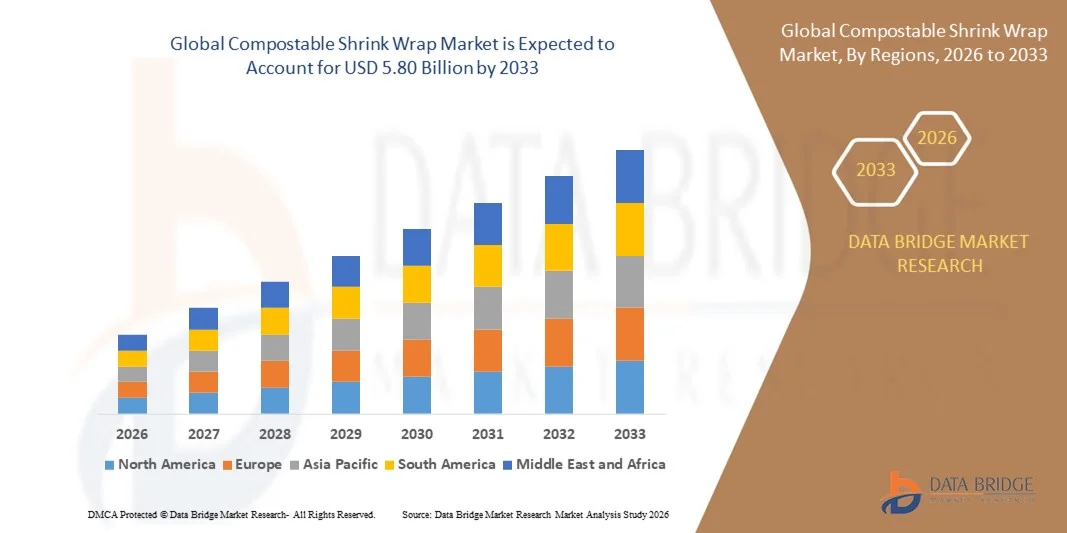
- The global compostable shrink wrap market size was valued at USD 1.50 billion in 2025 and is expected to reach USD 5.80 billion by 2033, at a CAGR of 18.4% during the forecast period
- The market growth is largely fueled by the increasing global focus on sustainability and the rising demand for eco-friendly packaging solutions that reduce plastic waste. Consumers and businesses are prioritizing biodegradable and compostable materials, driving manufacturers to adopt compostable shrink wraps across food, retail, and industrial applications
- Furthermore, regulatory support and government initiatives promoting sustainable packaging, such as bans on single-use plastics and incentives for compostable materials, are accelerating the adoption of compostable shrink wraps. These converging factors are encouraging both established brands and new entrants to expand their product offerings, thereby significantly boosting the market’s growth
Compostable Shrink Wrap Market Analysis
- Compostable shrink wraps, made from materials such as PLA, PHA, and starch blends, are increasingly vital in modern packaging solutions due to their ability to maintain product integrity while being environmentally friendly. These wraps are widely used across food packaging, personal care, and industrial sectors, offering both functional performance and sustainable benefits
- The escalating demand for compostable shrink wraps is primarily fueled by growing consumer awareness regarding environmental impact, the rising adoption of sustainable practices by manufacturers, and the preference for packaging solutions that align with circular economy principles. These trends are establishing compostable shrink wraps as a preferred alternative to conventional plastic films in multiple industries
- North America dominated the compostable shrink wrap market with a share of 34.5% in 2025, due to rising demand for sustainable packaging solutions and growing consumer awareness regarding environmental impact
- Asia-Pacific is expected to be the fastest growing region in the compostable shrink wrap market during the forecast period due to rising urbanization, disposable incomes, and environmental awareness in countries such as China, Japan, and India
- Unprinted segment dominated the market with a market share of 55.7% in 2025, due to its cost-effectiveness and versatility for bulk packaging needs. Unprinted shrink wraps are widely used in food packaging and industrial bundling, providing protection without the need for branding or design, which makes them appealing for large-scale operations. Their simplicity also allows easy adaptation across different machinery types, reducing operational costs for manufacturers
Report Scope and Compostable Shrink Wrap Market Segmentation
|
Attributes |
Compostable Shrink Wrap Key Market Insights |
|
Segments Covered |
|
|
Countries Covered |
North America
Europe
Asia-Pacific
Middle East and Africa
South America
|
|
Key Market Players |
|
|
Market Opportunities |
|
|
Value Added Data Infosets |
In addition to the insights on market scenarios such as market value, growth rate, segmentation, geographical coverage, and major players, the market reports curated by the Data Bridge Market Research also include import export analysis, production capacity overview, production consumption analysis, price trend analysis, climate change scenario, supply chain analysis, value chain analysis, raw material/consumables overview, vendor selection criteria, PESTLE Analysis, Porter Analysis, and regulatory framework. |
Compostable Shrink Wrap Market Trends
Rising Adoption of Eco-Friendly Packaging Solutions
- A notable trend in the compostable shrink wrap market is the increasing shift toward eco-friendly and sustainable packaging materials driven by mounting regulatory pressures and consumer preference for environmentally responsible products. This trend is fostering innovation in materials science and packaging design, with businesses emphasizing reduced plastic usage and compostable alternatives for retail, food, and e-commerce applications
- For instance, companies such as BASF and TIPA are supplying biodegradable and fully compostable shrink films that are being adopted across food packaging and consumer goods sectors. These solutions enable brands to meet sustainability goals while maintaining product protection and visual appeal
- Retailers and e-commerce companies are increasingly integrating compostable shrink wraps to enhance their green credentials and reduce plastic waste in supply chains. This adoption supports corporate sustainability initiatives and aligns packaging strategies with circular economy principles
- The demand for biodegradable packaging solutions is also influencing small and medium-sized enterprises to explore compostable shrink films as cost-effective and environmentally conscious alternatives to traditional plastics. This shift is encouraging wider market penetration and innovation in packaging formats
- Food service and fresh produce sectors are leveraging compostable shrink wraps to extend shelf life while minimizing environmental footprint. The use of plant-based polymers in these applications is driving technical advancements and encouraging adoption in temperature-sensitive logistics
- The market is witnessing growth in multi-layered compostable shrink wraps that offer barrier protection, printability, and mechanical strength. These innovations are enhancing the functional performance of eco-friendly films and reinforcing the transition toward sustainable packaging practices across industries
Compostable Shrink Wrap Market Dynamics
Driver
Growing Consumer Awareness of Environmental Sustainability
- Rising consumer consciousness regarding environmental impact is driving the demand for compostable shrink wraps, as buyers increasingly prefer products with minimal ecological footprint. Brands are responding by adopting renewable, plant-based films that support sustainability messaging and reduce plastic pollution
- For instance, Tetra Pak has implemented compostable shrink wraps in their packaging solutions to meet rising consumer expectations for recyclable and biodegradable materials. This strategy strengthens brand reputation and aligns with global sustainability commitments
- Retailers and FMCG companies are promoting compostable packaging to differentiate themselves in a competitive market and appeal to environmentally conscious consumers. This driver is fostering widespread adoption and investment in eco-friendly film technologies
- Government regulations and incentives supporting sustainable packaging further reinforce this trend, creating a favorable environment for compostable shrink wrap deployment. Compliance with such policies encourages innovation and accelerates market penetration
- The growing integration of corporate social responsibility initiatives across industries is promoting the use of sustainable packaging options. Consumer pressure combined with regulatory frameworks continues to drive market expansion for compostable shrink wraps
Restraint/Challenge
High Production Costs of Compostable Shrink Wraps
- The compostable shrink wrap market faces challenges due to the higher production costs of biodegradable films, which involve specialized raw materials, advanced polymer processing, and rigorous quality control. These cost factors limit widespread adoption among price-sensitive manufacturers and retailers
- For instance, BASF employs proprietary biopolymer formulations and extrusion technologies to produce compostable shrink films, which incur higher manufacturing expenses compared to conventional plastics. These costs impact pricing strategies and market competitiveness
- Scaling production while maintaining consistent film quality and mechanical properties remains a significant challenge. Manufacturers must balance functional performance with economic feasibility to meet demand
- Raw material volatility, such as fluctuations in corn or PLA polymer prices, further contributes to cost instability and operational uncertainty. These factors complicate supply chain management and profitability
- The market continues to experience constraints in achieving cost-effective large-scale production without compromising environmental performance. Overcoming these financial and technical challenges is critical to enabling broader adoption of compostable shrink wraps
Compostable Shrink Wrap Market Scope
The market is segmented on the basis of material, product type, and applications.
- By Material
On the basis of material, the compostable shrink wrap market is segmented into PLA (Polylactic Acid), PHA (Polyhydroxyalkanoates), starch blends, and other biodegradable polymers. The PLA segment dominated the market with the largest market revenue share of 49% in 2025, driven by its high transparency, flexibility, and ease of processing in conventional shrink wrap machinery. PLA is widely preferred in food and retail packaging due to its certified compostability and ability to maintain product freshness without chemical residues. In addition, PLA’s compatibility with printing and labeling processes enhances its appeal for branded packaging solutions, supporting strong demand in the market.
The PHA segment is anticipated to witness the fastest growth rate from 2026 to 2033, fueled by increasing interest in fully biodegradable alternatives with superior barrier properties. For instance, companies such as Danimer Scientific are expanding PHA production for compostable packaging, highlighting its potential in both food and industrial applications. PHA’s strength in heat resistance and water vapor barrier performance makes it suitable for products requiring longer shelf life, while its environmentally friendly profile attracts eco-conscious manufacturers and retailers.
- By Product Type
On the basis of product type, the compostable shrink wrap market is segmented into unprinted and printed variants. The unprinted segment held the largest market revenue share of 55.7% in 2025, supported by its cost-effectiveness and versatility for bulk packaging needs. Unprinted shrink wraps are widely used in food packaging and industrial bundling, providing protection without the need for branding or design, which makes them appealing for large-scale operations. Their simplicity also allows easy adaptation across different machinery types, reducing operational costs for manufacturers.
The printed segment is expected to witness the fastest growth from 2026 to 2033, driven by the growing emphasis on branding, product information, and promotional packaging. For instance, companies such as BASF are offering printed compostable shrink wraps with customizable designs for retail and personal care products. Printed variants enhance visual appeal, support marketing strategies, and help brands communicate sustainability commitments, driving higher adoption across commercial and consumer-facing applications.
- By Applications
On the basis of applications, the compostable shrink wrap market is segmented into food packaging, industrial packaging, personal care and cosmetics, and agriculture and horticulture. The food packaging segment dominated the market in 2025, accounting for the largest revenue share due to the growing consumer preference for sustainable, safe, and chemically free packaging options. Compostable shrink wraps provide effective protection for perishable goods while meeting regulatory standards for environmental safety, making them widely adopted by food manufacturers and retailers. Their transparency, flexibility, and sealing properties further support consumer convenience and product visibility.
The personal care and cosmetics segment is projected to witness the fastest growth from 2026 to 2033, fueled by increasing adoption of sustainable packaging in premium and eco-conscious brands. For instance, companies such as L’Oréal are incorporating compostable shrink wraps to package beauty and cosmetic products, enhancing brand image while reducing environmental impact. These wraps offer high-quality printability for aesthetics, while ensuring that packaging waste is minimized, aligning with rising consumer demand for sustainability in personal care products.
Compostable Shrink Wrap Market Regional Analysis
- North America dominated the compostable shrink wrap market with the largest revenue share of 34.5% in 2025, driven by rising demand for sustainable packaging solutions and growing consumer awareness regarding environmental impact
- Manufacturers and retailers in the region highly prioritize eco-friendly packaging that reduces plastic waste, supports brand sustainability goals, and complies with evolving regulatory standards for compostable materials
- This adoption is further supported by advanced recycling infrastructure, high disposable incomes, and strong preference for sustainable food and retail packaging, establishing compostable shrink wrap as a favored choice across various industries
U.S. Compostable Shrink Wrap Market Insight
The U.S. compostable shrink wrap market captured the largest revenue share in 2025 within North America, fueled by the rapid adoption of environmentally responsible packaging in food, personal care, and industrial sectors. Businesses are increasingly seeking packaging solutions that meet consumer demand for sustainability while maintaining product protection. The growing use of compostable wraps in retail and e-commerce packaging, combined with increased regulatory focus on reducing single-use plastics, is driving market growth. Moreover, initiatives promoting circular economy practices and corporate ESG commitments further propel the adoption of compostable shrink wraps in the U.S.
Europe Compostable Shrink Wrap Market Insight
The Europe compostable shrink wrap market is projected to expand at a substantial CAGR throughout the forecast period, primarily driven by stringent environmental regulations and consumer preference for eco-friendly packaging solutions. Urbanization, coupled with the rise of organic and packaged food products, is fostering the adoption of compostable shrink wraps. European businesses are also emphasizing sustainable branding and compliance with EU directives on packaging waste. The market is witnessing significant growth across food packaging, personal care, and industrial sectors, with compostable wraps being increasingly integrated into both retail-ready and bulk packaging applications.
U.K. Compostable Shrink Wrap Market Insight
The U.K. compostable shrink wrap market is anticipated to grow at a noteworthy CAGR during the forecast period, driven by increasing environmental awareness and demand for sustainable alternatives to conventional plastic packaging. Both manufacturers and retailers are adopting compostable wraps to meet consumer expectations and regulatory requirements. The U.K.’s strong e-commerce and retail infrastructure, combined with growing adoption in food and personal care sectors, is expected to continue to stimulate market growth.
Germany Compostable Shrink Wrap Market Insight
The Germany compostable shrink wrap market is expected to expand at a considerable CAGR during the forecast period, fueled by the country’s emphasis on sustainability, eco-conscious consumer behavior, and strict packaging regulations. Germany’s developed infrastructure and focus on innovation encourage adoption in food, industrial, and horticulture applications. Compostable shrink wraps are being increasingly integrated into packaging processes, with a strong preference for biodegradable and high-performance materials aligning with local environmental initiatives.
Asia-Pacific Compostable Shrink Wrap Market Insight
The Asia-Pacific compostable shrink wrap market is poised to grow at the fastest CAGR during the forecast period of 2026 to 2033, driven by rising urbanization, disposable incomes, and environmental awareness in countries such as China, Japan, and India. The region’s growing food, retail, and industrial packaging sectors, along with government initiatives promoting sustainable packaging, are driving adoption. Furthermore, Asia-Pacific is emerging as a manufacturing hub for compostable packaging materials, increasing accessibility and affordability for a wider consumer base.
Japan Compostable Shrink Wrap Market Insight
The Japan compostable shrink wrap market is gaining momentum due to the country’s environmentally conscious consumer base, technological advancements, and demand for high-quality sustainable packaging. The market emphasizes packaging solutions that maintain product integrity while reducing environmental impact. The growing use of compostable wraps in food, personal care, and horticulture sectors, along with government support for biodegradable materials, is fueling market growth.
China Compostable Shrink Wrap Market Insight
The China compostable shrink wrap market accounted for the largest market revenue share in Asia-Pacific in 2025, attributed to the country’s expanding manufacturing base, rapid urbanization, and growing environmental awareness. China’s adoption of sustainable packaging in food, personal care, and industrial applications is increasing, supported by regulatory push and rising demand for eco-friendly alternatives. Strong domestic production capabilities, along with government initiatives promoting compostable and biodegradable materials, are key factors propelling market growth in China.
Compostable Shrink Wrap Market Share
The compostable shrink wrap industry is primarily led by well-established companies, including:
- S.R BIO PLASTIC (India)
- BASF SE (Germany)
- NatureWorks LLC (U.S.)
- Mitsubishi Chemical Holding Corporation (Japan)
- Biome Technologies plc (U.K.)
- Amcor plc (Switzerland)
- Sealed Air (U.S.)
- Mondi (Austria)
- Tetra Pak International S.A. (Switzerland)
- IMEX Packaging (India)
- BIOPAK (Australia)
- Smurfit Kappa (Ireland)
- Green Pack (U.K.)
- Treetop Biopak (U.K.)
- Berkley (U.S.)
- International Paper (U.S.)
- Kingfa Science & Technology (India)
Latest Developments in Global Compostable Shrink Wrap Market
- In June 2025, UKHI launched EcoGran Compostable Shrink Wrap, a new high‑clarity, fully compostable shrink film designed for retail, food, and industrial packaging applications. This development is significant for the compostable shrink wrap market as it enhances the availability of scalable, cost‑effective sustainable packaging that runs seamlessly on existing cast film extrusion lines, encouraging broader adoption by manufacturers seeking to reduce environmental impact while maintaining performance. By utilising local agricultural residues and supporting a circular economy, EcoGran strengthens regional supply chains and reinforces industry momentum toward eco‑friendly packaging solutions
- In September 2024, Carbios and Sleever launched a market-first home compostable shrink sleeve, entering a long-term partnership to produce mono-oriented transverse shrink films. This development is expected to significantly influence the compostable shrink wrap market by providing sustainable labeling and packaging solutions for premium products such as wine and spirits. The collaboration strengthens the availability of high-performance, home-compostable packaging and highlights growing demand for eco-friendly alternatives in the beverage and luxury goods sectors, encouraging other players to invest in innovative compostable materials
- In July 2024, TIPA, a global leader in packaging solutions, partnered with Fresh-Lock Caps, a leading reusable packaging brand, to promote home compostable packaging adoption. This initiative is projected to accelerate market growth by raising awareness of sustainable packaging practices and increasing accessibility of compostable solutions in retail and consumer sectors. The partnership underscores the rising importance of environmentally responsible packaging and positions home-compostable films as a mainstream alternative, particularly in fast-moving consumer goods and reusable packaging ecosystems
- In December 2020, KM Packaging, a global supplier of flexible packaging and lidding films, introduced its new C-Range of compostable products, which includes shrink wrap, stretch wrap, adhesive tape, nets, and bags. This launch expanded KM Packaging’s portfolio of sustainable flexible packaging solutions, offering customers a broader range of eco-friendly options. The development supports the compostable shrink wrap market by catering to industrial and retail packaging needs and highlights a trend toward multi-application biodegradable materials, reinforcing the shift from conventional plastics to sustainable alternatives
- In September 2020, Nature Fresh Farms released a 100% home-compostable wrap for their Long English Cucumbers, marking a first in the North American market. This initiative demonstrates the growing adoption of eco-friendly packaging in the fresh produce sector and is expected to influence market dynamics by setting a precedent for sustainable, home-compostable solutions in North America. The launch reflects consumer demand for environmentally responsible packaging and encourages competitors to integrate compostable wraps into their supply chains to meet sustainability goals
SKU-
Get online access to the report on the World's First Market Intelligence Cloud

- Interactive Data Analysis Dashboard
- Company Analysis Dashboard for high growth potential opportunities
- Research Analyst Access for customization & queries
- Competitor Analysis with Interactive dashboard
- Latest News, Updates & Trend analysis
- Harness the Power of Benchmark Analysis for Comprehensive Competitor Tracking
Global Compostable Shrink Wrap Market, Supply Chain Analysis and Ecosystem Framework
To support market growth and help clients navigate the impact of geopolitical shifts, DBMR has integrated in-depth supply chain analysis into its Global Compostable Shrink Wrap Market research reports. This addition empowers clients to respond effectively to global changes affecting their industries. The supply chain analysis section includes detailed insights such as Global Compostable Shrink Wrap Market consumption and production by country, price trend analysis, the impact of tariffs and geopolitical developments, and import and export trends by country and HSN code. It also highlights major suppliers with data on production capacity and company profiles, as well as key importers and exporters. In addition to research, DBMR offers specialized supply chain consulting services backed by over a decade of experience, providing solutions like supplier discovery, supplier risk assessment, price trend analysis, impact evaluation of inflation and trade route changes, and comprehensive market trend analysis.
Research Methodology
Data collection and base year analysis are done using data collection modules with large sample sizes. The stage includes obtaining market information or related data through various sources and strategies. It includes examining and planning all the data acquired from the past in advance. It likewise envelops the examination of information inconsistencies seen across different information sources. The market data is analysed and estimated using market statistical and coherent models. Also, market share analysis and key trend analysis are the major success factors in the market report. To know more, please request an analyst call or drop down your inquiry.
The key research methodology used by DBMR research team is data triangulation which involves data mining, analysis of the impact of data variables on the market and primary (industry expert) validation. Data models include Vendor Positioning Grid, Market Time Line Analysis, Market Overview and Guide, Company Positioning Grid, Patent Analysis, Pricing Analysis, Company Market Share Analysis, Standards of Measurement, Global versus Regional and Vendor Share Analysis. To know more about the research methodology, drop in an inquiry to speak to our industry experts.
Customization Available
Data Bridge Market Research is a leader in advanced formative research. We take pride in servicing our existing and new customers with data and analysis that match and suits their goal. The report can be customized to include price trend analysis of target brands understanding the market for additional countries (ask for the list of countries), clinical trial results data, literature review, refurbished market and product base analysis. Market analysis of target competitors can be analyzed from technology-based analysis to market portfolio strategies. We can add as many competitors that you require data about in the format and data style you are looking for. Our team of analysts can also provide you data in crude raw excel files pivot tables (Fact book) or can assist you in creating presentations from the data sets available in the report.












