


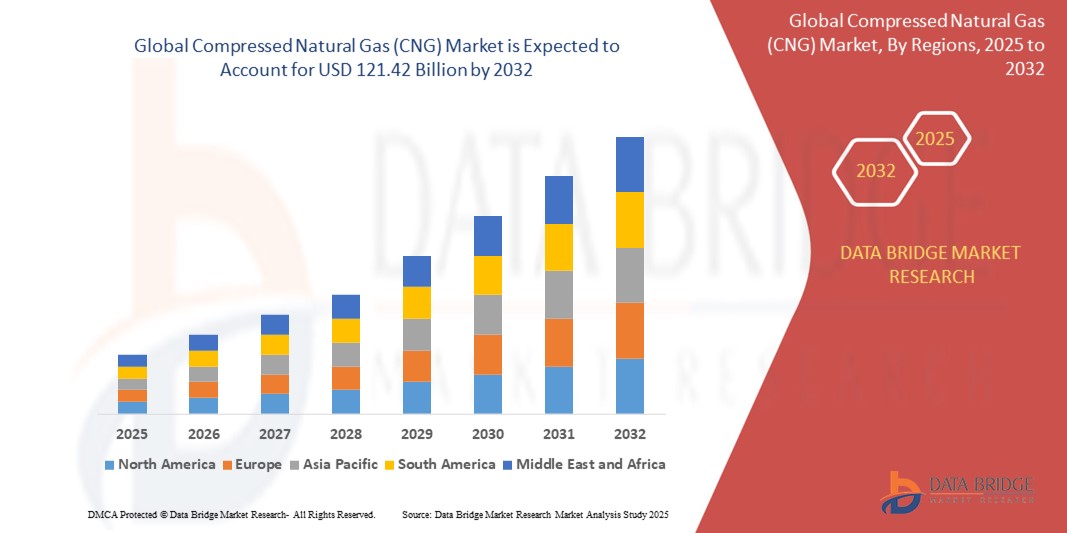
Compressed Natural Gas (CNG) Market Size
- The global compressed natural gas (CNG) market size was valued at USD 92.21 billion in 2024 and is expected to reach USD 121.42 billion by 2032, at a CAGR of 3.50% during the forecast period
- The market growth is primarily driven by increasing demand for cleaner and more sustainable fuel alternatives, supportive government policies promoting low-emission vehicles, and advancements in CNG infrastructure and refueling technologies
- Rising environmental concerns, coupled with the cost-effectiveness of CNG compared to traditional fuels, are accelerating its adoption across various vehicle segments, particularly in emerging economies
Compressed Natural Gas (CNG) Market Analysis
- Compressed natural gas (CNG) is a cleaner alternative fuel used primarily in transportation, offering lower emissions compared to gasoline and diesel, making it a preferred choice for eco-conscious markets
- The growing adoption of CNG is fueled by increasing environmental regulations, rising fuel costs, and the expansion of CNG refueling infrastructure globally
- Asia-Pacific dominated the compressed natural gas (CNG) market with the largest revenue share of 45.3% in 2024, driven by widespread adoption in countries such as China, India, and Pakistan, supported by government incentives, low-cost CNG fuel, and extensive refueling networks
- North America is expected to be the fastest-growing region during the forecast period, attributed to increasing investments in CNG infrastructure, rising demand for sustainable transportation solutions, and supportive policies promoting clean energy in the U.S. and Canada
- The associated gas segment dominated the market with a market share of 89.91% in 2024, driven by its abundant supply, economic efficiency, and environmental benefits as it is produced alongside crude oil, reducing waste and emissions
Report Scope and Compressed Natural Gas (CNG) Market Segmentation
|
Attributes |
Compressed Natural Gas (CNG) Key Market Insights |
|
Segments Covered |
|
|
Countries Covered |
North America
Europe
Asia-Pacific
Middle East and Africa
South America
|
|
Key Market Players |
|
|
Market Opportunities |
|
|
Value Added Data Infosets |
In addition to the insights on market scenarios such as market value, growth rate, segmentation, geographical coverage, and major players, the market reports curated by the Data Bridge Market Research also include import export analysis, production capacity overview, production consumption analysis, price trend analysis, climate change scenario, supply chain analysis, value chain analysis, raw material/consumables overview, vendor selection criteria, PESTLE Analysis, Porter Analysis, and regulatory framework. |
Compressed Natural Gas (CNG) Market Trends
“Increasing Integration of Advanced Storage Technologies and IoT”
- The global Compressed Natural Gas (CNG) market is experiencing a significant trend toward the integration of advanced storage technologies and Internet of Things (IoT) solutions
- Innovations in lightweight composite materials, such as carbon fiber and glass fiber for Type IV CNG tanks, enhance storage efficiency and vehicle performance by reducing weight and improving safety
- IoT-enabled CNG systems allow real-time monitoring of tank pressure, fuel levels, and system integrity, providing actionable insights for fleet operators and vehicle owners
- For instance, companies are developing IoT platforms that track CNG consumption patterns to optimize refueling schedules and predict maintenance needs for fuel systems
- This trend enhances the efficiency and reliability of CNG systems, making them more appealing to both commercial fleet operators and individual consumers
- IoT integration also supports smart fleet management by analyzing data on vehicle routes, fuel efficiency, and emissions, contributing to cost savings and environmental compliance
Compressed Natural Gas (CNG) Market Dynamics
Driver
“Rising Demand for Cleaner Fuels and Stringent Emission Regulations”
- Growing consumer and industry demand for environmentally friendly fuel alternatives, driven by rising fuel costs and environmental concerns, is a major driver for the global CNG market
- CNG-powered vehicles produce significantly lower emissions compared to gasoline or diesel, with studies showing a reduction of up to 25% in CO2 emissions per kilometer traveled
- Government mandates, particularly in regions such as Asia-Pacific with policies promoting clean energy, are accelerating CNG adoption through subsidies, tax incentives, and infrastructure investments
- The expansion of 5G and IoT technologies enhances CNG applications by enabling faster data transmission for real-time fuel monitoring and fleet management
- Automakers are increasingly integrating CNG systems as standard or optional features in vehicles to meet regulatory requirements and consumer demand for sustainable transportation
Restraint/Challenge
“High Initial Costs and Limited Refueling Infrastructure”
- The high upfront costs for CNG vehicle conversions, advanced tank manufacturing (e.g., Type IV composite tanks), and refueling station development pose a significant barrier, particularly in emerging markets
- Retrofitting existing vehicles with CNG kits, such as sequential or venturi systems, involves complex and costly integration processes
- Limited availability of CNG refueling stations, especially in rural or less-developed regions, restricts market growth and discourages adoption among long-haul vehicle operators
- Data security concerns related to IoT-enabled CNG systems, including risks of cyberattacks on connected fuel systems, raise privacy and compliance challenges with varying global regulations
- These factors can deter potential adopters and slow market expansion, particularly in regions with cost sensitivity or underdeveloped infrastructure
Compressed Natural Gas (CNG) market Scope
The market is segmented on the basis of source, kits, distribution type, and end use.
- By Source
On the basis of source, the global compressed natural gas (CNG) market is segmented into associated gas and non-associated gas. The associated gas segment dominated the market with a market share of 89.91% in 2024, driven by its abundant supply, economic efficiency, and environmental benefits as it is produced alongside crude oil, reducing waste and emissions.
The non-associated gas segment is anticipated to witness the fastest growth rate of 12.5% from 2025 to 2032, fueled by the decline in global crude oil production and the shift toward non-associated gas reserves, particularly in regions such as the Middle East and Russia, to meet rising CNG demand.
- By Kits
On the basis of kits, the global compressed natural gas (CNG) market is segmented into sequential and Venturi. The sequential segment is expected to dominate the market with a 59.41% share in 2024, owing to its enhanced engine performance, efficiency, reduced emissions, cost-effectiveness, and longevity, making it a preferred choice for CNG vehicle conversions.
The venturi segment is projected to experience robust growth from 2025 to 2032, driven by its simplicity and affordability, which appeal to cost-conscious markets, particularly in developing regions adopting CNG vehicles.
- By Distribution Type
On the basis of distribution type, the global compressed natural gas (CNG) market is segmented into cylinders/tanks, accumulators, composite manifolds, and others. The cylinders/tanks segment is expected to dominate the market with an 80.14% share in 2024, driven by the critical role of CNG tanks in storing compressed gas at high pressures (up to 250 bar) for safe and efficient vehicle operation. Type 4 tanks, made from advanced composite materials, are particularly favored for their lightweight and high-capacity features.
The accumulators segment is anticipated to witness significant growth from 2025 to 2032, as they enhance storage efficiency and support the expanding virtual pipeline systems, improving CNG accessibility in areas without direct pipeline access.
- By End Use
On the basis of end use, the global compressed natural gas (CNG) market is segmented into light motor vehicles, medium motor vehicles, and heavy motor vehicles. The light motor vehicles segment is expected to dominate the market with a 63.28% share in 2024, driven by the high volume of passenger vehicles globally, rising consumer demand for cost-effective and eco-friendly fuel options, and increasing adoption of CNG in urban areas to combat air pollution.
The heavy motor vehicles segment is projected to witness the fastest growth rate of 19.6% from 2025 to 2032, fueled by the growing adoption of CNG in long-haul trucks and buses for cost savings, reduced emissions, and compliance with stringent environmental regulations, supported by expanding refueling infrastructure.
Compressed Natural Gas (CNG) Market Regional Analysis
- Asia-Pacific dominated the compressed natural gas (CNG) market with the largest revenue share of 45.3% in 2024, driven by widespread adoption in countries such as China, India, and Pakistan, supported by government incentives, low-cost CNG fuel, and extensive refueling networks
- Consumers prioritize CNG for its cost-effectiveness, lower emissions, and reduced maintenance costs compared to traditional fuels, particularly in regions with high fuel prices and environmental concerns
- Growth is supported by advancements in CNG technology, including lightweight Type 4 tanks and sequential kits, alongside increasing adoption in both OEM and aftermarket segments for various vehicle types
Japan Compressed Natural Gas (CNG) Market Insight
Japan’s CNG market is expected to witness significant growth due to strong consumer preference for high-quality, technologically advanced CNG systems that enhance vehicle efficiency and safety. The presence of major automotive manufacturers and the integration of CNG systems in OEM vehicles accelerate market penetration. Rising interest in aftermarket CNG conversions also contributes to growth.
China Compressed Natural Gas (CNG) Market Insight
China holds the largest share of the Asia-Pacific CNG market, propelled by rapid urbanization, increasing vehicle ownership, and strong demand for cost-effective and eco-friendly fuel solutions. The country’s growing middle class and focus on sustainable mobility support the adoption of advanced CNG technologies. Strong domestic manufacturing capabilities and competitive pricing enhance market accessibility.
North America Compressed Natural Gas (CNG) Market
The North America compressed natural gas (CNG) market is expected to witness the fastest growth rate. This growth is fueled by a strong emphasis on reducing carbon emissions, abundant natural gas resources, and growing consumer and commercial adoption of cleaner fuel alternatives. The region benefits from increasing government support through incentives and regulations promoting the use of CNG in various sectors, particularly transportation.
U.S. Compressed Natural Gas (CNG) Market Insight
The U.S. compressed natural gas (CNG) market is expected to witness significant growth, fueled by strong aftermarket demand and growing consumer awareness of CNG’s environmental and cost-saving benefits. The trend towards cleaner transportation solutions and expanding refueling infrastructure further boosts market expansion. Automakers’ integration of CNG systems in factory-built vehicles complements aftermarket sales, creating a robust market ecosystem.
Europe Compressed Natural Gas (CNG) Market Insight
The Europe CNG market is expected to witness significant growth, supported by stringent environmental regulations and a focus on reducing carbon emissions. Consumers seek CNG solutions that offer lower emissions and fuel efficiency while meeting safety standards. Growth is prominent in both new vehicle installations and retrofit projects, with countries such as Germany and Italy showing significant uptake due to urban air quality concerns and supportive policies.
U.K. Compressed Natural Gas (CNG) Market Insight
The U.K. market for CNG is expected to witness rapid growth, driven by demand for cleaner fuel alternatives and cost-effective transportation in urban and suburban settings. Increased awareness of CNG’s environmental benefits and lower operational costs encourages adoption. Evolving regulations balancing emissions reduction with vehicle safety standards influence consumer choices, promoting compliant CNG systems.
Germany Compressed Natural Gas (CNG) Market Insight
Germany is expected to witness rapid growth in the CNG market, attributed to its advanced automotive manufacturing sector and high consumer focus on fuel efficiency and sustainability. German consumers prefer advanced CNG technologies, such as Type 4 tanks and sequential kits, that reduce emissions and contribute to lower fuel consumption. Integration of CNG systems in premium vehicles and aftermarket options supports sustained market growth.
Compressed Natural Gas (CNG) Market Share
The compressed natural gas (CNG) industry is primarily led by well-established companies, including:
- NIS (Serbia)
- KryoGas (Serbia)
- TotalEnergies SE (France)
- Chevron Corporation (U.S.)
- Shell PLC (U.K.)
- Adani Group (India)
- J-W Power Company (U.S.)
- INDIAN OIL CORPORATION LIMITED (India)
- JIO-BP (India)
- ENGIE GROUP (U.K.)
- INDRAPRASTHA GAS LIMITED (India)
- TRILLIUM ENERGY (U.S.)
What are the Recent Developments in Global Compressed Natural Gas (CNG) Market?
- In February 2025, Iran inaugurated 12 new compressed natural gas (CNG) stations across six provinces, marking a significant step in its ongoing efforts to expand clean fuel infrastructure. The launch coincided with the 46th anniversary of the Islamic Revolution and was led by the National Iranian Oil Products Distribution Company (NIOPDC). This expansion brings the total number of operational CNG stations in the country to over 2,600, supporting Iran’s goal of reducing gasoline consumption and promoting natural gas as a cleaner, cost-effective alternative
- In February 2025, Noida International Airport (NIA) announced a strategic partnership with Indraprastha Gas Limited (IGL) to develop Compressed Natural Gas (CNG) infrastructure at the airport. As part of the initiative, two CNG stations will be constructed—one in the west precinct and another in the airside area—to serve travelers, airport staff, and logistics partners. IGL will also build a City Gas Distribution (CGD) network and supply piped natural gas (PNG) to food courts, lounges, and kitchens. This collaboration highlights the integration of clean energy solutions into aviation infrastructure
- In February 2024, Shell PLC finalized its acquisition of Nature Energy Biogas A/S, Europe’s largest producer of renewable natural gas (RNG). The Danish company, which operates 14 industrial-scale biomethane plants, now functions as a wholly owned subsidiary of Shell. This strategic move significantly enhances Shell’s low-carbon fuel portfolio and supports its ambition to build a global, integrated RNG value chain. The acquisition also includes a pipeline of 30 new plant projects across Europe and North America, reinforcing Shell’s commitment to sustainable energy alternatives
- In July 2023, Time Technoplast announced a significant expansion in its CNG Cascade manufacturing capacity to meet rising demand for clean fuel storage and transport solutions. Under Phase 1, the company added capacity for 300 cascades annually. Building on this momentum, Phase 2 aims to increase total annual capacity to 480 cascades, with further plans to scale up to 1,080 cascades per year by the end of FY 2023–24. This expansion reflects growing adoption of CNG infrastructure and the company’s leadership in Type-IV composite cylinder technology
- In October 2022, Advik Hi-Tech Private Limited, a leading Indian automotive components manufacturer, entered into a technology collaboration with NIKKI Co. Ltd., a renowned Japanese fuel systems company, to produce compressed natural gas (CNG) regulators in India. This strategic alliance aims to localize production, strengthen the domestic supply chain, and support India’s push for cleaner mobility solutions. The partnership combines Nikki’s proven regulator technology with Advik’s manufacturing expertise to serve the growing demand in passenger cars, commercial vehicles, and industrial applications

- Interactive Data Analysis Dashboard
- Company Analysis Dashboard for high growth potential opportunities
- Research Analyst Access for customization & queries
- Competitor Analysis with Interactive dashboard
- Latest News, Updates & Trend analysis
- Harness the Power of Benchmark Analysis for Comprehensive Competitor Tracking
Global Compressed Natural Gas Cng Market, Supply Chain Analysis and Ecosystem Framework
To support market growth and help clients navigate the impact of geopolitical shifts, DBMR has integrated in-depth supply chain analysis into its Global Compressed Natural Gas Cng Market research reports. This addition empowers clients to respond effectively to global changes affecting their industries. The supply chain analysis section includes detailed insights such as Global Compressed Natural Gas Cng Market consumption and production by country, price trend analysis, the impact of tariffs and geopolitical developments, and import and export trends by country and HSN code. It also highlights major suppliers with data on production capacity and company profiles, as well as key importers and exporters. In addition to research, DBMR offers specialized supply chain consulting services backed by over a decade of experience, providing solutions like supplier discovery, supplier risk assessment, price trend analysis, impact evaluation of inflation and trade route changes, and comprehensive market trend analysis.
Data collection and base year analysis are done using data collection modules with large sample sizes. The stage includes obtaining market information or related data through various sources and strategies. It includes examining and planning all the data acquired from the past in advance. It likewise envelops the examination of information inconsistencies seen across different information sources. The market data is analysed and estimated using market statistical and coherent models. Also, market share analysis and key trend analysis are the major success factors in the market report. To know more, please request an analyst call or drop down your inquiry.
The key research methodology used by DBMR research team is data triangulation which involves data mining, analysis of the impact of data variables on the market and primary (industry expert) validation. Data models include Vendor Positioning Grid, Market Time Line Analysis, Market Overview and Guide, Company Positioning Grid, Patent Analysis, Pricing Analysis, Company Market Share Analysis, Standards of Measurement, Global versus Regional and Vendor Share Analysis. To know more about the research methodology, drop in an inquiry to speak to our industry experts.
Data Bridge Market Research is a leader in advanced formative research. We take pride in servicing our existing and new customers with data and analysis that match and suits their goal. The report can be customized to include price trend analysis of target brands understanding the market for additional countries (ask for the list of countries), clinical trial results data, literature review, refurbished market and product base analysis. Market analysis of target competitors can be analyzed from technology-based analysis to market portfolio strategies. We can add as many competitors that you require data about in the format and data style you are looking for. Our team of analysts can also provide you data in crude raw excel files pivot tables (Fact book) or can assist you in creating presentations from the data sets available in the report.













