


Global Connected Ship Market
Market Size in USD Billion
CAGR :
% 
 USD
7.93 Billion
USD
10.24 Billion
2025
2033
USD
7.93 Billion
USD
10.24 Billion
2025
2033
 Forecast Period Forecast Period |
2026 –2033 |
 Market Size (Base Year) Market Size (Base Year) |
USD 7.93 Billion |
 Market Size (Forecast Year) Market Size (Forecast Year) |
USD 10.24 Billion |
 CAGR CAGR |
% |
| Major Markets Players |
|
Connected Ship Market Size
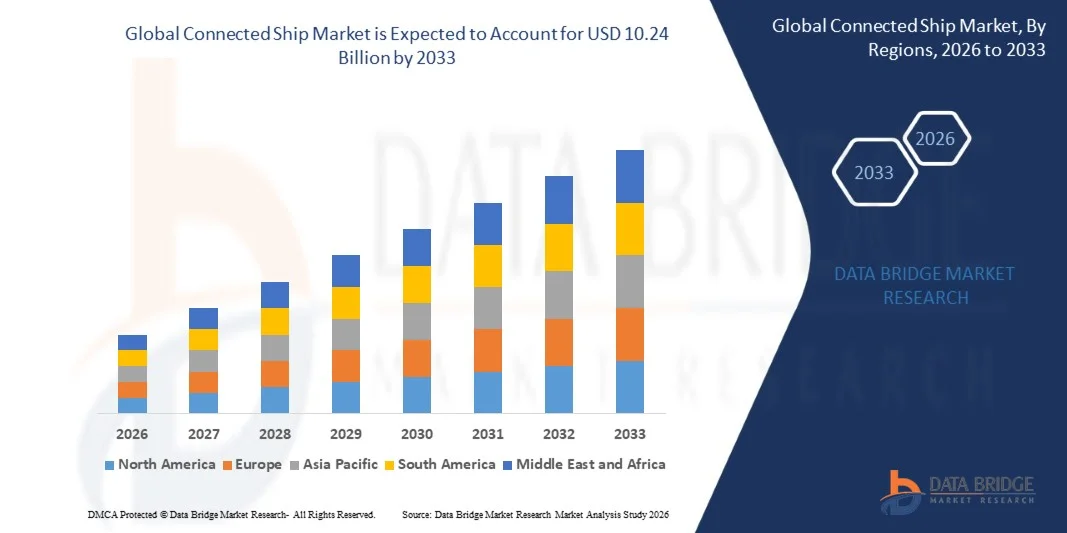
- The global connected ship market size was valued at USD 7.93 billion in 2025 and is expected to reach USD 10.24 billion by 2033, at a CAGR of 3.24% during the forecast period
- The market growth is largely fuelled by the increasing adoption of digital technologies such as IoT, satellite communication, and real-time monitoring systems to improve vessel efficiency, safety, and operational performance
- The growing need for enhanced maritime safety, predictive maintenance, and fuel optimization is accelerating the deployment of connected ship solutions across commercial and defense fleets
Connected Ship Market Analysis
- Connected ship solutions are gaining significant traction as shipping companies focus on improving operational efficiency, reducing downtime, and enhancing fleet management through real-time data insights
- Increasing integration of advanced technologies such as artificial intelligence, big data analytics, and cloud computing is enabling smarter navigation, improved communication, and optimized route planning
- North America dominated the connected ship market with the largest revenue share in 2025, driven by increasing adoption of advanced maritime communication systems and growing investments in digital shipping technologies
- Asia-Pacific region is expected to witness the highest growth rate in the global connected ship market, driven by expanding commercial shipping activities, increasing shipbuilding in countries such as China, South Korea, and Japan, and rising adoption of advanced connectivity, automation, and smart navigation technologies. In addition, strong government support for smart ports and maritime digital transformation accelerates regional market growth
- The Commercial segment held the largest market revenue share in 2025 driven by the growing adoption of connected technologies across cargo vessels, container ships, and tankers to improve operational efficiency and reduce fuel consumption. Connected solutions enable real-time monitoring, predictive maintenance, and route optimization, making them essential for commercial fleet operators
Report Scope and Connected Ship Market Segmentation
|
Attributes |
Connected Ship Key Market Insights |
|
Segments Covered |
|
|
Countries Covered |
North America
Europe
Asia-Pacific
Middle East and Africa
South America
|
|
Key Market Players |
|
|
Market Opportunities |
|
|
Value Added Data Infosets |
In addition to the market insights such as market value, growth rate, market segments, geographical coverage, market players, and market scenario, the market report curated by the Data Bridge Market Research team includes in-depth expert analysis, import/export analysis, pricing analysis, production consumption analysis, and pestle analysis. |
Connected Ship Market Trends
“Increasing Adoption Of IoT And Smart Maritime Technologies”
• The growing focus on digital transformation in the maritime industry is significantly shaping the connected ship market, as shipping companies increasingly adopt IoT-enabled systems to improve operational efficiency, safety, and fleet performance. Connected ship technologies enable real-time monitoring, predictive maintenance, and optimized navigation, helping operators reduce downtime and operational costs. This trend is strengthening adoption across commercial shipping, offshore, and defense sectors, encouraging companies to invest in advanced digital maritime solutions
• Increasing demand for real-time data analytics and remote vessel management has accelerated the adoption of connected ship solutions. Fleet operators are actively seeking technologies that enhance situational awareness, improve fuel efficiency, and support proactive decision-making. This has led to collaborations between technology providers and shipping companies to develop integrated platforms that improve operational reliability and overall vessel performance
• Digitalization and automation trends are influencing maritime operations, with companies emphasizing enhanced connectivity, cybersecurity, and system integration. These factors are helping shipping companies improve operational transparency, regulatory compliance, and safety standards. Organizations are also focusing on implementing cloud-based platforms and satellite communication systems to support seamless vessel-to-shore connectivity and data exchange
• For instance, in 2024, Kongsberg Gruppen in Norway and Wärtsilä in Finland expanded their connected ship and digital fleet management solutions for commercial vessels. These solutions were introduced to enhance real-time monitoring, improve fuel optimization, and support predictive maintenance. The developments strengthened their digital maritime portfolios and supported increased adoption of smart shipping technologies globally
• While demand for connected ship solutions is increasing, sustained market expansion depends on continuous innovation, reliable satellite connectivity, and cost-effective implementation. Companies are focusing on improving system scalability, cybersecurity, and integration capabilities to support broader adoption across global fleets
Connected Ship Market Dynamics
Driver
“Growing Demand For Operational Efficiency And Real-Time Fleet Monitoring”
• Increasing need for efficient fleet management and operational optimization is a major driver for the connected ship market. Shipping companies are adopting connected technologies to monitor vessel performance, improve fuel efficiency, and reduce maintenance costs. These solutions enable real-time insights that support better decision-making and operational planning
• Rising global trade and maritime transportation activities are influencing market growth. Connected ship solutions help improve route optimization, cargo monitoring, and overall vessel utilization. These capabilities support shipping companies in enhancing productivity and maintaining competitive advantage in a dynamic global market
• Maritime technology providers are actively enhancing their offerings through innovation, partnerships, and digital platform development. These efforts are helping shipping operators improve operational visibility, safety, and efficiency. Increasing awareness regarding the benefits of digital shipping is further supporting adoption across commercial and defense sectors
• For instance, in 2023, ABB in Switzerland and Rolls-Royce Holdings in the U.K. enhanced their smart shipping and connected vessel solutions to improve operational efficiency and remote monitoring. These developments enabled shipping companies to optimize performance and reduce operational risks. The expansion supported the growing adoption of connected ship technologies globally
• Although demand for connected ship solutions is rising, continued growth depends on improving connectivity infrastructure, reducing deployment costs, and enhancing system reliability. Investments in advanced communication technologies and digital platforms will be essential for supporting long-term market growth
Restraint/Challenge
“High Implementation Cost And Connectivity Limitations”
• The high cost associated with implementing connected ship systems remains a significant challenge, particularly for small and mid-sized fleet operators. Expenses related to hardware installation, satellite communication, and system integration can limit adoption. These cost barriers may delay digital transformation initiatives in the maritime sector
• Connectivity limitations in remote ocean regions also affect the effectiveness of connected ship solutions. Inconsistent satellite coverage and bandwidth constraints can impact real-time data transmission and operational efficiency. These challenges require continuous investment in advanced communication infrastructure
• Cybersecurity risks associated with connected ship systems are another major concern impacting market growth. Increasing connectivity exposes vessels to potential cyber threats, requiring strong security measures and monitoring systems. Companies must invest in advanced cybersecurity solutions to protect critical maritime operations
• For instance, in 2024, shipping companies adopting solutions from Inmarsat in the U.K. and Iridium Communications in the U.S. reported challenges related to high satellite connectivity costs and integration complexity. These factors increased operational expenses and slowed adoption among smaller fleet operators. Companies also emphasized the need for reliable and secure connectivity solutions
• Overcoming these challenges will require cost-efficient technologies, improved satellite infrastructure, and enhanced cybersecurity measures. Collaboration between maritime operators and technology providers will help improve accessibility and support the long-term growth of the connected ship market
Connected Ship Market Scope
The market is segmented on the basis of ship type, installation type, fit, and application.
• By Ship Type
On the basis of ship type, the connected ship market is segmented into Commercial and Defense. The Commercial segment held the largest market revenue share in 2025 driven by the growing adoption of connected technologies across cargo vessels, container ships, and tankers to improve operational efficiency and reduce fuel consumption. Connected solutions enable real-time monitoring, predictive maintenance, and route optimization, making them essential for commercial fleet operators.
The Defense segment is expected to witness the fastest growth rate from 2026 to 2033, driven by increasing investments in naval modernization and the rising need for advanced communication and surveillance systems. Connected ship technologies help enhance situational awareness, mission efficiency, and operational coordination, supporting the growing demand from naval forces.
• By Installation Type
On the basis of installation type, the connected ship market is segmented into On-board and Onshore. The On-board segment held the largest market revenue share in 2025 driven by the increasing deployment of sensors, communication systems, and monitoring platforms directly on vessels. These systems enable real-time performance tracking, safety management, and efficient fleet operations, supporting improved operational control.
The Onshore segment is expected to witness the fastest growth rate from 2026 to 2033, driven by the growing importance of shore-based control centers for remote vessel monitoring and fleet management. Onshore solutions help shipping companies analyze vessel data, optimize operations, and improve decision-making through centralized platforms.
• By Fit
On the basis of fit, the connected ship market is segmented into Line Fit and Retrofit. The Line Fit segment held the largest market revenue share in 2025 driven by the increasing integration of connected technologies in newly built ships. Shipbuilders are incorporating advanced digital systems during vessel construction to enhance performance, safety, and operational efficiency.
The Retrofit segment is expected to witness the fastest growth rate from 2026 to 2033, driven by the growing need to upgrade existing fleets with connected ship solutions. Retrofit installations allow ship owners to enhance vessel capabilities, improve monitoring, and extend the operational life of ships without replacing them.
• By Application
On the basis of application, the connected ship market is segmented into Fleet Operations, Vessel Traffic Management, and Fleet Health Monitoring. The Fleet Operations segment held the largest market revenue share in 2025 driven by the increasing demand for real-time fleet tracking, route optimization, and operational efficiency. Connected ship systems help improve fleet performance and reduce operational costs.
The Fleet Health Monitoring segment is expected to witness the fastest growth rate from 2026 to 2033, driven by the rising adoption of predictive maintenance and condition monitoring solutions. These systems help identify potential equipment failures, reduce downtime, and enhance vessel reliability, supporting efficient maritime operations.
Connected Ship Market Regional Analysis
• North America dominated the connected ship market with the largest revenue share in 2025, driven by increasing adoption of advanced maritime communication systems and growing investments in digital shipping technologies
• Shipping companies in the region highly value real-time monitoring, predictive maintenance, and enhanced fleet management offered by connected ship solutions to improve operational efficiency and safety
• This widespread adoption is further supported by strong maritime infrastructure, presence of leading technology providers, and increasing focus on improving fuel efficiency and regulatory compliance, establishing connected ship solutions as essential for modern fleet operations
U.S. Connected Ship Market Insight
The U.S. connected ship market captured the largest revenue share in 2025 within North America, fueled by the increasing adoption of smart maritime technologies and growing focus on fleet digitalization. Shipping operators are prioritizing connected systems to enhance vessel performance, safety, and operational visibility. The rising use of satellite communication, IoT, and cloud-based fleet management platforms is further driving market growth. Moreover, strong investments in maritime modernization and naval technologies are significantly contributing to the expansion of the connected ship market.
Europe Connected Ship Market Insight
The Europe connected ship market is expected to witness the fastest growth rate from 2026 to 2033, primarily driven by increasing focus on maritime digitalization and regulatory compliance. The presence of major shipping companies and technology providers is supporting adoption of connected solutions. European fleet operators are adopting these technologies to improve operational efficiency, reduce emissions, and enhance maritime safety. The region is also experiencing increased integration of connected systems in both commercial and naval vessels.
U.K. Connected Ship Market Insight
The U.K. connected ship market is expected to witness the fastest growth rate from 2026 to 2033, driven by growing investments in maritime innovation and smart shipping technologies. Shipping companies are increasingly adopting connected solutions to improve fleet performance and operational efficiency. In addition, the country’s strong maritime heritage and focus on digital transformation are supporting the adoption of advanced vessel connectivity systems.
Germany Connected Ship Market Insight
The Germany connected ship market is expected to witness the fastest growth rate from 2026 to 2033, fueled by increasing adoption of advanced maritime technologies and strong focus on industrial innovation. Germany’s well-established shipbuilding industry and emphasis on automation are promoting the deployment of connected ship solutions. The integration of IoT and data analytics in maritime operations is also contributing to market expansion.
Asia-Pacific Connected Ship Market Insight
The Asia-Pacific connected ship market is expected to witness the fastest growth rate from 2026 to 2033, driven by expanding maritime trade, increasing shipbuilding activities, and rising digitalization across the shipping industry. Governments and shipping companies in the region are investing in smart maritime infrastructure and connected technologies. The region’s growing role as a global shipping hub is further accelerating adoption.
Japan Connected Ship Market Insight
The Japan connected ship market is expected to witness the fastest growth rate from 2026 to 2033 due to strong technological capabilities and advanced shipbuilding industry. Japanese shipping companies are increasingly adopting connected ship technologies to improve operational efficiency and safety. The integration of automation, IoT, and advanced communication systems is further driving market growth.
China Connected Ship Market Insight
The China connected ship market accounted for the largest market revenue share in Asia-Pacific in 2025, attributed to the country’s large shipbuilding sector and expanding maritime trade. China is actively investing in smart shipping and digital maritime infrastructure. The presence of major ship manufacturers and increasing adoption of connected technologies are key factors supporting market growth.
Connected Ship Market Share
The Connected Ship industry is primarily led by well-established companies, including:
- Northrop Grumman (U.S.)
- General Electric Company (U.S.)
- Wärtsilä (Finland)
- KONGSBERG (Norway)
- Marlink (Norway)
- ABB (Switzerland)
- Emerson Electric Co. (U.S.)
- Hyundai Heavy Industries Co., Ltd. (South Korea)
- Lockheed Martin Corporation (U.S.)
- RH Marine (Netherlands)
- Rockwell Automation (U.S.)
- Schneider Electric (France)
- Siemens (Germany)
- Viasat, Inc. (U.S.)
- Intelsat (U.S.)
- Inmarsat Global Limited (U.K.)
- Atos SE (France)
- Iridium Communications Inc. (U.S.)
- Synectics plc (U.K.)
- Ulstein Group ASA (Norway)
Latest Developments in Global Connected Ship Market
- In December 2024, Marlink, partnership, announced the deployment of its Sealink NextGen solution for Thoresen Shipping’s fleet, integrating VSAT and Starlink LEO services across 24 vessels to enhance digitalization, strengthen cybersecurity, improve application performance, and drive operational efficiency, thereby accelerating adoption of hybrid maritime connectivity solutions in the market
- In May 2024, Danelec and DanPilot, technology development, introduced a remote piloting solution enabling ships to be navigated without onboard pilots, improving safety, reducing fuel consumption, optimizing logistics, and supporting environmentally sustainable and autonomous shipping trends in the maritime industry
- In January 2023, Marlink, contract agreement, partnered with Thome Group to deliver hybrid network connectivity for at least 100 ships, enhancing fleet communication reliability and operational efficiency while boosting demand for integrated satellite and hybrid connectivity services globally
- In November 2021, Samsung Heavy Industries, certification approval, received Approval in Principle from Bureau Veritas for its VESSEL smart chip LNG carrier solution, validating smart ship technologies and encouraging wider adoption of intelligent vessel systems across the maritime sector
- In November 2021, Wärtsilä, product deployment, delivered its integrated bridge and navigation solution for a polar expedition vessel, improving navigation accuracy, operational safety, and efficiency, thereby supporting the growing demand for advanced digital bridge systems
- In July 2021, ABB and in April 2021, Inmarsat, platform launch and partnership, introduced digital fleet intelligence and navigation compliance solutions with OneOcean, enabling real-time vessel monitoring, regulatory compliance, and performance optimization, which strengthened the shift toward SaaS-based maritime digitalization solutions globally
SKU-
Get online access to the report on the World's First Market Intelligence Cloud

- Interactive Data Analysis Dashboard
- Company Analysis Dashboard for high growth potential opportunities
- Research Analyst Access for customization & queries
- Competitor Analysis with Interactive dashboard
- Latest News, Updates & Trend analysis
- Harness the Power of Benchmark Analysis for Comprehensive Competitor Tracking
Research Methodology
Data collection and base year analysis are done using data collection modules with large sample sizes. The stage includes obtaining market information or related data through various sources and strategies. It includes examining and planning all the data acquired from the past in advance. It likewise envelops the examination of information inconsistencies seen across different information sources. The market data is analysed and estimated using market statistical and coherent models. Also, market share analysis and key trend analysis are the major success factors in the market report. To know more, please request an analyst call or drop down your inquiry.
The key research methodology used by DBMR research team is data triangulation which involves data mining, analysis of the impact of data variables on the market and primary (industry expert) validation. Data models include Vendor Positioning Grid, Market Time Line Analysis, Market Overview and Guide, Company Positioning Grid, Patent Analysis, Pricing Analysis, Company Market Share Analysis, Standards of Measurement, Global versus Regional and Vendor Share Analysis. To know more about the research methodology, drop in an inquiry to speak to our industry experts.
Customization Available
Data Bridge Market Research is a leader in advanced formative research. We take pride in servicing our existing and new customers with data and analysis that match and suits their goal. The report can be customized to include price trend analysis of target brands understanding the market for additional countries (ask for the list of countries), clinical trial results data, literature review, refurbished market and product base analysis. Market analysis of target competitors can be analyzed from technology-based analysis to market portfolio strategies. We can add as many competitors that you require data about in the format and data style you are looking for. Our team of analysts can also provide you data in crude raw excel files pivot tables (Fact book) or can assist you in creating presentations from the data sets available in the report.












