




Global Construction Management Software Market
Market Size in USD Billion
CAGR :
% 
 USD
5.40 Billion
USD
9.41 Billion
2025
2033
USD
5.40 Billion
USD
9.41 Billion
2025
2033
 Forecast Period Forecast Period |
2026 –2033 |
 Market Size (Base Year) Market Size (Base Year) |
USD 5.40 Billion |
 Market Size (Forecast Year) Market Size (Forecast Year) |
USD 9.41 Billion |
 CAGR CAGR |
% |
| Major Markets Players |
|
Construction Management Software Market Overview
The Construction Management Software Market was valued at USD 5.40 Billion in 2025 and is projected to reach USD 9.41 Billion by 2033, growing at a CAGR of 7.2% from 2026 to 2033. The market is experiencing consistent growth driven by rapid digitalization of construction workflows, increasing adoption of cloud based project management platforms, and rising demand for real time collaboration tools across large scale infrastructure and commercial projects. Growing integration of BIM, AI driven analytics, and mobile enabled construction solutions is further strengthening market adoption across global construction ecosystems.
The increasing global focus on improving construction efficiency, reducing project delays, and optimizing cost management is accelerating the adoption of advanced construction management software. Rising infrastructure development, smart city initiatives, and urban expansion projects are further driving demand for centralized digital platforms that enable seamless coordination across stakeholders. In addition, growing emphasis on data driven decision making, predictive project planning, and automated workflow management is supporting continuous market growth across residential, commercial, and industrial construction sectors.
Key Market Trends & Insights
- North America dominated the Construction Management Software Market with the largest revenue share of 32.4% in 2025, supported by high adoption of digital construction technologies, strong presence of large construction enterprises, and widespread use of cloud based project management platforms
- The solution segment led the market with a 63% share in 2025, driven by strong demand for integrated project planning, scheduling, cost estimation, and document management platforms across large-scale construction projects
- Asia-Pacific is expected to be the fastest-growing region at a CAGR of 9.93% from 2026 to 2033, fueled by rapid urbanization, large scale infrastructure development, and increasing adoption of digital construction technologies
- Smartphone is the fastest-growing device type, projected to register a CAGR of 14.2% from 2026 to 2033, supported by increasing demand for mobile accessibility and real-time project updates on construction sites
- The computer segment dominated the device type category with a 58% revenue share in 2025, led by widespread usage of desktop and laptop systems for detailed project planning, BIM modeling, and large-scale data management
- License based accounted for 55% of the market in 2025, preferred by traditional enterprise procurement practices and long-term software ownership preferences among large construction firms
- The services segment is the fastest-growing offering category, with a CAGR of 11.8% from 2026 to 2033, driven by rising demand for implementation, customization, training, and support services
Market Size & Forecast
- Global Market Value (2025): USD 5.40 Billion
- Expected Market Value (2033): USD 9.41 Billion
- Forecast CAGR (2026–2033): 7.2%
- Leading Region in 2025: North America
- Fastest Growing Region: Asia-Pacific
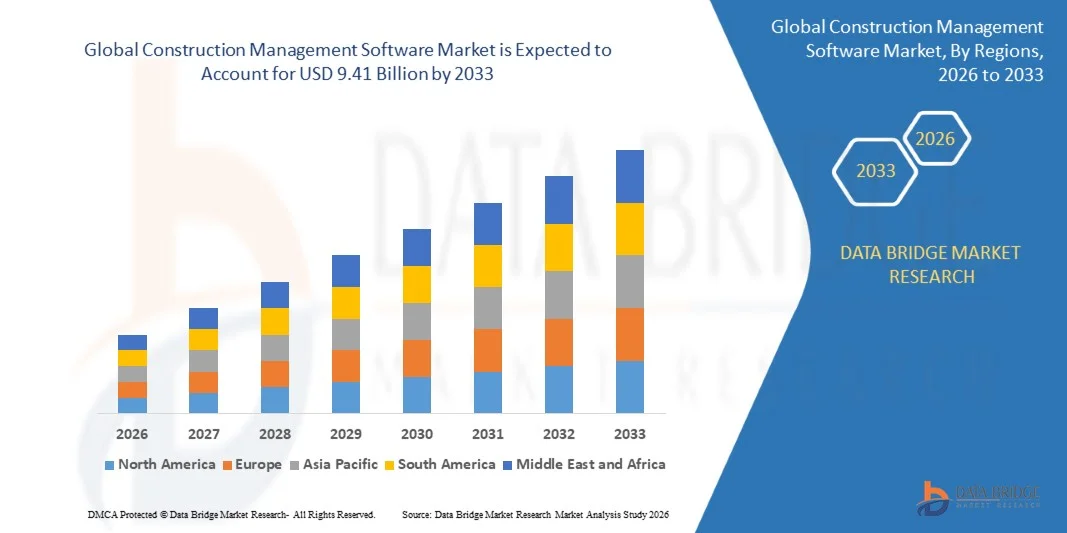
Report Scope and Construction Management Software Market Segmentation
|
Attributes |
Construction Management Software Key Market Insights |
|
Segments Covered |
|
|
Countries Covered |
North America · U.S. · Canada · Mexico Europe · Germany · France · U.K. · Netherlands · Switzerland · Belgium · Russia · Italy · Spain · Turkey · Rest of Europe Asia-Pacific · China · Japan · India · South Korea · Singapore · Malaysia · Australia · Thailand · Indonesia · Philippines · Rest of Asia-Pacific Middle East and Africa · Saudi Arabia · U.A.E. · South Africa · Egypt · Israel · Rest of Middle East and Africa South America · Brazil · Argentina · Rest of South America |
|
Key Market Players |
· Oracle Corporation (U.S.) · Procore Technologies, Inc. (U.S.) · Intuit Inc. (U.S.) · Trimble Inc. (U.S.) · ConstructConnect (U.S.) · Sage Group plc (U.K.) · Autodesk Inc. (U.S.) · Buildertrend (U.S.) · Smartsheet Inc. (U.S.) · Branch Metrics (U.S.) · Epicor Software Corporation (U.S.) · Jonas Construction Software Inc. (Canada) · Wrike, Inc. (U.S.) · Finalcad SARL (France) · Constellation HomeBuilder Systems (Canada) · CMiC (Canada) · ITAakash Strategic Soft. (P) Ltd. (India) · RIB CCS (Germany) · V-Plan (U.K.) · CoConstruct (U.S.) · UDA Technologies (U.S.) · STACK Construction Technologies (U.S.) · Systemates, Inc. (U.S.) · Tilos Americas (U.S.) · INSPECTIVITY PTY LTD. (Australia) · ClockShark, LLC (U.S.) · Mitek Inc. (U.S.) · EZOfficeInventory (U.S.) · Bentley Systems, Incorporated (U.S.) |
|
Market Opportunities |
· Expansion of Smart City Projects · Growth in Modular Construction Technologies · Integration of BIM and Digital Twin Solutions |
|
Value Added Data Infosets |
In addition to the market insights such as market value, growth rate, market segments, geographical coverage, market players, and market scenario, the market report curated by the Data Bridge Market Research team includes in-depth expert analysis, import/export analysis, pricing analysis, production consumption analysis, and pestle analysis. |
Construction Management Software Market Trends
Trend: Increasing Cloud and AI Adoption in Construction Platforms
Construction companies are rapidly adopting cloud based and AI integrated construction management platforms to improve project coordination, scheduling accuracy, and cost efficiency across large scale projects. These platforms enable real time collaboration between stakeholders, automated progress tracking, and predictive analytics for risk mitigation. Growing integration of BIM, mobile applications, and data driven project monitoring is further accelerating digital transformation across the construction industry.
Companies such as Autodesk Inc. with Autodesk Construction Cloud and Procore Technologies, Inc. are actively deploying AI enabled project management tools to enhance workflow automation, improve project visibility, and strengthen decision making across global construction operations.
Construction Management Software Market Dynamics
Key Market Driver: Rising Demand for Real Time Project Visibility and Cost Control
The increasing complexity of construction projects is driving strong demand for real time project tracking, centralized data access, and cost control solutions. Construction firms are increasingly adopting digital platforms to reduce delays, optimize resource allocation, and improve collaboration across multiple project stakeholders. Cloud based construction management systems are enabling better transparency and operational efficiency across large infrastructure and commercial developments.
Companies such as Trimble Inc. and Procore Technologies, Inc. are widely used for real time construction monitoring and project control, helping contractors improve cost efficiency and reduce project overruns across global construction sites.
Key Restraint/Challenge: High Cost and Slow Digital Adoption among Small Contractors
High implementation costs of advanced construction management software, combined with resistance to digital transformation among small and mid sized contractors, remain a key challenge for market growth. Many smaller firms still rely on traditional paper based or semi digital workflows due to limited technical expertise and budget constraints. Integration complexity with existing legacy systems further slows adoption in emerging construction markets.
Buildertrend and CoConstruct have highlighted that small contractors often face challenges in adopting full scale digital platforms due to subscription costs and training requirements, limiting faster penetration of advanced construction software in smaller project segments.
Key Market Opportunity: Growth in Modular Construction Technologies
The rising adoption of modular and prefabricated construction methods is creating significant opportunities for construction management software providers. Modular construction requires highly coordinated planning, precise scheduling, and real time supply chain management, which increases demand for advanced digital project management tools. Integration of AI driven planning and BIM based design coordination is further improving efficiency in modular project execution.
Companies such as Autodesk Inc. and CMiC are increasingly offering BIM integrated scheduling and resource optimization solutions that support modular construction workflows, enabling faster project delivery and improved cost efficiency across residential and commercial construction projects.
Construction Management Software Market Scope
The construction management software market is segmented on the basis of offering, device type, pricing model, application, and vertical.
- By Offering
On the basis of offering, the Construction Management Software Market is segmented into solution and services. The Solution segment dominated the market with the largest share of 63% in 2025, driven by strong demand for integrated project planning, scheduling, cost estimation, and document management platforms across large-scale construction projects. Increasing adoption of cloud-based construction software is enabling real-time collaboration and centralized data access for project stakeholders. Contractors and firms are prioritizing end-to-end digital platforms to improve productivity and reduce project delays. Continuous advancements in AI-enabled project analytics and BIM integration further strengthen the dominance of this segment.
The Services segment is projected to register the fastest growth at a CAGR of 11.8% from 2026 to 2033, supported by rising demand for implementation, customization, training, and support services. Growing complexity of construction workflows is driving organizations to seek expert consulting for software deployment and optimization. Increasing transition from legacy systems to cloud-based platforms is further boosting service requirements. Managed services adoption is also rising among mid-sized contractors aiming to reduce IT burden. Expanding digital transformation initiatives across the construction sector continue to accelerate segment growth.
- By Device Type
On the basis of device type, the market is segmented into smartphone and computer. The Computer segment dominated the market with a share of 58% in 2025, driven by widespread usage of desktop and laptop systems for detailed project planning, BIM modeling, and large-scale data management. Construction professionals rely on high-performance computing systems for handling complex design and scheduling applications. On-site and office-based coordination is primarily managed through computer-based platforms for higher accuracy and processing capability. Strong enterprise adoption of desktop software solutions further reinforces this dominance.
The Smartphone segment is projected to register the fastest growth at a CAGR of 14.2% from 2026 to 2033, driven by increasing demand for mobile accessibility and real-time project updates on construction sites. Field engineers and contractors are increasingly using mobile apps for progress tracking, reporting, and communication. Advancements in mobile-enabled construction software and cloud synchronization are improving usability and efficiency. Growing penetration of 5G connectivity is further enhancing real-time data exchange. Rising workforce mobility across construction sites continues to accelerate segment expansion.
- By Pricing Model
On the basis of pricing model, the market is segmented into license based and subscription based. The License Based segment dominated the market with a share of 55% in 2025, supported by traditional enterprise procurement practices and long-term software ownership preferences among large construction firms. Organizations with established IT infrastructure continue to prefer upfront licensing for cost control and customization flexibility. High reliance on legacy enterprise systems further sustains adoption of license-based models. Strong demand from large contractors and infrastructure developers reinforces segment leadership.
The Subscription Based segment is projected to register the fastest growth at a CAGR of 11.1% from 2026 to 2033, driven by increasing adoption of SaaS-based construction management platforms. Flexible pricing structures and lower initial investment requirements are encouraging small and mid-sized contractors to adopt subscription models. Continuous software updates, scalability, and cloud accessibility are key advantages supporting growth. Vendors are increasingly shifting toward recurring revenue models to expand customer reach. Rapid digitalization of construction workflows is accelerating subscription-based adoption.
- By Application
On the basis of application, the market is segmented into preconstruction, project management, resource management, financial management, customer relationship management software, and others. The Project Management segment dominated the market with a share of 41.41% in 2025, driven by its critical role in scheduling, coordination, and execution of construction activities. Increasing complexity of construction projects is driving demand for centralized platforms that improve visibility and control. Integration of BIM and AI-based scheduling tools further strengthens adoption. Strong reliance on real-time monitoring and collaboration tools supports segment leadership.
The Preconstruction segment is projected to register the fastest growth at a CAGR of 9.68% from 2026 to 2033, driven by rising emphasis on planning accuracy and risk mitigation before project execution. Advanced estimating, design collaboration, and feasibility analysis tools are gaining traction among contractors and developers. Increasing use of digital twin and predictive analytics technologies is improving decision-making efficiency. Growing focus on reducing project delays and cost overruns is further boosting adoption. Expanding infrastructure development activities continue to accelerate segment growth.
- By Vertical
On the basis of vertical, the market is segmented into residential construction contractors, commercial construction contractors, landscaping contractor, construction manager, engineer, architect, and others. The Commercial Construction Contractors segment dominated the market with a share of 41% in 2025, driven by large-scale infrastructure and commercial building projects requiring advanced project coordination tools. High adoption of digital construction platforms in office complexes, retail spaces, and industrial facilities supports market dominance. Strong emphasis on cost optimization and timeline efficiency further reinforces adoption. Increasing urban development projects across major economies contributes to segment leadership.
The Residential Construction Contractors segment is projected to register the fastest growth at a CAGR of 12.9% from 2026 to 2033, driven by rising housing demand and rapid urbanization. Increasing adoption of affordable construction management solutions among small and mid-sized builders is accelerating digital transformation. Growing use of mobile-based project tracking tools is improving on-site efficiency. Government-backed housing development programs are further supporting segment expansion. Expanding residential renovation and redevelopment activities continue to drive growth momentum.
Construction Management Software Market Regional Analysis
North America dominated the construction management software market and accounted for the largest revenue share of 32.4% in 2025, driven by high adoption of digital construction technologies, strong presence of large construction enterprises, and widespread use of cloud based project management platforms. The region benefits from advanced construction infrastructure, high BIM penetration, and strong integration of AI and IoT enabled project monitoring systems. Contractors and developers across commercial, residential, and infrastructure projects are increasingly investing in centralized construction management solutions to improve cost control and project efficiency. In addition, the presence of leading software vendors and strong digital transformation initiatives across the construction sector continue to reinforce North America’s leadership position in the global market.
U.S. Construction Management Software Market Insight
The U.S. Construction Management Software market is experiencing strong growth driven by rapid digitalization of construction workflows, increasing demand for real time project tracking, and large scale infrastructure modernization programs. Construction firms are heavily adopting cloud based platforms to improve collaboration between stakeholders and enhance productivity across complex projects. Strong integration of BIM, AI based scheduling, and predictive analytics is further improving project accuracy and risk management. In addition, rising investment in smart city development and commercial real estate expansion is accelerating software adoption across the U.S. construction ecosystem.
Canada Construction Management Software Market Insight
The Canada Construction Management Software market is witnessing steady growth supported by rising infrastructure development activities and increasing adoption of digital project management tools across construction firms. Companies are focusing on improving operational efficiency and reducing project delays through cloud based collaboration platforms. Growing investments in residential housing projects and public infrastructure modernization are further supporting software adoption. In addition, increasing emphasis on sustainable construction practices and regulatory compliance is driving demand for advanced construction management solutions in Canada.
Europe Construction Management Software Market Insight
The Europe Construction Management Software market is expanding steadily due to strong regulatory frameworks, increasing digital transformation in construction processes, and rising adoption of BIM enabled project management systems. Construction companies across the region are prioritizing cost optimization, sustainability, and efficiency in large scale infrastructure and commercial projects. Strong emphasis on green building initiatives and energy efficient construction practices is further driving software deployment. In addition, growing investments in smart infrastructure development continue to support regional market expansion.
U.K. Construction Management Software Market Insight
The U.K. Construction Management Software market is growing steadily, driven by high adoption of digital construction technologies, strong focus on infrastructure modernization, and increasing use of cloud based project management platforms. Construction firms are leveraging software solutions to improve project coordination, reduce delays, and enhance resource allocation efficiency. Strong government support for housing and transport infrastructure projects is further accelerating demand. In addition, rising integration of AI and data analytics in construction planning is strengthening market growth in the U.K.
Germany Construction Management Software Market Insight
The Germany Construction Management Software market is expanding due to strong industrial construction activity, increasing adoption of digital engineering tools, and rising emphasis on efficiency and sustainability in construction projects. Companies in the manufacturing, automotive, and infrastructure sectors are increasingly using advanced project management platforms to streamline operations. Strong regulatory standards and focus on energy efficient construction practices are further driving software adoption. In addition, growing integration of BIM and IoT enabled construction monitoring systems is accelerating market development in Germany.
Asia-Pacific Construction Management Software Market Insight
The Asia-Pacific Construction Management Software market is expected to register the fastest growth with a CAGR of 9.93% from 2026 to 2033, driven by rapid urbanization, large scale infrastructure development, and increasing adoption of digital construction technologies. Rising government investments in smart cities, transportation networks, and residential housing projects are significantly boosting demand for construction management platforms. Countries such as China, India, Japan, and South Korea are witnessing strong deployment of cloud based and mobile enabled construction software. In addition, expanding construction activity and growing focus on project efficiency are further accelerating regional market expansion.
Japan Construction Management Software Market Insight
The Japan Construction Management Software market is witnessing steady growth supported by advanced construction practices, strong emphasis on automation, and increasing adoption of digital project management systems. Construction firms are focusing on improving efficiency and reducing labor dependency through AI and robotics integrated workflows. Strong infrastructure modernization initiatives and aging workforce challenges are further driving software adoption. In addition, rising use of BIM and real time collaboration tools is strengthening demand in Japan.
China Construction Management Software Market Insight
The China Construction Management Software market is growing rapidly due to massive infrastructure development, rapid urban expansion, and strong adoption of digital construction technologies. Construction companies are increasingly using cloud based project management platforms to improve coordination and cost efficiency across large scale projects. Strong government support for smart city development and digital infrastructure transformation is further accelerating market adoption. In addition, rising integration of AI driven analytics and mobile construction applications is significantly boosting market growth in China.
Construction Management Software Market Share
The construction management software industry is primarily led by well-established companies, including:
- Oracle Corporation (U.S.)
- Procore Technologies, Inc. (U.S.)
- Intuit Inc. (U.S.)
- Trimble Inc. (U.S.)
- ConstructConnect (U.S.)
- Sage Group plc (U.K.)
- Autodesk Inc. (U.S.)
- Buildertrend (U.S.)
- Smartsheet Inc. (U.S.)
- Branch Metrics (U.S.)
- Epicor Software Corporation (U.S.)
- Jonas Construction Software Inc. (Canada)
- Wrike, Inc. (U.S.)
- Finalcad SARL (France)
- Constellation HomeBuilder Systems (Canada)
- CMiC (Canada)
- ITAakash Strategic Soft. (P) Ltd. (India)
- RIB CCS (Germany)
- V-Plan (U.K.)
- CoConstruct (U.S.)
- UDA Technologies (U.S.)
- STACK Construction Technologies (U.S.)
- Systemates, Inc. (U.S.)
- Tilos Americas (U.S.)
- INSPECTIVITY PTY LTD. (Australia)
- ClockShark, LLC (U.S.)
- Mitek Inc. (U.S.)
- EZOfficeInventory (U.S.)
- Bentley Systems, Incorporated (U.S.)
Latest Developments in Construction Management Software Market
- In February 2026, Autodesk launched an AI powered progress tracking module designed to automate as built versus BIM comparisons for large scale projects exceeding USD 500 million. This development significantly enhances project monitoring accuracy and reduces manual verification efforts, strengthening Autodesk’s position in high value infrastructure and complex construction management segments. The innovation is expected to improve real time decision making, minimize project delays, and increase adoption of AI driven construction analytics across enterprise level projects
- In January 2026, Procore reported preliminary Q4 2025 results indicating annual revenue surpassing USD 1 billion, supported by strong 38% international growth. This performance reflects expanding global adoption of Procore’s cloud based construction management platform and increasing demand for centralized project coordination tools. The results reinforce the company’s competitive position in the construction software market and highlight accelerating penetration in international markets driven by digital transformation in construction workflows
- In December 2025, Oracle introduced a digital twin IoT module within its Construction and Engineering Cloud platform aimed at infrastructure owners. This enhancement strengthens real time asset monitoring, predictive maintenance, and lifecycle management capabilities for large infrastructure projects. The integration of IoT and digital twin technologies improves operational visibility and supports data driven decision making, positioning Oracle more strongly in the advanced construction management software ecosystem
- In November 2025, Trimble and NVIDIA announced a strategic partnership to integrate generative AI into equipment logistics planning for construction operations. This collaboration enhances optimization of machinery deployment, resource allocation, and project scheduling efficiency across large construction sites. The integration of AI powered simulation and logistics modeling is expected to reduce operational costs, improve productivity, and accelerate digital transformation in construction project management
- In January 2024, Autodesk acquired Payapps, a construction payment and compliance management solutions provider, to strengthen its construction management software portfolio. This acquisition enhances Autodesk Construction Cloud by improving payment workflows, increasing financial transparency, and ensuring stronger compliance across project lifecycles. The integration supports more efficient contractor payment processes and reduces administrative friction, thereby expanding Autodesk’s value proposition in end to end construction management solutions
SKU-
Get online access to the report on the World's First Market Intelligence Cloud

- Interactive Data Analysis Dashboard
- Company Analysis Dashboard for high growth potential opportunities
- Research Analyst Access for customization & queries
- Competitor Analysis with Interactive dashboard
- Latest News, Updates & Trend analysis
- Harness the Power of Benchmark Analysis for Comprehensive Competitor Tracking
Research Methodology
Data collection and base year analysis are done using data collection modules with large sample sizes. The stage includes obtaining market information or related data through various sources and strategies. It includes examining and planning all the data acquired from the past in advance. It likewise envelops the examination of information inconsistencies seen across different information sources. The market data is analysed and estimated using market statistical and coherent models. Also, market share analysis and key trend analysis are the major success factors in the market report. To know more, please request an analyst call or drop down your inquiry.
The key research methodology used by DBMR research team is data triangulation which involves data mining, analysis of the impact of data variables on the market and primary (industry expert) validation. Data models include Vendor Positioning Grid, Market Time Line Analysis, Market Overview and Guide, Company Positioning Grid, Patent Analysis, Pricing Analysis, Company Market Share Analysis, Standards of Measurement, Global versus Regional and Vendor Share Analysis. To know more about the research methodology, drop in an inquiry to speak to our industry experts.
Customization Available
Data Bridge Market Research is a leader in advanced formative research. We take pride in servicing our existing and new customers with data and analysis that match and suits their goal. The report can be customized to include price trend analysis of target brands understanding the market for additional countries (ask for the list of countries), clinical trial results data, literature review, refurbished market and product base analysis. Market analysis of target competitors can be analyzed from technology-based analysis to market portfolio strategies. We can add as many competitors that you require data about in the format and data style you are looking for. Our team of analysts can also provide you data in crude raw excel files pivot tables (Fact book) or can assist you in creating presentations from the data sets available in the report.












