




Global Contact Adhesives Market
Market Size in USD Billion
CAGR :
% 
 USD
4.03 Billion
USD
6.37 Billion
2025
2033
USD
4.03 Billion
USD
6.37 Billion
2025
2033
 Forecast Period Forecast Period |
2026 –2033 |
 Market Size (Base Year) Market Size (Base Year) |
USD 4.03 Billion |
 Market Size (Forecast Year) Market Size (Forecast Year) |
USD 6.37 Billion |
 CAGR CAGR |
% |
| Major Markets Players |
|
Contact Adhesives Market Size
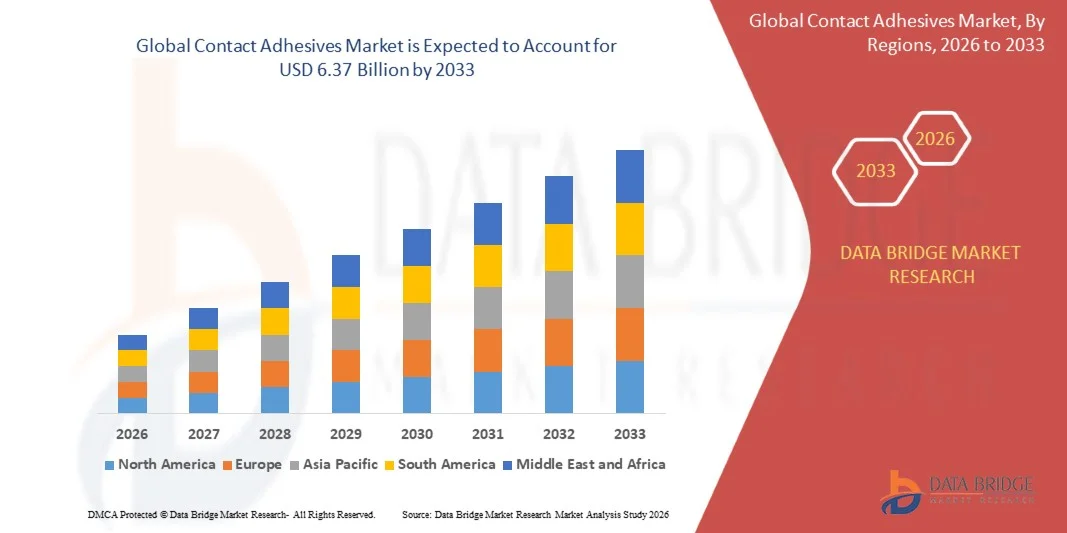
- The global contact adhesives market size was valued at USD 4.03 billion in 2025 and is expected to reach USD 6.37 billion by 2033, at a CAGR of 5.90% during the forecast period
- The market growth is largely fueled by the increasing demand for durable, high-performance bonding solutions across industries such as automotive, construction, packaging, and furniture, which require strong adhesion and long-lasting reliability
- Furthermore, rising emphasis on sustainable and eco-friendly adhesive formulations, along with regulatory compliance for industrial and consumer applications, is driving manufacturers to innovate and expand their contact adhesives offerings. These converging factors are accelerating the adoption of contact adhesives, thereby significantly boosting the industry’s growth
Contact Adhesives Market Analysis
- Contact adhesives are fast-bonding, solvent-based or water-based adhesives that provide instant adhesion between surfaces such as wood, metal, plastics, rubber, and laminates. They are widely used in industrial, commercial, and household applications due to their versatility, strength, and ease of application
- The escalating demand for contact adhesives is primarily fueled by rapid industrialization, growth in the automotive and construction sectors, increasing use of laminated and composite materials, and the rising need for specialized adhesives that meet high-performance and sustainability standards
- Asia-Pacific dominated the contact adhesives market with a share of 39.1% in 2025, due to expanding construction, automotive, and packaging industries, along with a strong presence of adhesive manufacturing hubs
- North America is expected to be the fastest growing region in the contact adhesives market during the forecast period due to robust demand across automotive, construction, furniture, and packaging industries
- Neoprene segment dominated the market with a market share of 44% in 2025, due to its superior adhesion to diverse substrates, including metals, plastics, and rubber. Neoprene-based adhesives offer excellent heat and chemical resistance, making them suitable for industrial applications, automotive bonding, and construction projects. Their versatility and long-standing presence in the market have made them a preferred choice among manufacturers seeking reliability and durability
Report Scope and Contact Adhesives Market Segmentation
|
Attributes |
Contact Adhesives Key Market Insights |
|
Segments Covered |
|
|
Countries Covered |
North America
Europe
Asia-Pacific
Middle East and Africa
South America
|
|
Key Market Players |
|
|
Market Opportunities |
|
|
Value Added Data Infosets |
In addition to the insights on market scenarios such as market value, growth rate, segmentation, geographical coverage, and major players, the market reports curated by the Data Bridge Market Research also include import export analysis, production capacity overview, production consumption analysis, price trend analysis, climate change scenario, supply chain analysis, value chain analysis, raw material/consumables overview, vendor selection criteria, PESTLE Analysis, Porter Analysis, and regulatory framework. |
Contact Adhesives Market Trends
“Growing Adoption of Sustainable and Eco-Friendly Adhesive Solutions”
- A significant trend in the contact adhesives market is the increasing focus on sustainable and eco-friendly adhesive solutions, driven by rising environmental awareness and regulatory pressures across industries. Manufacturers are developing low-VOC, water-based, and solvent-free adhesives to minimize ecological impact and improve workplace safety
- For instance, Henkel offers Loctite and Pritt eco-friendly adhesive ranges that cater to industrial and consumer applications, promoting reduced chemical emissions while maintaining strong bonding performance. These products are being widely adopted in automotive assembly, furniture manufacturing, and packaging sectors
- The demand for adhesives with enhanced performance characteristics such as fast curing, high bond strength, and durability is shaping product innovation. This trend is encouraging the development of multifunctional adhesives that can perform under varied operational and environmental conditions
- Construction and woodworking industries are increasingly selecting adhesives that provide strong, long-lasting bonds without compromising sustainability standards. This is positioning environmentally responsible adhesives as a preferred choice for large-scale building and renovation projects
- Rising consumer preference for green products in packaging and consumer goods is driving manufacturers to offer adhesives that comply with eco-labels and international sustainability certifications. Such adoption is influencing procurement policies and supplier selection in both industrial and commercial segments
- The market is witnessing growing collaborations between adhesive producers and raw material suppliers to ensure sustainable sourcing and circular economy practices. This focus is reinforcing the long-term shift toward eco-conscious adhesive solutions across global industries
Contact Adhesives Market Dynamics
Driver
“Rising Demand from Automotive, Construction, and Packaging Industries”
- The growing requirements for reliable and high-performance bonding solutions in automotive, construction, and packaging sectors are driving the contact adhesives market. Adhesives provide flexibility, structural integrity, and efficiency in assembly processes across these industries
- For instance, 3M supplies a broad portfolio of contact adhesives that are extensively used in automotive interior assembly and furniture manufacturing, enabling faster production and stronger bonding while reducing reliance on mechanical fasteners. This is facilitating productivity and design flexibility
- Increasing infrastructure projects worldwide are boosting demand for construction adhesives that can replace traditional joining methods, offering speed and durability in wood, metal, and composite applications. This trend is driving higher adoption of contact adhesives in residential and commercial construction
- The packaging industry is embracing contact adhesives for flexible packaging, cartons, and labeling applications, where strong adhesion and quick setting properties are critical. This is reinforcing the need for specialized adhesives tailored to varied packaging materials
- Growing emphasis on lightweight materials and assembly efficiency, particularly in automotive and aerospace segments, is supporting the adoption of contact adhesives as alternatives to mechanical fasteners. This is positioning adhesives as integral components in modern manufacturing strategies
Restraint/Challenge
“High Raw Material Costs and Stringent Environmental Regulations”
- The contact adhesives market faces challenges due to fluctuating raw material costs, which impact production expenses and pricing strategies. Essential ingredients such as polymers, resins, and solvents often experience price volatility, affecting overall market dynamics
- For instance, H.B. Fuller has highlighted cost pressures arising from resin and polymer price increases, which influence adhesive production budgets and margins. Companies are adopting cost-optimization strategies and exploring alternative formulations to mitigate this challenge
- Stringent environmental regulations concerning VOC emissions, chemical usage, and workplace safety impose compliance costs on manufacturers. Meeting these requirements requires investment in research, production adjustments, and certification processes
- Limited availability of eco-compliant raw materials can constrain supply chains and delay production schedules, particularly for water-based or solvent-free adhesives. This reliance on specialized inputs adds operational complexity and influences market accessibility
- The need to balance performance, sustainability, and cost-effectiveness continues to challenge manufacturers. These constraints collectively pressure companies to innovate formulations and manufacturing processes while maintaining adherence to regulatory standards
Contact Adhesives Market Scope
The market is segmented on the basis of resin type, technology, application, raw material, and mode of application.
• By Resin Type
On the basis of resin type, the contact adhesives market is segmented into neoprene, polyurethane, acrylic, styrene butadiene copolymer (SBC), and others. The neoprene segment dominated the largest market revenue share of 44% in 2025, driven by its superior adhesion to diverse substrates, including metals, plastics, and rubber. Neoprene-based adhesives offer excellent heat and chemical resistance, making them suitable for industrial applications, automotive bonding, and construction projects. Their versatility and long-standing presence in the market have made them a preferred choice among manufacturers seeking reliability and durability. Neoprene adhesives also integrate well with solvent- and water-based formulations, further enhancing their market acceptance and widespread usage.
The polyurethane segment is anticipated to witness the fastest growth rate from 2026 to 2033, fueled by rising demand in the automotive, construction, and packaging sectors. For instance, companies such as Henkel have introduced advanced polyurethane-based contact adhesives with high flexibility and strong bonding strength suitable for lightweight and composite materials. Polyurethane adhesives are favored for their excellent mechanical properties, impact resistance, and environmental durability, which drive adoption in high-performance applications. Their compatibility with modern automated application systems also contributes to the segment’s accelerated growth.
• By Technology
On the basis of technology, the contact adhesives market is segmented into solvent-based, water-based, and others. The solvent-based segment held the largest revenue share in 2025, attributed to its rapid bonding strength, versatility across substrates, and widespread use in industrial manufacturing. Solvent-based adhesives offer strong performance under high-temperature and high-moisture conditions, which makes them highly suitable for construction and automotive assembly lines. Manufacturers prefer solvent-based formulations for heavy-duty applications due to their predictable cure time and strong adhesion properties. These adhesives also provide superior shelf-life stability and compatibility with various resin types, enhancing their market presence.
The water-based segment is projected to witness the fastest CAGR from 2026 to 2033, driven by increasing environmental regulations and the shift toward eco-friendly adhesives. For instance, 3M has developed high-performance water-based contact adhesives that reduce VOC emissions while maintaining bonding strength for woodworking and packaging applications. Water-based technologies offer lower odor, easier cleanup, and improved safety for end users, which encourages adoption in residential and commercial applications. Their growth is further supported by advancements in polymer chemistry that enhance adhesion and durability in water-based formulations.
• By Application
On the basis of application, the contact adhesives market is segmented into woodworking, leather and footwear, automotive, construction, and packaging. The woodworking segment dominated the largest revenue share in 2025, owing to the consistent demand from furniture manufacturing and interior design projects. Contact adhesives in woodworking provide strong initial tack, quick bonding, and long-term durability for laminates, veneers, and composite panels. Companies prefer these adhesives to ensure precise alignment, gap-filling properties, and resistance to environmental stresses in furniture and cabinetry. The reliability and ease of use of contact adhesives for wood substrates have strengthened their market position over time.
The automotive segment is expected to witness the fastest growth from 2026 to 2033, driven by increasing production of lightweight vehicles and the rising use of composite materials. For instance, Sika has introduced advanced contact adhesives for automotive assembly that provide strong adhesion to plastics, metals, and foams while improving crash performance. Automotive contact adhesives are valued for their vibration resistance, flexibility, and compatibility with automation in assembly lines. Rising demand for vehicle interiors, trim bonding, and under-the-hood applications further fuels the segment’s growth trajectory.
• By Raw Material
On the basis of raw material, the contact adhesives market is segmented into polychloroprene, polyurethane, acrylic polymers, styrene butadiene rubber, butyl rubber, and natural rubber. The polychloroprene segment held the largest market revenue share in 2025, attributed to its strong adhesion, chemical resistance, and thermal stability. Polychloroprene-based adhesives are commonly used in automotive, footwear, and construction applications due to their ability to bond diverse materials effectively. Their durability, water resistance, and high tensile strength make them a reliable choice for industrial-grade bonding needs. Manufacturers also leverage polychloroprene adhesives for retrofit and repair applications, increasing overall market penetration.
The polyurethane raw material segment is anticipated to experience the fastest growth rate from 2026 to 2033, fueled by its versatility across flexible and rigid substrates and rising demand in high-performance applications. For instance, BASF has developed polyurethane-based adhesives with excellent elasticity and impact resistance for the automotive and packaging industries. Polyurethane adhesives provide superior mechanical properties, longevity, and chemical resistance, which drives adoption in applications requiring durable and flexible bonds. Increasing awareness of polyurethane’s environmentally friendly formulations also supports market expansion.
• By Mode of Application
On the basis of mode of application, the contact adhesives market is segmented into spraying, curtain coating, roller coating, and brushing. The spraying segment dominated the largest market revenue share in 2025, driven by its efficiency in large-scale industrial operations and uniform adhesive distribution. Spray application enables high-speed bonding, precise coverage, and compatibility with automated production lines, making it ideal for woodworking, automotive, and packaging industries. Companies prefer spray application for its ability to reduce adhesive wastage, ensure consistent performance, and improve overall productivity. The versatility of spraying across multiple adhesive formulations further strengthens its dominance.
The roller coating segment is projected to witness the fastest growth from 2026 to 2033, fueled by increasing adoption in construction and packaging sectors for high-volume, continuous bonding operations. For instance, Henkel offers roller-applied contact adhesives that provide strong initial tack and consistent coverage for laminates, films, and sheets. Roller coating ensures precise adhesive thickness, reduces manual labor, and supports integration with automated systems. Its growing use in industrial-scale applications contributes significantly to the segment’s accelerated growth.
Contact Adhesives Market Regional Analysis
- Asia-Pacific dominated the contact adhesives market with the largest revenue share of 39.1% in 2025, driven by expanding construction, automotive, and packaging industries, along with a strong presence of adhesive manufacturing hubs
- The region’s cost-effective production landscape, increasing investments in specialty adhesives, and growing exports of industrial and consumer adhesives are accelerating market expansion
- Availability of skilled labor, favorable government policies, and rapid industrialization across developing economies are contributing to increased consumption of contact adhesives in both industrial and commercial sectors
China Contact Adhesives Market Insight
China held the largest share in the Asia-Pacific contact adhesives market in 2025, owing to its established chemical manufacturing base and leadership in adhesive production for automotive, construction, and furniture sectors. The country benefits from favorable government policies supporting industrial growth, extensive manufacturing infrastructure, and strong export capabilities. Rising domestic demand for high-performance adhesives and ongoing investments in R&D for innovative adhesive formulations further strengthen market growth.
India Contact Adhesives Market Insight
India is witnessing the fastest growth in the Asia-Pacific region, fueled by rapid industrialization, expansion of automotive and construction sectors, and rising adoption of modern manufacturing techniques. Government initiatives such as "Make in India" and increased investments in chemical and specialty adhesive infrastructure are strengthening demand. In addition, growing packaging, furniture, and footwear industries, along with increased exports of adhesive products, are contributing to robust market expansion.
Europe Contact Adhesives Market Insight
The Europe contact adhesives market is expanding steadily, supported by stringent regulatory standards, high demand for durable and environmentally compliant adhesives, and rising investments in specialty and sustainable adhesive technologies. The region emphasizes quality, performance, and compliance with environmental norms, particularly in automotive, construction, and packaging applications. Increasing use of contact adhesives in advanced manufacturing and industrial automation is further enhancing market growth.
Germany Contact Adhesives Market Insight
Germany’s contact adhesives market is driven by its leadership in automotive and industrial manufacturing, strong chemical industry infrastructure, and focus on innovation and R&D. Well-established collaborations between academic institutions and chemical manufacturers foster continuous development of high-performance and specialty adhesives. Demand is particularly strong in automotive assembly, industrial machinery, and precision engineering applications.
U.K. Contact Adhesives Market Insight
The U.K. market is supported by mature manufacturing and construction industries, rising demand for specialty adhesives in automotive and packaging sectors, and increased focus on sustainability and regulatory compliance. Investments in R&D, academic-industry collaboration, and adoption of eco-friendly adhesive formulations are driving market growth. The country continues to play a significant role in high-value industrial adhesive markets due to innovation and technological adoption.
North America Contact Adhesives Market Insight
North America is projected to grow at the fastest CAGR from 2026 to 2033, driven by robust demand across automotive, construction, furniture, and packaging industries. Strong emphasis on industrial automation, high-performance adhesive technologies, and reshoring of manufacturing operations are boosting demand. In addition, growing focus on environmentally friendly adhesives, technological innovations, and strategic collaborations among key players are supporting market expansion.
U.S. Contact Adhesives Market Insight
The U.S. accounted for the largest share in the North America market in 2025, underpinned by its strong industrial base, extensive R&D infrastructure, and significant investments in specialty and high-performance adhesives. Rising demand from automotive, construction, and packaging industries, coupled with a focus on sustainability and regulatory compliance, is driving adoption. Presence of key market players, advanced manufacturing capabilities, and a mature distribution network further solidify the U.S.’s leading position in the region.
Contact Adhesives Market Share
The contact adhesives industry is primarily led by well-established companies, including:
- 3M (U.S.)
- Arkema (France)
- Sika AG (Switzerland)
- Henkel Adhesives Technologies India Private Limited (India)
- H.B. Fuller Company (U.S.)
- Illinois Tool Works Inc. (U.S.)
- Huntsman International LLC (U.S.)
- Pidilite Industries Ltd (India)
- Jubilant Industries Ltd (India)
- Royal Adhesives & Sealants LLC (U.S.)
- Permabond LLC (U.S.)
- Hernon Manufacturing, Inc. (U.S.)
- Master Bond Inc. (U.S.)
- Delo Industrial Adhesives, LLC (U.S.)
- Scott Bader Company Ltd. (U.K.)
- Dymax Corporation (U.S.)
- Loxeal S.r.l. (Italy)
- Mapei S.p.A (Italy)
- Uniseal Inc. (U.S.)
Latest Developments in Global Contact Adhesives Market
- In March 2026, Henkel launched new tinplate can packaging for its adhesive solutions based on CO₂‑reduced steel, marking a significant step toward sustainable production practices. This innovation supports the growing global emphasis on eco-friendly packaging, allowing manufacturers to reduce carbon footprint while maintaining product safety and performance. The shift toward greener packaging enhances customer preference for environmentally responsible adhesive solutions, driving demand for sustainable adhesives across industrial and commercial sectors. This move also positions Henkel as a leader in integrating sustainability into industrial adhesive solutions, potentially setting a benchmark for competitors
- In February 2026, Sika AG acquired Akkim, a prominent Turkish adhesives and sealants manufacturer, expanding its global production capacity and regional market presence. The acquisition enables Sika to strengthen its competitive position in Europe, the Middle East, and emerging markets, while broadening its portfolio of specialty adhesives. Enhanced production capabilities and distribution networks are expected to accelerate revenue growth, improve market penetration, and provide tailored solutions for industrial, construction, and automotive applications. This consolidation reflects a trend of strategic mergers in the market aimed at achieving scale and technological leadership
- In January 2026, BioBond Adhesives introduced BioAdhere SUP250, a biobased industrial adhesive designed for high-performance mobility and defense applications. This development highlights the rising demand for sustainable adhesives that combine environmental responsibility with superior mechanical performance. The launch is expected to drive adoption of plant-based adhesive technologies across industrial and specialty applications, encouraging manufacturers to shift toward eco-conscious bonding solutions. It also underscores how innovation in bio-based polymers can expand the functional scope of adhesives while supporting corporate sustainability goals
- In May 2024, Dorotape launched its GalleryLam SL98 ultra-high gloss laminate, engineered to protect large-format digital prints against scratches, high temperatures, grease, liquids, and household chemicals. This product enhances the performance of adhesive-backed laminates, expanding their application in signage, decorative graphics, and high-end printing markets. By offering superior protection and visual appeal, it strengthens the product portfolios of distributors and increases demand for compatible contact adhesives. The launch also demonstrates the growing focus on high-performance, specialty adhesives in consumer and commercial end-use industries
- In April 2024, Henkel’s Aquence PS 3017 RE, a water-based acrylic pressure-sensitive adhesive, received independent recyclability certification for packaging components. This recognition emphasizes the increasing importance of environmentally sustainable adhesive formulations that support circular packaging systems. The certification is likely to encourage wider adoption of eco-friendly adhesives in packaging, particularly for PET bottles and olefinic filmic labels, as manufacturers seek compliance with regulatory and consumer expectations. This development also positions Henkel as a pioneer in sustainable adhesive solutions, strengthening its competitive edge
SKU-
Get online access to the report on the World's First Market Intelligence Cloud

- Interactive Data Analysis Dashboard
- Company Analysis Dashboard for high growth potential opportunities
- Research Analyst Access for customization & queries
- Competitor Analysis with Interactive dashboard
- Latest News, Updates & Trend analysis
- Harness the Power of Benchmark Analysis for Comprehensive Competitor Tracking
Global Contact Adhesives Market, Supply Chain Analysis and Ecosystem Framework
To support market growth and help clients navigate the impact of geopolitical shifts, DBMR has integrated in-depth supply chain analysis into its Global Contact Adhesives Market research reports. This addition empowers clients to respond effectively to global changes affecting their industries. The supply chain analysis section includes detailed insights such as Global Contact Adhesives Market consumption and production by country, price trend analysis, the impact of tariffs and geopolitical developments, and import and export trends by country and HSN code. It also highlights major suppliers with data on production capacity and company profiles, as well as key importers and exporters. In addition to research, DBMR offers specialized supply chain consulting services backed by over a decade of experience, providing solutions like supplier discovery, supplier risk assessment, price trend analysis, impact evaluation of inflation and trade route changes, and comprehensive market trend analysis.
Research Methodology
Data collection and base year analysis are done using data collection modules with large sample sizes. The stage includes obtaining market information or related data through various sources and strategies. It includes examining and planning all the data acquired from the past in advance. It likewise envelops the examination of information inconsistencies seen across different information sources. The market data is analysed and estimated using market statistical and coherent models. Also, market share analysis and key trend analysis are the major success factors in the market report. To know more, please request an analyst call or drop down your inquiry.
The key research methodology used by DBMR research team is data triangulation which involves data mining, analysis of the impact of data variables on the market and primary (industry expert) validation. Data models include Vendor Positioning Grid, Market Time Line Analysis, Market Overview and Guide, Company Positioning Grid, Patent Analysis, Pricing Analysis, Company Market Share Analysis, Standards of Measurement, Global versus Regional and Vendor Share Analysis. To know more about the research methodology, drop in an inquiry to speak to our industry experts.
Customization Available
Data Bridge Market Research is a leader in advanced formative research. We take pride in servicing our existing and new customers with data and analysis that match and suits their goal. The report can be customized to include price trend analysis of target brands understanding the market for additional countries (ask for the list of countries), clinical trial results data, literature review, refurbished market and product base analysis. Market analysis of target competitors can be analyzed from technology-based analysis to market portfolio strategies. We can add as many competitors that you require data about in the format and data style you are looking for. Our team of analysts can also provide you data in crude raw excel files pivot tables (Fact book) or can assist you in creating presentations from the data sets available in the report.












