
Global Context Aware Computing Market
Market Size in USD Billion
CAGR :
% 
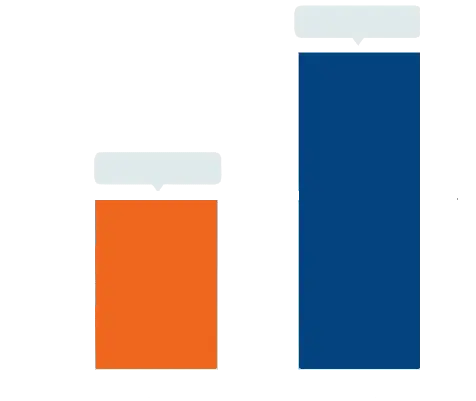 USD
77.90 Billion
USD
652.86 Billion
2025
2033
USD
77.90 Billion
USD
652.86 Billion
2025
2033
 Forecast Period Forecast Period |
2026 –2033 |
 Market Size (Base Year) Market Size (Base Year) |
USD 77.90 Billion |
 Market Size (Forecast Year) Market Size (Forecast Year) |
USD 652.86 Billion |
 CAGR CAGR |
% |
| Major Markets Players |
|
Context Aware Computing Market Size
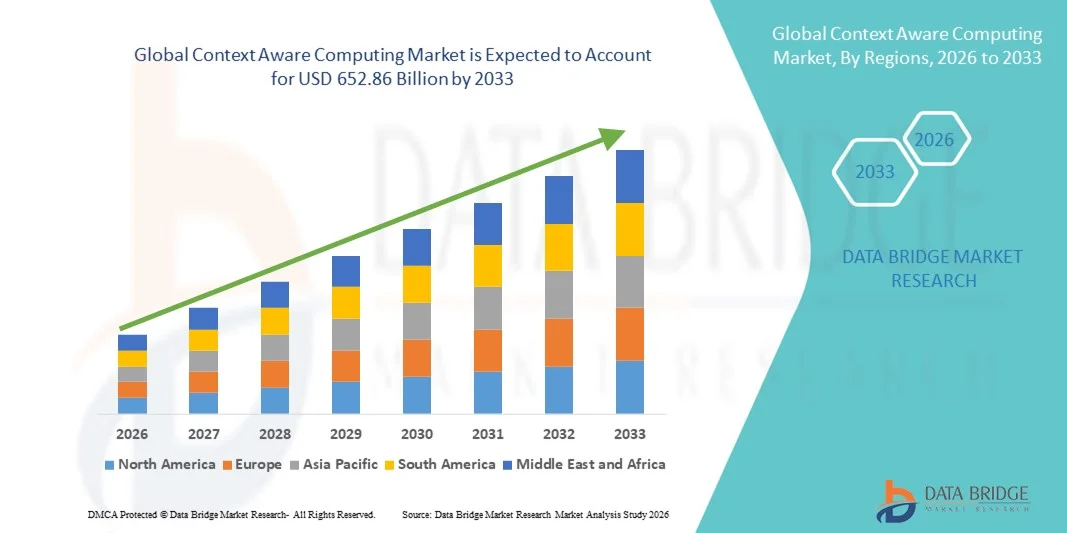
- The global context aware computing market size was valued at USD 77.9 billion in 2025 and is expected to reach USD 652.86 billion by 2033, at a CAGR of 30.44% during the forecast period
- The market growth is largely fueled by increasing adoption of smart devices, IoT integration, and advanced sensor technologies, enabling systems to perceive and respond to environmental and contextual changes in real time
- Furthermore, rising demand for personalized user experiences, enhanced operational efficiency, and intelligent automation across industries is accelerating the uptake of Context-Aware Computing solutions, thereby significantly boosting the industry's growth
Context Aware Computing Market Analysis
- Context‑Aware Computing Market — intelligent computing systems that sense, interpret, and respond to environmental and user context — are increasingly important across sectors like smart homes, healthcare, automotive, retail and industrial automation due to their ability to enable personalized experiences, real‑time decision‑making, and adaptive automation. This has led to growing demand for context‑aware systems integrated with AI, IoT, edge computing, and cloud analytics
- The rising adoption of IoT‑enabled devices, expanding smart infrastructure budgets, and enterprises’ need for real‑time insights and automation are key drivers bolstering the global Context Aware Computing Market growth. Organizations are focusing on solutions that deliver context‑driven personalization, improved operational efficiency, and predictive analytics
- North America dominated the context aware computing market in 2025 with 38.7%% market share — supported by advanced digital infrastructure, early smart technology adoption, high enterprise IoT deployment, and strong R&D investments from major technology companies. The U.S remains a major contributor within this regional share
- Asia‑Pacific is expected to be the fastest‑growing region during the forecast period, with increasing urbanization, rapid IoT penetration, government initiatives (e.g., smart cities), and rising consumer demand for context‑aware solutions driving the regional adoption. The APAC share is projected to expand significantly from its base in 2025 as emerging markets like China, India, Japan and South Korea scale deployments
- The User Context segment held the largest market revenue share of 35.1% in 2025, driven by the proliferation of mobile devices, wearables, and AI-powered personalization
Report Scope and Context Aware Computing Market Segmentation
|
Attributes |
Context Aware Computing Key Market Insights |
|
Segments Covered |
|
|
Countries Covered |
North America
Europe
Asia-Pacific
Middle East and Africa
South America
|
|
Key Market Players |
|
|
Market Opportunities |
|
|
Value Added Data Infosets |
In addition to the insights on market scenarios such as market value, growth rate, segmentation, geographical coverage, and major players, the market reports curated by the Data Bridge Market Research also include in-depth expert analysis, patient epidemiology, pipeline analysis, pricing analysis, and regulatory framework. |
Context Aware Computing Market Trends
Enhanced Adoption of Context-Aware Applications
- A significant and accelerating trend in the global Context Aware Computing market is the increasing adoption of context-aware applications across healthcare, retail, manufacturing, and smart environments. These applications leverage sensors, location data, and real-time analytics to provide personalized, adaptive, and efficient experiences for end-users
- For instance, in healthcare, context-aware computing systems are being integrated into patient monitoring solutions that automatically adjust alerts and notifications based on patient status, improving response times and operational efficiency. Similarly, in retail, stores are deploying context-aware systems to track shopper behavior and dynamically adjust promotions and inventory
- Context-aware computing is increasingly being combined with IoT and mobile devices to provide intelligent insights and automated responses, such as energy management in smart buildings, predictive maintenance in manufacturing, and adaptive learning in educational environments
- The growing availability of affordable sensors, cloud-based analytics platforms, and edge computing technologies is enabling broader deployment of context-aware solutions across small and large-scale operations
- This trend towards adaptive, responsive, and intelligent systems is reshaping expectations across industries, encouraging companies to integrate context-aware computing solutions to enhance operational efficiency, improve user experience, and drive innovation
- Companies such as IBM, Cisco, and SAP are increasingly developing context-aware solutions that leverage real-time data streams, analytics, and predictive modeling to provide actionable insights in sectors including healthcare, logistics, and smart cities
Context Aware Computing Market Dynamics
Driver
Rising Demand for Intelligent and Adaptive Systems
- The increasing need for intelligent, adaptive, and data-driven systems across various industries is driving growth in the context-aware computing market. Organizations are seeking solutions that can automatically respond to environmental changes, optimize operations, and enhance user engagement
- For instance, in manufacturing, context-aware systems are used for predictive maintenance, reducing downtime and operational costs by analyzing machine performance in real-time
- The growing proliferation of IoT devices, sensors, and connected infrastructure further supports the adoption of context-aware computing, enabling real-time data collection and actionable insights
- Furthermore, the increasing focus on automation, smart environments, and operational efficiency across industries such as healthcare, retail, and logistics is fueling demand for context-aware solutions
Restraint/Challenge
Data Privacy, Security Concerns, and Integration Complexity
- Concerns surrounding data privacy and security pose a significant challenge to the adoption of context-aware computing. These systems often rely on large amounts of personal and operational data, which can be vulnerable to breaches or misuse
- For instance, in healthcare, sensitive patient data collected through context-aware systems must comply with strict regulations such as HIPAA, and any security lapse can significantly impact adoption
- Integration complexity with existing IT infrastructure is another barrier. Companies may face challenges connecting context-aware computing platforms with legacy systems, IoT devices, or analytics platforms
- High initial investment costs for implementing advanced context-aware systems, including sensor networks, computing platforms, and analytics tools, can also hinder adoption, particularly among small- and medium-sized enterprises
- Overcoming these challenges requires robust data encryption, secure authentication protocols, seamless system integration, and comprehensive user training to build trust and ensure smooth deployment
- Despite gradual reductions in hardware and software costs, organizations continue to weigh the return on investment, which can delay broader adoption of context-aware computing systems
Context Aware Computing Market Scope
The Global Context Aware Computing Market is segmented on the basis of Product, Context, and Industry Verticals.
- By Product
On the basis of product, the market is segmented into Active Maps, Adaptive Phones, Augmented Reality, Guide Systems, Conference Assistants, Cyber Guides, Fieldwork, Shopping Assistants, and Others. The Active Maps segment dominated the market with a revenue share of 28.4% in 2025, driven by the growing need for real-time navigation and location-aware services across industries. The segment’s strong adoption in mobile devices, enterprise applications, and logistics operations has reinforced its market leadership. Active Maps provide highly accurate geospatial data, aiding decision-making in urban planning, fleet management, and travel sectors. Integration with AI and machine learning allows predictive analytics and route optimization, enhancing user experience. Enterprises leverage these solutions for operational efficiency and cost reduction. Consumer adoption is also rising due to smartphone penetration and smart vehicle integration. The segment benefits from continuous technological advancements, such as 3D mapping and AR overlays. Partnerships between map providers and tech companies have strengthened its ecosystem. Overall, the Active Maps segment continues to dominate due to its reliability, versatility, and broad applicability in commercial and consumer markets.
The Shopping Assistants segment is expected to witness the fastest CAGR of 22.3% from 2026 to 2033, fueled by the increasing demand for personalized retail experiences. Retailers are integrating AI-powered assistants to provide real-time recommendations and enhance customer engagement. The surge in e-commerce and omnichannel retail strategies has accelerated adoption. Shopping Assistants also leverage context-aware computing to track user behavior, preferences, and location, delivering tailored offers. Mobile apps, in-store kiosks, and wearable devices are key deployment channels. Consumers benefit from enhanced convenience, time savings, and improved decision-making. The market is further supported by AI advancements, natural language processing, and integration with voice assistants. Retailers use these systems to drive sales, increase loyalty, and optimize inventory management. With rising investments in smart retail technologies and digital transformation, Shopping Assistants are set to grow rapidly across regions globally.
- By Context
On the basis of context, the market is segmented into Computing Context, User Context, Physical Context, and Time Context. The User Context segment held the largest market revenue share of 35.1% in 2025, driven by the proliferation of mobile devices, wearables, and AI-powered personalization. User Context solutions adapt services based on individual preferences, behaviors, and location, enhancing user satisfaction. These systems are widely applied in smart homes, retail, healthcare, and enterprise solutions. Real-time data analysis allows dynamic adjustment of services, improving productivity and convenience. Integration with mobile apps and cloud services has increased accessibility and functionality. User Context also enables predictive insights, helping businesses anticipate customer needs. Strong consumer awareness of personalized services drives adoption. Technology advancements, including machine learning and sensor networks, strengthen its capabilities. Continuous investments in AI and IoT integration further boost market dominance. This segment’s versatility across industries makes it highly attractive for enterprise and consumer applications, solidifying its leadership.
The Time Context segment is projected to witness the fastest CAGR of 20.8% from 2026 to 2033, driven by applications that optimize scheduling, reminders, and dynamic content delivery. Time-aware solutions are increasingly used in healthcare for patient monitoring, smart homes for energy management, and enterprises for workflow optimization. These systems analyze temporal patterns to predict and automate user needs. The adoption of AI algorithms enhances predictive accuracy and personalization. Mobile apps, wearable devices, and enterprise software are key implementation channels. Businesses benefit from improved efficiency, resource allocation, and customer engagement. Integration with cloud computing allows scalable deployment and real-time updates. Consumer interest in time-saving and automation solutions supports growth. With rising adoption across multiple sectors, Time Context solutions are expected to achieve rapid expansion globally.
- By Industry Verticals
On the basis of industry verticals, the market is segmented into BFSI, Healthcare and Life Sciences, Telecommunications and IT, Government and Public Sector, Manufacturing, Consumer Goods and Retail, Media and Entertainment, and Others. The Telecommunications and IT segment held the largest market revenue share of 31.7% in 2025, driven by the integration of context-aware computing in network optimization, enterprise solutions, and smart devices. Telecom operators leverage these solutions for personalized services, enhanced connectivity, and efficient network management. Context-aware computing enables predictive maintenance, dynamic resource allocation, and improved user experience. Enterprise adoption for data analytics, workflow automation, and decision support has strengthened the segment. The growth of IoT devices and smart applications further fuels demand. Strong investments by IT companies in AI, cloud, and sensor technologies enhance capabilities. Telecom and IT companies also utilize context-aware solutions for cybersecurity and operational efficiency. With rising smartphone penetration and enterprise digitalization, this segment maintains a dominant market position globally.
The Healthcare and Life Sciences segment is expected to witness the fastest CAGR of 21.5% from 2026 to 2033, fueled by the growing adoption of context-aware solutions for patient monitoring, predictive diagnostics, and personalized treatment. Hospitals, clinics, and healthcare providers use these systems to enhance operational efficiency and improve patient outcomes. Remote healthcare, telemedicine, and smart hospital initiatives drive adoption. AI-powered monitoring systems analyze contextual patient data in real-time for early intervention. Integration with wearable devices allows continuous health tracking. Time- and user-aware solutions optimize scheduling and care delivery. Government initiatives for digital health transformation further boost growth. The rise of personalized medicine and patient-centric care models is accelerating market expansion in this vertical.
Context Aware Computing Market Regional Analysis
- North America dominated the context aware computing market with the largest revenue share of 38.7% in 2025, supported by advanced digital infrastructure, early adoption of smart technologies, high enterprise IoT deployment, and strong R&D investments from major technology companies
- The U.S. is the largest contributor within this regional share, capturing 81% of North America’s revenue in 2025, driven by the widespread adoption of connected devices, home automation, and intelligent keyless entry solutions. Consumers increasingly prioritize convenience, advanced security, and seamless integration with voice assistants such as Alexa, Google Assistant, and Apple HomeKit. DIY smart home setups, coupled with mobile application control, further expand market penetration
- Residential, commercial, and multi-family properties are embracing Context Aware Computing solutions. The region benefits from high disposable incomes, a tech-savvy population, and growing preference for remote monitoring. Enterprises are adopting these solutions for employee access control and operational efficiency. Overall, strong consumer awareness, robust infrastructure, and supportive policies accelerate market growth across the region
U.S. Context Aware Computing Market Insight
The U.S. context aware computing market captured the largest revenue share within North America at in 2025, fueled by the swift uptake of connected devices and the expanding trend of home automation. Consumers prioritize home security through intelligent keyless entry systems and smart locks integrated with IoT devices. The growing preference for DIY smart home setups, mobile app integration, and voice-controlled systems drives adoption. Integration with smart home ecosystems such as Alexa, Google Assistant, and Apple HomeKit further accelerates market growth. Residential and commercial sectors are increasingly adopting these solutions for convenience, safety, and energy efficiency. Strong technological infrastructure, urbanization, and rising consumer awareness also support market expansion. Key drivers include seamless connectivity, enhanced security features, and the demand for smart, interoperable home devices.
Europe Context Aware Computing Market Insight
The Europe context aware computing market is projected to expand at a substantial CAGR during the forecast period, primarily driven by stringent security regulations, increasing urbanization, and growing demand for connected devices in homes and offices. European consumers are drawn to the convenience, energy efficiency, and reliability offered by smart locks and other context-aware solutions. Growth spans residential, commercial, and multi-family housing applications, with adoption in both new constructions and renovation projects. The integration of smart locks with home automation systems, IoT devices, and energy management platforms supports market expansion. Government policies and technological maturity further enhance adoption, with consumers and businesses increasingly seeking secure, easy-to-use solutions.
U.K. Context Aware Computing Market Insight
The U.K. context aware computing market is anticipated to grow at a noteworthy CAGR during the forecast period, driven by rising home automation trends, heightened security concerns, and demand for convenience. Homeowners and businesses are increasingly adopting keyless entry solutions due to burglary concerns and a desire for seamless smart home integration. The U.K.’s strong e-commerce and retail infrastructure supports market growth, while connected devices such as mobile apps and voice assistants drive consumer adoption. Residential, commercial, and multi-family properties are key deployment segments, supported by government initiatives promoting smart homes and building automation.
Germany Context Aware Computing Market Insight
The Germany context aware computing market is expected to expand at a considerable CAGR during the forecast period, fueled by high awareness of digital security, innovative home automation solutions, and sustainability trends. The market benefits from Germany’s advanced infrastructure, strong technological ecosystem, and preference for privacy-focused solutions. Smart locks are increasingly integrated with IoT platforms, connected lighting, and security systems in residential and commercial applications. Consumers value reliable, eco-conscious, and technologically advanced solutions that combine security, convenience, and energy efficiency. The integration of keyless entry systems in new constructions and renovations further supports growth.
Asia-Pacific Context Aware Computing Market Insight
The Asia-Pacific context aware computing market is expected to be the fastest-growing region during the forecast period, with a projected CAGR from 2026 to 2033, driven by rapid urbanization, rising disposable incomes, and widespread IoT adoption. Government initiatives promoting smart cities and digitalization accelerate the adoption of context-aware solutions in countries such as China, India, Japan, and South Korea. Consumers in APAC are increasingly adopting smart homes and connected buildings, supported by affordable smart lock options and domestic manufacturing.
Japan Context Aware Computing Market Insight
The Japan context aware computing market is gaining momentum due to a high-tech culture, rapid urbanization, and increasing demand for convenience. Adoption of smart locks and connected devices is driven by security concerns, integration with home IoT systems, and the rising number of smart homes. Japan’s aging population further increases demand for easy-to-use, secure access solutions across residential and commercial applications.
China Context Aware Computing Market Insight
The China context aware computing market accounted for the largest revenue share in APAC in 2025, fueled by a rapidly expanding middle class, high urbanization, and strong technological adoption. China is a major smart home market, with smart locks gaining popularity in residential, commercial, and rental properties. Government smart city initiatives, affordable context-aware solutions, and strong domestic manufacturers are key growth drivers, supporting widespread deployment and adoption.
Context Aware Computing Market Share
The Context Aware Computing industry is primarily led by well-established companies, including:
- IBM (U.S.)
- Microsoft (U.S.)
- Google (U.S.)
- Apple (U.S.)
- SAP (Germany)
- Oracle (U.S.)
- Intel (U.S.)
- Cisco Systems (U.S.)
- Samsung Electronics (South Korea)
- Qualcomm (U.S.)
- Fujitsu (Japan)
- NEC Corporation (Japan)
- Huawei Technologies (China)
- Hitachi (Japan)
- Siemens (Germany)
- Sony Corporation (Japan)
- Ericsson (Sweden)
- NTT Data (Japan)
- Accenture (Ireland)
- Infosys (India)
Latest Developments in Global Context Aware Computing Market
- In March 2025, Synaptics extended its Astra AI‑Native platform by launching the SR‑Series high‑performance adaptive microcontroller units (MCUs) designed for scalable multimodal context‑aware edge AI computing. These MCUs support three power tiers — performance, efficiency, and ultra‑low‑power always‑on modes — enabling IoT devices to interpret and react to real‑world context with adaptive vision, audio, and voice capabilities
- In June 2025, several industry reports highlighted context‑aware AI services tailored for specific verticals like retail being announced, enabling real‑time personalization and inventory optimization using contextual data analytics
- In April 2024, Microsoft announced the integration of advanced context‑aware AI features into its Azure Cloud platform. This upgrade enhanced real‑time environmental and user behavioral data interpretation — allowing enterprises across healthcare, retail, and manufacturing to deploy adaptive applications that react dynamically to context signals
SKU-
Get online access to the report on the World's First Market Intelligence Cloud

- Interactive Data Analysis Dashboard
- Company Analysis Dashboard for high growth potential opportunities
- Research Analyst Access for customization & queries
- Competitor Analysis with Interactive dashboard
- Latest News, Updates & Trend analysis
- Harness the Power of Benchmark Analysis for Comprehensive Competitor Tracking
Research Methodology
Data collection and base year analysis are done using data collection modules with large sample sizes. The stage includes obtaining market information or related data through various sources and strategies. It includes examining and planning all the data acquired from the past in advance. It likewise envelops the examination of information inconsistencies seen across different information sources. The market data is analysed and estimated using market statistical and coherent models. Also, market share analysis and key trend analysis are the major success factors in the market report. To know more, please request an analyst call or drop down your inquiry.
The key research methodology used by DBMR research team is data triangulation which involves data mining, analysis of the impact of data variables on the market and primary (industry expert) validation. Data models include Vendor Positioning Grid, Market Time Line Analysis, Market Overview and Guide, Company Positioning Grid, Patent Analysis, Pricing Analysis, Company Market Share Analysis, Standards of Measurement, Global versus Regional and Vendor Share Analysis. To know more about the research methodology, drop in an inquiry to speak to our industry experts.
Customization Available
Data Bridge Market Research is a leader in advanced formative research. We take pride in servicing our existing and new customers with data and analysis that match and suits their goal. The report can be customized to include price trend analysis of target brands understanding the market for additional countries (ask for the list of countries), clinical trial results data, literature review, refurbished market and product base analysis. Market analysis of target competitors can be analyzed from technology-based analysis to market portfolio strategies. We can add as many competitors that you require data about in the format and data style you are looking for. Our team of analysts can also provide you data in crude raw excel files pivot tables (Fact book) or can assist you in creating presentations from the data sets available in the report.