




Global Conversational Ai Market
Market Size in USD Billion
CAGR :
% 
 USD
16.02 Billion
USD
89.80 Billion
2025
2033
USD
16.02 Billion
USD
89.80 Billion
2025
2033
 Forecast Period Forecast Period |
2026 –2033 |
 Market Size (Base Year) Market Size (Base Year) |
USD 16.02 Billion |
 Market Size (Forecast Year) Market Size (Forecast Year) |
USD 89.80 Billion |
 CAGR CAGR |
% |
| Major Markets Players |
|
Conversational Artificial Intelligence (AI) Market Size
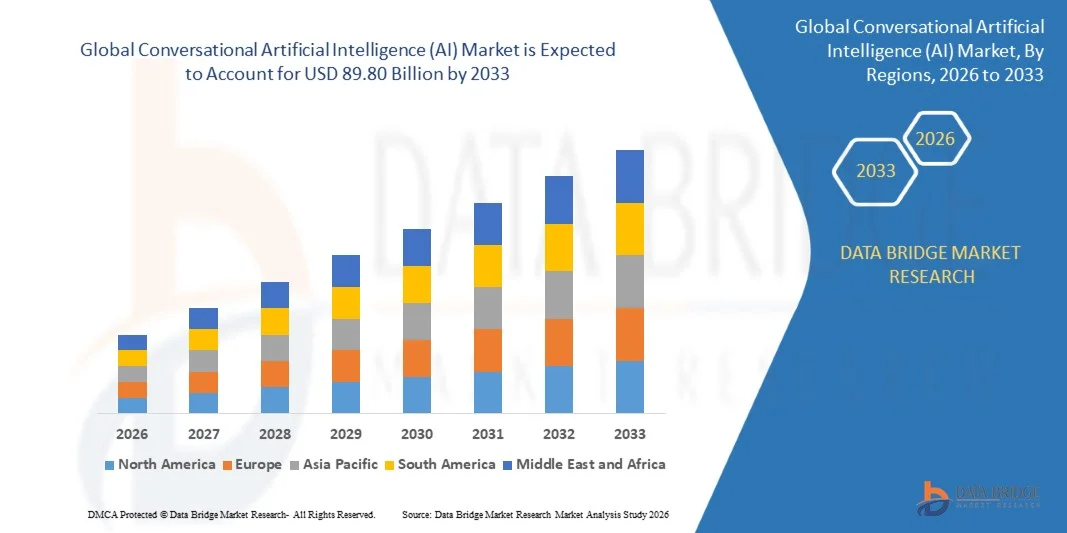
- The global conversational Artificial Intelligence (AI) market size was valued at USD 16.02 billion in 2025 and is expected to reach USD 89.80 billion by 2033, at a CAGR of 24.04% during the forecast period
- The market growth is largely fueled by the increasing adoption of AI-powered solutions across enterprises and customer-facing applications, leading to enhanced automation, improved operational efficiency, and personalized user experiences in sectors such as BFSI, healthcare, and e-commerce
- Furthermore, rising demand for intelligent virtual assistants and chatbots that can deliver real-time responses, handle customer queries efficiently, and integrate seamlessly with existing digital platforms is driving the deployment of conversational AI solutions. These converging factors are accelerating adoption across industries, thereby significantly boosting market growth
Conversational Artificial Intelligence (AI) Market Analysis
- Conversational AI solutions, including chatbots and intelligent virtual assistants, are increasingly vital for automating customer interactions, enhancing engagement, and providing personalized experiences across web, mobile, and telephonic platforms in both large enterprises and SMEs
- The escalating demand for conversational AI is primarily fueled by the growing need for efficient customer support, enhanced brand engagement, and cost-effective automation, in addition to advancements in machine learning, natural language processing, and speech recognition technologies
- North America dominated the conversational Artificial Intelligence (AI) market with a share of 26.56% in 2025, due to rapid digital transformation across industries and high adoption of AI-powered customer engagement solutions
- Asia-Pacific is expected to be the fastest growing region in the conversational Artificial Intelligence (AI) market during the forecast period due to rapid digitalization and mobile-first strategies across the region
- Platform segment dominated the market with a market share of 61.56% in 2025, due to its role as the foundational backbone for implementing AI-driven communication solutions. Its versatility and scalability enable businesses to build, customize, and deploy conversational applications for diverse uses such as customer support and virtual assistants
Report Scope and Conversational Artificial Intelligence (AI) Market Segmentation
|
Attributes |
Conversational Artificial Intelligence (AI) Key Market Insights |
|
Segments Covered |
|
|
Countries Covered |
North America
Europe
Asia-Pacific
Middle East and Africa
South America
|
|
Key Market Players |
|
|
Market Opportunities |
|
|
Value Added Data Infosets |
In addition to the market insights such as market value, growth rate, market segments, geographical coverage, market players, and market scenario, the market report curated by the Data Bridge Market Research team includes in-depth expert analysis, import/export analysis, pricing analysis, production consumption analysis, and pestle analysis. |
Conversational Artificial Intelligence (AI) Market Trends
“Rising Adoption of AI-Powered Customer Engagement Solutions”
- A significant trend in the conversational AI market is the increasing deployment of AI-powered solutions for customer engagement, driven by businesses seeking faster response times, improved customer satisfaction, and operational efficiency. These solutions are enhancing customer interactions across multiple touchpoints, including websites, messaging apps, and voice platforms
- For instance, companies such as LivePerson and Nuance Communications provide AI chatbots and virtual assistants that enable enterprises to deliver real-time support and personalized recommendations to users. This is improving engagement rates, reducing response delays, and streamlining customer service operations
- The integration of conversational AI with voice assistants and smart devices is expanding rapidly, enabling natural language processing capabilities that allow seamless human-like interactions. This trend is positioning AI-driven conversations as essential components of modern digital ecosystems
- Enterprises are leveraging conversational AI to optimize internal workflows and employee support systems, where applications such as virtual HR assistants and IT helpdesk bots provide instant guidance and automate routine tasks. This is accelerating adoption in large organizations seeking productivity gains
- The e-commerce sector is increasingly utilizing conversational AI to deliver personalized shopping experiences, where recommendation engines and AI assistants analyze user behavior to guide purchases. This is boosting conversion rates and fostering customer loyalty
- The market is witnessing strong innovation in multilingual and context-aware conversational AI systems that enhance user understanding across global markets. These advanced solutions are enabling businesses to expand reach, deliver consistent experiences, and strengthen brand presence worldwide
Conversational Artificial Intelligence (AI) Market Dynamics
Driver
“Growing Need for Automation and Personalized User Experiences”
- The rising demand for automation and customized interactions is driving the adoption of conversational AI solutions that can handle repetitive tasks, answer queries, and deliver personalized recommendations. These capabilities are reducing human workload while enhancing customer satisfaction
- For instance, IBM Watson Assistant enables businesses such as Autodesk to implement AI-driven support systems that provide contextually relevant responses and automate customer service workflows. This integration improves operational efficiency and ensures faster resolution of user issues
- The adoption of AI-driven analytics combined with conversational interfaces is helping organizations understand user preferences, enabling more targeted services. This trend is fueling the development of highly adaptive virtual agents capable of anticipating customer needs
- Enterprises across banking, healthcare, and telecom sectors are increasingly deploying AI assistants for 24/7 support, improving accessibility and responsiveness. These applications are driving higher engagement and more efficient service delivery
- The focus on omnichannel experiences is reinforcing the deployment of conversational AI across web, mobile, and voice platforms, ensuring consistent interactions. This alignment is contributing to sustained market growth and wider acceptance of AI-powered solutions
Restraint/Challenge
“Data Privacy and Security Concerns”
- The conversational AI market faces challenges due to increasing concerns over data privacy and security, as AI systems handle sensitive personal and organizational information. Breaches or misuse of conversational data can lead to reputational damage and regulatory penalties
- For instance, concerns around customer data usage in chatbots deployed by companies such as Facebook and Google have raised scrutiny from privacy watchdogs and regulatory bodies. These challenges necessitate robust encryption, compliance measures, and secure data handling practices
- Ensuring GDPR, CCPA, and other regional compliance adds complexity to system design and operational protocols, affecting deployment timelines. Organizations must balance advanced AI capabilities with strict adherence to privacy regulations
- The risk of adversarial attacks, unauthorized access, and AI model exploitation continues to constrain market growth. Vendors are investing in secure AI frameworks and continual monitoring to mitigate these risks
- Maintaining user trust while leveraging AI-driven personalization remains a critical challenge. Addressing these concerns is essential for widespread adoption and long-term sustainability of conversational AI solutions
Conversational Artificial Intelligence (AI) Market Scope
The market is segmented on the basis of component, type, technology, deployment model, application, organization size, business function, mode of integration, and end-user.
- By Component
On the basis of component, the Conversational AI market is segmented into Platform and Services. The Platform segment held the largest market revenue share of 61.56% in 2025, driven by its role as the foundational backbone for implementing AI-driven communication solutions. Its versatility and scalability enable businesses to build, customize, and deploy conversational applications for diverse uses such as customer support and virtual assistants.
The Services segment, which includes managed services, professional services, training & consulting, system integration & implementation, and support & maintenance, is expected to witness the fastest growth rate from 2026 to 2033. This growth is fueled by the increasing need for specialized expertise in deploying, managing, and optimizing complex conversational AI solutions, as businesses seek to maximize their investment and ensure seamless operation.
- By Type
On the basis of type, the conversational Artificial Intelligence (AI) market is segmented into Intelligent Virtual Assistants and Chatbots. The Chatbots segment held the largest market revenue share in 2025, driven by their widespread adoption across industries for enhancing customer engagement and streamlining operations. The continuous advancements in machine learning and natural language processing (NLP) have significantly improved chatbot capabilities, making them a popular choice for automating routine interactions and data gathering.
The Intelligent Virtual Assistants segment is anticipated to witness the fastest growth rate from 2026 to 2033. This growth is attributed to the increasing sophistication of IVAs, which offer more human-such as and personalized interactions, capable of handling complex queries and providing proactive assistance. The rising demand for smart speaker-based technologies and home automation also contributes to the rapid expansion of IVAs.
- By Technology
On the basis of technology, the conversational Artificial Intelligence (AI) market is segmented into Machine Learning and Deep Learning, Natural Language Processing (NLP), and Automated Speech Recognition (ASR). The Natural Language Processing (NLP) segment held the largest market revenue share in 2025, as it serves as the fundamental technology enabling AI systems to interpret, understand, and respond to human language effectively. NLP's crucial role in allowing machines to process vast amounts of natural language data underpins much of the conversational AI capabilities.
The Automatic Speech Recognition (ASR) segment is expected to witness the fastest growth rate from 2026 to 2033. This acceleration is driven by the increasing consumer preference for voice interactions and the continuous advancements in ASR technology, making voice-based conversational AI more accurate and accessible across various devices and applications.
- By Deployment Model
On the basis of deployment model, the conversational Artificial Intelligence (AI) market is segmented into On-Premises and Cloud. The Cloud deployment segment held the largest market revenue share in 2025, driven by the increasing importance of cloud-based technologies and services in businesses globally. Cloud platforms offer significant advantages such as scalability, flexibility, and reduced infrastructure management, making them highly attractive for deploying and managing conversational AI solutions.
The Cloud deployment segment is also expected to witness the fastest growth rate from 2026 to 2033. This rapid growth is fueled by the continuous improvements in cloud-based conversational AI platforms, including regular updates, advanced features, and seamless integration with other cloud services, offering a cost-effective and agile solution for businesses of all sizes.
- By Application
On the basis of application, the conversational Artificial Intelligence (AI) market is segmented into Customer Support, Personal Assistant, Branding and Advertisement, Customer Engagement and Retention, Onboarding and Employee Engagement, Data Privacy and Compliance, and Others. The Customer Support segment held the largest market revenue share in 2025, driven by the widespread need for businesses to efficiently and effectively manage customer interactions. Conversational AI significantly enhances customer support by providing 24/7 availability, reducing response times, and automating responses to frequently asked questions.
The Customer Engagement and Retention segment is expected to witness the fastest growth rate from 2026 to 2033. This is due to the growing emphasis on personalized customer experiences and the ability of conversational AI to foster deeper relationships through tailored interactions, proactive communication, and continuous support, thereby improving customer satisfaction and loyalty.
- By Organization Size
On the basis of organization size, the conversational Artificial Intelligence (AI) market is segmented into Large Enterprises and Small and Medium-Sized Enterprises (SMEs). The Large Enterprises segment held the largest market revenue share in 2025, primarily due to their substantial investment capabilities and complex operational needs that necessitate robust conversational AI solutions for customer service, internal communications, and process automation.
The Small and Medium-Sized Enterprises (SMEs) segment is anticipated to witness the fastest growth rate from 2026 to 2033. This growth is driven by the increasing accessibility and affordability of cloud-based conversational AI platforms, which enable SMEs to leverage advanced AI capabilities to enhance customer interactions, optimize operations, and compete more effectively with larger organizations.
- By Business Function
On the basis of business function, the conversational Artificial Intelligence (AI) market is segmented into Sales and Marketing, Finance, HR, Operations, and IT Service Management. The Sales and Marketing segment accounted for the largest market share in 2025. This is due to the increasing adoption of conversational AI for lead generation, customer relationship management, personalized marketing campaigns, and real-time customer engagement to drive sales and enhance brand perception.
The Human Resources (HR) segment is projected to experience the fastest growth rate from 2026 to 2033. This acceleration is driven by the growing adoption of conversational AI to streamline HR functions such as recruiting and talent acquisition, employee onboarding, handling routine queries, and providing self-service options, thereby improving efficiency and employee experience.
- By Mode of Integration
On the basis of mode of integration, the conversational Artificial Intelligence (AI) market is segmented into Web-based, App-based, and Telephonic. Web-based integration holds the dominant share due to the widespread use of chatbots on websites for immediate customer interaction driven by businesses’ focus on improving user engagement, reducing response times, and providing personalized support across digital touchpoints. For instance, companies such as Zendesk and Intercom offer web-based conversational AI solutions that enable enterprises to deploy intelligent chatbots for customer service, lead generation, and query resolution.
App-based integration is expected to see rapid growth due to the proliferation of mobile applications and the demand for seamless in-app conversational experiences. Telephonic integration, though more traditional, continues to evolve with advanced voice AI for call centers and IVR systems.
- By End User
On the basis of end user, the conversational Artificial Intelligence (AI) market is segmented into Banking, Financial Services, and Insurance (BFSI), Retail and Ecommerce, Healthcare and Life Sciences, Travel and Hospitality, Telecom, Media and Entertainment, and Others. The Retail and Ecommerce segment accounted for the largest market revenue share in 2025, driven by the sector's continuous innovation and the immense need to enhance customer engagement, personalize shopping experiences, and automate customer service across various touchpoints.
The Healthcare and Life Sciences segment is expected to witness the fastest growth rate from 2026 to 2033. This surge is attributed to the increasing adoption of conversational AI for patient engagement, appointment scheduling, providing health information, medical assistance, and streamlining administrative tasks, leading to improved patient care and operational efficiency.
Conversational Artificial Intelligence (AI) Market Regional Analysis
- North America dominated the conversational Artificial Intelligence (AI) market with the largest revenue share of 26.56% in 2025, driven by rapid digital transformation across industries and high adoption of AI-powered customer engagement solutions
- The region’s strong presence of leading technology companies and startups accelerates innovation and deployment of advanced conversational AI platforms
- Increasing integration of AI with voice assistants and smart devices in both consumer and enterprise sectors boosts market penetration
U.S. Conversational Artificial Intelligence (AI) Market Insight
The U.S. conversational Artificial Intelligence (AI) market captured the largest revenue share in 2025 within North America, driven by widespread deployment across sectors such as retail, healthcare, and banking. The country is witnessing an accelerated shift toward automation in customer interaction, with companies investing in AI-driven solutions for chatbots and virtual assistants. Businesses are focusing on enhancing customer engagement and operational efficiency by deploying natural language-enabled systems across online and offline platforms. The strong presence of key technology providers and robust IT infrastructure also support extensive AI integration. Moreover, growing demand for intelligent voice assistants in smartphones and smart home devices continues to boost the market.
Europe Conversational Artificial Intelligence (AI) Market Insight
The Europe conversational Artificial Intelligence (AI) market is projected to expand at a substantial CAGR throughout the forecast period, backed by the adoption of digital transformation strategies among enterprises. European companies are implementing conversational AI to improve customer experience, meet compliance standards, and manage multi-language communication needs. The rising integration of AI with enterprise platforms, CRM systems, and customer-facing interfaces is contributing to growth. Sectors such as banking, retail, and automotive are leveraging AI solutions for 24/7 support and personalized services. In addition, advancements in voice recognition and emotional AI capabilities are gaining traction in enhancing user interaction quality.
U.K. Conversational Artificial Intelligence (AI) Market Insight
The U.K. conversational Artificial Intelligence (AI) market is anticipated to grow at a noteworthy CAGR during the forecast period, supported by increasing AI adoption across digital banking, online retail, and public services. Organizations are investing in AI-based customer service tools to streamline communication and improve service delivery. The expansion of AI startup ecosystems and government support for AI innovation are accelerating market maturity. Businesses are using AI chatbots to automate frequently asked questions, handle booking services, and manage digital workflows. As customer expectations for instant, personalized communication increase, conversational AI is becoming a key differentiator across industries.
Germany Conversational Artificial Intelligence (AI) Market Insight
The Germany conversational Artificial Intelligence (AI) market is expected to expand at a considerable CAGR during the forecast period, led by industrial digitization and demand for real-time support in B2B and B2C environments. Companies are deploying AI-driven chat solutions in e-commerce, telecommunications, and logistics to improve responsiveness and efficiency. The focus on data privacy and secure AI implementations aligns with consumer expectations, further supporting growth. In addition, German enterprises are exploring hybrid conversational systems that integrate AI and human agents to provide a more holistic user experience. Innovations in voice-based AI tools and integration with ERP systems are also gaining momentum.
Asia-Pacific Conversational Artificial Intelligence (AI) Market Insight
The Asia-Pacific conversational Artificial Intelligence (AI) market is poised to grow at the fastest CAGR of 24% during the forecast period of 2026 to 2033, spurred by rapid digitalization and mobile-first strategies across the region. Businesses in countries such as India, China, and Japan are using conversational AI to manage large-scale customer interactions efficiently. With a tech-savvy population and increasing mobile app usage, chatbots and virtual agents are becoming standard tools in customer engagement. For instance, e-commerce platforms in the region are deploying AI assistants to manage order tracking, product queries, and payment assistance. This widespread use across industries is shaping market expansion.
Japan Conversational Artificial Intelligence (AI) Market Insight
The Japan conversational Artificial Intelligence (AI) market is gaining traction, supported by the nation’s focus on automation and digital convenience. Businesses are integrating conversational AI into customer service, smart devices, and public-facing systems to streamline operations and enhance user interaction. Japan’s advanced technology landscape and familiarity with robotics and artificial intelligence offer a fertile ground for AI-driven communication tools. Use cases include AI receptionists, virtual travel assistants, and AI in healthcare appointment systems. As companies continue to optimize customer journeys and labor-saving solutions, conversational AI adoption in Japan is set to rise significantly.
China Conversational Artificial Intelligence (AI) Market Insight
The China conversational Artificial Intelligence (AI) market accounted for the largest market revenue share in Asia Pacific in 2025, supported by high mobile penetration and aggressive digital service expansion. The country is at the forefront of adopting AI technologies for customer engagement, especially in e-commerce, fintech, and social platforms. Chinese tech giants are investing heavily in developing multilingual and voice-enabled conversational AI systems to serve a vast and diverse user base. AI assistants are being deployed for customer inquiries, product recommendations, and logistics tracking. Government initiatives supporting AI development and the availability of skilled talent further bolster the country’s leadership in this market.
Conversational Artificial Intelligence (AI) Market Share
The conversational Artificial Intelligence (AI) industry is primarily led by well-established companies, including:
- Google, LLC (U.S.)
- Microsoft (U.S.)
- IBM (U.S.)
- Amazon Web Services, Inc. (U.S.)
- Baidu (China)
- Oracle (U.S.)
- SAP SE (Germany)
- FIS (U.S.)
- Artificial Solutions (Sweden)
- Kore.ai, Inc. (U.S.)
- Conversica, Inc. (U.S.)
- Inbenta Holdings Inc. (U.S.)
- Creative Virtual Ltd. (U.S.)
- SoundHound AI, Inc. (U.S.)
- Avaamo (U.S.)
- Jio Haptik Technologies Limited (U.S.)
- Solvvy (U.S.)
- Cisco Systems, Inc. (U.S.)
- Kasisto (U.S.)
- Gupshup (U.S.)
Latest Developments in Global Conversational Artificial Intelligence (AI) Market
- In August 2023, Inbenta acquired Horizn, a Toronto-based software company specializing in interactive product demonstrations. This acquisition will integrate Horizn’s innovative technology into Inbenta’s AI-driven customer experience platform. By enhancing its offerings with Horizn’s capabilities, Inbenta aims to provide clients with engaging, immersive experiences that facilitate product understanding and customer satisfaction, thus reinforcing its commitment to transforming digital interactions in the marketplace
- In August 2023, Kore.ai Inc. introduced an integration of its Experience Optimization Platform with Zoom Contact Center, providing users with an intelligent virtual assistant powered by the Kore.ai XO platform. This integration enables Zoom's customers to leverage advanced conversational AI, enhancing customer service efficiency and responsiveness. By automating interactions, it allows businesses to streamline operations and improve user engagement, ultimately driving better customer experiences and satisfaction
- In March 2023, Nuance Communications launched the Dragon Ambient eXperience Express, the first product to blend conversational and ambient AI with OpenAI’s latest model, GPT-4. This innovative system automates clinical documentation within workflows, building on the success of the Dragon Medical product line. By enhancing the existing Dragon Ambient solution, Nuance aims to improve healthcare documentation processes, enabling healthcare providers to focus more on patient care
- In April 2021, Microsoft announced its acquisition of Nuance Communications for $19.7 billion in an all-cash deal, aiming to strengthen its voice recognition and transcription technology capabilities. Nuance, a leader in AI-based solutions, brings extensive expertise that will enhance Microsoft's offerings in healthcare and other sectors. This acquisition reflects Microsoft's commitment to advancing AI technologies and integrating them into its product ecosystem to better serve its customers
- In March 2021, Google Cloud announced the general availability of Vertex AI, a managed machine learning platform designed to streamline the development and maintenance of AI models. Vertex AI provides businesses with robust tools and infrastructure, enabling faster deployment of machine learning applications. By facilitating easier access to advanced AI capabilities, Google Cloud aims to empower organizations to leverage AI technologies more effectively and efficiently
SKU-
Get online access to the report on the World's First Market Intelligence Cloud

- Interactive Data Analysis Dashboard
- Company Analysis Dashboard for high growth potential opportunities
- Research Analyst Access for customization & queries
- Competitor Analysis with Interactive dashboard
- Latest News, Updates & Trend analysis
- Harness the Power of Benchmark Analysis for Comprehensive Competitor Tracking
Research Methodology
Data collection and base year analysis are done using data collection modules with large sample sizes. The stage includes obtaining market information or related data through various sources and strategies. It includes examining and planning all the data acquired from the past in advance. It likewise envelops the examination of information inconsistencies seen across different information sources. The market data is analysed and estimated using market statistical and coherent models. Also, market share analysis and key trend analysis are the major success factors in the market report. To know more, please request an analyst call or drop down your inquiry.
The key research methodology used by DBMR research team is data triangulation which involves data mining, analysis of the impact of data variables on the market and primary (industry expert) validation. Data models include Vendor Positioning Grid, Market Time Line Analysis, Market Overview and Guide, Company Positioning Grid, Patent Analysis, Pricing Analysis, Company Market Share Analysis, Standards of Measurement, Global versus Regional and Vendor Share Analysis. To know more about the research methodology, drop in an inquiry to speak to our industry experts.
Customization Available
Data Bridge Market Research is a leader in advanced formative research. We take pride in servicing our existing and new customers with data and analysis that match and suits their goal. The report can be customized to include price trend analysis of target brands understanding the market for additional countries (ask for the list of countries), clinical trial results data, literature review, refurbished market and product base analysis. Market analysis of target competitors can be analyzed from technology-based analysis to market portfolio strategies. We can add as many competitors that you require data about in the format and data style you are looking for. Our team of analysts can also provide you data in crude raw excel files pivot tables (Fact book) or can assist you in creating presentations from the data sets available in the report.












