




Global Cooling Fabrics Market
Market Size in USD Billion
CAGR :
% 
 USD
2.47 Billion
USD
5.27 Billion
2025
2033
USD
2.47 Billion
USD
5.27 Billion
2025
2033
 Forecast Period Forecast Period |
2026 –2033 |
 Market Size (Base Year) Market Size (Base Year) |
USD 2.47 Billion |
 Market Size (Forecast Year) Market Size (Forecast Year) |
USD 5.27 Billion |
 CAGR CAGR |
% |
| Major Markets Players |
|
Cooling Fabrics Market Size
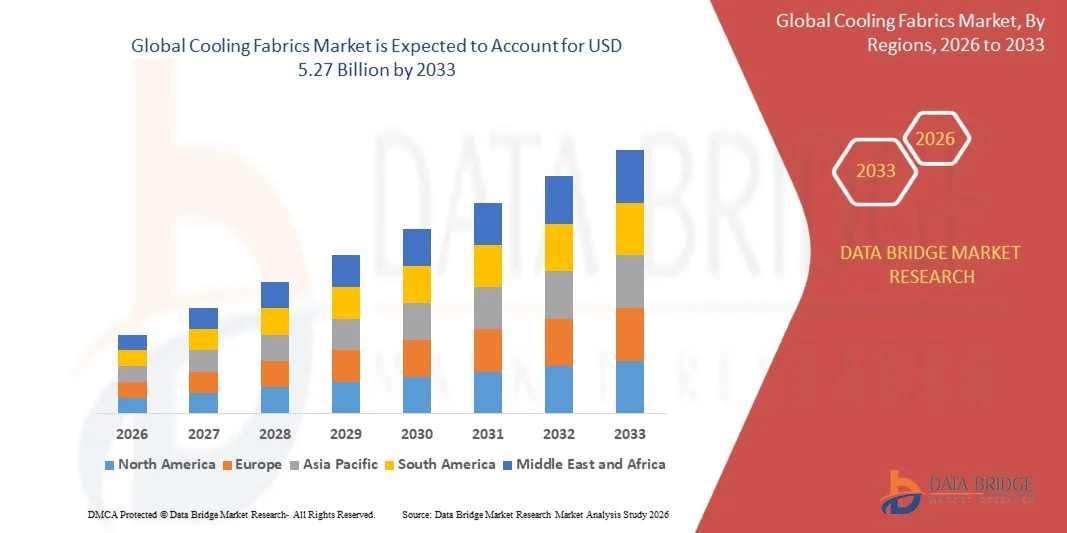
- The global cooling fabrics market size was valued at USD 2.47 billion in 2025 and is expected to reach USD 5.27 billion by 2033, at a CAGR of 9.95% during the forecast period
- The cooling fabrics market growth is largely fueled by rising global temperatures, increasing awareness of heat stress management, and growing demand for high-performance textiles across sportswear, outdoor apparel, and workwear applications
- Furthermore, rapid advancements in textile engineering such as phase change materials, moisture-wicking technologies, and breathable fiber innovations are enhancing product efficiency and driving wider adoption across both developed and emerging markets. These converging factors are accelerating the integration of cooling fabrics into mainstream apparel and technical textile applications, thereby significantly boosting industry growth
Cooling Fabrics Market Analysis
- Cooling fabrics, designed to regulate body temperature through heat dissipation, moisture control, and enhanced breathability, are becoming essential components of modern functional apparel used in sports, military, healthcare, and lifestyle segments due to their comfort-enhancing and performance-driven properties
- The rising demand for cooling fabrics is primarily driven by increasing consumer preference for comfort-focused clothing, expanding outdoor and fitness activities, and growing adoption of smart and functional textiles that improve thermal regulation in diverse climatic conditions
- North America dominated the cooling fabrics market with a share of3% in 2025, due to rising demand for thermal comfort textiles across sportswear, outdoor apparel, and military uniforms
- Asia-Pacific is expected to be the fastest growing region in the cooling fabrics market during the forecast period due to rapid urbanization, rising temperatures, and increasing disposable incomes across developing economies
- Synthetic cooling fabrics segment dominated the market with a market share of 69.7% in 2025, due to its superior durability, moisture-wicking properties, and cost efficiency in large-scale production. Materials such as polyester and nylon blends are widely used across sportswear and lifestyle apparel due to their consistent cooling performance and adaptability
Report Scope and Cooling Fabrics Market Segmentation
|
Attributes |
Cooling Fabrics Key Market Insights |
|
Segments Covered |
|
|
Countries Covered |
North America · U.S. · Canada · Mexico Europe · Germany · France · U.K. · Netherlands · Switzerland · Belgium · Russia · Italy · Spain · Turkey · Rest of Europe Asia-Pacific · China · Japan · India · South Korea · Singapore · Malaysia · Australia · Thailand · Indonesia · Philippines · Rest of Asia-Pacific Middle East and Africa · Saudi Arabia · U.A.E. · South Africa · Egypt · Israel · Rest of Middle East and Africa South America · Brazil · Argentina · Rest of South America |
|
Key Market Players |
· Coolcore (U.S.) · Ahlstrom-Munksjö (Finland) · Polartec (U.S.) · Asahi Kasei Advance Corporation (Japan) · HexArmor (U.S.) · Balavigna Mills Pvt. Ltd. (India) · LIBOLON (Taiwan) · NILIT (Israel) · Nan Ya Plastics Corporation (Taiwan) · Tex-Ray Industrial Co. Ltd. (Taiwan) · Technical Absorbents Limited (U.K.) · Eastman Chemical Company (U.S.) · Tongkun Group Co. Ltd. (China) · Kolon Industries Inc. (South Korea) · Kuraray Co. Ltd. (Japan) · BASF SE (Germany) · Akra Polyester (Turkey) · Radici Partecipazioni SpA (Italy) · Singtex (Taiwan) |
|
Market Opportunities |
· Expansion in Sportswear and Athleisure Segment · Rising Use in Medical and Protective Clothing Applications |
|
Value Added Data Infosets |
In addition to the insights on market scenarios such as market value, growth rate, segmentation, geographical coverage, and major players, the market reports curated by the Data Bridge Market Research also include import export analysis, production capacity overview, production consumption analysis, price trend analysis, climate change scenario, supply chain analysis, value chain analysis, raw material/consumables overview, vendor selection criteria, PESTLE Analysis, Porter Analysis, and regulatory framework. |
Cooling Fabrics Market Trends
“Rising Adoption of Advanced Thermal Regulation and Moisture Control Textiles”
- A significant trend in the cooling fabrics market is the increasing integration of advanced thermal regulation and moisture control technologies into performance textiles, driven by rising demand for comfort-focused apparel across sportswear, outdoor clothing, and industrial workwear. This trend is enhancing the role of cooling fabrics as essential functional materials in high-temperature and high-activity environments
- For instance, Polartec develops advanced performance textiles with moisture-wicking and temperature regulation properties widely used in outdoor and athletic apparel by brands such as The North Face. Such innovations improve wearer comfort by managing sweat and heat buildup during intense physical activity
- The adoption of phase change materials and bio-based cooling fibers is expanding as manufacturers focus on improving heat absorption and dissipation efficiency. Companies such as Outlast Technologies provide thermal regulation solutions used in apparel and bedding applications, supporting stable body temperature control
- Sportswear and athleisure brands are increasingly incorporating cooling fabrics to enhance endurance and comfort for athletes and fitness users. Nike integrates advanced cooling and sweat-management fabrics in its Dri-FIT apparel line to improve performance during high-intensity activities
- The healthcare and protective clothing sectors are also adopting cooling textiles to improve comfort for professionals working in high-stress environments. Medical textile solutions from companies such as Cardinal Health support temperature management in hospital garments and protective wear
- The market is witnessing growing use of lightweight and breathable fabrics designed to enhance airflow and reduce heat stress in extreme weather conditions. This growing integration is reinforcing cooling fabrics as a core component of next-generation functional and smart textiles across multiple end-use industries
Cooling Fabrics Market Dynamics
Driver
“Growing Demand for Comfortable and High-Performance Apparel”
- The cooling fabrics market is primarily driven by increasing global demand for comfortable, lightweight, and high-performance apparel that enhances thermal regulation during physical activity and extreme weather conditions. This demand is accelerating the adoption of functional textiles across sportswear, outdoor gear, and everyday clothing applications
- For instance, Under Armour incorporates HeatGear technology in its apparel range to deliver cooling and sweat-wicking performance for athletes. Such innovations help improve endurance and comfort during prolonged physical exertion
- The rising popularity of fitness activities, gym culture, and outdoor sports is significantly boosting the need for apparel that maintains body temperature balance. Adidas integrates Climachill and HEAT.RDY technologies in its sportswear to enhance cooling efficiency during training and competition
- Growing consumer preference for multifunctional clothing that combines style, comfort, and performance is further strengthening market demand. Brands such as Lululemon are expanding their technical apparel offerings with fabrics designed for breathability and moisture control
- The continuous evolution of textile engineering and innovation in smart fabrics is reinforcing the shift toward performance-oriented apparel. This sustained demand for comfort-driven clothing is positioning cooling fabrics as a key segment within the global functional textiles industry
Restraint/Challenge
“High Manufacturing Cost and Complex Fabric Technology”
- The cooling fabrics market faces significant challenges due to high production costs and complex manufacturing processes involved in developing advanced thermal regulation textiles. The integration of specialized fibers, coatings, and functional treatments increases production difficulty and overall cost structures
- For instance, Schoeller Textil AG develops advanced performance fabrics with cooling and moisture management technologies that require precise chemical and mechanical processing. These sophisticated production methods increase operational costs and limit large-scale affordability
- The use of high-performance materials such as phase change materials, nanofibers, and specialty polymers further elevates raw material expenses. Companies such as Outlast Technologies rely on advanced PCM-based systems that require controlled integration into textile structures
- Manufacturing cooling fabrics requires advanced machinery, controlled environments, and skilled technical expertise to ensure consistent performance and durability. This increases capital investment requirements for textile manufacturers across the value chain
- The combination of technological complexity and cost-intensive production limits widespread adoption in price-sensitive markets. These factors collectively act as a restraint, requiring continuous innovation to balance performance efficiency with cost-effectiveness in the cooling fabrics industry
Cooling Fabrics Market Scope
The market is segmented on the basis of technology, type, textile type, and application.
- By Technology
On the basis of technology, the cooling fabrics market is segmented into active cooling fabrics and passive cooling fabrics. The passive cooling fabrics segment dominated the market with the largest revenue share in 2025 due to its wide adoption in everyday apparel and sportswear applications. These fabrics rely on moisture management, heat dissipation, and advanced fiber structures to provide cooling comfort without external energy input. Their cost effectiveness, ease of integration into existing textile manufacturing, and broad availability across consumer segments further strengthen their leading position. Strong demand from fitness wear and casual clothing continues to support sustained market dominance.
The active cooling fabrics segment is anticipated to witness the fastest growth rate from 2026 to 2033, driven by rising innovation in wearable cooling systems and smart textile integration. These fabrics utilize external mechanisms such as phase change materials or electronic cooling elements to regulate body temperature more precisely. Increasing demand in high-performance sports, military gear, and occupational safety wear is accelerating adoption. Continuous advancements in smart textiles and growing investment in performance-driven apparel are further enhancing growth momentum in this segment.
- By Type
On the basis of type, the cooling fabrics market is segmented into synthetic cooling fabrics and natural cooling fabrics. The synthetic cooling fabrics segment held the dominant market share of 69.7% in 2025 due to its superior durability, moisture-wicking properties, and cost efficiency in large-scale production. Materials such as polyester and nylon blends are widely used across sportswear and lifestyle apparel due to their consistent cooling performance and adaptability. Strong manufacturing scalability and compatibility with advanced textile treatments further reinforce their leading position. High consumer preference for performance-oriented clothing continues to sustain segment dominance.
The natural cooling fabrics segment is expected to register the fastest growth rate from 2026 to 2033, supported by increasing demand for eco-friendly and sustainable textile solutions. These fabrics, derived from cotton, bamboo, and other plant-based fibers, offer improved breathability and skin comfort. Rising environmental awareness and shift toward biodegradable materials are encouraging manufacturers to expand natural fabric offerings. Continuous innovation in blending natural fibers with cooling technologies is further driving adoption across premium apparel categories.
- By Textile Type
On the basis of textile type, the cooling fabrics market is segmented into woven, nonwoven, and knitted fabrics. The knitted segment dominated the market in 2025 owing to its high flexibility, stretchability, and superior comfort characteristics. Knitted structures allow better airflow and moisture management, making them highly suitable for sportswear and activewear applications. Strong adoption in fitness apparel and athleisure segments supports sustained demand. Manufacturers also prefer knitted fabrics due to ease of integration with performance-enhancing yarn technologies.
The nonwoven segment is projected to witness the fastest growth rate from 2026 to 2033, driven by increasing usage in protective clothing and industrial cooling applications. Nonwoven fabrics offer lightweight construction, customizable thickness, and efficient thermal regulation capabilities. Growing demand for advanced protective wearing in healthcare, military, and industrial environments is accelerating adoption. Continuous innovation in nonwoven fabrication techniques is further expanding their application scope in high-performance cooling textiles.
- By Application
On the basis of application, the cooling fabrics market is segmented into sports apparel, lifestyle, protective wearing, and others. The sports apparel segment dominated the market in 2025 due to high global participation in fitness activities and increasing demand for performance-enhancing clothing. Cooling fabrics in sportswear help regulate body temperature, improve endurance, and enhance overall athletic comfort. Strong brand investments in activewear innovation and rising consumer health awareness further support segment leadership. Expanding athleisure trends continue to reinforce sustained demand across global markets.
The protective wearing segment is anticipated to witness the fastest growth rate from 2026 to 2033, driven by rising need for thermal comfort in industrial and hazardous working environments. Cooling fabrics integrated into protective gear help reduce heat stress and improve worker safety during prolonged exposure to high temperatures. Increasing adoption in defense, construction, and emergency services is accelerating growth. Continuous development of advanced protective textiles with integrated cooling properties is further strengthening market expansion in this segment.
Cooling Fabrics Market Regional Analysis
- North America dominated the cooling fabrics market with the largest revenue share of 34.3% in 2025, driven by rising demand for thermal comfort textiles across sportswear, outdoor apparel, and military uniforms
- Consumers in the region increasingly prioritize heat regulation performance, moisture management, and lightweight breathable fabrics, supporting strong adoption across both performance and lifestyle clothing
- This growth is further supported by high disposable incomes, strong penetration of performance apparel brands, and increasing awareness of heat stress management in extreme weather conditions, strengthening the use of cooling fabrics across residential, commercial, and defense applications
U.S. Cooling Fabrics Market Insight
The U.S. cooling fabrics market captured the largest revenue share within North America in 2025, driven by rapid expansion of athleisure wear and increasing participation in outdoor sports and fitness activities. Consumers are increasingly shifting toward functional textiles that regulate body temperature during physical activity and prolonged outdoor exposure. The growing integration of cooling fabrics in sportswear, workwear, and bedding solutions further supports market expansion. Strong innovation in textile engineering and demand from military and healthcare sectors also continue to accelerate adoption across the country.
Europe Cooling Fabrics Market Insight
The Europe cooling fabrics market is projected to expand at a substantial CAGR during the forecast period, driven by strict sustainability regulations and rising demand for eco-friendly textile innovations. For instance Adidas has been investing in performance textiles that combine cooling functionality with recycled fiber materials, supporting sustainable product development. Consumers in the region increasingly prefer breathable and thermoregulating fabrics in apparel, home textiles, and automotive interiors. Growing focus on climate adaptation clothing and premium fashion integration is further strengthening market growth across both Western and Northern Europe.
U.K. Cooling Fabrics Market Insight
The U.K. cooling fabrics market is anticipated to grow at a notable CAGR during the forecast period, driven by increasing consumer focus on comfort-based clothing and rising awareness of heat-related discomfort during warmer seasons. Demand is expanding across sportswear, school uniforms, and workplace apparel where thermal regulation is becoming a key requirement. The strong retail and e-commerce network in the country is improving accessibility to advanced textile products. Growing adoption of functional fashion and performance-based clothing is further supporting market penetration across urban consumers.
Germany Cooling Fabrics Market Insight
The Germany cooling fabrics market is expected to expand at a considerable CAGR during the forecast period, driven by strong industrial textile innovation and increasing demand for high-performance functional materials. For instance BASF has been involved in advanced material solutions supporting moisture management and thermal regulation in technical textiles. Germany’s focus on sustainability and engineering precision supports adoption in automotive interiors, sports apparel, and medical textiles. Growing preference for eco-conscious, durable, and technologically enhanced fabrics is reinforcing long-term market expansion.
Asia-Pacific Cooling Fabrics Market Insight
The Asia-Pacific cooling fabrics market is poised to grow at the fastest CAGR during the forecast period, driven by rapid urbanization, rising temperatures, and increasing disposable incomes across developing economies. Growing awareness of heat stress management in densely populated regions is significantly boosting demand for breathable and lightweight textiles. The region’s strong manufacturing base for textile production is improving affordability and availability of cooling fabric solutions. Expanding sportswear consumption and government support for textile innovation are further strengthening regional growth.
Japan Cooling Fabrics Market Insight
The Japan cooling fabrics market is gaining momentum due to advanced textile technology adoption and strong consumer preference for comfort-oriented apparel solutions. The aging population is increasing demand for temperature-regulating clothing that enhances comfort in daily wear and healthcare applications. Integration of smart textiles with moisture control and breathable fibers is becoming more common across premium apparel segments. Strong focus on innovation and precision textile engineering continues to support steady market expansion.
China Cooling Fabrics Market Insight
The China cooling fabrics market accounted for the largest revenue share in Asia-Pacific in 2025, driven by large-scale textile manufacturing capacity and strong domestic consumption of functional apparel. Rapid urbanization and rising middle-class spending are increasing demand for sportswear, outdoor clothing, and summer comfort textiles. For instance Li Ning has been incorporating performance cooling materials into its athletic apparel lines, supporting market visibility and adoption. Strong government support for textile modernization and smart fabric development is further accelerating market growth across the country.
Cooling Fabrics Market Share
The cooling fabrics industry is primarily led by well-established companies, including:
- Coolcore (U.S.)
- Ahlstrom-Munksjö (Finland)
- Polartec (U.S.)
- Asahi Kasei Advance Corporation (Japan)
- HexArmor (U.S.)
- Balavigna Mills Pvt. Ltd. (India)
- LIBOLON (Taiwan)
- NILIT (Israel)
- Nan Ya Plastics Corporation (Taiwan)
- Tex-Ray Industrial Co. Ltd. (Taiwan)
- Technical Absorbents Limited (U.K.)
- Eastman Chemical Company (U.S.)
- Tongkun Group Co. Ltd. (China)
- Kolon Industries Inc. (South Korea)
- Kuraray Co. Ltd. (Japan)
- BASF SE (Germany)
- Akra Polyester (Turkey)
- Radici Partecipazioni SpA (Italy)
- Singtex (Taiwan)
Latest Developments in Global Cooling Fabrics Market
- In February 2025, Noble Biomaterials and Coolcore collaborated to launch COOLPRO fabric, integrating Ionic+ Pro yarn technology with biomimetic fiber geometry to deliver enhanced cooling performance along with long-lasting antimicrobial protection. This innovation is strengthening the cooling fabrics market by increasing demand for multifunctional textiles that combine temperature regulation and hygiene benefits, particularly across sportswear, healthcare garments, and performance apparel segments where comfort and safety are critical
- In January 2024, HeiQ Materials AG expanded its smart textile portfolio with advanced cooling fabric solutions designed to improve thermoregulation across varying environmental conditions. This development is supporting market growth by accelerating adoption of sustainable and performance-driven cooling textiles in activewear and lifestyle clothing, driven by rising consumer demand for comfort, durability, and eco-friendly fabric technologies
- In June 2023, at ITMA Milano 2023, HeiQ Materials AG introduced its biobased innovations, prominently featuring HeiQ Cool, a dual-action cooling fabric designed to enhance wearer comfort by improving heat dissipation and moisture management. This launch is positively impacting the cooling fabrics market by encouraging broader adoption of bio-based and functional textile solutions in sportswear and everyday apparel applications
- In January 2023, NILIT introduced an upgraded version of its SENSIL EcoCare recycled Nylon 6.6, produced entirely from U.S. materials at its Martinsville facility and compliant with Berry Amendment, USMCA, and CAFTA standards. This advancement is supporting the cooling fabrics market by increasing the use of sustainable and locally sourced fibers across activewear, medical textiles, and defense applications while reducing environmental impact through recycled material usage
- In March 2024, Adidas expanded its HEAT.RDY performance apparel technology with improved ventilation structures and moisture-wicking engineering to enhance cooling efficiency during high-intensity physical activity. This development is strengthening the cooling fabrics market by boosting demand for advanced sportswear textiles that improve thermal comfort, particularly among athletes and fitness consumers seeking high-performance and breathable clothing solutions
SKU-
Get online access to the report on the World's First Market Intelligence Cloud

- Interactive Data Analysis Dashboard
- Company Analysis Dashboard for high growth potential opportunities
- Research Analyst Access for customization & queries
- Competitor Analysis with Interactive dashboard
- Latest News, Updates & Trend analysis
- Harness the Power of Benchmark Analysis for Comprehensive Competitor Tracking
Global Cooling Fabrics Market, Supply Chain Analysis and Ecosystem Framework
To support market growth and help clients navigate the impact of geopolitical shifts, DBMR has integrated in-depth supply chain analysis into its Global Cooling Fabrics Market research reports. This addition empowers clients to respond effectively to global changes affecting their industries. The supply chain analysis section includes detailed insights such as Global Cooling Fabrics Market consumption and production by country, price trend analysis, the impact of tariffs and geopolitical developments, and import and export trends by country and HSN code. It also highlights major suppliers with data on production capacity and company profiles, as well as key importers and exporters. In addition to research, DBMR offers specialized supply chain consulting services backed by over a decade of experience, providing solutions like supplier discovery, supplier risk assessment, price trend analysis, impact evaluation of inflation and trade route changes, and comprehensive market trend analysis.
Research Methodology
Data collection and base year analysis are done using data collection modules with large sample sizes. The stage includes obtaining market information or related data through various sources and strategies. It includes examining and planning all the data acquired from the past in advance. It likewise envelops the examination of information inconsistencies seen across different information sources. The market data is analysed and estimated using market statistical and coherent models. Also, market share analysis and key trend analysis are the major success factors in the market report. To know more, please request an analyst call or drop down your inquiry.
The key research methodology used by DBMR research team is data triangulation which involves data mining, analysis of the impact of data variables on the market and primary (industry expert) validation. Data models include Vendor Positioning Grid, Market Time Line Analysis, Market Overview and Guide, Company Positioning Grid, Patent Analysis, Pricing Analysis, Company Market Share Analysis, Standards of Measurement, Global versus Regional and Vendor Share Analysis. To know more about the research methodology, drop in an inquiry to speak to our industry experts.
Customization Available
Data Bridge Market Research is a leader in advanced formative research. We take pride in servicing our existing and new customers with data and analysis that match and suits their goal. The report can be customized to include price trend analysis of target brands understanding the market for additional countries (ask for the list of countries), clinical trial results data, literature review, refurbished market and product base analysis. Market analysis of target competitors can be analyzed from technology-based analysis to market portfolio strategies. We can add as many competitors that you require data about in the format and data style you are looking for. Our team of analysts can also provide you data in crude raw excel files pivot tables (Fact book) or can assist you in creating presentations from the data sets available in the report.












