Global Coronary Artery Disease Market
Market Size in USD Billion

 USD
24.97 Billion
USD
49.25 Billion
2024
2032
USD
24.97 Billion
USD
49.25 Billion
2024
2032
 Forecast Period Forecast Period |
2025 - 2032 |
 Market Size (Base Year) Market Size (Base Year) |
USD 24.97 Billion |
 Market Size (Forecast Year) Market Size (Forecast Year) |
USD 49.25 Billion |
 CAGR CAGR |
% |
| Major Markets Players |
|
Coronary Artery Disease Market Size
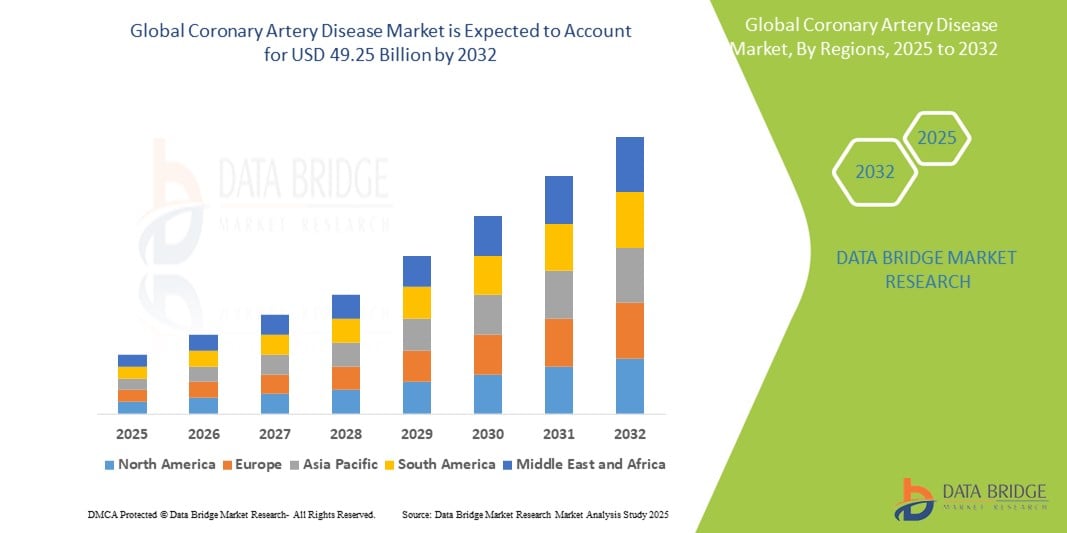
- The global coronary artery disease market was valued at USD 24.97 million in 2024 and is expected to reach USD 49.25 billion by 2032
- During the forecast period of 2025 to 2032 the market is likely to grow at a CAGR of 8.86% primarily driven by the increasing prevalence of coronary artery disease (CAD), rising aging population, advancements in medical technology, and growing awareness about heart health
- This growth is driven by factors such as the development of innovative treatments, improved diagnostic techniques, rising healthcare expenditure, increasing adoption of minimally invasive procedures, and the expansion of healthcare infrastructure globally
Coronary Artery Disease Market Analysis
- The coronary artery disease market has been growing steadily as heart-related conditions remain a leading cause of death worldwide, with over 18 million deaths annually due to cardiovascular diseases, according to the World Health Organization
- There is a growing preference for minimally invasive procedures such as angioplasty and stenting, with companies such as Boston Scientific and Medtronic offering advanced stent systems that are reducing recovery times significantly for patients
- Advanced diagnostic tools such as coronary CT angiography and stress tests are being increasingly adopted, with hospitals such as the Cleveland Clinic using advanced imaging technology for precise heart disease diagnostics
- The trend towards personalized medicine is reshaping the market, with treatments being tailored to individual genetic profiles
- For instance, the use of genetic testing to personalize statin therapy in patients with coronary artery disease has become more common
- Technological advancements, such as robotic-assisted surgeries and artificial intelligence in diagnostics, are enhancing treatment precision, with systems such as the Da Vinci Surgical System being used for coronary artery bypass grafting in major medical centers such as Johns Hopkins Hospital
Report Scope and Coronary Artery Disease Market Segmentation
|
Attributes |
Coronary Artery Disease Key Market Insights |
|
Segments Covered |
|
|
Countries Covered |
North America
Europe
Asia-Pacific
Middle East and Africa
South America
|
|
Key Market Players |
|
|
Market Opportunities |
|
|
Value Added Data Infosets |
In addition to the insights on market scenarios such as market value, growth rate, segmentation, geographical coverage, and major players, the market reports curated by the Data Bridge Market Research also include depth expert analysis, patient epidemiology, pipeline analysis, pricing analysis, and regulatory framework. |
Coronary Artery Disease Market Trends
“Increasing Preference for Minimally Invasive Procedures”
- Minimally invasive procedures such as angioplasty and stent placement are increasingly preferred over traditional coronary artery bypass surgeries, offering quicker recovery and fewer complications. Hospitals such as the Cleveland Clinic have adopted these methods for their patient-friendly outcomes, with angioplasty being one of the most common procedures performed globally
- Procedures such as angioplasty are now done through small punctures, reducing the need for large incisions and lengthy hospital stays
- For instance, patients undergoing angioplasty at the Mayo Clinic are often discharged within 24 hours, significantly reducing recovery times compared to traditional surgery, which may require a hospital stay of several days
- The development of drug-eluting stents, which release medication to prevent artery re-narrowing, has enhanced the effectiveness of minimally invasive procedures. According to a study by the National Institutes of Health, these stents have significantly lowered the risk of restenosis, improving long-term patient outcomes
- Minimally invasive procedures come with a lower risk of infections and other complications. A study published in the Journal of the American College of Cardiology highlighted that patient who underwent percutaneous coronary interventions experienced fewer complications than those who had traditional open-heart surgery
- Minimally invasive approaches lead to less pain and a faster return to normal activities, contributing to an improved patient experience
- For instance, patients at Johns Hopkins Hospital who undergo angioplasty and stenting often return to work within a few days, enhancing overall quality of life after the procedure
Coronary Artery Disease Market Dynamics
Driver
“Increasing Prevalence of Heart Disease Globally”
- The increasing prevalence of heart disease globally drives the coronary artery disease market, with cardiovascular diseases causing nearly 18 million deaths annually
- For instance, the Cleveland Clinic performs thousands of coronary interventions annually, meeting the growing demand due to rising heart disease cases
- Coronary artery disease is prevalent in developed nations due to lifestyle factors. In the U.S., nearly 18 million adults have coronary artery disease, as reported by the Centers for Disease Control and Prevention, pushing for more treatments and interventions, particularly in hospitals such as the Mayo Clinic
- Awareness about heart health is rising, prompting more people to seek medical attention. Campaigns such as the American Heart Association’s "Go Red for Women" have led to increased screenings, with hospitals such as Johns Hopkins reporting higher consultations for heart disease screenings
- Advancements in diagnostic tools, such as coronary CT angiography, improve early detection and treatment. The Mayo Clinic uses these tools to detect heart disease earlier, allowing for more precise and effective treatment of coronary artery disease
- Healthcare facilities such as the Cleveland Clinic and Mayo Clinic are adopting minimally invasive procedures such as angioplasty and stent placements, with these methods proving highly successful in reducing recovery times and complications, providing patients with faster and safer treatment options
Opportunity
“Advancement of Personalized Medicine”
- A significant opportunity in the coronary artery disease market is the rise of personalized medicine, allowing treatments to be tailored based on an individual’s genetic makeup, lifestyle, and disease progression
- Personalized medicine enables more targeted therapies, improving treatment outcomes and minimizing side effects
- For instance, certain patients may respond better to specific cholesterol-lowering medications based on their genetic profiles, enhancing the effectiveness of treatment
- Companies are investing in genetic testing and advanced diagnostics to create customized treatment plans
- For instance, testing platforms such as those used by LabCorp help identify genetic markers, offering better treatment pathways for coronary artery disease patients
- With personalized medicine, there’s an opportunity to detect coronary artery disease earlier
- For instance, genetic screening could allow doctors to identify at-risk patients before symptoms develop, enabling early, proactive interventions
- As healthcare systems increasingly adopt personalized medicine, the demand for genetic testing kits, personalized drugs, and lifestyle management apps will rise. This trend is driving innovation and market expansion, providing significant growth opportunities for pharmaceutical companies and medical device manufacturers
Restraint/Challenge
“High Cost of Treatments and Procedures”
- One of the major challenges facing the coronary artery disease market is the high cost of treatments and procedures, which can limit access, especially in low-income region
- For instance, drug-eluting stents used in angioplasty are significantly more expensive than bare-metal stents, limiting their availability in resource-constrained settings such as rural areas in India and sub-Saharan Africa
- The cost of surgery and post-operative care, including hospital stays and rehabilitation, adds a substantial financial burden on patients. In countries such as the U.S., the cost of coronary artery bypass surgery can exceed USD 100,000, making it less accessible for many patients without adequate insurance coverage
- The high cost of advanced diagnostic tools and treatments can deter patients from seeking timely medical intervention
- For instance, patients in developing countries may avoid early detection through advanced imaging such as coronary CT angiography due to the prohibitive cost, leading to delayed diagnoses and worsened health outcomes
- Healthcare systems in many developing nations struggle to implement cutting-edge diagnostic tools and treatments due to financial constraints. Hospitals in countries such as Brazil and South Africa may lack the necessary infrastructure to provide advanced coronary artery disease therapies, slowing the adoption of more effective treatments
- Rising overall healthcare expenditures put additional pressure on government budgets and insurance systems to balance the cost of care. In countries such as the UK and Canada, public healthcare systems are increasingly facing budget cuts, which can limit patient access to newer and more costly coronary artery disease treatments
Coronary Artery Disease Market Scope
The market is segmented on the basis of diagnosis, treatment, end users, and distribution channel
|
Segmentation |
Sub-Segmentation |
|
By Diagnosis |
|
|
By Treatment |
|
|
By End Users |
|
|
By Distribution Channel |
|
Coronary Artery Disease Market Regional Analysis
“North America is the Dominant Region in the Coronary Artery Disease Market”
- North America dominates the coronary artery disease market due to the high prevalence of heart disease in the region, making it a key area for treatment and intervention
- The region boasts advanced healthcare infrastructure, providing widespread access to state-of-the-art medical technologies and treatment options
- Substantial healthcare funding supports the early adoption of cutting-edge treatments, enabling healthcare providers to offer the best care to patients
- A strong focus on research and development in North America fosters innovation in novel therapeutic and diagnostic tools, helping to improve patient outcomes
- North America's leadership in medical research and the development of new coronary artery disease treatments solidifies its position as the dominant market in the sector
“Asia-Pacific is Projected to Register the Highest Growth Rate”
- The Asia Pacific region is the fastest-growing market for coronary artery disease due to rapid urbanization and an aging population
- Lifestyle changes in countries such as China and India are leading to a rise in heart disease cases, driving increased demand for coronary treatments and interventions
- The adoption of advanced medical devices, including coronary stents and diagnostic tools, is growing rapidly across the region
- Emerging economies in Asia Pacific are investing heavily in healthcare infrastructure, further enhancing access to treatments and care for coronary artery disease
- With continued economic growth and healthcare advancements, the Asia Pacific market is expected to expand significantly, providing substantial growth opportunities in the future
Coronary Artery Disease Market Share
The market competitive landscape provides details by competitor. Details included are company overview, company financials, revenue generated, market potential, investment in research and development, new market initiatives, global presence, production sites and facilities, production capacities, company strengths and weaknesses, product launch, product width and breadth, application dominance. The above data points provided are only related to the companies' focus related to market.
The Major Market Leaders Operating in the Market Are:
- Pfizer Inc. (U.S.)
- Amgen Inc. (U.S.)
- Cytokinetics (U.S.)
- Hikma Pharmaceutical PLC (U.K.)
- AbbVie Inc. (U.S.)
- Lupin (India)
- Wockhardt (India)
- GLENMARK PHARMACEUTICAL LTD. (India)
- Zydus Pharmaceutical Inc. (U.S.)
- Amneal Pharmaceuticals LLC (U.S.)
- Accord Healthcare (U.S.)
- Aurobindo Pharma (India)
- LG Chem. (South Korea)
SKU-

- Interactive Data Analysis Dashboard
- Company Analysis Dashboard for high growth potential opportunities
- Research Analyst Access for customization & queries
- Competitor Analysis with Interactive dashboard
- Latest News, Updates & Trend analysis
- Harness the Power of Benchmark Analysis for Comprehensive Competitor Tracking
Data collection and base year analysis are done using data collection modules with large sample sizes. The stage includes obtaining market information or related data through various sources and strategies. It includes examining and planning all the data acquired from the past in advance. It likewise envelops the examination of information inconsistencies seen across different information sources. The market data is analysed and estimated using market statistical and coherent models. Also, market share analysis and key trend analysis are the major success factors in the market report. To know more, please request an analyst call or drop down your inquiry.
The key research methodology used by DBMR research team is data triangulation which involves data mining, analysis of the impact of data variables on the market and primary (industry expert) validation. Data models include Vendor Positioning Grid, Market Time Line Analysis, Market Overview and Guide, Company Positioning Grid, Patent Analysis, Pricing Analysis, Company Market Share Analysis, Standards of Measurement, Global versus Regional and Vendor Share Analysis. To know more about the research methodology, drop in an inquiry to speak to our industry experts.
Data Bridge Market Research is a leader in advanced formative research. We take pride in servicing our existing and new customers with data and analysis that match and suits their goal. The report can be customized to include price trend analysis of target brands understanding the market for additional countries (ask for the list of countries), clinical trial results data, literature review, refurbished market and product base analysis. Market analysis of target competitors can be analyzed from technology-based analysis to market portfolio strategies. We can add as many competitors that you require data about in the format and data style you are looking for. Our team of analysts can also provide you data in crude raw excel files pivot tables (Fact book) or can assist you in creating presentations from the data sets available in the report.