




Global Cranial Clamps Market
Market Size in USD Billion
CAGR :
% 
 USD
306.65 Billion
USD
443.48 Billion
2025
2033
USD
306.65 Billion
USD
443.48 Billion
2025
2033
 Forecast Period Forecast Period |
2026 - 2033 |
 Market Size (Base Year) Market Size (Base Year) |
USD 306.65 Billion |
 Market Size (Forecast Year) Market Size (Forecast Year) |
USD 443.48 Billion |
 CAGR CAGR |
% |
| Major Markets Players |
|
Cranial Clamps Market Overview
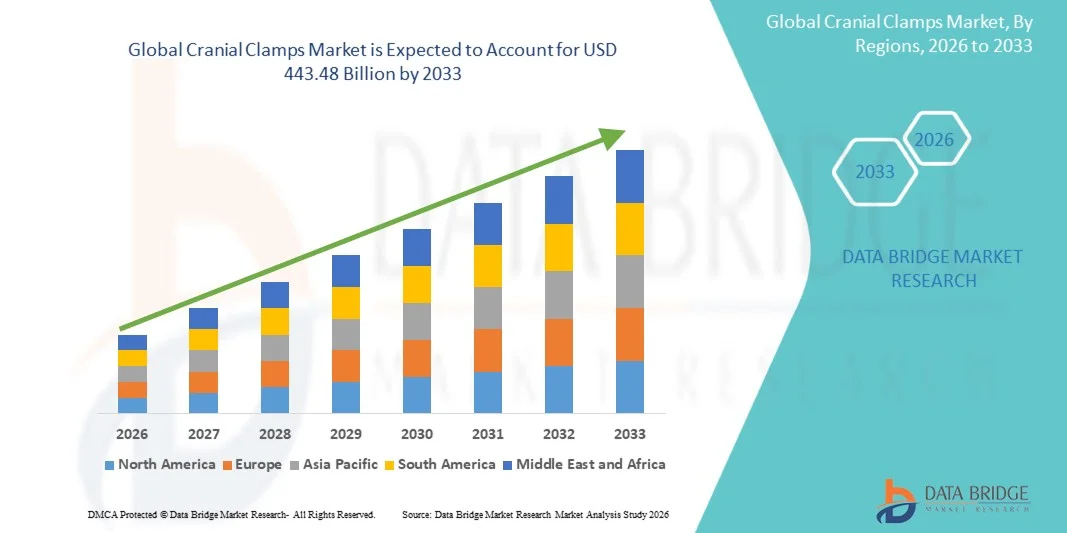
The Cranial Clamps Market was valued at USD 306.65 billion in 2025 and is projected to reach USD 443.48 billion by 2033, growing at a CAGR of 4.72% from 2026 to 2033. The Cranial Clamps Market is experiencing steady growth driven by rising demand for precise neurosurgical procedures, increasing prevalence of neurological disorders, and continuous advancements in neurosurgical instruments. Growing adoption of minimally invasive brain and spine surgeries, along with the need for enhanced surgical accuracy and patient safety, is further supporting market expansion.
The increasing burden of traumatic brain injuries, brain tumors, and other neurosurgical conditions, combined with a growing aging population, is driving higher surgical intervention rates globally. In addition, improvements in operating room technologies, including advanced neuro-navigation systems and robotic-assisted surgeries, are encouraging hospitals and specialty neurosurgical centers to adopt modern cranial fixation and stabilization devices. Rising healthcare investments and expanding access to specialized neurosurgical care in emerging economies are further accelerating the adoption of cranial clamps.
Key Market Trends & Insights
- North America dominated the Cranial Clamps Market with the largest revenue share of 33.84% in 2025, supported by advanced neurosurgical infrastructure, strong healthcare spending, and widespread adoption of technologically advanced operating room equipment across hospitals and specialty neurosurgical centers.
- The Pin Fixation Clamps (Mayfield) segment led the market by Design Type in 2025, driven by its high stability, precision cranial immobilization, and extensive use in complex neurosurgical procedures including tumor resection and trauma surgeries.
- Asia-Pacific is expected to be the fastest-growing region at a CAGR of 7.2% from 2026 to 2033, fueled by rising healthcare investments, expanding neurosurgical capabilities, and increasing patient pool in countries such as China, India, and Japan.
- Radiolucent cranial clamps under the Speciality segment are the fastest-growing category, driven by increasing demand for imaging-compatible surgical devices that allow real-time intraoperative CT and MRI guidance.
- The Adult patient segment dominates the market with the largest share in 2025, attributed to the higher incidence of brain tumors, stroke-related interventions, and traumatic brain injuries among the adult population.
- The Surgery application segment leads the market, driven by widespread use of cranial clamps in neurosurgical procedures requiring rigid head fixation for optimal surgical precision and safety.
- Hospitals remain the dominant end-use segment, accounting for the largest share of the market, supported by high patient inflow, availability of advanced neurosurgical infrastructure, and preference for complex inpatient neurosurgical procedures.
- The Adult segment dominated the market with a share of 78.35% in 2025, primarily due to the higher incidence of brain tumors, stroke, and traumatic brain injuries in the adult population
Market Size & Forecast
- Global Market Value (2025): USD 306.65 Billion
- Expected Market Value (2033): USD 443.48 Billion
- Forecast CAGR (2026–2033): 4.72%
- Leading Region in 2025: North America
- Fastest Growing Region: Asia-Pacific
Report Scope and Cranial Clamps Market Segmentation
|
Attributes |
Cranial Clamps Key Market Insights |
|
Segments Covered |
|
|
Countries Covered |
North America · U.S. · Canada · Mexico Europe · Germany · France · U.K. · Netherlands · Switzerland · Belgium · Russia · Italy · Spain · Turkey · Rest of Europe Asia-Pacific · China · Japan · India · South Korea · Singapore · Malaysia · Australia · Thailand · Indonesia · Philippines · Rest of Asia-Pacific Middle East and Africa · Saudi Arabia · U.A.E. · South Africa · Egypt · Israel · Rest of Middle East and Africa South America · Brazil · Argentina · Rest of South America |
|
Key Market Players |
• B. Braun Melsungen AG (Germany) |
|
Market Opportunities |
· Rising demand for minimally invasive neurosurgery · Expansion of neurosurgical infrastructure in emerging markets · Technological advancement in imaging-compatible and hybrid clamps |
|
Value Added Data Infosets |
In addition to the insights on market scenarios such as market value, growth rate, segmentation, geographical coverage, and major players, the market reports curated by the Data Bridge Market Research also include in-depth expert analysis, geographically represented company-wise production and capacity, network layouts of distributors and partners, detailed and updated price trend analysis and deficit analysis of supply chain and demand. |
Cranial Clamps Market Trends
Trend: Increasing Adoption in Advanced Neurosurgical and Training Ecosystems
High-precision cranial clamps are increasingly being adopted in neurosurgical training environments and operating room simulations to improve surgical accuracy and procedural safety. Leading neurosurgical institutes are integrating clamp systems with neuronavigation platforms and digital OR simulation setups to train surgeons in complex cranial procedures such as tumor resection, aneurysm clipping, and trauma management.
For instance, major teaching hospitals in Europe and North America have expanded the use of Mayfield pin fixation systems in simulation-based neurosurgical training programs, improving surgical precision and reducing intraoperative positioning errors by an estimated 15–25% in training environments. Integration with 3D visualization and VR-assisted surgical rehearsal systems is further enabling skill development without patient risk.
Cranial Clamps Market Dynamics
Key Market Driver: Rising Burden of Neurological Disorders and Growth in Neurosurgical Procedures
The increasing global incidence of neurological conditions such as brain tumors, traumatic brain injuries (TBI), and cerebrovascular diseases is significantly driving demand for cranial clamps. According to global health studies, TBI alone affects over 50–60 million people annually worldwide, creating sustained demand for neurosurgical interventions requiring rigid head fixation systems.
Hospitals and specialty neurosurgical centers are increasingly relying on advanced cranial fixation devices such as pin-based Mayfield clamps to ensure stability during delicate procedures like microsurgery and deep brain tumor excisions. In high-volume neurosurgical centers, cranial clamps are used in over 90% of intracranial procedures, reflecting their critical role in surgical workflows. The expansion of neuro-ICUs and increasing adoption of image-guided surgery systems are further accelerating market growth.
Key Restraint/Challenge: High Cost of Advanced Neurosurgical Fixation Systems and Limited Access in Emerging Markets
A major challenge in the Cranial Clamps Market is the high cost of advanced fixation systems and associated neurosurgical infrastructure. Premium cranial clamp systems with radiolucent and MRI-compatible designs can cost significantly more than conventional headrest systems, limiting adoption in small hospitals and developing regions.
In addition, the requirement for compatible operating room infrastructure—such as neuronavigation systems, intraoperative imaging, and sterilization protocols—further increases total procedural costs. In many low- and middle-income countries, less than 30–40% of tertiary care hospitals are equipped with advanced neurosurgical stabilization tools, restricting widespread adoption.
For instance, several public healthcare systems in Asia and Africa still rely on basic horseshoe headrests instead of advanced pin fixation systems due to budget constraints and limited neurosurgical training infrastructure.
Key Market Opportunity: Integration with Neuronavigation, Robotics, and AI-Assisted Neurosurgery Platforms
The integration of cranial clamps with advanced neuronavigation systems, robotic-assisted neurosurgery platforms, and AI-based surgical planning tools presents a major growth opportunity. Modern operating rooms are increasingly shifting toward fully integrated digital neurosurgical ecosystems where cranial fixation devices are synchronized with imaging and navigation systems for real-time precision control.
Hospitals adopting integrated OR platforms have reported improvements of up to 20–30% in surgical workflow efficiency and reduced intraoperative adjustment time when using radiolucent cranial clamps with navigation systems. A notable example is the adoption of hybrid neurosurgical suites in leading U.S. and European hospitals, where cranial clamps are directly integrated with intraoperative CT/MRI and robotic arms, enabling safer tumor resections and epilepsy surgeries. In addition, the expansion of AI-assisted surgical planning platforms is expected to improve pre-operative positioning accuracy and reduce complication rates, creating strong long-term demand for smart, sensor-integrated cranial clamp systems across hospitals and ambulatory surgical centers
Cranial Clamps Market Scope
The Cranial Clamps market is segmented on the basis of design type, speciality, patient, application, and end use.
- By Design Type
On the basis of design type, the Cranial Clamps Market is segmented into Horseshoe Headrests Clamps (Sugita) and Pin Fixation Clamps (Mayfield). The Pin Fixation Clamps (Mayfield) segment dominated the market with a share of 57.86% in 2025, owing to its superior cranial stability, high precision immobilization, and widespread adoption in complex neurosurgical procedures such as tumor resection, aneurysm clipping, and trauma surgeries. These systems are preferred in advanced neurosurgical centers due to their compatibility with neuronavigation and intraoperative imaging systems, ensuring enhanced surgical accuracy and patient safety. Increasing incidence of traumatic brain injuries (TBI), which affect over 50 million people globally each year, further supports strong demand for pin fixation systems across hospitals. In addition, rising adoption of minimally invasive neurosurgery and image-guided procedures is reinforcing segment dominance across developed healthcare markets including North America and Europe. The Horseshoe Headrests Clamps (Sugita) segment is widely used for routine neurosurgical positioning and pediatric cases due to its non-invasive design and ease of use, but remains secondary in high-complexity surgeries. Growing preference for rigid fixation in advanced neurosurgical workflows continues to strengthen Mayfield system leadership across global operating rooms.
The Pin Fixation Clamps (Mayfield) segment is projected to register the fastest growth at a CAGR of 6.8% from 2026 to 2033, driven by increasing demand for high-precision neurosurgical stabilization systems and expansion of advanced neurosurgical infrastructure in emerging economies. Rising adoption of radiology-integrated operating rooms and AI-assisted surgical navigation systems is further accelerating uptake of pin-based cranial clamps. Hospitals are increasingly shifting from conventional headrest systems to rigid fixation devices to reduce intraoperative movement errors, which can improve surgical precision by up to 20–25% in complex brain procedures. Growth is also supported by increasing neurosurgical procedures in aging populations, particularly in Asia-Pacific where stroke and tumor-related surgeries are rising significantly. In addition, technological advancements such as radiolucent and MRI-compatible pin fixation systems are expanding clinical applications. Increasing investments in neuro-ICUs and specialty neurosurgical centers globally are further boosting demand for advanced fixation solutions.
- By Speciality
On the basis of speciality, the Cranial Clamps Market is segmented into General, Radiolucent, and Sterilisable. The General segment dominated the market with a share of 44.12% in 2025, driven by its extensive use in standard neurosurgical procedures where basic cranial immobilization is required. These clamps are widely adopted in hospitals and ambulatory surgical centers due to their cost-effectiveness and ease of sterilization. High procedural volume in routine neurosurgeries such as hematoma evacuation and basic cranial trauma management supports strong demand for general cranial clamps. In addition, their compatibility with conventional operating room setups makes them the most widely used category across developing healthcare systems. However, increasing demand for advanced imaging and surgical precision is gradually shifting preference toward specialized variants.
The Radiolucent segment is expected to register the fastest growth at a CAGR of 7.1% from 2026 to 2033, driven by increasing adoption of intraoperative imaging systems such as CT and MRI during neurosurgical procedures. Radiolucent clamps allow uninterrupted imaging without artifact interference, significantly improving surgical accuracy and outcomes. Hospitals adopting hybrid operating rooms have reported up to 30% improvement in intraoperative decision-making efficiency when using radiolucent fixation systems. Rising demand for minimally invasive neurosurgery and neuronavigation-assisted procedures is further fueling segment growth. Additionally, increasing investment in advanced neurosurgical infrastructure in North America, Europe, and Asia-Pacific is accelerating adoption. Growing focus on precision medicine and image-guided brain surgery is expected to further strengthen demand for radiolucent cranial clamps globally.
- By Patient
On the basis of patient, the Cranial Clamps Market is segmented into Adult and Paediatric. The Adult segment dominated the market with a share of 78.35% in 2025, primarily due to the higher incidence of brain tumors, stroke, and traumatic brain injuries in the adult population. Adults account for the majority of neurosurgical procedures globally, particularly in tertiary care hospitals and trauma centers. Increasing prevalence of lifestyle-related neurological disorders and aging populations in developed countries further contributes to strong demand for cranial clamps in adult surgeries. In addition, complex procedures such as aneurysm clipping and tumor resections are predominantly performed in adult patients, requiring rigid fixation systems like Mayfield clamps. Rising healthcare access and improved neurosurgical capabilities in emerging economies are further reinforcing segment dominance.
The Paediatric segment is projected to register the fastest growth at a CAGR of 6.5% from 2026 to 2033, driven by increasing incidence of congenital neurological disorders, pediatric brain tumors, and trauma cases. Pediatric neurosurgery requires highly specialized and adjustable cranial fixation systems such as horseshoe headrests and modified pin clamps designed for smaller skull anatomy. Growing establishment of pediatric neurosurgical centers in Asia-Pacific and Latin America is supporting market expansion. Advances in low-pressure fixation systems designed to reduce skull damage risk in children are also accelerating adoption. In addition, rising awareness of early diagnosis and treatment of neurological disorders in children is contributing to increased surgical interventions globally.
- By Application
On the basis of application, the Cranial Clamps Market is segmented into Surgery and Imaging. The Surgery segment dominated the market with a share of 72.94% in 2025, driven by widespread use of cranial clamps in neurosurgical procedures requiring rigid head stabilization. These include tumor resections, epilepsy surgeries, aneurysm clipping, and trauma-related interventions. High procedural volumes in hospitals and neurosurgical centers globally are a major growth driver. Cranial clamps are considered essential surgical tools, used in over 90% of intracranial surgeries in advanced healthcare facilities. Increasing adoption of minimally invasive neurosurgery and robotic-assisted procedures is further reinforcing segment dominance.
The Imaging segment is expected to register the fastest growth at a CAGR of 6.9% from 2026 to 2033, driven by increasing use of intraoperative CT and MRI-guided neurosurgery. Radiolucent cranial clamps are essential for real-time imaging without distortion, enabling improved surgical precision and reduced complications. Growing adoption of neuronavigation systems and hybrid operating rooms is significantly boosting demand. Hospitals integrating imaging with surgical workflows have reported up to 25% improvement in procedural accuracy and reduced revision surgeries. Rising investment in advanced diagnostic and surgical infrastructure, particularly in North America, Europe, and Asia-Pacific, is further accelerating growth in the imaging segment.
- By End Use
On the basis of end use, the Cranial Clamps Market is segmented into Hospitals, Clinics, and Ambulatory Surgical Centres. The Hospitals segment dominated the market with a share of 81.26% in 2025, owing to the high volume of neurosurgical procedures performed in hospital settings and availability of advanced operating room infrastructure. Hospitals are equipped with neuronavigation systems, intraoperative imaging, and specialized neurosurgical teams, making them the primary users of cranial clamps. Increasing prevalence of neurological disorders and trauma cases globally further strengthens hospital dominance. Large tertiary care hospitals perform thousands of neurosurgical procedures annually, requiring reliable and high-precision fixation systems. In addition, strong reimbursement frameworks in developed countries support hospital-based neurosurgical interventions.
The Ambulatory Surgical Centres segment is projected to register the fastest growth at a CAGR of 6.7% from 2026 to 2033, driven by increasing shift toward outpatient neurosurgical procedures and minimally invasive surgeries. ASC facilities are increasingly adopting compact and cost-effective cranial clamp systems suitable for short-duration procedures. Rising healthcare cost pressures and demand for faster recovery times are encouraging outpatient surgical models. Technological advancements in portable imaging and modular neurosurgical equipment are enabling broader ASC adoption. Growth is particularly strong in developed markets such as the U.S. and Europe, where outpatient neurosurgical care is expanding rapidly.
Cranial Clamps Market Regional Analysis
North America dominated the Cranial Clamps market and accounted for the largest revenue share of 33.84% in 2025, supported by advanced neurosurgical infrastructure, high healthcare expenditure, and widespread adoption of technologically advanced operating room equipment across hospitals, trauma centers, and specialty neurosurgical institutes. The region also benefits from a high volume of complex neurosurgical procedures, strong presence of leading medical device manufacturers, and early adoption of neuronavigation, intraoperative imaging, and robotic-assisted surgery systems. Increasing prevalence of neurological disorders, traumatic brain injuries, and brain tumors further strengthens demand for cranial fixation devices. In addition, continuous investment in neurosurgical R&D, training programs, and hospital modernization initiatives is reinforcing North America’s leadership position in the global market.
U.S. Cranial Clamps Market Insight
The U.S. Cranial Clamps market is witnessing strong growth due to rising incidence of neurological disorders, increasing number of neurosurgical procedures, and advanced hospital infrastructure equipped with state-of-the-art operating rooms. The country performs a high volume of complex brain and spine surgeries annually, with cranial clamps used in the majority of intracranial procedures for rigid head stabilization. Strong presence of leading medical device companies and rapid adoption of radiolucent and MRI-compatible fixation systems are further driving market expansion. In addition, integration of AI-assisted surgical planning, neuronavigation systems, and robotic neurosurgery platforms is improving surgical precision and efficiency. Growing investments in trauma care centers and academic neurosurgical training institutions continue to accelerate demand across the U.S. healthcare ecosystem.
Europe Cranial Clamps Market Insight
The Europe Cranial Clamps market remains a major contributor to global revenue, driven by strong healthcare systems, advanced neurosurgical capabilities, and widespread adoption of precision surgical tools. Countries such as Germany, France, and the U.K. are at the forefront of minimally invasive neurosurgery and image-guided surgical procedures. Increasing use of radiolucent cranial clamps in hybrid operating rooms is enhancing surgical accuracy and intraoperative imaging quality. The region also benefits from strong government healthcare funding, high patient awareness, and well-established neurosurgical training programs. Rising prevalence of neurological conditions and expanding geriatric population further support market growth. In addition, continuous innovation in surgical instrumentation and strong presence of leading European medical device manufacturers are reinforcing regional expansion.
U.K. Cranial Clamps Market Insight
The U.K. Cranial Clamps market is experiencing steady growth, supported by a strong National Health Service (NHS) framework, increasing neurosurgical procedure volumes, and growing adoption of advanced operating room technologies. Hospitals and academic medical centers are increasingly integrating cranial fixation systems with neuronavigation and intraoperative imaging platforms to improve surgical outcomes. Rising cases of brain injuries and neuro-oncological conditions are contributing to higher demand for neurosurgical interventions. In addition, investments in surgical training infrastructure and minimally invasive neurosurgery are supporting adoption of advanced cranial clamps. The U.K.’s focus on improving patient safety, reducing surgical complications, and modernizing hospital infrastructure continues to strengthen market growth.
Germany Cranial Clamps Market Insight
The Germany Cranial Clamps market is expanding steadily due to its strong medical device manufacturing base, advanced neurosurgical research ecosystem, and high adoption of precision surgical technologies. Leading hospitals and university medical centers in Germany are extensively using cranial clamps in complex neurosurgical procedures, including tumor resections and vascular brain surgeries. Increasing integration of radiolucent fixation systems with intraoperative MRI and CT imaging is improving surgical precision. Strong government support for healthcare innovation and medical R&D is further driving market development. In addition, Germany’s aging population and rising prevalence of neurological disorders are contributing to increased neurosurgical procedure volumes, strengthening long-term demand for cranial clamps.
Asia-Pacific Cranial Clamps Market Insight
The Asia-Pacific Cranial Clamps market is expected to witness the fastest growth, with a CAGR of 7.2% from 2026 to 2033, driven by rapid expansion of healthcare infrastructure, increasing neurosurgical procedures, and rising healthcare investments in countries such as China, India, and Japan. Growing incidence of traumatic brain injuries and stroke cases is significantly boosting demand for neurosurgical interventions requiring cranial fixation systems. Governments across the region are investing heavily in hospital modernization and specialty neurosurgical centers. In addition, increasing adoption of advanced surgical technologies such as neuronavigation, VR-assisted training, and minimally invasive neurosurgery is accelerating market expansion. Rising medical tourism in Asia-Pacific is also contributing to higher procedure volumes and adoption of advanced cranial clamp systems.
Japan Cranial Clamps Market Insight
The Japan Cranial Clamps market is witnessing steady growth due to its advanced healthcare system, high neurosurgical expertise, and strong focus on precision medicine. Japanese hospitals and research institutions are early adopters of radiolucent and sterilisable cranial clamp systems, particularly in image-guided and minimally invasive neurosurgical procedures. Increasing prevalence of age-related neurological disorders is driving higher surgical intervention rates. In addition, strong integration of robotics, AI-assisted surgical planning, and advanced imaging technologies is enhancing surgical outcomes. Japan’s emphasis on safety, efficiency, and technological innovation continues to support adoption of advanced cranial fixation devices across leading medical centers.
China Cranial Clamps Market Insight
The China Cranial Clamps market is growing rapidly, driven by expanding healthcare infrastructure, rising neurosurgical procedure volumes, and strong government investment in advanced medical technologies. Increasing cases of traumatic brain injuries, stroke, and brain tumors are fueling demand for neurosurgical interventions requiring cranial stabilization systems. Rapid modernization of hospitals and expansion of tier-1 and tier-2 healthcare facilities are significantly increasing adoption of advanced surgical equipment. In addition, growing integration of AI-based surgical planning, neuronavigation systems, and digital operating rooms is enhancing surgical precision and efficiency. Strong domestic manufacturing capabilities and increasing medical device innovation are further supporting China’s emergence as one of the fastest-growing markets globally.
Cranial Clamps Market Share
The Cranial Clamps industry is primarily led by well-established companies, including:
- B. Braun Melsungen AG (Germany)
- Integra LifeSciences Holdings Corporation (U.S.)
- Stryker Corporation (U.S.)
- Zimmer Biomet Holdings Inc. (U.S.)
- Adeor Medical AG (Germany)
- Mizuho Medical Co., Ltd. (Japan)
- Mayfield (Ohio Medical Instrument Company) (U.S.)
- Scanlan International Inc. (U.S.)
- Codman Neuro (Johnson & Johnson MedTech) (U.S.)
- PMT Corporation (U.S.)
- Aesculap, Inc. (B. Braun subsidiary) (U.S./Germany)
- Natus Medical Incorporated (U.S.)
- Spiggle & Theis Medizintechnik GmbH (Germany)
- KLS Martin Group (Germany)
- Medicon eG (Germany)
- Micromar Industria e Comércio Ltda. (Brazil)
- Ningbo Heliqi Medical Instruments Co., Ltd. (China)
- Shanghai Medical Instruments (Group) Co., Ltd. (China)
- Jiangsu Yuyue Medical Equipment & Supply Co., Ltd. (China)
- GPC Medical Ltd. (India)
- Allengers Medical Systems Ltd. (India)
- Romsons Scientific & Surgical Pvt. Ltd. (India)
- Surtex Instruments Ltd. (India/UK)
- Sklar Surgical Instruments (U.S.)
- Rudolf Medical GmbH + Co. KG (Germany)
- OsteoMed (U.S.)
- Zimmer MedizinSysteme GmbH (Germany)
- Truphatek International Ltd. (Israel)
- Hu-Friedy Manufacturing Co., LLC (U.S.)
- Shenzhen Medke Technology Co., Ltd. (China)
- Inomed Medizintechnik GmbH (Germany)
Latest Developments in Cranial Clamps Market
- In October 2021, B. Braun Melsungen AG, in collaboration with biotechnology company T&R Biofab, announced advancements in 3D-printed patient-specific craniofacial implant solutions, expanding its neurosurgical and cranial reconstruction portfolio. The development focused on improving post-craniotomy reconstruction outcomes using biocompatible materials and additive manufacturing technology, supporting personalized neurosurgical treatment approaches and improved surgical precision
- In June 2021, Integra LifeSciences continued strengthening its globally recognized MAYFIELD cranial stabilization system portfolio, widely used in neurosurgical procedures for rigid head fixation during craniotomies and complex brain surgeries. The MAYFIELD system remains one of the most widely adopted cranial fixation platforms in hospitals worldwide, supporting neuronavigation-assisted neurosurgery and maintaining strong clinical preference across neurosurgical operating rooms
- In March 2023, Stryker Corporation expanded its neurosurgical ecosystem by enhancing integration of cranial stabilization systems with advanced surgical navigation and imaging platforms, supporting improved precision in neurosurgical procedures. These developments strengthened the use of cranial fixation devices in tumor resections, trauma surgeries, and minimally invasive brain procedures, improving workflow efficiency and surgical accuracy in hospital settings
- In September 2023, Medtronic plc advanced its neurosurgical solutions portfolio by strengthening head fixation systems integrated with neuronavigation technologies, enabling improved intraoperative guidance during brain and spine surgeries. These systems are increasingly used in high-complexity neurosurgical procedures, helping reduce surgical errors and improving patient outcomes through real-time imaging support
- In May 2024, global cranial fixation system manufacturers highlighted increased adoption of patient-specific and 3D-printed cranial stabilization solutions, driven by rising demand for customized neurosurgical devices. The use of additive manufacturing technology enabled anatomically precise cranial clamps and fixation components, improving surgical accuracy and reducing post-operative complications in reconstructive neurosurgery
- In August 2024, leading companies including Integra LifeSciences, B. Braun, and Stryker focused on advancing AI-integrated neurosurgical workflows and imaging-compatible cranial fixation systems, enabling real-time intraoperative decision support. These innovations are increasingly being adopted in hybrid operating rooms to enhance precision in tumor surgery, vascular neurosurgery, and trauma care
- In February 2025, the global cranial fixation devices market saw growing adoption of radiolucent and MRI-compatible cranial clamps, enabling uninterrupted intraoperative imaging during neurosurgical procedures. Hospitals and specialty neurosurgical centers increasingly deployed these systems to improve accuracy in image-guided surgeries, particularly in neuro-oncology and cerebrovascular procedures
SKU-
Get online access to the report on the World's First Market Intelligence Cloud

- Interactive Data Analysis Dashboard
- Company Analysis Dashboard for high growth potential opportunities
- Research Analyst Access for customization & queries
- Competitor Analysis with Interactive dashboard
- Latest News, Updates & Trend analysis
- Harness the Power of Benchmark Analysis for Comprehensive Competitor Tracking
Research Methodology
Data collection and base year analysis are done using data collection modules with large sample sizes. The stage includes obtaining market information or related data through various sources and strategies. It includes examining and planning all the data acquired from the past in advance. It likewise envelops the examination of information inconsistencies seen across different information sources. The market data is analysed and estimated using market statistical and coherent models. Also, market share analysis and key trend analysis are the major success factors in the market report. To know more, please request an analyst call or drop down your inquiry.
The key research methodology used by DBMR research team is data triangulation which involves data mining, analysis of the impact of data variables on the market and primary (industry expert) validation. Data models include Vendor Positioning Grid, Market Time Line Analysis, Market Overview and Guide, Company Positioning Grid, Patent Analysis, Pricing Analysis, Company Market Share Analysis, Standards of Measurement, Global versus Regional and Vendor Share Analysis. To know more about the research methodology, drop in an inquiry to speak to our industry experts.
Customization Available
Data Bridge Market Research is a leader in advanced formative research. We take pride in servicing our existing and new customers with data and analysis that match and suits their goal. The report can be customized to include price trend analysis of target brands understanding the market for additional countries (ask for the list of countries), clinical trial results data, literature review, refurbished market and product base analysis. Market analysis of target competitors can be analyzed from technology-based analysis to market portfolio strategies. We can add as many competitors that you require data about in the format and data style you are looking for. Our team of analysts can also provide you data in crude raw excel files pivot tables (Fact book) or can assist you in creating presentations from the data sets available in the report.












