


What is the Cryptocurrency Banking Market Size and Growth Rate?
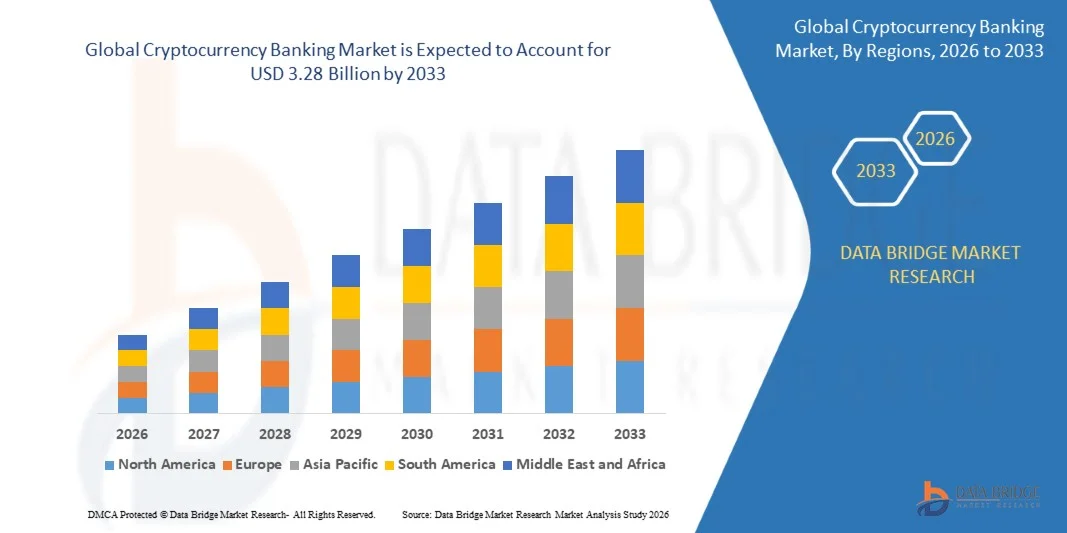
- As per Data Bridge Market Research analysis, the cryptocurrency banking market was valued at USD 1.94 billion in 2025 and is projected to reach USD 3.28 billion by 2033, growing at a CAGR of 6.80% from 2026 to 2033.
- The market is experiencing consistent growth driven by increasing institutional adoption of digital assets, rising demand for integrated financial services that bridge traditional banking and blockchain ecosystems, and evolving regulatory frameworks that provide clearer guidelines for cryptocurrency operations.
- The integration of traditional banking and blockchain technology is reshaping financial services, enabling users to engage in transactions with greater speed and security. As digital currencies gain traction, financial institutions are increasingly exploring ways to incorporate these assets into their offerings, potentially reshaping the landscape of banking.
Market Size & Forecast
- Market Value (2025): USD 1.94 Billion
- Expected Market Value (2033): USD 3.28 Billion
- Forecast CAGR (2026–2033): 6.80%
- Leading Region in 2025: North America
- Fastest Growing Region: Asia-Pacific
What are the Major Takeaways of the Cryptocurrency Banking Market?
- North America dominated the cryptocurrency banking market and accounted for the largest revenue share of 45.5% in 2025, supported by increasing adoption of digital currencies, favorable regulatory frameworks, and a tech-savvy population.
- Asia-Pacific cryptocurrency banking market is expected to witness the fastest growth rate from 2026 to 2033, driven by increasing digitalization, a young population, and rising interest in alternative financial solutions. Countries such as China and Japan are leading the way, with China focusing on its digital yuan while Japan embraces a more open regulatory environment for cryptocurrencies.
- The crypto lending segment dominated the market in 2025, owing to the high yield potential it offers users in a turbulent market and the ability to earn interest on crypto holdings while allowing borrowings against collateralized assets. These platforms provide users with options to earn interest on their crypto holdings while allowing borrowings against collateralized assets.
- The Investment Services segment is projected to register the fastest growth from 2026 to 2033, driven by rising demand for professional portfolio management and advisory services as institutional interest grows. These services include advisory services and trading platforms aimed at increasing participation in the burgeoning market.
- The Individual Users segment led the market in 2025, supported by growing interest in cryptocurrency as an accessible asset class and the ease of use provided by user-friendly platforms. This group generally seeks to diversify their investment portfolios and explore innovative financial solutions.
- The Institutional Investors segment is expected to experience the fastest growth from 2026 to 2033, driven by increasing participation from major financial entities that leverage substantial resources and expertise to engage in crypto banking activities. Their involvement marks a transformational shift in the market, enhancing credibility and driving technological innovation.
Report Scope and Cryptocurrency Banking Market Segmentation
|
Attributes |
Cryptocurrency Banking Key Market Insights |
|
Segments Covered |
|
|
Countries Covered |
North America
Europe
Asia-Pacific
Middle East and Africa
South America
|
|
Key Market Players |
|
|
Market Opportunities |
|
|
Value Added Data Infosets |
In addition to the market insights such as market value, growth rate, market segments, geographical coverage, market players, and market scenario, the market report curated by the Data Bridge Market Research team includes in-depth expert analysis, import/export analysis, pricing analysis, production consumption analysis, and pestle analysis. |
What is the Key Trend in the Cryptocurrency Banking Market?
- Traditional banks are increasingly integrating cryptocurrency services such as digital asset custody, crypto trading, stablecoin payments, tokenized asset management, and blockchain-based settlement into their core banking offerings. This convergence of traditional finance (TradFi) and digital assets is enabling banks to attract new customer segments while expanding digital financial services.
- For instance, in March 2025, Emirates NBD launched cryptocurrency trading services through its digital banking platform Liv X in partnership with Aquanow, enabling customers to securely buy, sell, and hold cryptocurrencies directly within the bank's mobile application.
- Financial institutions are increasingly investing in digital asset custody, stablecoin infrastructure, blockchain settlement networks, and tokenized financial products as regulatory clarity improves, allowing banks to diversify revenue streams while supporting institutional and retail crypto adoption.
- Regulatory authorities are supporting responsible crypto integration by providing clearer guidance for banks to engage in crypto-related activities under established risk management frameworks, accelerating institutional participation in digital asset banking.
- For instance, in March 2025, the U.S. Office of the Comptroller of the Currency (OCC) reaffirmed that national banks and federal savings associations may provide crypto-asset custody, certain stablecoin activities, and participate in distributed ledger networks without requiring prior supervisory non-objection, reducing barriers to cryptocurrency banking services.
- As financial institutions continue expanding regulated cryptocurrency services and governments establish clearer digital asset frameworks, the convergence of traditional banking and blockchain-based financial infrastructure is expected to accelerate, making cryptocurrency banking a core component of next-generation financial services.
What are the Key Drivers of the Cryptocurrency Banking Market?
- The increasing institutional adoption of cryptocurrencies, combined with clearer regulatory frameworks, is driving demand for cryptocurrency banking services, including digital asset custody, crypto trading, stablecoin payments, and blockchain-based financial infrastructure.
- For instance, in March 2025, the U.S. Office of the Comptroller of the Currency (OCC) issued Interpretive Letter 1183, confirming that national banks and federal savings associations may engage in crypto-asset custody, certain stablecoin activities, and distributed ledger network participation without prior supervisory approval, encouraging broader participation in cryptocurrency banking.
- Banks, fintech firms, and digital asset service providers are expanding regulated crypto offerings to meet rising demand from retail and institutional investors for secure, compliant, and integrated digital financial services.
- For instance, in March 2025, Emirates NBD, through its digital bank Liv, partnered with Aquanow to launch cryptocurrency trading services, enabling customers to buy, sell, and hold cryptocurrencies directly within its banking application while maintaining regulated banking standards.
- As governments continue establishing supportive digital asset regulations and financial institutions expand blockchain-based banking capabilities, institutional confidence and customer adoption are expected to accelerate, driving sustained growth in the cryptocurrency banking market.
Which Factors are Challenging the Growth of the Cryptocurrency Banking Market?
- Cryptocurrency banking faces significant challenges due to evolving regulatory requirements, fragmented legal frameworks across jurisdictions, and stringent compliance obligations related to anti-money laundering (AML), know-your-customer (KYC), and counter-terrorism financing (CTF) regulations.
- These regulatory complexities increase compliance costs, delay product launches, and discourage many traditional financial institutions from expanding cryptocurrency banking services, particularly in regions where digital asset regulations remain uncertain.
- For instance, in January 2025, the European Union's Markets in Crypto-Assets (MiCA) regulation became fully applicable, requiring crypto-asset service providers and banking institutions offering digital asset services to comply with comprehensive licensing, governance, consumer protection, and operational resilience requirements, increasing compliance obligations across the industry.
- The need for continuous monitoring of changing regulations, cybersecurity risks, and financial crime prevention further raises operational expenses for banks and crypto service providers, particularly for smaller institutions with limited compliance resources.
- As regulatory requirements continue to evolve globally, the high cost of compliance and legal uncertainty are expected to remain key barriers to the widespread adoption and expansion of cryptocurrency banking services, especially among smaller financial institutions and emerging market participants.
How is the Cryptocurrency Banking Market Segmented?
The cryptocurrency banking market is segmented on the basis of service type, user type, deployment type, and technology.
- By Service Type
On the basis of service type, the cryptocurrency banking market is segmented into cryptocurrency wallets, crypto lending, crypto merchant services, payment processing, and investment services. The crypto lending segment dominated the market in 2025, owing to the high yield potential it offers users in a turbulent market and the ability to earn interest on crypto holdings while allowing borrowings against collateralized assets. These platforms provide users with options to earn interest on their crypto holdings while allowing borrowings against collateralized assets.
The Investment Services segment is projected to register the fastest growth from 2026 to 2033, driven by rising demand for professional portfolio management and advisory services as institutional interest grows. These services include advisory services and trading platforms aimed at increasing participation in the burgeoning market.
- By User Type
On the basis of user type, the cryptocurrency banking market is segmented into individual users, retail investors, institutional investors, and businesses. The Individual Users segment led the market in 2025, supported by growing interest in cryptocurrency as an accessible asset class and the ease of use provided by user-friendly platforms. This group generally seeks to diversify their investment portfolios and explore innovative financial solutions.
The Institutional Investors segment is expected to experience the fastest growth from 2026 to 2033, driven by increasing participation from major financial entities that leverage substantial resources and expertise to engage in crypto banking activities. Their involvement marks a transformational shift in the market, enhancing credibility and driving technological innovation.
- By Deployment Type
On the basis of deployment type, the cryptocurrency banking market is segmented into cloud-based and on-premises. The Cloud-Based segment dominated the market in 2025 due to its scalability, ease of access, and relatively lower operational costs. Organizations are increasingly adopting cloud solutions for their flexibility and the ability to leverage advanced technologies such as AI and machine learning for enhanced security and user experience.
The on-premises segment is expected to witness the fastest growth from 2026 to 2033, driven by rapid adaptability and broad accessibility. These solutions enable banks to respond quickly to changing market demands while offering significant advantages such as reduced infrastructure costs and improved scalability.
- By Technology
On the basis of technology, the cryptocurrency banking market is segmented into blockchain technology, smart contracts, and decentralized finance. The Blockchain Technology segment dominated the market in 2025, serving as the backbone for secure and efficient transactions. Its decentralized nature ensures the integrity of data while minimizing risks associated with fraud.
The Decentralized Finance (DeFi) segment is expected to witness the fastest CAGR from 2026 to 2033, driven by demand for borderless, permissionless financial services that leverage blockchain technology without traditional intermediaries. DeFi leverages blockchain for innovative applications such as lending, borrowing, and trading, fostering a new era of financial inclusion.
Which Region Holds the Largest Share of the Cryptocurrency Banking Market?
- North America dominated the cryptocurrency banking market and accounted for the largest revenue share of 45.5% in 2025, supported by increasing adoption of digital currencies, favorable regulatory frameworks, and a tech-savvy population.
- The region benefits from regulatory clarity from agencies such as the SEC, which has fueled growth and enhanced market credibility. The presence of established financial institutions venturing into cryptocurrency banking is also notable, attracting more users. The region's focus on security and compliance continues to shape its competitive edge.
U.S. Cryptocurrency Banking Market Insight
The U.S. dominated the cryptocurrency banking market and accounted for the largest revenue share in 2025, supported by rising adoption of digital assets, favorable regulatory frameworks, and a tech-savvy population. Increasing investments in compliance infrastructure and growing demand for regulated crypto services are contributing to market growth. Furthermore, the presence of key players such as Coinbase, Kraken, and Gemini, along with established financial institutions venturing into cryptocurrency banking, is enhancing market credibility and attracting more users.
Europe Cryptocurrency Banking Market Insight
Europe is expected to witness the fastest growth rate from 2026 to 2033, significantly influenced by the establishment of comprehensive regulatory frameworks, such as the EU's MiCA regulation, which aims to create a unified approach to cryptocurrency. Countries such as Germany and France are leading the charge, fostering an environment conducive to innovation while ensuring consumer protection and market integrity. The competitive landscape is characterized by a mix of established players such as Bitstamp and Nexo and emerging startups offering services from trading to lending.
U.K. Cryptocurrency Banking Market Insight
The U.K. cryptocurrency banking market is expected to witness the fastest growth rate from 2026 to 2033, driven by the country's strong fintech sector, increasing adoption of blockchain technologies, and growing institutional interest in digital assets. Financial institutions are expanding cryptocurrency-related services, including custody, payments, and digital asset management, to address evolving customer requirements. Moreover, supportive innovation policies, a mature financial ecosystem, and increasing investment in blockchain startups are expected to further stimulate market growth.
Germany Cryptocurrency Banking Market Insight
The Germany cryptocurrency banking market is expected to witness the fastest growth rate from 2026 to 2033, fueled by increasing adoption of regulated digital asset services, strong demand for secure crypto custody solutions, and rising enterprise investments in blockchain technology. Germany's advanced financial infrastructure and emphasis on regulatory compliance support the expansion of cryptocurrency banking services across both institutional and retail segments. The growing integration of blockchain into financial operations and increasing interest in tokenized assets are also contributing to sustained market growth.
Asia-Pacific Cryptocurrency Banking Market Insight
The Asia-Pacific cryptocurrency banking market is expected to witness the fastest growth rate from 2026 to 2033, driven by increasing digitalization, a young population, and rising interest in alternative financial solutions. Countries such as China and Japan are leading the way, with China focusing on its digital yuan while Japan embraces a more open regulatory environment for cryptocurrencies. Growing awareness regarding digital assets, rising adoption of advanced financial technologies, and increasing demand for scalable and cost-effective banking solutions are supporting regional market expansion.
China Cryptocurrency Banking Market Insight
The China dominated the cryptocurrency banking market and accounted for the largest revenue share in 2025, driven by the country's focus on its digital yuan initiative and increasing digitalization of financial services. The government's push for central bank digital currency (CBDC) adoption is creating opportunities for cryptocurrency banking services. In addition, rising investments in blockchain technology and fintech innovation are positioning China as a key market for cryptocurrency banking in the Asia-Pacific region.
Japan Cryptocurrency Banking Market Insight
The Japan cryptocurrency banking market is expected to witness the fastest growth rate from 2026 to 2033 due to rising investments in digital asset technologies and a more open regulatory environment for cryptocurrencies. The country's progressive approach to cryptocurrency regulation, including licensing requirements for exchanges, has fostered a stable and secure market environment. Financial institutions and fintech companies are increasingly adopting blockchain technology and offering cryptocurrency services, contributing to market growth.
Which are the Top Companies in Cryptocurrency Banking Market?
The cryptocurrency banking industry is primarily led by well-established companies, including:
- Coinbase (U.S.)
- Binance (Malta)
- JPMorgan Chase (U.S.)
- Standard Chartered (UK)
- Sygnum Bank (Singapore)
- Kraken (U.S.)
- Gemini (U.S.)
- Bitstamp (Luxembourg)
- Crypto.com (Seychelles)
- Nexo (Bulgaria)
- Bitfinex (Hong Kong)
- Revolut (UK)
- SEBA Bank (Switzerland)
- Wirex (UK)
- BankProv (U.S.)
- BBVA (Spain)
- BCB Group (UK)
What are Latest Developments in Cryptocurrency Banking Market?
- In March 2025, Emirates NBD launched cryptocurrency trading services through its digital banking platform Liv X in partnership with Aquanow, enabling customers to securely buy, sell, and hold cryptocurrencies directly within the bank's mobile application.
- In March 2025, Emirates NBD, through its digital bank Liv, partnered with Aquanow to launch cryptocurrency trading services, enabling customers to buy, sell, and hold cryptocurrencies directly within its banking application while maintaining regulated banking standards.
- In March 2025, the U.S. Office of the Comptroller of the Currency (OCC) issued Interpretive Letter 1183, confirming that national banks and federal savings associations may engage in crypto-asset custody, certain stablecoin activities, and distributed ledger network participation without prior supervisory approval, encouraging broader participation in cryptocurrency banking.

- Interactive Data Analysis Dashboard
- Company Analysis Dashboard for high growth potential opportunities
- Research Analyst Access for customization & queries
- Competitor Analysis with Interactive dashboard
- Latest News, Updates & Trend analysis
- Harness the Power of Benchmark Analysis for Comprehensive Competitor Tracking
Data collection and base year analysis are done using data collection modules with large sample sizes. The stage includes obtaining market information or related data through various sources and strategies. It includes examining and planning all the data acquired from the past in advance. It likewise envelops the examination of information inconsistencies seen across different information sources. The market data is analysed and estimated using market statistical and coherent models. Also, market share analysis and key trend analysis are the major success factors in the market report. To know more, please request an analyst call or drop down your inquiry.
The key research methodology used by DBMR research team is data triangulation which involves data mining, analysis of the impact of data variables on the market and primary (industry expert) validation. Data models include Vendor Positioning Grid, Market Time Line Analysis, Market Overview and Guide, Company Positioning Grid, Patent Analysis, Pricing Analysis, Company Market Share Analysis, Standards of Measurement, Global versus Regional and Vendor Share Analysis. To know more about the research methodology, drop in an inquiry to speak to our industry experts.
Data Bridge Market Research is a leader in advanced formative research. We take pride in servicing our existing and new customers with data and analysis that match and suits their goal. The report can be customized to include price trend analysis of target brands understanding the market for additional countries (ask for the list of countries), clinical trial results data, literature review, refurbished market and product base analysis. Market analysis of target competitors can be analyzed from technology-based analysis to market portfolio strategies. We can add as many competitors that you require data about in the format and data style you are looking for. Our team of analysts can also provide you data in crude raw excel files pivot tables (Fact book) or can assist you in creating presentations from the data sets available in the report.













