


Global Customer Engagement Hub Market
Market Size in USD Million
CAGR :
% 
 USD
962.36 Million
USD
1,267.24 Million
2025
2033
USD
962.36 Million
USD
1,267.24 Million
2025
2033
 Forecast Period Forecast Period |
2026 –2033 |
 Market Size (Base Year) Market Size (Base Year) |
USD 962.36 Million |
 Market Size (Forecast Year) Market Size (Forecast Year) |
USD 1,267.24 Million |
 CAGR CAGR |
% |
| Major Markets Players |
|
Customer Engagement Hub Market Size
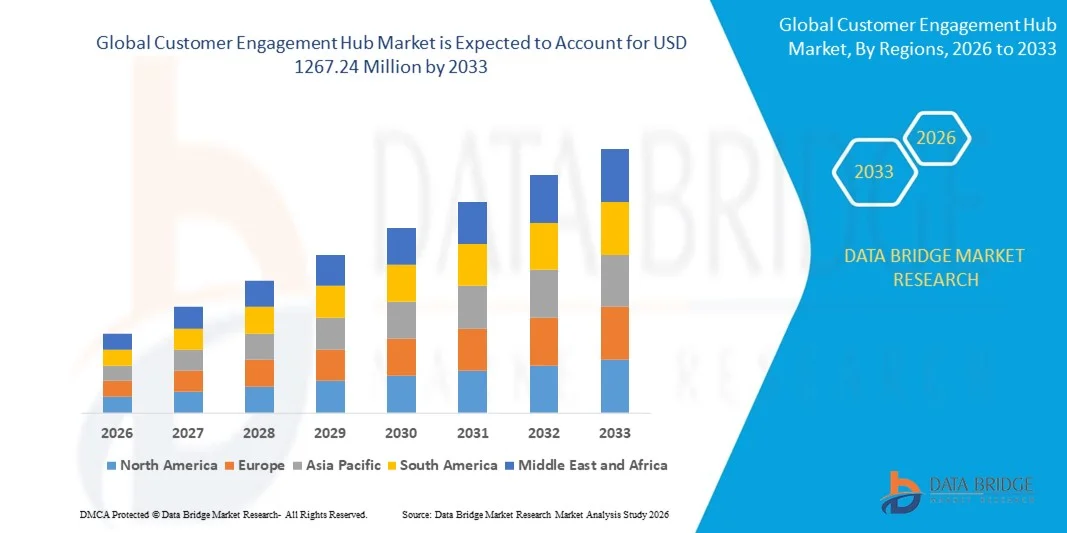
- The global customer engagement hub market size was valued at USD 962.36 million in 2025 and is expected to reach USD 1267.24 million by 2033, at a CAGR of 3.50% during the forecast period
- The market growth is largely fueled by the increasing adoption of cloud-based platforms, AI-powered analytics, and omnichannel customer engagement solutions, leading to enhanced personalization, improved operational efficiency, and deeper customer insights across enterprises
- Furthermore, rising enterprise demand for real-time, integrated, and user-friendly engagement tools is establishing Customer Engagement Hubs as essential solutions for managing customer interactions across web, mobile, social, and contact center channels. These converging factors are accelerating the adoption of advanced engagement platforms, thereby significantly driving market growth
Customer Engagement Hub Market Analysis
- Customer Engagement Hubs, offering centralized platforms for managing, analyzing, and optimizing customer interactions, are becoming increasingly vital for enterprises seeking to enhance customer satisfaction, loyalty, and overall experience across multiple industries
- The growing need for data-driven decision-making, improved customer retention, and seamless integration with CRM, marketing automation, and support systems is primarily fueling the demand for Customer Engagement Hubs, as businesses aim to deliver consistent and personalized experiences across all touchpoints
- North America dominated the customer engagement hub market with a share of 39.5% in 2025, due to increasing demand for omnichannel customer engagement solutions and advanced analytics to improve customer experience
- Asia-Pacific is expected to be the fastest growing region in the customer engagement hub market during the forecast period due to rapid digitalization, urbanization, and increasing adoption of cloud-based and AI-enabled engagement platforms in countries such as China, India, and Japan
- Cloud segment dominated the market with a market share of 57.9% in 2025, due to its scalability, reduced upfront investment, and flexibility in deployment. Organizations increasingly prefer cloud-based solutions for seamless updates, remote accessibility, and integration with other enterprise software, which enhances customer interaction management
Report Scope and Customer Engagement Hub Market Segmentation
|
Attributes |
Customer Engagement Hub Key Market Insights |
|
Segments Covered |
|
|
Countries Covered |
North America
Europe
Asia-Pacific
Middle East and Africa
South America
|
|
Key Market Players |
|
|
Market Opportunities |
|
|
Value Added Data Infosets |
In addition to the insights on market scenarios such as market value, growth rate, segmentation, geographical coverage, and major players, the market reports curated by the Data Bridge Market Research also include in-depth expert analysis, geographically represented company-wise production and capacity, network layouts of distributors and partners, detailed and updated price trend analysis and deficit analysis of supply chain and demand. |
Customer Engagement Hub Market Trends
Rising Adoption of AI-Powered Customer Engagement Solutions
- A significant trend in the customer engagement hub market is the increasing adoption of AI-driven solutions that enable businesses to deliver personalized, efficient, and responsive customer interactions. These AI-powered platforms help organizations analyze large volumes of customer data, automate engagement workflows, and provide predictive insights to enhance overall service quality
- For instance, Salesforce offers Einstein AI within its Customer 360 platform, which provides predictive recommendations and automated engagement tools for improved customer experience. Companies leveraging these capabilities can tailor communications, identify customer needs proactively, and streamline service operations
- Enterprises are increasingly integrating AI with omnichannel platforms to unify customer touchpoints across email, chat, social media, and mobile applications. This convergence is driving the evolution of engagement hubs as central platforms that facilitate seamless interactions and consistent messaging
- The rise of conversational AI, chatbots, and virtual assistants is enhancing real-time support capabilities, enabling businesses to resolve queries quickly and reduce response times. Such implementations are improving customer satisfaction and operational efficiency across industries
- Data analytics and machine learning integration are enabling predictive customer behavior analysis, campaign optimization, and personalized recommendations. These capabilities are making engagement hubs essential for data-driven marketing strategies and loyalty management
- The market is witnessing accelerated growth as companies adopt AI-based engagement platforms to improve customer retention, revenue generation, and service quality. The increasing demand for actionable insights and automated interaction management is reinforcing the strategic importance of customer engagement hubs
Customer Engagement Hub Market Dynamics
Driver
Growing Demand for Omnichannel and Personalized Customer Experiences
- The market growth is driven by the rising need for integrated platforms that deliver consistent and personalized customer experiences across multiple channels. Organizations aim to engage customers seamlessly through digital, mobile, and in-person interactions to strengthen brand loyalty and satisfaction
- For instance, Adobe Experience Cloud provides comprehensive tools for omnichannel customer engagement, enabling brands such as Coca-Cola to deliver targeted campaigns and personalized interactions across web, mobile, and social media channels. This capability enhances user engagement and drives revenue growth
- Increasing competition and higher customer expectations are pushing enterprises to adopt engagement hubs that provide unified customer profiles, journey mapping, and tailored content delivery. Businesses leveraging these insights can optimize interactions and improve conversion rates
- Companies are investing in technologies that enable real-time personalization, predictive recommendations, and adaptive content delivery. This trend is fueling demand for platforms that combine AI, analytics, and workflow automation
- The growing focus on customer lifetime value and retention strategies is reinforcing the importance of integrated engagement hubs. Businesses seek solutions that provide actionable insights, automate routine processes, and deliver measurable ROI on customer experience initiatives
Restraint/Challenge
Data Privacy and Regulatory Compliance Concerns
- The market faces challenges due to stringent data privacy regulations, including GDPR, CCPA, and other regional compliance requirements that restrict the collection, storage, and processing of customer information. Adhering to these regulations increases operational complexity and compliance costs
- For instance, Microsoft Dynamics 365 Customer Insights implements robust data governance and privacy features to help enterprises manage customer data in compliance with legal requirements. Companies must ensure that engagement platforms meet these standards to avoid penalties and reputational risks
- The need to secure sensitive customer information across multiple channels adds pressure on IT and security teams, requiring advanced encryption, monitoring, and audit capabilities. Non-compliance or data breaches can significantly impact customer trust and brand reputation
- Integrating AI and analytics while maintaining privacy compliance presents additional technical challenges, especially when handling large volumes of behavioral and transactional data. Organizations must balance personalization with data protection obligations
- The evolving regulatory landscape and increasing public awareness of data privacy issues continue to pose obstacles to the rapid adoption of engagement hubs. Companies must invest in compliance frameworks, secure infrastructure, and transparent data practices to mitigate these challenges
Customer Engagement Hub Market Scope
The market is segmented on the basis of deployment type, enterprise size, and industry vertical.
- By Deployment Type
On the basis of deployment type, the Customer Engagement Hub market is segmented into on-premise and cloud. The cloud segment dominated the market with the largest revenue share of 57.9% in 2025, driven by its scalability, reduced upfront investment, and flexibility in deployment. Organizations increasingly prefer cloud-based solutions for seamless updates, remote accessibility, and integration with other enterprise software, which enhances customer interaction management. Cloud deployment also supports analytics and AI-powered personalization, allowing businesses to gain real-time insights and improve customer experience. Its ability to support multi-channel engagement and rapid feature deployment makes cloud solutions the preferred choice across industries.
The on-premise segment is expected to witness the fastest growth from 2026 to 2033, fueled by concerns around data security, regulatory compliance, and customization needs. For instance, companies in BFSI such as HSBC implement on-premise Customer Engagement Hubs to maintain strict control over sensitive customer data and tailor workflows to internal processes. Organizations with existing IT infrastructure can leverage on-premise deployments to integrate legacy systems while maintaining performance and reliability. The growing emphasis on data sovereignty and local hosting requirements also supports the adoption of on-premise solutions in regulated markets.
- By Enterprise Size
On the basis of enterprise size, the market is segmented into small enterprises, medium enterprises, and large enterprises. The large enterprises segment dominated the market in 2025, driven by substantial investment capacity, complex customer interaction needs, and the requirement for advanced analytics and omnichannel integration. Large organizations often adopt Customer Engagement Hubs to manage high volumes of customer queries, personalize engagement at scale, and ensure consistent brand experiences. The integration of AI and automation in these hubs allows large enterprises to enhance operational efficiency and reduce response times while maintaining customer satisfaction.
The small enterprises segment is anticipated to witness the fastest growth from 2026 to 2033, fueled by increasing digital adoption and the availability of cost-effective SaaS-based Customer Engagement Hub solutions. For instance, startups and SMEs in retail use platforms such as Salesforce Customer 360 to centralize customer data, streamline support, and run targeted marketing campaigns without heavy IT infrastructure. Small enterprises benefit from the flexibility of subscription models, pay-as-you-go plans, and easy scalability, allowing them to expand their customer engagement capabilities as their business grows. The rising focus on personalized customer interactions is further driving adoption among small enterprises seeking competitive differentiation.
- By Industry Vertical
On the basis of industry vertical, the market is segmented into retail, manufacturing, BFSI, IT, healthcare, and others. The BFSI segment dominated the market in 2025, driven by stringent regulatory requirements, the need for secure and personalized customer interactions, and the high volume of customer transactions. Financial institutions increasingly leverage Customer Engagement Hubs to integrate multiple communication channels, monitor customer sentiment, and automate workflows, enhancing both service quality and compliance adherence. The adoption of advanced analytics, AI-driven insights, and omnichannel support in BFSI enables proactive customer engagement, risk management, and improved retention rates.
The retail segment is expected to witness the fastest growth from 2026 to 2033, fueled by the rising demand for personalized shopping experiences and real-time customer support. For instance, companies such as Walmart implement Customer Engagement Hubs to track customer preferences, optimize promotions, and offer timely assistance across online and in-store channels. Retailers leverage these platforms to integrate e-commerce, loyalty programs, and social media interactions, enhancing overall customer experience. The growing importance of customer retention and targeted marketing strategies is further driving rapid adoption in the retail sector.
Customer Engagement Hub Market Regional Analysis
- North America dominated the customer engagement hub market with the largest revenue share of 39.5% in 2025, driven by increasing demand for omnichannel customer engagement solutions and advanced analytics to improve customer experience
- Businesses in the region are investing in platforms that integrate CRM, AI-driven insights, and automated workflows, enabling personalized and seamless interactions across multiple channels such as email, chat, and social media
- This widespread adoption is further supported by high digital maturity, robust IT infrastructure, and a strong focus on customer-centric strategies, establishing Customer Engagement Hubs as a preferred solution for enterprises across BFSI, retail, and IT sectors
U.S. Customer Engagement Hub Market Insight
The U.S. market captured the largest revenue share in North America in 2025, fueled by rapid adoption of cloud-based engagement platforms and AI-powered analytics. Companies are prioritizing real-time customer insights and automated communication to enhance loyalty and retention. The growing use of mobile and web access platforms, along with integration with CRM and marketing automation tools, is significantly driving growth. Moreover, enterprises are increasingly deploying omnichannel engagement strategies that leverage AI chatbots, personalized messaging, and predictive analytics to deliver superior customer experience.
Europe Customer Engagement Hub Market Insight
The Europe market is projected to expand at a substantial CAGR during the forecast period, primarily driven by regulatory emphasis on data privacy, such as GDPR, and the rising need for personalized customer interactions. Increasing digitization in retail, BFSI, and healthcare sectors is promoting the adoption of advanced engagement platforms. European enterprises are also drawn to cloud solutions for their scalability, flexibility, and integration with analytics tools. Growth is further supported by the focus on customer satisfaction, operational efficiency, and multichannel engagement, covering web, mobile, and social platforms.
U.K. Customer Engagement Hub Market Insight
The U.K. market is anticipated to grow at a noteworthy CAGR, driven by the rising adoption of digital customer engagement platforms across BFSI, retail, and IT sectors. Organizations are focusing on AI-based personalization, predictive analytics, and automated workflows to strengthen customer relationships. The U.K.’s strong e-commerce infrastructure and preference for mobile-first engagement solutions continue to propel the market. In addition, enterprises are increasingly implementing cloud-based Customer Engagement Hubs to enhance efficiency, data-driven decision-making, and seamless omnichannel communication.
Germany Customer Engagement Hub Market Insight
The Germany market is expected to expand at a considerable CAGR, fueled by growing awareness of digital customer engagement and the demand for innovative, data-driven solutions. German enterprises prioritize secure, privacy-compliant platforms to manage large volumes of customer interactions. Integration with CRM systems, AI analytics, and automation is increasing across retail, manufacturing, and BFSI sectors. Moreover, Germany’s focus on digital transformation, coupled with advanced IT infrastructure, is supporting the adoption of both cloud and on-premise Customer Engagement Hubs for enhanced operational efficiency.
Asia-Pacific Customer Engagement Hub Market Insight
The Asia-Pacific market is poised to grow at the fastest CAGR during 2026 to 2033, driven by rapid digitalization, urbanization, and increasing adoption of cloud-based and AI-enabled engagement platforms in countries such as China, India, and Japan. Businesses across retail, BFSI, and IT sectors are investing in omnichannel solutions to enhance customer experience and operational efficiency. Government initiatives supporting digital transformation, along with growing awareness of AI-driven analytics, are driving adoption. Furthermore, APAC is emerging as a hub for SaaS-based engagement solutions, making platforms more accessible and affordable to enterprises of all sizes.
Japan Customer Engagement Hub Market Insight
The Japan market is gaining momentum due to the country’s advanced technology ecosystem, emphasis on customer satisfaction, and demand for seamless digital interactions. Enterprises are leveraging AI, chatbots, and mobile-first engagement platforms to deliver real-time, personalized customer support. The growing focus on automation and predictive analytics, combined with increasing adoption of cloud solutions, is fueling growth. In addition, Japan’s aging population is encouraging the development of user-friendly engagement tools for easier interaction across web and mobile channels.
China Customer Engagement Hub Market Insight
The China market accounted for the largest revenue share in Asia-Pacific in 2025, attributed to rapid urbanization, expanding e-commerce, and high digital adoption among enterprises. Organizations are increasingly investing in Customer Engagement Hubs to integrate multichannel communication, automate workflows, and analyze customer behavior. Strong local technology providers, affordable SaaS-based solutions, and government support for digital infrastructure are driving growth. The push towards smart digital strategies and AI-enabled engagement is enabling enterprises to enhance customer retention and deliver personalized experiences across industries.
Customer Engagement Hub Market Share
The customer engagement hub industry is primarily led by well-established companies, including:
- Avaya Inc. (U.S.)
- IBM Corporation (U.S.)
- Huawei Technologies Co. Ltd. (China)
- Qualtrics (U.S.)
- Zendesk (U.S.)
- Oracle Corporation (U.S.)
- OpenText Corp (Canada)
- SAS Institute Inc. (U.S.)
- Adobe Inc. (U.S.)
- Cisco Systems, Inc. (U.S.)
- Zoho Corporation Pvt. Ltd. (India)
- Tech Mahindra Limited (India)
- Software AG (Germany)
- Tata Consultancy Services Limited (India)
Latest Developments in Global Customer Engagement Hub Market
- In February 2026, SAP announced the expansion of its customer engagement platform by rebranding SAP Emarsys as SAP Engagement Cloud and enhancing it with real-time AI orchestration capabilities. This development allows enterprises to unify customer engagement across all channels, improving coordination between marketing, sales, and service teams. The platform’s advanced analytics enable more precise segmentation and personalized interactions, strengthening SAP’s position in the competitive engagement hub market and helping clients drive higher customer satisfaction and loyalty
- In October 2025, Microsoft unveiled an upgraded version of its Dynamics 365 platform, incorporating enhanced AI-driven customer insights features. The upgrade empowers businesses to analyze customer behavior in real time, predict trends, and deliver personalized experiences across digital and offline channels. By integrating these capabilities, Microsoft positions itself as a leader in providing comprehensive, intelligent engagement solutions that meet evolving enterprise demands and support customer retention strategies
- In September 2025, Adobe launched a new suite of tools designed to improve customer journey mapping and personalization. The initiative enables businesses to gain deeper visibility into each stage of the customer lifecycle, identify engagement gaps, and deliver tailored content and interactions. Adobe’s expansion of its engagement offerings strengthens its competitive edge, particularly among organizations seeking creative-driven, data-informed customer experiences
- In August 2025, Salesforce announced a strategic partnership with a leading AI firm to enhance its customer engagement analytics capabilities. This move allows Salesforce clients to leverage advanced AI models to better understand customer preferences, predict behavior, and optimize engagement strategies. The partnership underscores Salesforce’s commitment to integrating cutting-edge technology, which is expected to boost customer satisfaction and loyalty while consolidating its market leadership
- In January 2025, ChurnZero launched Engagement AI, an AI-powered feature that analyzes customer interactions such as emails, surveys, and meetings to provide sentiment insights and risk indicators. This advancement enables customer success teams to proactively identify at-risk clients, personalize outreach, and improve retention outcomes. By embedding AI-driven insights into its engagement platform, ChurnZero enhances the value proposition for businesses aiming to strengthen long-term customer relationships and maximize engagement effectiveness
SKU-
Get online access to the report on the World's First Market Intelligence Cloud

- Interactive Data Analysis Dashboard
- Company Analysis Dashboard for high growth potential opportunities
- Research Analyst Access for customization & queries
- Competitor Analysis with Interactive dashboard
- Latest News, Updates & Trend analysis
- Harness the Power of Benchmark Analysis for Comprehensive Competitor Tracking
Global Customer Engagement Hub Market, Supply Chain Analysis and Ecosystem Framework
To support market growth and help clients navigate the impact of geopolitical shifts, DBMR has integrated in-depth supply chain analysis into its Global Customer Engagement Hub Market research reports. This addition empowers clients to respond effectively to global changes affecting their industries. The supply chain analysis section includes detailed insights such as Global Customer Engagement Hub Market consumption and production by country, price trend analysis, the impact of tariffs and geopolitical developments, and import and export trends by country and HSN code. It also highlights major suppliers with data on production capacity and company profiles, as well as key importers and exporters. In addition to research, DBMR offers specialized supply chain consulting services backed by over a decade of experience, providing solutions like supplier discovery, supplier risk assessment, price trend analysis, impact evaluation of inflation and trade route changes, and comprehensive market trend analysis.
Research Methodology
Data collection and base year analysis are done using data collection modules with large sample sizes. The stage includes obtaining market information or related data through various sources and strategies. It includes examining and planning all the data acquired from the past in advance. It likewise envelops the examination of information inconsistencies seen across different information sources. The market data is analysed and estimated using market statistical and coherent models. Also, market share analysis and key trend analysis are the major success factors in the market report. To know more, please request an analyst call or drop down your inquiry.
The key research methodology used by DBMR research team is data triangulation which involves data mining, analysis of the impact of data variables on the market and primary (industry expert) validation. Data models include Vendor Positioning Grid, Market Time Line Analysis, Market Overview and Guide, Company Positioning Grid, Patent Analysis, Pricing Analysis, Company Market Share Analysis, Standards of Measurement, Global versus Regional and Vendor Share Analysis. To know more about the research methodology, drop in an inquiry to speak to our industry experts.
Customization Available
Data Bridge Market Research is a leader in advanced formative research. We take pride in servicing our existing and new customers with data and analysis that match and suits their goal. The report can be customized to include price trend analysis of target brands understanding the market for additional countries (ask for the list of countries), clinical trial results data, literature review, refurbished market and product base analysis. Market analysis of target competitors can be analyzed from technology-based analysis to market portfolio strategies. We can add as many competitors that you require data about in the format and data style you are looking for. Our team of analysts can also provide you data in crude raw excel files pivot tables (Fact book) or can assist you in creating presentations from the data sets available in the report.












