




Global Cybersecurity Market
Market Size in USD Billion
CAGR :
% 
 USD
248.67 Billion
USD
513.97 Billion
2025
2033
USD
248.67 Billion
USD
513.97 Billion
2025
2033
 Forecast Period Forecast Period |
2026 - 2033 |
 Market Size (Base Year) Market Size (Base Year) |
USD 248.67 Billion |
 Market Size (Forecast Year) Market Size (Forecast Year) |
USD 513.97 Billion |
 CAGR CAGR |
% |
| Major Markets Players |
|
Cybersecurity Market Size
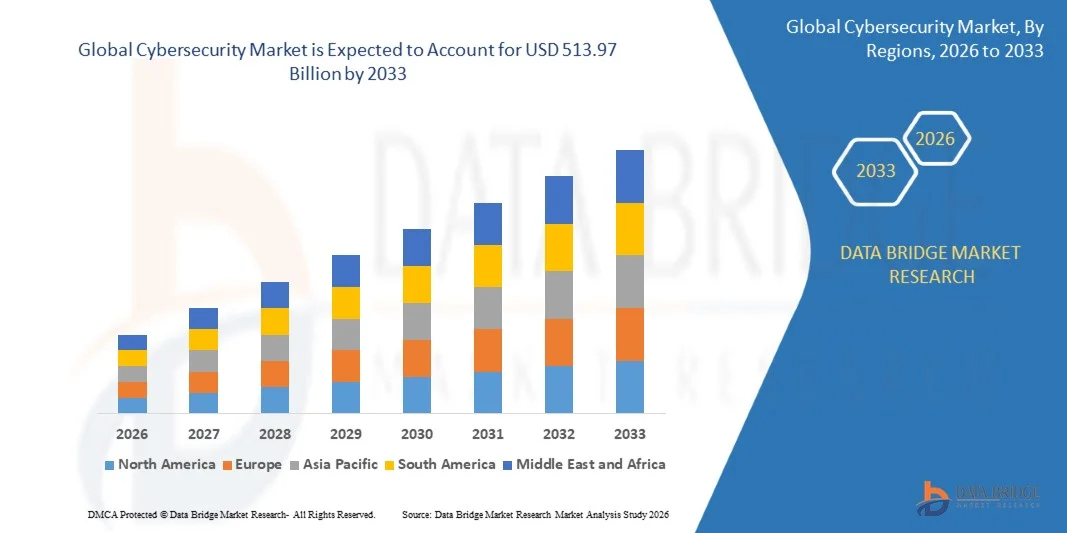
- The global Cybersecurity market size was valued at USD 248.67 billion in 2025and is expected to reach USD 513.97 billion by 2033, at a CAGR of 9.5% during the forecast period.
- Market growth is primarily driven by increasing cyber threats, rising adoption of cloud computing, rapid digital transformation across industries, and growing demand for advanced data protection solutions.
- Additionally, increasing investments in Artificial Intelligence (AI)-powered threat detection, Zero Trust architecture, cloud security platforms, and endpoint protection technologies are significantly accelerating market expansion.
Cybersecurity Market Analysis
- Cyber security solutions, including network security, endpoint protection, cloud security, identity and access management, and threat intelligence platforms, play a critical role in protecting enterprise infrastructure, sensitive data, and digital assets from cyberattacks and unauthorized access.
- The growing frequency of ransomware attacks, phishing incidents, data breaches, and Advanced Persistent Threats (APTs) is driving organizations to strengthen their cyber defense capabilities.
- North America dominated the Cyber Security market with a revenue share of 36.48% in 2025, supported by strong adoption of advanced security technologies, increasing cybersecurity investments, and strict data privacy regulations across enterprises and government organizations.
- Asia-Pacific is expected to witness the fastest growth during the forecast period due to rapid digitalization, increasing internet penetration, expansion of cloud infrastructure, and rising cybersecurity awareness across countries such as China, India, Japan, and South Korea.
- The cloud security segment dominated the market with 29.64% share in 2025, owing to increasing migration of enterprise workloads to cloud environments and rising demand for secure cloud infrastructure management.
Report Scope and Cybersecurity Market Segmentation
|
Attributes |
Cybersecurity Key Market Insights |
|
Segments Covered |
|
|
Countries Covered |
North America · U.S. · Canada · Mexico Europe · Germany · France · U.K. · Netherlands · Switzerland · Belgium · Russia · Italy · Spain · Turkey · Rest of Europe Asia-Pacific · China · Japan · India · South Korea · Singapore · Malaysia · Australia · Thailand · Indonesia · Philippines · Rest of Asia-Pacific Middle East and Africa · Saudi Arabia · U.A.E. · South Africa · Egypt · Israel · Rest of Middle East and Africa South America · Brazil · Argentina · Rest of South America |
|
Key Market Players |
|
|
Market Opportunities |
· Increasing adoption of AI-powered cybersecurity and threat intelligence platforms · Growing deployment of Zero Trust architecture and cloud-native security solutions |
|
Value Added Data Infosets |
In addition to the market insights such as market value, growth rate, market segments, geographical coverage, market players, and market scenario, the market report curated by the Data Bridge Market Research team includes in-depth expert analysis, import/export analysis, pricing analysis, production consumption analysis, and pestle analysis. |
Cybersecurity Market Trends
“Increasing Adoption of AI-Driven Threat Detection and Zero Trust Security Models”
- A major trend shaping the global Cyber Security market is the increasing integration of Artificial Intelligence (AI), Machine Learning (ML), behavioral analytics, and automation into cybersecurity platforms.
- Enterprises across banking, healthcare, manufacturing, retail, and government sectors are increasingly deploying intelligent security solutions to identify, analyze, and mitigate cyber threats in real time.
- Zero Trust security frameworks are gaining significant traction due to their ability to continuously authenticate users, devices, and applications across distributed IT environments.
- AI-powered Security Information and Event Management (SIEM) systems and Security Operations Centers (SOCs) are enabling organizations to improve threat detection accuracy and reduce incident response time.
- Cloud-native security platforms, endpoint detection and response (EDR) solutions, and extended detection and response (XDR) technologies are witnessing strong demand globally.
- Governments worldwide are implementing stricter cybersecurity regulations and data protection laws, accelerating investments in enterprise cybersecurity infrastructure.
- Increasing adoption of remote work models, Internet of Things (IoT) devices, and connected digital ecosystems is further supporting market growth.
Cybersecurity Market Dynamics
Driver
“Growing Demand for Advanced Data Protection and Digital Security Infrastructure”
- The increasing frequency and sophistication of cyberattacks are major factors driving the growth of the Cyber Security market.
- Organizations across multiple industries are increasingly implementing advanced cybersecurity solutions to safeguard critical infrastructure, enterprise networks, customer data, and digital operations.
- Rising adoption of cloud computing, hybrid work environments, mobile devices, and IoT-connected systems is significantly increasing demand for advanced cyber protection technologies.
- Businesses are heavily investing in endpoint security, cloud security, identity management, firewall solutions, and threat intelligence platforms to strengthen digital resilience.
- Expansion of digital banking, e-commerce, healthcare digitization, and smart infrastructure projects is accelerating the deployment of cybersecurity technologies globally.
- Government regulations related to data privacy, cybersecurity compliance, and critical infrastructure protection are further contributing to market expansion.
- Increasing adoption of AI-driven automation and predictive threat analytics is enabling organizations to improve operational security efficiency.
Restraint/Challenge
“Shortage of Skilled Cybersecurity Professionals and Rising Complexity of Threat Landscape”
- One of the major challenges in the Cyber Security market is the shortage of skilled cybersecurity professionals capable of managing complex digital security environments.
- Small and medium-sized enterprises (SMEs) often face budget constraints and technical limitations in implementing enterprise-grade cybersecurity infrastructure.
- The rapidly evolving threat landscape, including ransomware, insider threats, and AI-powered cyberattacks, creates continuous operational challenges for organizations.
- Integration of advanced cybersecurity platforms with legacy IT systems can be technically complex and costly.
- Increasing concerns regarding data privacy, regulatory compliance, and third-party security vulnerabilities continue to impact enterprise cybersecurity strategies.
- High implementation and maintenance costs associated with advanced cybersecurity solutions may limit adoption in developing economies.
- Additionally, growing sophistication of cybercriminal networks and cross-border cyber threats are creating challenges for global cybersecurity governance and risk management.
Cybersecurity Market Scope
The market is segmented on the basis of components, application, type of threat, security type, deployment model, enterprise size, and verticals.
- By components
On the basis of components, the global Cyber Security market is segmented into service and solutions/software.
The solutions/software segment dominated the market with the largest revenue share in 2025, driven by the increasing adoption of advanced cybersecurity platforms for threat detection, endpoint protection, network monitoring, cloud security, and identity management across enterprises. Organizations are heavily investing in integrated cybersecurity software solutions to safeguard sensitive business data, digital assets, and critical infrastructure from evolving cyber threats. The growing deployment of AI-powered security analytics, Security Information and Event Management (SIEM) systems, endpoint detection and response (EDR) platforms, and Zero Trust security frameworks is significantly supporting the growth of this segment. Additionally, increasing cloud adoption and digital transformation initiatives across industries are further accelerating demand for advanced cybersecurity software solutions globally.
The service segment is expected to witness the fastest growth during the forecast period, fueled by rising demand for managed security services, consulting services, incident response, penetration testing, and cybersecurity training solutions. Organizations are increasingly outsourcing cybersecurity operations to managed service providers (MSPs) to improve operational efficiency and strengthen threat management capabilities. The shortage of skilled cybersecurity professionals and the increasing complexity of cyberattacks are significantly driving adoption of cybersecurity services across small, medium, and large enterprises globally.
- By application
On the basis of application, the global Cyber Security market is segmented into identity & access management, data security & privacy service offering, governance risk & compliance, unified vulnerability management service offering, and others.
The identity & access management segment dominated the market with the largest revenue share in 2025, driven by increasing demand for secure authentication, user access control, and identity verification solutions across enterprise environments. Organizations are increasingly deploying multi-factor authentication (MFA), privileged access management (PAM), and biometric authentication technologies to prevent unauthorized access and strengthen digital security infrastructure. Rising adoption of cloud computing, remote work models, and Zero Trust security frameworks is significantly contributing to segment growth.
The unified vulnerability management service offering segment is expected to witness the fastest growth during the forecast period due to increasing cyber threats, growing demand for real-time vulnerability assessment, and rising focus on proactive threat management strategies. Organizations are increasingly implementing vulnerability scanning, risk prioritization, and automated remediation platforms to strengthen cybersecurity posture and reduce exposure to security breaches.
- By Type of Threat
On the basis of type of threat, the global Cyber Security market is segmented into malware, distributed denial-of-service attacks (DDoS), man-in-the-middle (MITM) attacks, zero-day exploits, denial-of-service (DoS), and others.
The malware segment dominated the market with the largest revenue share in 2025, driven by the increasing frequency of ransomware attacks, spyware infections, trojans, and malicious software targeting enterprise networks and connected devices. Organizations across banking, healthcare, government, and retail sectors are increasingly investing in advanced anti-malware solutions, endpoint protection platforms, and AI-powered threat detection technologies to mitigate malware-related risks. The rapid growth of digital infrastructure and internet-connected systems is further accelerating demand for malware protection solutions globally.
The zero-day exploits segment is expected to witness the fastest growth during the forecast period, fueled by increasing sophistication of cyberattacks and rising concerns regarding unknown software vulnerabilities. Enterprises are increasingly deploying advanced threat intelligence platforms, behavioral analytics systems, and AI-driven cybersecurity tools to identify and mitigate zero-day attacks before significant operational damage occurs.
- By Security Type
On the basis of security type, the global Cyber Security market is segmented into infrastructure security, network security, application security, cloud security, endpoint security, and others.
The cloud security segment dominated the market with the largest revenue share in 2025, driven by increasing enterprise migration toward cloud-based environments and rising demand for secure cloud workload protection, identity management, and data encryption technologies. Organizations are increasingly implementing cloud-native security solutions to protect hybrid and multi-cloud infrastructures from cyber threats and unauthorized access. The rapid expansion of SaaS, PaaS, and IaaS platforms is significantly contributing to the growth of this segment globally.
The endpoint security segment is expected to witness the fastest growth during the forecast period due to increasing adoption of remote work environments, rising use of mobile devices, and growing cyber threats targeting endpoint devices. Endpoint detection and response (EDR), antivirus software, and mobile device management (MDM) solutions are increasingly being deployed to strengthen enterprise endpoint security and improve real-time threat response capabilities.
- By Deployment Model
On the basis of deployment model, the global Cyber Security market is segmented into cloud and on-premises.
The cloud segment dominated the market with the largest revenue share in 2025, driven by increasing adoption of cloud-based cybersecurity platforms offering scalability, centralized monitoring, cost efficiency, and remote accessibility. Organizations are increasingly deploying cloud-native security solutions to secure distributed workforces, hybrid cloud infrastructures, and digital business operations. Rising adoption of Software-as-a-Service (SaaS) security platforms and managed security services is significantly supporting market growth.
The on-premises segment is expected to witness steady growth during the forecast period, supported by increasing demand from highly regulated sectors such as BFSI, defense, healthcare, and government organizations requiring greater control over sensitive enterprise data and cybersecurity infrastructure.
- By Enterprise Size
On the basis of enterprise size, the global Cyber Security market is segmented into large enterprise and SMEs.
The large enterprise segment dominated the market with the largest revenue share in 2025, driven by increasing investments in enterprise cybersecurity infrastructure, threat intelligence systems, cloud security platforms, and regulatory compliance management. Large organizations are highly vulnerable to advanced cyberattacks due to their complex IT ecosystems and extensive digital operations, leading to strong adoption of advanced cybersecurity technologies globally.
The SMEs segment is expected to witness the fastest growth during the forecast period due to rising cyber threats targeting small and medium-sized businesses and increasing availability of affordable cloud-based cybersecurity solutions. SMEs are increasingly adopting managed security services, endpoint protection platforms, and cloud security technologies to strengthen business continuity and protect sensitive customer information.
- By Verticals
On the basis of verticals, the global Cyber Security market is segmented into IT, telecom, BFSI, manufacturing, automotive, retail, healthcare, energy & utilities, public sector, and others.
The BFSI segment dominated the market with the largest revenue share in 2025, driven by increasing digital banking adoption, rising online financial transactions, and growing demand for fraud prevention and secure payment infrastructure. Financial institutions are heavily investing in advanced cybersecurity solutions including identity management, threat intelligence, encryption technologies, and transaction security platforms to protect sensitive customer and financial data from cyberattacks.
The healthcare segment is expected to witness the fastest growth during the forecast period, fueled by increasing digitization of healthcare systems, rising adoption of electronic health records (EHRs), connected medical devices, and telemedicine platforms. Growing concerns regarding patient data privacy and ransomware attacks targeting healthcare organizations are significantly accelerating adoption of advanced cybersecurity solutions across the healthcare sector globally.
Cybersecurity Market Regional Analysis
- North America dominated the Cyber Security market with the largest revenue share of 36.48% in 2025, supported by strong cybersecurity investments, rapid cloud technology adoption, and increasing regulatory focus on data protection across the U.S. and Canada.
- The region benefits from the presence of major cybersecurity technology providers, advanced digital infrastructure, and strong enterprise awareness regarding cyber risk management.
- Government initiatives focused on national cybersecurity strategies and protection of critical infrastructure are significantly supporting regional market growth.
- Increasing investments in AI-driven cybersecurity platforms, cloud security technologies, and advanced threat intelligence systems are further strengthening North America’s leading market position.
U.S. Cybersecurity Market Insight
The U.S. Cyber Security market captured the largest revenue share in North America in 2025, driven by increasing cyber threats, strong enterprise cybersecurity spending, and rapid adoption of cloud-based security platforms. Organizations across banking, healthcare, defense, and IT sectors are increasingly deploying AI-powered threat intelligence systems, Zero Trust security frameworks, and endpoint protection solutions to improve digital security resilience. In addition, stringent regulatory compliance requirements and increasing investments in national cybersecurity infrastructure are significantly supporting market growth.
U.K. Cybersecurity Market Insight
The U.K. Cyber Security market is expected to grow at a notable CAGR during the forecast period, supported by increasing adoption of cloud security platforms, rising cybersecurity awareness, and growing government initiatives focused on digital resilience and data privacy protection.
Germany Cybersecurity Market Insight
The Germany Cyber Security market is anticipated to expand at a considerable CAGR during the forecast period due to strong industrial digitization, increasing Industry 4.0 adoption, and rising investments in enterprise cybersecurity infrastructure. Germany’s focus on data protection compliance and secure manufacturing systems is significantly supporting market expansion.
Asia-Pacific Cybersecurity Market Insight
The Asia-Pacific Cyber Security market is poised to grow at the fastest CAGR during the forecast period of 2026 to 2033, driven by rapid digital transformation, increasing internet penetration, and expanding cloud infrastructure adoption. Countries such as China, India, Japan, and South Korea are witnessing strong demand for enterprise cybersecurity solutions, cloud protection platforms, and advanced threat management systems.
Japan Cybersecurity Market Insight
The Japan Cyber Security market is gaining momentum due to increasing investments in digital infrastructure, cloud security, and AI-powered cyber defense technologies. Japan’s strong technology ecosystem and focus on protecting critical infrastructure are significantly contributing to market growth.
India Cybersecurity Market Insight
The India Cyber Security market is expected to witness significant growth during the forecast period, driven by rapid digitalization, expansion of fintech and e-commerce sectors, and increasing government initiatives promoting cybersecurity awareness and digital data protection. Rising adoption of cloud computing and connected digital services is significantly supporting market expansion in India.
Cybersecurity Market Share
The Cybersecurity industry is primarily led by well-established companies, including:
- Cisco Systems, Inc. (U.S.)
- Palo Alto Networks, Inc. (U.S.)
- Fortinet, Inc. (U.S.)
- CrowdStrike Holdings, Inc. (U.S.)
- Check Point Software Technologies Ltd. (Israel)
- IBM Corporation (U.S.)
- Microsoft Corporation (U.S.)
- Trend Micro Incorporated (Japan)
- Broadcom Inc. (U.S.)
- Sophos Ltd. (U.K.)
- McAfee Corp. (U.S.)
- Zscaler, Inc. (U.S.)
- Okta, Inc. (U.S.)
- Proofpoint, Inc. (U.S.)
- Kaspersky Lab (Russia)
- Trend Micro Incorporated (Japan)
- Rapid7, Inc. (U.S.)
- Tenable Holdings, Inc. (U.S.)
- SentinelOne, Inc. (U.S.)
- FireEye, Inc. (U.S.)
Recent Developments in Global Cybersecurity Market
- In April 2026, major cybersecurity providers launched advanced AI-powered threat intelligence and automated incident response platforms designed to strengthen enterprise cyber defense capabilities. These next-generation solutions leverage artificial intelligence, machine learning, and behavioral analytics to identify suspicious activities, predict cyber threats, automate security investigations, and reduce incident response times. The growing sophistication of ransomware attacks and advanced persistent threats (APTs) is significantly accelerating enterprise adoption of AI-driven cybersecurity technologies globally.
- In March 2026, leading cloud security companies expanded their Zero Trust security portfolios by introducing integrated identity verification, multi-factor authentication (MFA), privileged access management (PAM), and real-time access control technologies. These solutions are helping organizations improve user authentication, secure remote work environments, and strengthen protection across hybrid and multi-cloud infrastructures. Increasing adoption of cloud computing and distributed workforce models is significantly driving demand for Zero Trust security frameworks.
- In February 2026, cybersecurity firms introduced advanced endpoint detection and response (EDR) platforms integrated with predictive analytics, threat intelligence, and behavioral monitoring capabilities. These solutions enable organizations to continuously monitor endpoint devices, identify malicious activities in real time, and automate threat remediation processes. The rapid increase in cyberattacks targeting laptops, mobile devices, servers, and connected enterprise systems is significantly supporting demand for intelligent endpoint security technologies.
- In January 2026, enterprises across banking, healthcare, manufacturing, and IT sectors increased investments in cloud-native application protection platforms (CNAPP) and Secure Access Service Edge (SASE) technologies to support hybrid work environments and secure digital operations. These platforms combine networking and cybersecurity capabilities, enabling organizations to improve cloud application security, secure remote access, optimize network performance, and strengthen overall cyber resilience in distributed IT environments.
- In December 2025, major technology providers expanded their managed security service portfolios to help organizations improve cybersecurity operations, threat monitoring, compliance management, and incident response capabilities. Managed Security Service Providers (MSSPs) are increasingly offering 24/7 security monitoring, cloud security management, vulnerability assessment, and regulatory compliance solutions to address the growing shortage of skilled cybersecurity professionals and rising complexity of enterprise cyber threats globally.
SKU-
Get online access to the report on the World's First Market Intelligence Cloud

- Interactive Data Analysis Dashboard
- Company Analysis Dashboard for high growth potential opportunities
- Research Analyst Access for customization & queries
- Competitor Analysis with Interactive dashboard
- Latest News, Updates & Trend analysis
- Harness the Power of Benchmark Analysis for Comprehensive Competitor Tracking
Research Methodology
Data collection and base year analysis are done using data collection modules with large sample sizes. The stage includes obtaining market information or related data through various sources and strategies. It includes examining and planning all the data acquired from the past in advance. It likewise envelops the examination of information inconsistencies seen across different information sources. The market data is analysed and estimated using market statistical and coherent models. Also, market share analysis and key trend analysis are the major success factors in the market report. To know more, please request an analyst call or drop down your inquiry.
The key research methodology used by DBMR research team is data triangulation which involves data mining, analysis of the impact of data variables on the market and primary (industry expert) validation. Data models include Vendor Positioning Grid, Market Time Line Analysis, Market Overview and Guide, Company Positioning Grid, Patent Analysis, Pricing Analysis, Company Market Share Analysis, Standards of Measurement, Global versus Regional and Vendor Share Analysis. To know more about the research methodology, drop in an inquiry to speak to our industry experts.
Customization Available
Data Bridge Market Research is a leader in advanced formative research. We take pride in servicing our existing and new customers with data and analysis that match and suits their goal. The report can be customized to include price trend analysis of target brands understanding the market for additional countries (ask for the list of countries), clinical trial results data, literature review, refurbished market and product base analysis. Market analysis of target competitors can be analyzed from technology-based analysis to market portfolio strategies. We can add as many competitors that you require data about in the format and data style you are looking for. Our team of analysts can also provide you data in crude raw excel files pivot tables (Fact book) or can assist you in creating presentations from the data sets available in the report.












