Global Degaussing System Market
Market Size in USD Billion
CAGR :
% 
 USD
1.13 Billion
USD
1.53 Billion
2025
2033
USD
1.13 Billion
USD
1.53 Billion
2025
2033
 Forecast Period Forecast Period |
2026 –2033 |
 Market Size (Base Year) Market Size (Base Year) |
USD 1.13 Billion |
 Market Size (Forecast Year) Market Size (Forecast Year) |
USD 1.53 Billion |
 CAGR CAGR |
% |
| Major Markets Players |
|
Degaussing System Market Size
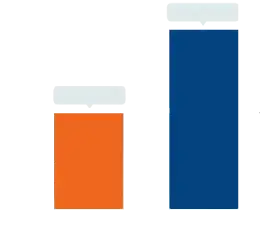
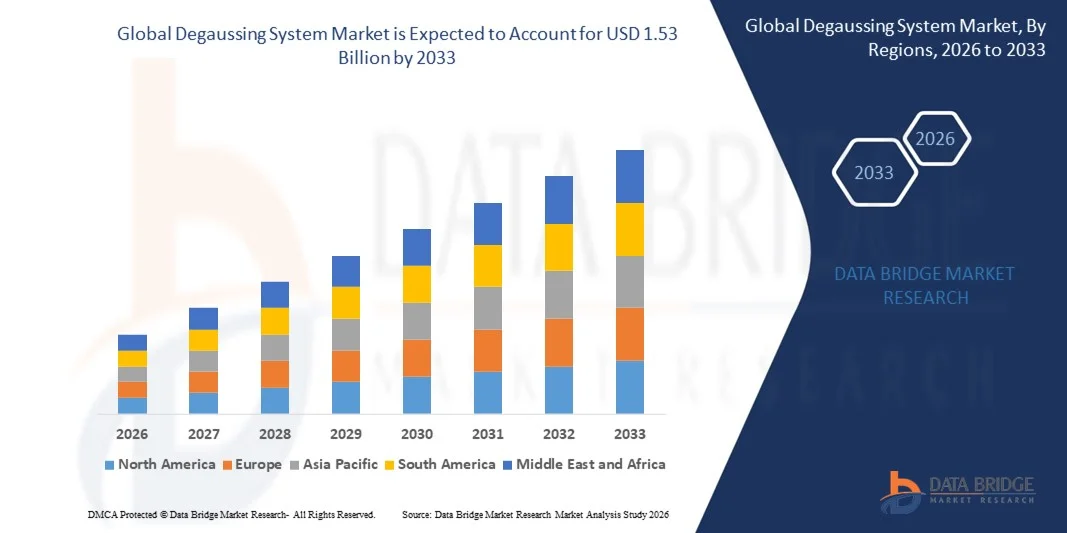
- The global degaussing system market size was valued at USD 1.13 billion in 2025 and is expected to reach USD 1.53 billion by 2033, at a CAGR of 3.90% during the forecast period
- The market growth is largely driven by increasing naval modernization programs and the rising need to protect vessels from magnetic mines and underwater threats, prompting the adoption of advanced degaussing systems across both surface ships and submarines
- Furthermore, growing investments in fleet protection technologies, automated monitoring systems, and high-performance magnetic signature management solutions are establishing degaussing systems as essential components for modern naval operations. These converging factors are accelerating the deployment of degaussing solutions, thereby significantly boosting the market's growth
Degaussing System Market Analysis
- Degaussing systems, designed to reduce a ship’s magnetic signature and protect against magnetic mines, are becoming increasingly critical in modern naval defense and commercial maritime operations due to their role in enhancing vessel survivability and operational safety
- The rising demand for degaussing systems is primarily fueled by expanding naval fleets, technological advancements in ship protection solutions, and heightened maritime security concerns, coupled with the integration of automated and high-efficiency systems across new constructions and retrofitted vessels
- North America dominated the degaussing system market with a share of 44% in 2025, due to increasing naval modernization programs, defense budget allocation, and the presence of major defense contractors implementing advanced degaussing solutions
- Asia-Pacific is expected to be the fastest growing region in the degaussing system market during the forecast period due to rapid naval modernization, increasing defense expenditure, and rising geopolitical tensions in the region
- Degaussing segment dominated the market with a market share of around 50% in 2025, due to its essential role in reducing a vessel’s magnetic signature to protect against mines and other threats. Navies and commercial fleets prioritize degaussing solutions for their proven effectiveness in maintaining operational security and minimizing risk in both peacetime and conflict scenarios
Report Scope and Degaussing System Market Segmentation
|
Attributes |
Degaussing System Key Market Insights |
|
Segments Covered |
|
|
Countries Covered |
North America
Europe
Asia-Pacific
Middle East and Africa
South America
|
|
Key Market Players |
|
|
Market Opportunities |
|
|
Value Added Data Infosets |
In addition to the market insights such as market value, growth rate, market segments, geographical coverage, market players, and market scenario, the market report curated by the Data Bridge Market Research team includes in-depth expert analysis, import/export analysis, pricing analysis, production consumption analysis, and pestle analysis. |
Degaussing System Market Trends
Increasing Adoption of Advanced Magnetic Signature Management Systems
- A significant trend in the degaussing system market is the increasing adoption of advanced magnetic signature management systems by global naval forces to enhance vessel survivability against magnetic mines and underwater threats in complex maritime environments
- For instance, Ultra Electronics and ECA GROUP are deploying integrated degaussing and magnetic measurement solutions on new naval vessels, reinforcing the transition from traditional systems to more automated and precise signature control technologies
- The trend is gaining traction as navies worldwide prioritize automated continuous monitoring systems that can adapt magnetic signatures in real time, improving operational safety during port entries and combat scenarios
- The incorporation of digital sensors, feedback controls, and real-time diagnostics is enabling naval fleets to reduce maintenance cycles and improve magnetic signature predictability, increasing confidence in mission-critical deployments
- This shift toward smarter, networked degaussing systems is also encouraging defense contractors to integrate these systems with broader shipboard platforms, aligning with multi-domain operational requirements
- As maritime threats evolve, navies are placing stronger emphasis on maintaining minimal magnetic signatures, positioning advanced degaussing systems as indispensable for surface ships and submarines in contemporary naval strategies
Degaussing System Market Dynamics
Driver
Rising Naval Modernization Programs and Fleet Expansion
- Rising investments in naval modernization programs and continuous expansion of naval fleets are driving increased adoption of degaussing systems to protect surface and sub-surface vessels from magnetic threat vulnerabilities
- For instance, the U.S. Navy’s multi‑billion‑dollar shipbuilding initiatives, including the expansion of guided missile destroyers and littoral combat ships, are integrating state‑of‑the‑art degaussing technologies supplied by companies such as Wärtsilä to enhance magnetic signature reduction and fleet protection
- The need to upgrade legacy vessels with modern magnetic management systems is prompting defense ministries to allocate substantial budgets for retrofitting degaussing solutions that meet strict operational and safety standards
- Strategic partnerships between governments and industry players for fleet recapitalization have increased the procurement of automated and adaptive degaussing systems that support mission readiness across varied tactical environments
- This consistent focus on fleet enhancement and protection is reinforcing degaussing systems as critical defense assets, fueling long‑term demand and enabling sustained market growth
Restraint/Challenge
High Capital Investment and Complex Integration Requirements
- The degaussing system market faces challenges due to the high capital investment required for acquisition, installation, and long‑term maintenance of advanced magnetic signature management solutions on naval vessels
- For instance, retrofitting legacy fleets with modern degaussing systems supplied by STL Systems AG demands significant upfront expenditure, specialized equipment, and technical expertise, which can strain defense budgets and delay program execution
- The complexity of integrating degaussing technologies with existing shipboard power, control, and sensor systems increases engineering challenges and necessitates extended dockyard periods, further raising total lifecycle costs
- In addition, stringent validation and certification standards for degaussing performance require thorough testing, which can extend project timelines and elevate resource allocation during procurement cycles
- Balancing the need for effective magnetic signature reduction with economic feasibility continues to constrain some segments of the market, prompting stakeholders to seek cost optimization strategies while maintaining operational capability
Degaussing System Market Scope
The market is segmented on the basis of vessel type, solution, and end-user.
- By Vessel Type
On the basis of vessel type, the degaussing system market is segmented into small vessels (<100 M), medium vessels (100–200 M), and large vessels (>200 M). The large vessels segment dominated the market with the largest revenue share in 2025, driven by the extensive use of degaussing systems on naval ships, aircraft carriers, and large cargo vessels where magnetic signature reduction is critical for operational safety. Large vessels require sophisticated degaussing solutions to protect against magnetic mines and torpedoes, making them a priority for defense and commercial fleets. The high complexity and longer operational life of large vessels increase the demand for advanced systems with precise calibration and integration with onboard monitoring systems.
The medium vessels segment is anticipated to witness the fastest growth from 2026 to 2033, fueled by the increasing adoption of degaussing systems on patrol vessels, offshore support vessels, and medium-sized cargo ships. These vessels benefit from scalable degaussing solutions that enhance safety while remaining cost-effective. For instance, companies such as Kongsberg Maritime are providing modular systems suitable for medium-sized vessels, enabling efficient implementation without extensive retrofitting. Growing defense modernization programs and stricter maritime safety regulations are accelerating adoption in this segment.
- By Solution
On the basis of solution, the degaussing system market is segmented into degaussing, ranging, and deperming. The degaussing segment dominated the market with the largest share of around 50% in 2025 due to its essential role in reducing a vessel’s magnetic signature to protect against mines and other threats. Navies and commercial fleets prioritize degaussing solutions for their proven effectiveness in maintaining operational security and minimizing risk in both peacetime and conflict scenarios. The segment’s dominance is also supported by ongoing upgrades to existing systems and integration with modern ship automation and monitoring technologies.
The deperming segment is expected to witness the fastest growth from 2026 to 2033, driven by the increasing need to reset or neutralize vessel hull magnetism during maintenance or retrofit operations. For instance, Thales Group offers advanced deperming systems that provide precise control over magnetic field neutralization, enhancing ship survivability. Rising defense budgets and modernization initiatives are further promoting the adoption of deperming solutions across naval fleets globally.
- By End-User
On the basis of end-user, the degaussing system market is segmented into OEMs, aftermarket, and services. The OEM segment dominated the market in 2025, supported by the integration of degaussing systems into newly built naval and commercial vessels to meet operational safety requirements from the outset. Original equipment manufacturers focus on supplying fully tested and certified systems that comply with international maritime standards, ensuring reliability and long-term performance. OEM adoption is further reinforced by collaborations with defense contractors and shipbuilders for turnkey solutions.
The services segment is anticipated to witness the fastest growth from 2026 to 2033, driven by the rising demand for retrofitting, upgrades, and maintenance of existing degaussing systems. For instance, companies such as Rolls-Royce provide specialized service contracts to ensure vessels maintain optimal magnetic signature management throughout their operational life. Increasing global naval modernization programs and the growing need for lifecycle management solutions are contributing to strong growth in this segment.
Degaussing System Market Regional Analysis
- North America dominated the degaussing system market with the largest revenue share of 44% in 2025, driven by increasing naval modernization programs, defense budget allocation, and the presence of major defense contractors implementing advanced degaussing solutions
- Naval authorities and commercial fleets in the region prioritize reducing vessel magnetic signatures to enhance operational safety and compliance with maritime security standards
- This widespread adoption is further supported by technological advancements in monitoring systems, high investment capacity, and the strong presence of OEMs offering turnkey solutions, establishing degaussing systems as critical equipment for both defense and commercial vessels
U.S. Degaussing System Market Insight
The U.S. degaussing system market captured the largest revenue share in North America in 2025, fueled by extensive naval defense modernization and increasing investments in fleet protection technologies. The U.S. Navy’s focus on reducing magnetic signatures of vessels is driving demand for both shipboard and shore-based degaussing solutions. Integration of advanced sensors and automated monitoring systems is further enhancing system efficiency. In addition, partnerships with defense contractors and ongoing upgrades of existing vessels contribute to robust market growth.
Europe Degaussing System Market Insight
The Europe degaussing system market is projected to grow at a steady CAGR during the forecast period, driven by naval fleet upgrades and stringent defense safety standards. Countries such as France and Italy are increasingly implementing degaussing systems on both new constructions and retrofitted vessels. The rising emphasis on maritime security, coupled with increasing joint naval exercises, is fostering the adoption of degaussing technologies. European navies are also investing in advanced, energy-efficient solutions that align with environmental and operational regulations.
U.K. Degaussing System Market Insight
The U.K. degaussing system market is expected to expand at a notable CAGR, driven by strategic naval defense programs and the need for enhanced ship survivability. Royal Navy vessels are increasingly equipped with modern degaussing systems to reduce magnetic signatures and protect against underwater threats. Government defense modernization initiatives, along with the growing focus on fleet readiness, support market expansion. In addition, the U.K.’s strong shipbuilding and defense technology ecosystem facilitate integration of sophisticated degaussing solutions.
Germany Degaussing System Market Insight
The Germany degaussing system market is anticipated to grow steadily due to increasing investments in naval fleet modernization and adoption of advanced maritime protection technologies. Germany’s naval forces are prioritizing retrofitting existing vessels with automated degaussing systems to enhance operational safety. The emphasis on innovation, reliability, and energy-efficient solutions is driving demand in both commercial and defense maritime applications. Integration with other onboard electronic systems is also becoming increasingly prevalent to optimize fleet performance.
Asia-Pacific Degaussing System Market Insight
The Asia-Pacific degaussing system market is poised to grow at the fastest CAGR during 2026–2033, driven by rapid naval modernization, increasing defense expenditure, and rising geopolitical tensions in the region. Countries such as China, Japan, and India are actively expanding their fleets and equipping vessels with advanced degaussing systems. Government initiatives to enhance maritime security and investments in domestic defense manufacturing further support market adoption. Rising awareness of underwater threat mitigation and fleet survivability is fueling demand across both surface and submarine vessels.
Japan Degaussing System Market Insight
The Japan degaussing system market is gaining momentum due to the nation’s focus on naval defense modernization and the protection of maritime trade routes. Japanese vessels are increasingly equipped with advanced degaussing systems to reduce magnetic signatures against potential threats. The integration of automated monitoring and control systems with fleet operations is driving market growth. In addition, Japan’s strategic focus on enhancing naval readiness and technological self-reliance contributes to the adoption of sophisticated degaussing solutions.
China Degaussing System Market Insight
The China degaussing system market accounted for the largest revenue share in Asia-Pacific in 2025, driven by significant fleet expansion, naval modernization, and emphasis on maritime defense capabilities. China’s focus on minimizing magnetic vulnerability of surface and submarine vessels is a key factor boosting system adoption. The availability of domestic manufacturers and continuous R&D in naval protection technologies further support market growth. Strategic initiatives such as the development of advanced degaussing systems for new naval classes reinforce China’s leadership in the regional market.
Degaussing System Market Share
The degaussing system industry is primarily led by well-established companies, including:
- LARSEN & TOUBRO LIMITED (India)
- Polyamp AB (Sweden)
- Wärtsilä (Finland)
- Ultra Electronics Holdings plc (U.K.)
- ECA GROUP (France)
- IFEN S.p.A. (Italy)
- Dayatech Merin Sdn Bhd (Malaysia)
- American Superconductor Corporation (U.S.)
- STL Systems AG (Germany)
- Surma Ltd (Bangladesh)
- L3Harris Technologies, Inc. (U.S.)
- Groupe Gorgé (France)
Latest Developments in Global Degaussing System Market
- In May 2023, the U.S. Department of Defense awarded Fincantieri’s U.S. subsidiary, Marinette Marine (FMM), a USD 526 million contract to build the fourth Constellation-class destroyer for the U.S. Navy, part of a broader agreement valued at USD 5.5 billion for the main destroyer and nine option ships, including post-delivery support and crew training. This development is expected to significantly boost the U.S. degaussing system market, as these new destroyers will require advanced magnetic signature management and ship protection systems, driving demand for onboard degaussing solutions and supporting services
- In December 2022, American Superconductor Corporation (AMSC) entered into a supply agreement with Huntington Ingalls Industries through its Ingalls Shipbuilding division to provide ship protection systems based on high-temperature superconductors (HTS) for the San Antonio-class amphibious dock transport ship LPD-32. This initiative is poised to enhance the market for advanced naval degaussing technologies, as the deployment of HTS-based protection systems represents a shift toward more efficient and high-performance ship protection solutions, likely prompting further adoption across similar naval platforms
- In November 2022, BAE Systems secured a USD 5 billion contract with the U.K. Ministry of Defense to supply five anti-submarine warfare frigates for the Royal Navy. This development is expected to stimulate the U.K. degaussing system market, as these new frigates will necessitate sophisticated magnetic signature reduction and protection solutions, driving demand for both system manufacturing and integration services in the defense maritime segment
- In August 2022, the U.S. Navy signed a contract with Bollinger Shipyards to design and build an unmanned surface vessel (USV) capable of mine-sweeping and mine-hunting operations, with an initial order of three vessels and options for up to 27 additional ships. This contract is anticipated to expand the U.S. market for degaussing and ship protection systems, as mine-countermeasure USVs require specialized magnetic management technologies to operate safely in high-risk environments, highlighting the growing importance of autonomous naval platforms in driving market growth
- In February 2022, the U.K. commissioned ATLAS ELEKTRONIK U.K. to supply an autonomous minesweeper to the Royal Navy, equipped with advanced "detect and avoid" autonomy, towed side-scan sonar, and launch and recovery systems. This development is likely to strengthen the U.K. degaussing system market, as autonomous mine-countermeasure vessels demand precise magnetic signature control, further promoting the adoption of technologically advanced, automated degaussing solutions in naval operations
SKU-
Get online access to the report on the World's First Market Intelligence Cloud

- Interactive Data Analysis Dashboard
- Company Analysis Dashboard for high growth potential opportunities
- Research Analyst Access for customization & queries
- Competitor Analysis with Interactive dashboard
- Latest News, Updates & Trend analysis
- Harness the Power of Benchmark Analysis for Comprehensive Competitor Tracking
Research Methodology
Data collection and base year analysis are done using data collection modules with large sample sizes. The stage includes obtaining market information or related data through various sources and strategies. It includes examining and planning all the data acquired from the past in advance. It likewise envelops the examination of information inconsistencies seen across different information sources. The market data is analysed and estimated using market statistical and coherent models. Also, market share analysis and key trend analysis are the major success factors in the market report. To know more, please request an analyst call or drop down your inquiry.
The key research methodology used by DBMR research team is data triangulation which involves data mining, analysis of the impact of data variables on the market and primary (industry expert) validation. Data models include Vendor Positioning Grid, Market Time Line Analysis, Market Overview and Guide, Company Positioning Grid, Patent Analysis, Pricing Analysis, Company Market Share Analysis, Standards of Measurement, Global versus Regional and Vendor Share Analysis. To know more about the research methodology, drop in an inquiry to speak to our industry experts.
Customization Available
Data Bridge Market Research is a leader in advanced formative research. We take pride in servicing our existing and new customers with data and analysis that match and suits their goal. The report can be customized to include price trend analysis of target brands understanding the market for additional countries (ask for the list of countries), clinical trial results data, literature review, refurbished market and product base analysis. Market analysis of target competitors can be analyzed from technology-based analysis to market portfolio strategies. We can add as many competitors that you require data about in the format and data style you are looking for. Our team of analysts can also provide you data in crude raw excel files pivot tables (Fact book) or can assist you in creating presentations from the data sets available in the report.