


Global Deployable Military Shelter Market
Market Size in USD Million
CAGR :
% 
 USD
39.19 Million
USD
45.92 Million
2025
2033
USD
39.19 Million
USD
45.92 Million
2025
2033
 Forecast Period Forecast Period |
2026 –2033 |
 Market Size (Base Year) Market Size (Base Year) |
USD 39.19 Million |
 Market Size (Forecast Year) Market Size (Forecast Year) |
USD 45.92 Million |
 CAGR CAGR |
% |
| Major Markets Players |
|
Deployable Military Shelter Market Size
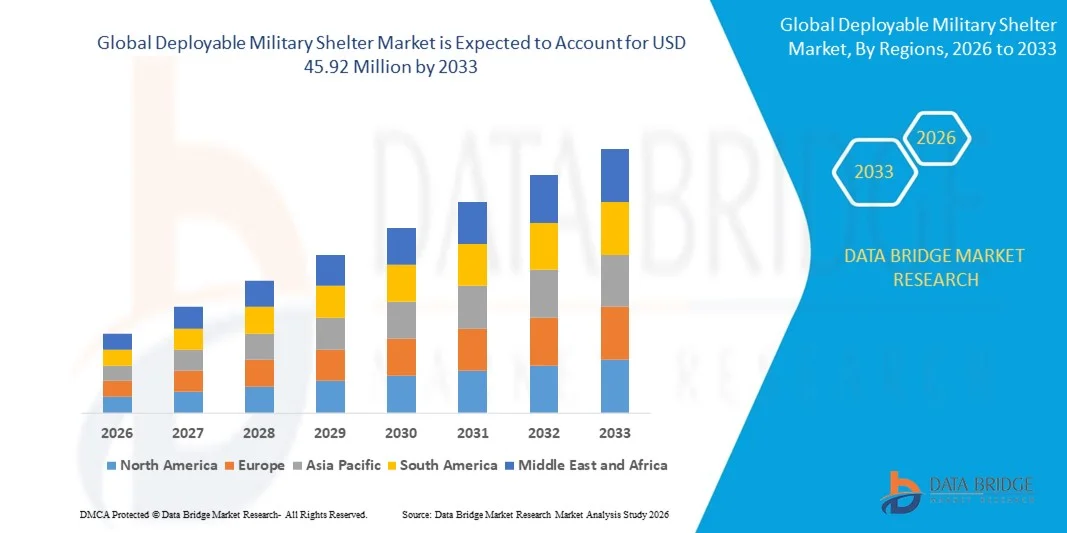
- The global deployable military shelter market size was valued at USD 39.19 million in 2025 and is expected to reach USD 45.92 million by 2033, at a CAGR of 2% during the forecast period
- The market growth is largely fueled by rising defense modernization programs, increasing military budgets, and the growing need for rapidly deployable, modular shelters for field operations, disaster response, and humanitarian missions
- Furthermore, technological advancements in lightweight materials, energy-efficient systems, and modular designs are enhancing the operational efficiency and versatility of deployable shelters. These converging factors are driving the adoption of modern shelter solutions, thereby significantly boosting the industry’s growth
Deployable Military Shelter Market Analysis
- Deployable military shelters, offering rapid deployment, structural durability, and multifunctional capabilities, are becoming essential infrastructure for modern military operations and emergency response scenarios due to their protection, portability, and adaptability across varied environments
- The escalating demand for these shelters is primarily fueled by increasing global military modernization initiatives, the need for mobile operational bases, and the requirement for energy-efficient and self-sufficient systems capable of supporting personnel, command posts, and medical facilities in both combat and humanitarian operations
- North America dominated the deployable military shelter market with a share of around 45% in 2025, due to rising defense budgets, increasing military modernization programs, and high demand for rapid deployment solutions in emergency and tactical operations
- Asia-Pacific is expected to be the fastest growing region in the deployable military shelter market during the forecast period due to increasing defense expenditure, rapid modernization of armed forces, and rising demand for mobile operational infrastructure in countries such as China, Japan, and India
- Composite segment dominated the market with a market share of 58.9% in 2025, due to its superior durability, resistance to harsh environmental conditions, and enhanced structural stability. Military forces often prefer composite shelters for long-term deployments where reliability and protection against extreme weather are critical. The market also sees strong demand for composite materials due to their lightweight yet robust nature, which allows for easier transportation and rapid deployment without compromising structural integrity
Report Scope and Deployable Military Shelter Market Segmentation
|
Attributes |
Deployable Military Shelter Key Market Insights |
|
Segments Covered |
|
|
Countries Covered |
North America
Europe
Asia-Pacific
Middle East and Africa
South America
|
|
Key Market Players |
|
|
Market Opportunities |
|
|
Value Added Data Infosets |
In addition to the insights on market scenarios such as market value, growth rate, segmentation, geographical coverage, and major players, the market reports curated by the Data Bridge Market Research also include in-depth expert analysis, geographically represented company-wise production and capacity, network layouts of distributors and partners, detailed and updated price trend analysis and deficit analysis of supply chain and demand. |
Deployable Military Shelter Market Trends
Increasing Adoption of Modular and Rapidly Deployable Shelter Systems
- A prominent trend in the deployable military shelter market is the growing adoption of modular and rapidly deployable shelter systems, driven by the need for flexible, mobile, and resilient infrastructure in military operations and disaster relief scenarios. These shelters provide quick assembly, enhanced mobility, and adaptability to diverse terrains and environmental conditions
- For instance, General Dynamics and Redco are supplying modular shelter solutions that can be deployed rapidly for forward operating bases and temporary command centers. These systems are enhancing operational readiness and enabling armed forces to respond efficiently to dynamic mission requirements
- The demand for expeditionary shelters is rising as militaries increasingly focus on reducing logistical footprints while maintaining operational capabilities. Modern shelters offer integrated utilities, climate control, and communication systems, which support sustained field operations
- Integration of advanced materials and insulation technologies in military shelters is increasing to improve survivability, durability, and protection against extreme weather and operational hazards. This trend is positioning deployable shelters as essential components for force protection and mission sustainability
- Defense agencies are investing in shelters that support multiple mission profiles, such as medical units, communications hubs, and command posts. The versatility of these shelters is accelerating innovation in rapid assembly mechanisms and modular design configurations
- The market is witnessing heightened interest in transportable shelters compatible with air, land, and sea logistics, which simplifies deployment in remote or hostile environments. This rising focus on mobility and adaptability is reinforcing the strategic importance of deployable military shelters
Deployable Military Shelter Market Dynamics
Driver
Rising Defense Modernization Programs and Military Infrastructure Investment
- The increasing focus on defense modernization programs and military infrastructure investment is driving demand for deployable military shelters that provide versatile, rapidly deployable solutions. Governments and armed forces are prioritizing operational flexibility and protection of personnel in diverse missions
- For instance, the U.S. Department of Defense has partnered with companies such as General Dynamics to enhance rapid-deployment capabilities through advanced modular shelter systems. These investments ensure that deployed forces maintain operational readiness in various theaters of operation
- The expansion of international military exercises and peacekeeping missions is creating a need for mobile, robust, and easily transportable shelters that can be quickly installed in remote locations. This requirement is boosting procurement and R&D for advanced deployable shelters
- Adoption of expeditionary and tactical infrastructure is increasing as militaries aim to reduce setup time while ensuring full operational functionality. Shelters are increasingly integrated with communications, power, and environmental control systems to support sustained operations
- The growing emphasis on operational efficiency, rapid mobilization, and personnel safety continues to fuel investments in deployable military shelters. This sustained focus positions the market for continued growth and technological advancement
Restraint/Challenge
High Production and Maintenance Costs of Advanced Shelter Systems
- The deployable military shelter market faces challenges from high production and maintenance costs associated with advanced modular systems, which incorporate specialized materials, insulation, and integrated utilities. These costs can limit adoption, particularly in regions with constrained defense budgets
- For instance, Redco’s advanced shelter solutions require extensive testing, specialized fabrication, and maintenance programs to ensure field reliability, contributing to higher lifecycle costs. These expenses may slow procurement cycles and impact cost-benefit considerations
- Complex assembly mechanisms and modular integration of communication and environmental systems increase maintenance requirements over traditional field structures. This creates additional logistical and operational challenges for armed forces
- The reliance on high-performance materials, such as ballistic fabrics and climate-resistant composites, elevates both procurement and replacement costs. Maintaining structural integrity under repeated deployments further adds to operational expenditure
- Scaling production while maintaining strict quality standards and military certifications is challenging for manufacturers, which can result in higher unit costs. These cost pressures require careful balancing of technological performance and economic feasibility across the supply chain
Deployable Military Shelter Market Scope
The market is segmented on the basis of material, shelter type, size, and application.
- By Material
On the basis of material, the deployable military shelter market is segmented into polymer fabric and composite. The composite segment dominated the market with the largest revenue share of 58.9% in 2025, driven by its superior durability, resistance to harsh environmental conditions, and enhanced structural stability. Military forces often prefer composite shelters for long-term deployments where reliability and protection against extreme weather are critical. The market also sees strong demand for composite materials due to their lightweight yet robust nature, which allows for easier transportation and rapid deployment without compromising structural integrity. Composites are increasingly integrated with modular designs and insulation systems, enhancing operational efficiency and personnel safety.
The polymer fabric segment is anticipated to witness the fastest growth rate from 2026 to 2033, fueled by the increasing adoption in temporary and rapid-response scenarios. For instance, companies such as ShelterWorks provide polymer fabric shelters that are lightweight, quick to deploy, and versatile for different terrains and missions. These shelters offer flexibility in design, ease of transport, and lower production costs, making them highly suitable for emergency or mobile military operations. In addition, polymer fabric shelters can be equipped with thermal and camouflage layers, catering to evolving tactical and environmental requirements.
- By Shelter
On the basis of shelter type, the market is segmented into rigid wall shelters and soft wall shelters. The rigid wall shelter segment dominated in 2025, driven by its high structural integrity, long-term usability, and enhanced protection against blasts, wind, and extreme temperatures. Military units often deploy rigid wall shelters as command posts, medical facilities, and aircraft bases where stability and safety are paramount. The market also benefits from the ability of rigid shelters to support heavy equipment and integrated systems such as power units, HVAC, and communications infrastructure. Their modularity allows for scalable configurations, making them a preferred choice for extended military operations.
Soft wall shelters are expected to witness the fastest CAGR from 2026 to 2033, fueled by their rapid deployability and transport efficiency. For instance, companies such as Mobile Deployment Systems manufacture soft wall shelters that can be quickly erected and packed for temporary missions. Their lightweight design and portability make them ideal for operations requiring mobility, emergency relief, or temporary housing. Soft wall shelters can also be customized with modular interiors, insulation panels, and camouflage features, meeting dynamic mission requirements while maintaining cost-effectiveness.
- By Size
On the basis of size, the market is segmented into small (up to 6 meters) and large (above 6 meters). The large-size segment dominated in 2025, driven by the demand for multifunctional operational centers, command posts, and medical facilities that require expansive floor space. Military organizations often deploy large shelters for coordination of personnel and equipment in forward operating bases or airfields. The market growth is supported by large shelters’ ability to integrate advanced systems, including climate control, communications, and security features. Large shelters provide enhanced operational efficiency and support for extended missions where personnel accommodation and workspace are critical.
Small-size shelters are anticipated to witness the fastest growth from 2026 to 2033, fueled by their compact design and ease of transport for rapid deployment scenarios. For instance, companies such as Deployable Structures Inc. offer small shelters suited for reconnaissance, temporary command posts, or vehicle-mounted applications. Their portability, quick setup, and adaptability make them ideal for tactical operations requiring minimal logistical footprint. Small shelters can also be rapidly reconfigured or combined with other units, supporting agile military strategies in diverse environments.
- By Application
On the basis of application, the market is segmented into medical facility, aircraft base, command post, vehicle-mounted, personnel, and operations centre. The command post segment dominated in 2025, driven by the critical need for secure, well-equipped centers for operational planning, communication, and coordination in military missions. Forces prioritize command post shelters for their integration capabilities, structural stability, and ability to house advanced communication and IT systems. The market also benefits from the use of command post shelters in both permanent bases and temporary deployments, supporting strategic decision-making and mission readiness. Their adaptability for multiple terrains and climates ensures reliability in diverse operational conditions.
The medical facility segment is expected to witness the fastest CAGR from 2026 to 2033, fueled by increasing demand for deployable healthcare units during field operations and humanitarian missions. For instance, companies such as RedGuard Shelter Systems provide modular medical shelters equipped for rapid setup and operation in remote or conflict zones. These shelters offer critical care capabilities, climate control, and infection control features, ensuring effective healthcare delivery. The market growth is further driven by military and disaster-response initiatives requiring portable and efficient medical infrastructure that can be deployed quickly to support personnel and civilians.
Deployable Military Shelter Market Regional Analysis
- North America dominated the deployable military shelter market with the largest revenue share of around 45% in 2025, driven by rising defense budgets, increasing military modernization programs, and high demand for rapid deployment solutions in emergency and tactical operations
- Military organizations in the region highly value shelters that offer durability, modularity, and quick deployment capabilities, suitable for a variety of missions such as command posts, medical facilities, and vehicle-mounted operations
- This widespread adoption is further supported by advanced defense infrastructure, strong technological capabilities, and strategic investment in lightweight, high-strength materials, establishing deployable shelters as essential solutions for both permanent bases and field operations
U.S. Deployable Military Shelter Market Insight
The U.S. deployable military shelter market captured the largest revenue share in 2025 within North America, fueled by the increasing need for mobile operational facilities and rapid-response infrastructure. Military forces are prioritizing shelters that combine structural integrity with quick assembly and modular design to support multiple mission scenarios. The growing focus on expeditionary bases, emergency medical facilities, and tactical command centers is further propelling market growth. Moreover, the integration of advanced materials such as composites and high-strength fabrics, alongside compatibility with vehicle-mounted and portable systems, is significantly contributing to the market’s expansion.
Europe Deployable Military Shelter Market Insight
The Europe deployable military shelter market is projected to expand at a substantial CAGR during the forecast period, primarily driven by defense modernization initiatives and increased adoption of advanced materials and modular designs. The need for flexible, quickly deployable shelters for military operations and humanitarian missions is encouraging investments across the region. European forces are also focusing on shelters that provide environmental protection, durability, and rapid setup, supporting both field operations and training exercises. In addition, collaborations with domestic manufacturers are enhancing the availability of tailored solutions that meet stringent operational and environmental standards.
U.K. Deployable Military Shelter Market Insight
The U.K. deployable military shelter market is anticipated to grow at a noteworthy CAGR during the forecast period, driven by increased emphasis on rapid deployment capabilities and operational readiness. Military and emergency response agencies are adopting modular shelters for command posts, medical units, and personnel accommodation. The U.K.’s strong defense infrastructure, combined with advanced research in lightweight and durable materials, is expected to continue stimulating market growth. Concerns regarding operational flexibility and mission-critical deployment efficiency are encouraging the selection of high-performance deployable shelters.
Germany Deployable Military Shelter Market Insight
The Germany deployable military shelter market is expected to expand at a considerable CAGR during the forecast period, fueled by defense modernization programs and demand for robust, eco-conscious solutions. German forces emphasize high-quality shelters capable of withstanding extreme weather conditions and supporting multifunctional operations. The country’s focus on technological innovation, sustainability, and integration with mobile and vehicle-mounted systems promotes adoption of advanced deployable shelters. In addition, modularity and rapid assembly capabilities are key factors driving market penetration in both military and emergency response applications.
Asia-Pacific Deployable Military Shelter Market Insight
The Asia-Pacific deployable military shelter market is poised to grow at the fastest CAGR during the forecast period of 2026 to 2033, driven by increasing defense expenditure, rapid modernization of armed forces, and rising demand for mobile operational infrastructure in countries such as China, Japan, and India. The region’s focus on rapid-response, disaster relief, and expeditionary deployments is driving adoption. Furthermore, as APAC becomes a hub for manufacturing advanced deployable shelters, the affordability, accessibility, and variety of solutions are expanding to meet both domestic and international requirements.
Japan Deployable Military Shelter Market Insight
The Japan deployable military shelter market is gaining momentum due to the country’s emphasis on disaster preparedness, technological advancement, and defense readiness. The demand is driven by shelters that are easy to deploy, highly durable, and compatible with smart logistics and mobile command systems. Integration with rapid assembly mechanisms and modular designs is fueling growth. Moreover, Japan’s aging military support infrastructure and frequent natural disasters are expected to increase reliance on efficient, portable shelters in both civilian and military operations.
China Deployable Military Shelter Market Insight
The China deployable military shelter market accounted for the largest market revenue share in Asia-Pacific in 2025, attributed to growing defense budgets, modernization of armed forces, and expanding domestic manufacturing capabilities. China is rapidly adopting deployable shelters for command posts, medical units, and field operations. The focus on smart, lightweight, and quickly deployable shelters enhances operational efficiency and mission flexibility. Government support, coupled with technological advancements and local manufacturing, are key factors propelling the market in China.
Deployable Military Shelter Market Share
The deployable military shelter industry is primarily led by well-established companies, including:
- HDT Global (U.S.)
- Alaska Structures, Inc. (U.S.)
- Super Structures Worldwide (U.S.)
- HTS tentiQ (U.S.)
- Berg Mfg, Inc. (U.S.)
- AAR Corp. (U.S.)
- Zeppelin (Germany)
- Kratos Defense & Security Solutions, Inc. (U.S.)
- Mobile Medical International (U.S.)
- General Dynamics Mission Systems, Inc. (U.S.)
- Marshall Aerospace and Defence Group (U.K.)
- Weatherhaven Global Resources Ltd. (Canada)
- DREHTAINER GmbH (Germany)
- CAMSS SHELTERS (U.K.)
- Rubb Buildings Ltd. (U.K.)
- Western Shelter Systems (U.S.)
Latest Developments in Global Deployable Military Shelter Market
- In May 2025, Rheinmetall AG unveiled a new variant of its armored medical shelter featuring enhanced ballistic protection and integrated telemedicine capabilities, significantly strengthening the company’s presence in rapid-deployment medical solutions. This development is expected to impact the market by raising standards for high-threat zone operations and driving demand for multifunctional shelters that combine protection, healthcare, and advanced technology in disaster response and near-peer conflict scenarios
- In February 2025, AAR Corp. completed its acquisition of a specialized technology firm focused on integrated power management and environmental control units, enhancing the operational self-sufficiency of its containerized shelter systems. This strategic move is anticipated to influence the market by enabling more energy-efficient and autonomous deployable shelters, meeting growing demand for mobile bases capable of extended field operations with reduced logistical dependency
- In November 2024, HDT Global secured a major contract to supply its energy-efficient Base-X shelters for a large-scale joint military exercise in the Indo-Pacific, highlighting the increasing importance of fuel-efficient and environmentally conscious shelter solutions. The contract is likely to drive market growth by encouraging broader adoption of energy-saving shelters in military exercises and forward operating bases, emphasizing sustainability alongside rapid deployability
- In August 2024, Losberger De Boer announced a strategic partnership with a leading composites firm to co-develop next-generation, lightweight rigid wall panels for its modular camp systems. This collaboration is expected to impact the market by reducing transportation costs and logistical footprint for forward-deployed military operations, while also accelerating innovation in modular, high-strength shelter technologies
- In June 2024, Coleman Manufacturing introduced a modular, hybrid fabric-rigid wall shelter system optimized for both extreme temperature conditions and quick assembly in remote areas. This development is projected to influence the market by expanding the versatility of deployable shelters for expeditionary missions and disaster relief operations, offering militaries and humanitarian agencies adaptable solutions that balance durability with rapid deployment
SKU-
Get online access to the report on the World's First Market Intelligence Cloud

- Interactive Data Analysis Dashboard
- Company Analysis Dashboard for high growth potential opportunities
- Research Analyst Access for customization & queries
- Competitor Analysis with Interactive dashboard
- Latest News, Updates & Trend analysis
- Harness the Power of Benchmark Analysis for Comprehensive Competitor Tracking
Global Deployable Military Shelter Market, Supply Chain Analysis and Ecosystem Framework
To support market growth and help clients navigate the impact of geopolitical shifts, DBMR has integrated in-depth supply chain analysis into its Global Deployable Military Shelter Market research reports. This addition empowers clients to respond effectively to global changes affecting their industries. The supply chain analysis section includes detailed insights such as Global Deployable Military Shelter Market consumption and production by country, price trend analysis, the impact of tariffs and geopolitical developments, and import and export trends by country and HSN code. It also highlights major suppliers with data on production capacity and company profiles, as well as key importers and exporters. In addition to research, DBMR offers specialized supply chain consulting services backed by over a decade of experience, providing solutions like supplier discovery, supplier risk assessment, price trend analysis, impact evaluation of inflation and trade route changes, and comprehensive market trend analysis.
Research Methodology
Data collection and base year analysis are done using data collection modules with large sample sizes. The stage includes obtaining market information or related data through various sources and strategies. It includes examining and planning all the data acquired from the past in advance. It likewise envelops the examination of information inconsistencies seen across different information sources. The market data is analysed and estimated using market statistical and coherent models. Also, market share analysis and key trend analysis are the major success factors in the market report. To know more, please request an analyst call or drop down your inquiry.
The key research methodology used by DBMR research team is data triangulation which involves data mining, analysis of the impact of data variables on the market and primary (industry expert) validation. Data models include Vendor Positioning Grid, Market Time Line Analysis, Market Overview and Guide, Company Positioning Grid, Patent Analysis, Pricing Analysis, Company Market Share Analysis, Standards of Measurement, Global versus Regional and Vendor Share Analysis. To know more about the research methodology, drop in an inquiry to speak to our industry experts.
Customization Available
Data Bridge Market Research is a leader in advanced formative research. We take pride in servicing our existing and new customers with data and analysis that match and suits their goal. The report can be customized to include price trend analysis of target brands understanding the market for additional countries (ask for the list of countries), clinical trial results data, literature review, refurbished market and product base analysis. Market analysis of target competitors can be analyzed from technology-based analysis to market portfolio strategies. We can add as many competitors that you require data about in the format and data style you are looking for. Our team of analysts can also provide you data in crude raw excel files pivot tables (Fact book) or can assist you in creating presentations from the data sets available in the report.












