




Global Dermatology Laser Market
Market Size in USD Billion
CAGR :
% 
 USD
2.57 Billion
USD
3.82 Billion
2025
2033
USD
2.57 Billion
USD
3.82 Billion
2025
2033
 Forecast Period Forecast Period |
2026 –2033 |
 Market Size (Base Year) Market Size (Base Year) |
USD 2.57 Billion |
 Market Size (Forecast Year) Market Size (Forecast Year) |
USD 3.82 Billion |
 CAGR CAGR |
% |
| Major Markets Players |
|
Dermatology Lasers Market Size
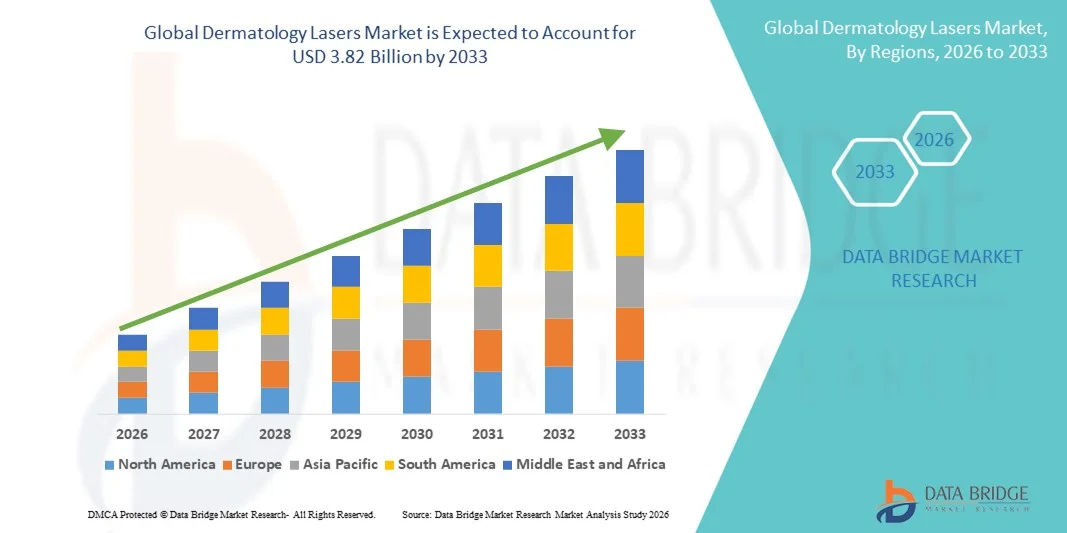
- The global dermatology lasers market size was valued at USD 2.57 billion in 2025 and is expected to reach USD 3.82 billion by 2033, at a CAGR of 5.11% during the forecast period
- The market growth is largely driven by the rising prevalence of skin disorders, increasing aesthetic consciousness, and continuous technological advancements in laser-based dermatological treatments across clinical and cosmetic settings
- Furthermore, growing demand for minimally invasive, precise, and effective skin treatment solutions for conditions such as acne, pigmentation, scars, and skin rejuvenation is establishing dermatology lasers as a preferred therapeutic modality. These converging factors are accelerating the adoption of dermatology laser technologies, thereby significantly boosting the market’s growth
Dermatology Lasers Market Analysis
- Dermatology lasers, offering targeted and energy-based treatment solutions for a broad range of medical and aesthetic skin conditions, are increasingly vital components of modern dermatology practices in both clinical and cosmetic settings due to their high precision, controlled tissue interaction, and minimally invasive treatment capabilities
- The escalating demand for dermatology lasers is primarily fueled by the rising incidence of chronic and aesthetic skin disorders, increasing patient awareness of advanced laser treatments, and a strong preference for non-surgical dermatological procedures with minimal downtime
- North America dominated the dermatology lasers market with the largest revenue share of 38.6% in 2025, characterized by advanced healthcare infrastructure, high procedure volumes, and rapid adoption of innovative laser technologies, with the U.S. witnessing strong demand across hospitals, dermatology clinics, and medical aesthetic centers driven by continuous technological innovation and presence of major industry players
- Asia-Pacific is expected to be the fastest-growing region in the dermatology lasers market during the forecast period due to rising disposable incomes, expanding medical tourism, increasing urbanization, and growing acceptance of aesthetic and therapeutic dermatology procedures
- The non-ablative lasers segment dominated the dermatology lasers market with a market share of 46.2% in 2025, driven by its widespread use in hair removal, facial rejuvenation, and pigment treatment procedures, supported by shorter recovery times, lower risk profiles, and strong patient and practitioner preference
Report Scope and Dermatology Lasers Market Segmentation
|
Attributes |
Dermatology Lasers Key Market Insights |
|
Segments Covered |
|
|
Countries Covered |
North America
Europe
Asia-Pacific
Middle East and Africa
South America
|
|
Key Market Players |
|
|
Market Opportunities |
|
|
Value Added Data Infosets |
In addition to the insights on market scenarios such as market value, growth rate, segmentation, geographical coverage, and major players, the market reports curated by the Data Bridge Market Research also include in-depth expert analysis, patient epidemiology, pipeline analysis, pricing analysis, and regulatory framework |
Dermatology Lasers Market Trends
Rising Shift Toward Non-Ablative and Combination Laser Technologies
- A significant and accelerating trend in the global dermatology lasers market is the growing preference for non-ablative and combination laser technologies that deliver effective clinical outcomes with minimal downtime and reduced risk of complications for patients
- These advanced laser systems are increasingly being adopted across dermatology clinics and aesthetic centers due to their ability to treat multiple skin conditions, including pigmentation, acne scars, hair removal, and skin rejuvenation, using a single platform
- For instance, modern non-ablative laser platforms integrate multiple wavelengths to address different skin depths and conditions, enabling practitioners to customize treatments based on individual patient needs and skin types
- Technological advancements such as real-time skin monitoring, energy modulation, and enhanced cooling mechanisms are further improving treatment precision, patient comfort, and procedural safety in dermatology laser applications
- The convergence of medical and aesthetic dermatology is also driving demand for versatile laser devices that can be used for both therapeutic indications such as psoriasis and vitiligo and cosmetic procedures such as facial rejuvenation and scar reduction
- This shift toward multifunctional, patient-friendly, and clinically efficient laser systems is reshaping practitioner expectations, encouraging manufacturers to focus on innovation, compact system design, and expanded clinical versatility
- Increasing deployment of portable and clinic-friendly laser systems is supporting adoption among small dermatology practices and outpatient aesthetic centers
Dermatology Lasers Market Dynamics
Driver
Increasing Prevalence of Skin Disorders and Demand for Minimally Invasive Treatments
- The rising incidence of chronic skin conditions, aesthetic concerns, and age-related dermatological issues, combined with growing patient preference for minimally invasive procedures, is a major driver fueling demand for dermatology laser systems
- For instance, the growing global burden of acne, psoriasis, vitiligo, and actinic keratosis has led to increased adoption of laser-based therapies due to their targeted treatment approach and reduced reliance on long-term medication
- Dermatology lasers offer advantages such as shorter recovery times, improved cosmetic outcomes, and reduced procedural discomfort, making them an attractive alternative to traditional surgical or pharmacological treatments
- Furthermore, increasing awareness of advanced dermatological treatments and expanding access to specialized dermatology clinics and medical aesthetic centers are supporting higher procedure volumes worldwide
- The continuous introduction of technologically advanced laser platforms with enhanced safety profiles and broader clinical applications is further accelerating adoption across both developed and emerging healthcare markets
- Rising demand for aesthetic procedures among the aging population is significantly contributing to higher utilization of dermatology laser treatments
- Expanding medical tourism for cosmetic and dermatological procedures is further stimulating demand for advanced laser systems in key regional hubs
Restraint/Challenge
High Equipment Costs and Stringent Regulatory Requirements
- The high initial cost of dermatology laser systems, along with ongoing maintenance and training expenses, presents a significant challenge to market growth, particularly for small and mid-sized dermatology clinics
- For instance, advanced laser platforms with multi-wavelength capabilities and integrated cooling systems require substantial capital investment, limiting adoption in cost-sensitive and emerging markets
- In addition, stringent regulatory requirements for medical laser devices, including safety certifications and clinical validation, can extend product approval timelines and increase development costs for manufacturers
- Variability in regulatory frameworks across regions further complicates global market entry, requiring companies to adapt products and documentation to meet country-specific compliance standards
- Addressing these challenges through cost-optimized device designs, flexible financing models, and streamlined regulatory strategies will be essential for broader market penetration and sustained growth
- Limited availability of trained dermatology professionals in certain regions can restrict effective utilization of advanced laser systems
- Concerns related to treatment side effects and post-procedure complications may reduce patient acceptance, particularly among first-time laser therapy users
Dermatology Lasers Market Scope
The market is segmented on the basis of device type, product type, technology, application, and end user.
- By Device Type
On the basis of device type, the dermatology lasers market is segmented into surgical lasers and vascular lasers. The surgical lasers segment dominated the market with the largest revenue share in 2025, driven by their extensive utilization in advanced dermatological procedures such as skin cancer treatment, scar revision, actinic keratosis removal, and complex lesion management. These lasers offer high precision, controlled tissue interaction, and reduced intraoperative bleeding, making them highly suitable for hospital-based and specialized dermatology procedures. Surgical lasers are widely adopted in cases requiring deeper tissue penetration and long-term clinical outcomes. Their dominance is further supported by rising incidences of skin cancer and chronic dermatological conditions globally. Continuous technological improvements in surgical laser accuracy and safety have reinforced their preference among clinicians. In addition, strong reimbursement support for hospital-based procedures in developed regions contributes to sustained demand.
The vascular lasers segment is expected to witness the fastest growth during the forecast period, fueled by increasing demand for minimally invasive treatments targeting vascular skin conditions. These lasers are commonly used to treat varicose veins, rosacea, hemangiomas, and vascular lesions with minimal damage to surrounding tissues. Rising aesthetic awareness and preference for non-surgical vascular treatments are key growth drivers. Improvements in wavelength specificity and cooling technologies are enhancing treatment efficacy and patient comfort. Expanding availability of vascular laser treatments in dermatology clinics is further supporting adoption. Growth in outpatient and cosmetic dermatology procedures is expected to accelerate this segment significantly.
- By Product Type
On the basis of product type, the market is segmented into pulse dye lasers, solid-state lasers, and gas lasers. The solid-state lasers segment dominated the market in 2025 due to their versatility, durability, and broad range of dermatological applications. These lasers are extensively used for hair removal, skin rejuvenation, scar treatment, and pigment correction procedures. Their ability to deliver stable energy output across multiple wavelengths supports consistent clinical outcomes. Solid-state lasers also offer longer operational life and lower maintenance requirements compared to other laser types. Strong adoption across dermatology clinics and cosmetic centers has reinforced segment dominance. Continuous innovation in solid-state laser platforms is further sustaining market leadership.
The pulse dye lasers segment is projected to grow at the fastest rate during the forecast period, driven by increasing use in treating vascular lesions, psoriasis, and inflammatory skin disorders. Pulse dye lasers are particularly valued for their high selectivity toward blood vessels and reduced side-effect profiles. Their effectiveness in treating sensitive skin conditions is expanding their clinical adoption. Technological advancements have improved pulse control and penetration depth, enhancing treatment outcomes. Rising awareness of targeted vascular therapies is supporting growth. Increased availability of pulse dye laser systems in specialized clinics is further accelerating segment expansion.
- By Technology
On the basis of technology, the dermatology lasers market is segmented into ablative lasers and non-ablative lasers. The non-ablative lasers segment dominated the market with the highest revenue share of 46.2% in 2025, driven by strong demand for procedures that offer minimal downtime and faster recovery. These lasers are widely used for hair removal, facial rejuvenation, and pigmentation treatments across cosmetic and clinical settings. Non-ablative technology minimizes damage to the skin surface while stimulating collagen production beneath. Their favorable safety profile makes them suitable for a wide range of skin types. Growing patient preference for low-risk and non-invasive procedures has reinforced adoption. High procedure volumes in aesthetic clinics continue to support segment dominance.
The ablative lasers segment is expected to witness the fastest growth during the forecast period due to rising demand for advanced skin resurfacing treatments. Ablative lasers are highly effective for deep scar reduction, wrinkle removal, and actinic keratosis treatment. Recent advancements in fractional ablative laser systems have reduced recovery times and improved safety. Increasing acceptance of controlled ablative treatments among patients is driving growth. These lasers are gaining popularity for delivering long-lasting cosmetic results. Expansion of advanced dermatology services is further supporting segment growth.
- By Application
On the basis of application, the market is segmented into hair removal, facial rejuvenation, tattoo removal, scar treatment, skin cancer, psoriasis, vitiligo, varicose veins, actinic keratosis, wound treatment, and others. The hair removal segment dominated the market in 2025, supported by consistently high global demand across both aesthetic and clinical dermatology settings. Laser hair removal is one of the most frequently performed cosmetic procedures worldwide. Advancements in laser safety for diverse skin tones have broadened the patient base. Long-lasting results and reduced treatment frequency enhance patient satisfaction. Growing aesthetic awareness among men and women continues to drive procedure volumes. The widespread availability of hair removal laser systems supports sustained dominance.
The tattoo removal segment is anticipated to witness the fastest growth during the forecast period, driven by increasing tattoo adoption followed by rising demand for tattoo correction and removal. Advanced laser technologies enable more effective pigment fragmentation with reduced skin damage. Social, professional, and personal factors are influencing tattoo removal decisions globally. Improved outcomes across different ink colors are expanding treatment acceptance. Rising awareness of safe tattoo removal options is supporting growth. Increased availability of specialized tattoo removal clinics is further accelerating this segment.
- By End User
On the basis of end user, the dermatology lasers market is segmented into hospital, ambulatory surgical centres, and dermatology and cosmetic clinics. The dermatology and cosmetic clinics segment dominated the market in 2025 due to high patient inflow for aesthetic and non-invasive dermatological procedures. These clinics provide specialized laser treatments with shorter waiting times and personalized care. Increasing establishment of standalone cosmetic clinics is supporting strong equipment demand. Clinics also adopt multiple laser platforms to offer diverse treatment portfolios. Growing consumer preference for outpatient aesthetic services reinforces segment dominance. Competitive pricing and convenience further drive patient preference.
The ambulatory surgical centres segment is expected to grow at the fastest rate during the forecast period, driven by the increasing shift toward outpatient dermatological procedures. These centers offer cost-effective and efficient laser treatments with reduced hospital stays. Growing demand for same-day dermatology procedures is supporting adoption. Advances in compact and portable laser systems are facilitating deployment in ambulatory settings. Favorable reimbursement for outpatient procedures in several regions supports growth. Rising focus on healthcare efficiency is further accelerating segment expansion.
Dermatology Lasers Market Regional Analysis
- North America dominated the dermatology lasers market with the largest revenue share of 38.6% in 2025, characterized by advanced healthcare infrastructure, high procedure volumes, and rapid adoption of innovative laser technologies
- Patients and healthcare providers in the region place strong emphasis on minimally invasive treatments, high clinical efficacy, and access to technologically advanced laser systems across both medical and cosmetic dermatology applications
- This widespread adoption is further supported by high healthcare spending, a large base of trained dermatology professionals, and growing awareness of advanced skin treatment options, establishing dermatology lasers as a preferred solution across hospitals, dermatology clinics, and cosmetic centers
U.S. Dermatology Lasers Market Insight
The U.S. dermatology lasers market captured the largest revenue share of 82% in 2025 within North America, fueled by high procedure volumes for both medical and aesthetic dermatology and rapid adoption of advanced laser technologies. Dermatology clinics and hospitals increasingly prioritize laser-based treatments for skin cancer, acne, scars, and cosmetic enhancement. The strong presence of leading laser manufacturers, coupled with continuous technological innovation, further propels market growth. Moreover, high patient awareness, favorable reimbursement for select procedures, and strong demand for minimally invasive treatments are significantly contributing to market expansion.
Europe Dermatology Lasers Market Insight
The Europe dermatology lasers market is projected to expand at a steady CAGR throughout the forecast period, primarily driven by rising demand for aesthetic procedures and increasing prevalence of chronic skin disorders. Stringent medical device regulations and high clinical standards encourage adoption of advanced, clinically validated laser systems. Growing urbanization and aging populations are further supporting demand for dermatological treatments. The region is witnessing strong uptake across hospitals and dermatology clinics, with lasers increasingly used for both therapeutic and cosmetic applications in established and emerging European markets.
U.K. Dermatology Lasers Market Insight
The U.K. dermatology lasers market is anticipated to grow at a notable CAGR during the forecast period, driven by increasing awareness of advanced skin treatments and rising demand for non-invasive aesthetic procedures. Concerns related to skin cancer, acne scarring, and pigmentation disorders are encouraging wider adoption of laser therapies. The country’s strong private healthcare and aesthetic clinic network supports high procedure volumes. In addition, growing acceptance of cosmetic dermatology and access to trained professionals are expected to sustain market growth in the U.K.
Germany Dermatology Lasers Market Insight
The Germany dermatology lasers market is expected to expand at a considerable CAGR during the forecast period, supported by a strong healthcare infrastructure and high emphasis on technological precision and patient safety. Germany’s focus on innovation and clinical efficiency promotes the adoption of advanced laser platforms in both hospitals and dermatology clinics. Rising demand for skin cancer treatment and medically indicated dermatological procedures is a key growth driver. Furthermore, preference for high-quality, regulation-compliant medical devices aligns with increased utilization of dermatology laser systems across the country.
Asia-Pacific Dermatology Lasers Market Insight
The Asia-Pacific dermatology lasers market is poised to grow at the fastest CAGR of 25% during the forecast period of 2026 to 2033, driven by rising disposable incomes, rapid urbanization, and expanding access to aesthetic and dermatological care. Countries such as China, Japan, South Korea, and India are witnessing strong growth in cosmetic dermatology procedures. Increasing medical tourism and growing awareness of laser-based treatments are further accelerating adoption. In addition, improving healthcare infrastructure and the entry of cost-effective laser systems are expanding the market across the region.
Japan Dermatology Lasers Market Insight
The Japan dermatology lasers market is gaining momentum due to the country’s advanced healthcare system, high aesthetic awareness, and strong demand for precision-based treatments. Japanese patients and providers place significant emphasis on safety, efficacy, and technological sophistication. Increasing use of lasers for skin rejuvenation, pigmentation disorders, and scar treatment is driving growth. Moreover, Japan’s aging population is boosting demand for dermatological treatments addressing age-related skin conditions in both clinical and cosmetic settings.
India Dermatology Lasers Market Insight
The India dermatology lasers market accounted for the largest revenue share in Asia Pacific in 2025, supported by rapid urbanization, a growing middle class, and increasing acceptance of aesthetic dermatology. India has emerged as a major hub for dermatology clinics offering laser-based treatments for hair removal, acne, and pigmentation. The expansion of medical tourism and availability of comparatively affordable laser systems are key growth drivers. In addition, rising awareness of advanced skin treatments and increasing number of trained dermatologists are propelling market growth across the country.
Dermatology Lasers Market Share
The Dermatology Lasers industry is primarily led by well-established companies, including:
- Lumenis Be Ltd. (Israel)
- Alma Lasers (Israel)
- Cynosure LLC (U.S.)
- Cutera, Inc. (U.S.)
- Fotona d.o.o. (Slovenia)
- Lutronic Corporation (South Korea)
- Quanta System S.p.A. (Italy)
- Sciton, Inc. (U.S.)
- Solta Medical, Inc. (U.S.)
- Asclepion Laser Technologies GmbH (Germany)
- DEKA M.E.L.A. S.r.l. (Italy)
- El.En. S.p.A. (Italy)
- Lynton Lasers Ltd. (U.K.)
- MedArt A/S (Denmark)
- Sharplight Technologies Ltd. (U.K.)
- Venus Concept Inc. (Canada)
- BISON Medical Co., Ltd. (South Korea)
- Sincoheren Ltd. (China)
- Shenzhen GSD Tech Co., Ltd. (China)
- IPG Photonics Corporation (U.S.)
What are the Recent Developments in Global Dermatology Lasers Market?
- In April 2025, Candela Corporation launched the Vbeam Pro laser platform, a dual-wavelength vascular and dermatologic laser system offering expanded precision and treatment versatility across a wide range of skin conditions, including rosacea, spider veins, scars, and pigmented lesions, representing a significant advancement in pulsed dye laser technology
- In April 2025, Ideal Image partnered with Candela to upgrade its hair removal laser fleet by incorporating Candela’s GentleMax Pro Plus laser with the new GLX delivery system, designed to deliver faster treatment times and enhanced patient comfort at clinics nationwide
- In October 2024, Accure Acne, Inc. announced that the U.S. Food and Drug Administration (FDA) cleared its Accure Laser System for long-term treatment of mild to severe inflammatory acne vulgaris, enabling a non-systemic laser-based therapeutic option with strong clinical outcomes
- In October 2024, Practical Dermatology reported FDA clearance of the Accure Laser System for acne vulgaris, validating the device’s novel laser wavelength and treat-to-temperature mechanism for effective inflammatory lesion reduction, enhancing the clinical landscape for acne laser treatments
- In August 2023, Acclaro Medical unveiled the UltraClear Laser-Coring treatment using a 2910 nm fiber laser to create microscopic ablation channels for deep wrinkles and scars, combining tissue coring with laser rejuvenation effects for improved skin texture with minimal downtime
SKU-
Get online access to the report on the World's First Market Intelligence Cloud

- Interactive Data Analysis Dashboard
- Company Analysis Dashboard for high growth potential opportunities
- Research Analyst Access for customization & queries
- Competitor Analysis with Interactive dashboard
- Latest News, Updates & Trend analysis
- Harness the Power of Benchmark Analysis for Comprehensive Competitor Tracking
Research Methodology
Data collection and base year analysis are done using data collection modules with large sample sizes. The stage includes obtaining market information or related data through various sources and strategies. It includes examining and planning all the data acquired from the past in advance. It likewise envelops the examination of information inconsistencies seen across different information sources. The market data is analysed and estimated using market statistical and coherent models. Also, market share analysis and key trend analysis are the major success factors in the market report. To know more, please request an analyst call or drop down your inquiry.
The key research methodology used by DBMR research team is data triangulation which involves data mining, analysis of the impact of data variables on the market and primary (industry expert) validation. Data models include Vendor Positioning Grid, Market Time Line Analysis, Market Overview and Guide, Company Positioning Grid, Patent Analysis, Pricing Analysis, Company Market Share Analysis, Standards of Measurement, Global versus Regional and Vendor Share Analysis. To know more about the research methodology, drop in an inquiry to speak to our industry experts.
Customization Available
Data Bridge Market Research is a leader in advanced formative research. We take pride in servicing our existing and new customers with data and analysis that match and suits their goal. The report can be customized to include price trend analysis of target brands understanding the market for additional countries (ask for the list of countries), clinical trial results data, literature review, refurbished market and product base analysis. Market analysis of target competitors can be analyzed from technology-based analysis to market portfolio strategies. We can add as many competitors that you require data about in the format and data style you are looking for. Our team of analysts can also provide you data in crude raw excel files pivot tables (Fact book) or can assist you in creating presentations from the data sets available in the report.












