Global Dermatomyositis Treatment Market
Market Size in USD Billion
CAGR :
% 
 USD
906.81 Billion
USD
1,350.01 Billion
2025
2033
USD
906.81 Billion
USD
1,350.01 Billion
2025
2033
 Forecast Period Forecast Period |
2026 –2033 |
 Market Size (Base Year) Market Size (Base Year) |
USD 906.81 Billion |
 Market Size (Forecast Year) Market Size (Forecast Year) |
USD 1,350.01 Billion |
 CAGR CAGR |
% |
| Major Markets Players |
|
Dermatomyositis Treatment Market Size
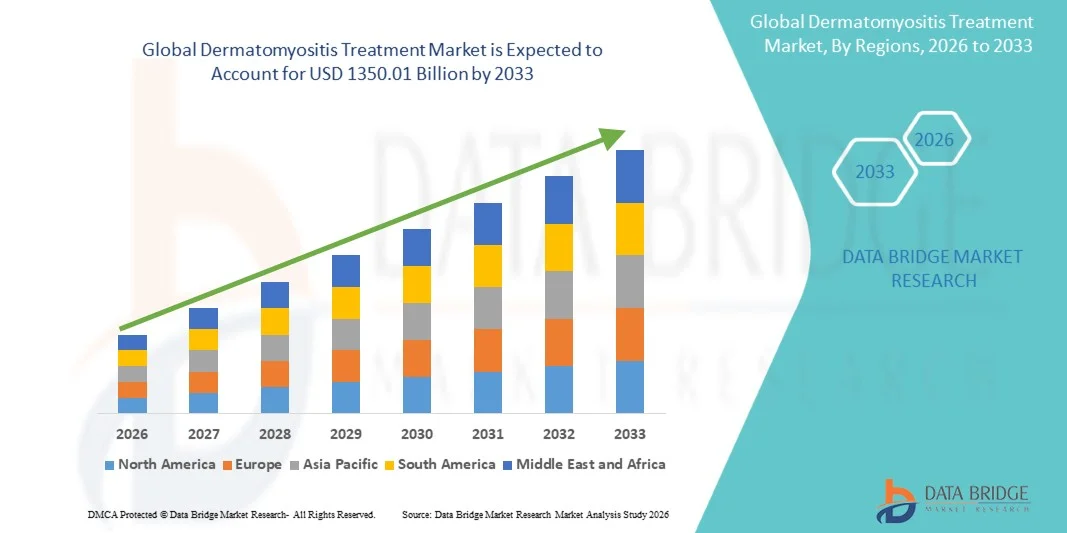
- The global dermatomyositis treatment market size was valued at USD 906.81 billion in 2025and is expected to reach USD 1350.01 billion by 2033, at a CAGR of 5.10% during the forecast period
- The market growth is largely fueled by the increasing awareness and diagnosis of rare autoimmune and inflammatory muscle disorders, along with advancements in immunology research and biologic therapies, leading to improved treatment outcomes for dermatomyositis patients
- Furthermore, rising adoption of corticosteroids, immunosuppressants, and targeted biologic therapies, along with growing focus on personalized medicine and early intervention strategies, are establishing dermatomyositis treatment solutions as essential components of modern autoimmune disease management. These converging factors are accelerating the uptake of dermatomyositis treatment solutions, thereby significantly boosting the industry's growth
Dermatomyositis Treatment Market Analysis
- Dermatomyositis treatment, including corticosteroids, immunosuppressants, intravenous immunoglobulin (IVIG), and biologic therapies, is increasingly vital in managing this rare autoimmune inflammatory disorder characterized by muscle weakness and skin manifestations
- The escalating demand for dermatomyositis treatment is primarily fueled by rising disease awareness, improved diagnostic capabilities, increasing adoption of biologic and targeted therapies, and growing focus on early and personalized treatment approaches
- North America dominated the dermatomyositis treatment market with the largest revenue share of 38.9% in 2025, characterized by advanced healthcare infrastructure, high adoption of biologic therapies, strong clinical research activity, and a well-established rare disease treatment ecosystem in the U.S.
- Asia-Pacific is expected to be the fastest growing region in the dermatomyositis treatment market during the forecast period due to improving healthcare access, increasing awareness of rare autoimmune diseases, rising healthcare expenditure, and expanding availability of advanced immunotherapy options
- The Oral segment held the largest market revenue share of 64.8% in 2025, driven by high patient compliance and ease of long-term administration
Report Scope and Dermatomyositis Treatment Market Segmentation
|
Attributes |
Dermatomyositis Treatment Key Market Insights |
|
Segments Covered |
|
|
Countries Covered |
North America · U.S. · Canada · Mexico Europe · Germany · France · U.K. · Netherlands · Switzerland · Belgium · Russia · Italy · Spain · Turkey · Rest of Europe Asia-Pacific · China · Japan · India · South Korea · Singapore · Malaysia · Australia · Thailand · Indonesia · Philippines · Rest of Asia-Pacific Middle East and Africa · Saudi Arabia · U.A.E. · South Africa · Egypt · Israel · Rest of Middle East and Africa South America · Brazil · Argentina · Rest of South America |
|
Key Market Players |
· AbbVie Inc. (U.S.) · Novartis AG (Switzerland) · Pfizer Inc. (U.S.) · F. Hoffmann-La Roche Ltd. (Switzerland) · Bristol-Myers Squibb Company (U.S.) · Merck & Co., Inc. (U.S.) · Eli Lilly and Company (U.S.) · AstraZeneca plc (U.K.) · Sanofi S.A. (France) · Amgen Inc. (U.S.) · Johnson & Johnson (U.S.) · Takeda Pharmaceutical Company Limited (Japan) · Teva Pharmaceutical Industries Ltd. (Israel) · Sun Pharmaceutical Industries Ltd. (India) · Cipla Limited (India) · Dr. Reddy’s Laboratories Ltd. (India) · Lupin Limited (India) · Zydus Lifesciences Ltd. (India) · Hikma Pharmaceuticals plc (U.K.) · Boehringer Ingelheim International GmbH (Germany) |
|
Market Opportunities |
· Growth in biologic and targeted therapy development · Expansion of rare disease research and orphan drug incentives |
|
Value Added Data Infosets |
In addition to the insights on market scenarios such as market value, growth rate, segmentation, geographical coverage, and major players, the market reports curated by the Data Bridge Market Research also include in-depth expert analysis, patient epidemiology, pipeline analysis, pricing analysis, and regulatory framework. |
Dermatomyositis Treatment Market Trends
“Advancements in Targeted Immunomodulatory and Precision Therapies”
- A significant and accelerating trend in the global dermatomyositis treatment market is the growing shift toward precision medicine and targeted immunomodulatory therapies. This evolution is improving treatment outcomes by enabling more personalized approaches based on disease severity, antibody profiles, and patient-specific immune responses
- For instance, biologic therapies and immunoglobulin-based treatments are increasingly being adopted in refractory dermatomyositis cases, particularly where conventional corticosteroid therapy alone is insufficient. This is helping clinicians achieve better disease control in patients with severe muscle inflammation and systemic involvement
- The use of advanced diagnostic biomarkers, including myositis-specific antibodies (MSAs) and myositis-associated antibodies (MAAs), is improving disease classification and enabling earlier therapeutic intervention. This supports more proactive management of disease progression and complication risk
- In addition, growing clinical research into JAK inhibitors and other targeted immunosuppressive agents is expanding the therapeutic landscape. These therapies are being evaluated for their ability to reduce inflammation while minimizing long-term steroid dependency and associated side effects
- The increasing adoption of multidisciplinary care models, involving rheumatologists, dermatologists, and neurologists, is further enhancing treatment coordination and improving overall patient outcomes in complex dermatomyositis cases
Dermatomyositis Treatment Market Dynamics
Driver
“Rising Disease Awareness and Expanding Access to Advanced Immunotherapies”
- The increasing awareness of autoimmune and inflammatory myopathies is a key driver supporting growth in the dermatomyositis treatment market. Earlier diagnosis rates are improving due to better clinical recognition of symptoms such as progressive muscle weakness and characteristic skin manifestations
- For instance, the broader availability of specialized autoimmune disease testing in tertiary care centers is enabling faster confirmation of dermatomyositis, allowing timely initiation of treatment and reducing the risk of irreversible muscle damage
- Expanding access to advanced immunotherapies, including intravenous immunoglobulin (IVIG) and biologics, is improving treatment outcomes, particularly for patients with moderate to severe disease presentations. These therapies are increasingly being integrated into standard care protocols
- Growing investments in rare disease research and orphan drug development are also accelerating innovation in dermatomyositis management. Pharmaceutical companies are actively exploring novel immunomodulatory pathways to improve efficacy and safety profiles
- In addition, improving healthcare infrastructure in emerging markets is contributing to broader access to specialist care and advanced treatment options, further supporting market expansion
Restraint/Challenge
“Complex Disease Pathophysiology and High Treatment Burden”
- One of the major challenges in the dermatomyositis treatment market is the complex and heterogeneous nature of the disease, which makes standardized treatment approaches difficult. Patients often present with varying degrees of muscle, skin, and systemic involvement
- For instance, treatment regimens frequently require long-term immunosuppression, which can increase the risk of infections and other treatment-related complications, requiring continuous clinical monitoring and dose adjustments
- The chronic nature of dermatomyositis creates a sustained treatment burden for patients, often involving prolonged therapy cycles, frequent hospital visits, and regular laboratory testing. This can negatively impact patient quality of life and adherence to treatment
- In addition, the high cost of biologic therapies and intravenous immunoglobulin limits accessibility in low- and middle-income regions, creating disparities in treatment availability
- Delays in diagnosis due to nonspecific early symptoms and overlap with other autoimmune disorders further complicate disease management and can result in progression to more severe stages before treatment initiation
- Addressing these challenges will require improved diagnostic pathways, increased affordability of advanced therapies, and continued development of safer, more targeted treatment options for long-term disease control
Dermatomyositis Treatment Market Scope
The market is segmented on the basis of treatment type, route of administration, end-users, and distribution channel.
- By Treatment Type
On the basis of treatment type, the Dermatomyositis Treatment market is segmented into Corticosteroids, Immunosuppressive Agents, and Others. The Corticosteroids segment dominated the largest market revenue share of 51.6% in 2025, driven by their strong anti-inflammatory and immunosuppressive effects in rapidly controlling disease symptoms. These drugs are widely recognized as first-line therapy for dermatomyositis management across global clinical guidelines. High prescribing rates among physicians support market dominance. Increasing early diagnosis of autoimmune disorders enhances treatment initiation. Availability of low-cost generic formulations improves accessibility. Strong hospital-based treatment protocols further reinforce adoption. Rising patient awareness of early symptom control supports demand. In addition, combination therapy usage with corticosteroids strengthens clinical outcomes and sustains leadership.
The Immunosuppressive Agents segment is expected to witness the fastest CAGR of 23.2% from 2026 to 2033, driven by increasing cases of steroid-resistant and chronic dermatomyositis. Drugs such as methotrexate, azathioprine, and mycophenolate mofetil are widely used for long-term disease control. Rising focus on steroid-sparing therapies supports adoption. Advancements in targeted immunomodulatory drugs improve treatment precision. Growing clinical trials in autoimmune disorders accelerate innovation. Increasing awareness of long-term steroid side effects further boosts demand. Expanding use in specialty rheumatology centers supports segment growth.
- By Route of Administration
On the basis of route of administration, the Dermatomyositis Treatment market is segmented into Oral, Topical, and Others. The Oral segment held the largest market revenue share of 64.8% in 2025, driven by high patient compliance and ease of long-term administration. Oral corticosteroids and immunosuppressants form the backbone of standard treatment regimens. Widespread availability of oral formulations supports strong adoption globally. Reduced need for hospital visits enhances convenience for chronic patients. Increasing shift toward outpatient care models further strengthens usage. Cost-effectiveness compared to injectable therapies supports preference. Improved drug absorption and formulation technologies enhance efficacy. Expanding healthcare access in emerging economies boosts market penetration.
The Topical segment is expected to witness the fastest CAGR of 21.7% from 2026 to 2033, driven by rising use in managing cutaneous manifestations of dermatomyositis. Topical corticosteroids help reduce skin inflammation, rashes, and discoloration effectively. Growing preference for localized treatment with fewer systemic side effects supports demand. Advancements in dermatological drug delivery systems improve absorption efficiency. Increasing awareness of skin-focused therapies boosts adoption. Rising combination use with systemic therapies further accelerates growth.
- By End-Users
On the basis of end-users, the Dermatomyositis Treatment market is segmented into Hospitals, Homecare, Specialty Clinics, and Others. The Hospitals segment accounted for the largest market revenue share of 48.9% in 2025, driven by strong availability of advanced diagnostic infrastructure and multidisciplinary autoimmune care. Hospitals remain primary centers for severe and acute dermatomyositis cases. Presence of experienced rheumatologists and dermatologists supports effective treatment. Increasing hospitalization rates for complex autoimmune disorders enhance demand. Government healthcare programs further strengthen hospital-based treatment systems. Access to advanced immunosuppressive therapies supports dominance. Rising awareness and early diagnosis contribute to higher patient inflow. Integration of specialized care units further boosts segment leadership.
The Specialty Clinics segment is expected to witness the fastest CAGR of 22.6% from 2026 to 2033, driven by increasing demand for personalized autoimmune disease management. These clinics provide focused rheumatology and dermatology care with continuous monitoring. Growing preference for outpatient-based treatment supports adoption. Availability of advanced diagnostic tools improves treatment accuracy. Rising awareness of rare autoimmune diseases accelerates patient visits. Expansion of specialty healthcare infrastructure further fuels growth.
- By Distribution Channel
On the basis of distribution channel, the Dermatomyositis Treatment market is segmented into Hospital Pharmacy, Online Pharmacy, and Retail Pharmacy. The Hospital Pharmacy segment held the largest market revenue share of 50.4% in 2025, driven by strong integration with inpatient treatment systems and physician-supervised dispensing of critical medications. Hospital pharmacies ensure controlled and safe distribution of corticosteroids and immunosuppressants. High dependency on hospital-based treatment pathways supports dominance. Government healthcare initiatives reinforce structured drug supply systems. Increasing hospitalization rates for autoimmune diseases strengthen demand. Regulatory oversight ensures compliance and patient safety. Strong linkage between hospitals and pharmacies enhances efficiency.
The Online Pharmacy segment is expected to witness the fastest CAGR of 24.5% from 2026 to 2033, driven by rapid digital healthcare adoption and increasing demand for home delivery of chronic medications. Expanding telemedicine platforms support online prescriptions and drug fulfillment. Rising internet penetration and smartphone usage boost accessibility. Patients prefer online channels for convenience, privacy, and time savings. Competitive pricing and discounts further attract users. Partnerships between e-pharmacy platforms and healthcare providers enhance distribution networks and accelerate market expansion.
Dermatomyositis Treatment Market Regional Analysis
- North America dominated the dermatomyositis treatment market with the largest revenue share of 38.9% in 2025, characterized by advanced healthcare infrastructure, high adoption of biologic therapies, strong clinical research activity, and a well-established rare disease treatment ecosystem in the U.S.
- The region benefits from strong availability of immunotherapies, intravenous immunoglobulin (IVIG), corticosteroids, and steroid-sparing agents, which are widely used in managing moderate to severe dermatomyositis cases
- High disease awareness, favorable reimbursement frameworks, and active involvement of leading pharmaceutical and biotechnology companies further support market expansion across North America
U.S. Dermatomyositis Treatment Market Insight
The U.S. dermatomyositis treatment market captured the largest revenue share within North America in 2025, supported by continuous advancements in biologics and immunomodulatory therapies. Increasing diagnosis rates of rare autoimmune disorders, coupled with improved access to specialized rheumatology and dermatology care, are driving treatment uptake. The presence of robust clinical research programs and ongoing development of targeted therapies such as JAK inhibitors and novel monoclonal antibodies is further strengthening market growth. In addition, patient support programs and expanded insurance coverage are improving long-term disease management outcomes.
Europe Dermatomyositis Treatment Market Insight
The Europe dermatomyositis treatment market is projected to expand at a steady CAGR during the forecast period, supported by strong regulatory frameworks for orphan and rare disease drugs and increasing awareness of autoimmune inflammatory myopathies. Growing adoption of biologics, IVIG therapy, and combination immunosuppressive regimens is driving demand across major European healthcare systems. In addition, expanding hospital networks and improved diagnostic capabilities are enabling earlier disease detection and more effective treatment initiation.
U.K. Dermatomyositis Treatment Market Insight
The U.K. dermatomyositis treatment market is anticipated to grow at a notable pace, driven by increasing focus on rare disease diagnosis and structured NHS pathways for autoimmune disorders. Rising utilization of biologic therapies and growing participation in clinical trials are enhancing treatment accessibility. Furthermore, strong academic–industry collaborations are supporting innovation in targeted immunotherapies for refractory dermatomyositis cases.
Germany Dermatomyositis Treatment Market Insight
The Germany dermatomyositis treatment market is expected to expand steadily, supported by a strong hospital infrastructure, high adoption of advanced biologics, and well-established reimbursement systems. Germany’s emphasis on precision medicine and immunology research is contributing to improved treatment strategies for inflammatory myopathies. Increasing use of corticosteroid-sparing agents and early intervention therapies is also helping reduce long-term disease complications.
Asia-Pacific Dermatomyositis Treatment Market Insight
The Asia-Pacific dermatomyositis treatment market is poised to grow at the fastest CAGR during the forecast period, driven by improving healthcare access, rising awareness of rare autoimmune diseases, increasing healthcare expenditure, and expanding availability of advanced immunotherapy options. Countries such as China, Japan, and India are witnessing stronger diagnostic capabilities and growing adoption of biologics, supported by government initiatives to enhance rare disease management.
Japan Dermatomyositis Treatment Market Insight
The Japan dermatomyositis treatment market is gaining traction due to its advanced healthcare system and strong focus on rare disease research. Increasing use of IVIG therapy, immunosuppressants, and biologic agents is supporting treatment outcomes. Japan’s aging population and high healthcare utilization rates are also contributing to sustained demand for long-term autoimmune disease management solutions.
China Dermatomyositis Treatment Market Insight
The China dermatomyositis treatment market accounted for a significant share in Asia Pacific in 2025, supported by expanding healthcare infrastructure, rising awareness of autoimmune disorders, and growing availability of biologic therapies. Increasing hospital investments, improved diagnostic rates, and stronger domestic pharmaceutical capabilities are accelerating treatment adoption. In addition, government support for rare disease drug development is further strengthening market growth.
Dermatomyositis Treatment Market Share
The Dermatomyositis Treatment industry is primarily led by well-established companies, including:
- AbbVie Inc. (U.S.)
- Novartis AG (Switzerland)
- Pfizer Inc. (U.S.)
- Hoffmann-La Roche Ltd. (Switzerland)
- Bristol-Myers Squibb Company (U.S.)
- Merck & Co., Inc. (U.S.)
- Eli Lilly and Company (U.S.)
- AstraZeneca plc (U.K.)
- Sanofi S.A. (France)
- Amgen Inc. (U.S.)
- Johnson & Johnson (U.S.)
- Takeda Pharmaceutical Company Limited (Japan)
- Teva Pharmaceutical Industries Ltd. (Israel)
- Sun Pharmaceutical Industries Ltd. (India)
- Cipla Limited (India)
- Reddy’s Laboratories Ltd. (India)
- Lupin Limited (India)
- Zydus Lifesciences Ltd. (India)
- Hikma Pharmaceuticals plc (U.K.)
- Boehringer Ingelheim International GmbH (Germany)
Latest Developments in Global Dermatomyositis Treatment Market
- In July 2021, the U.S. FDA expanded treatment options for dermatomyositis by supporting the use of intravenous immunoglobulin (IVIG) therapy for patients with refractory disease, marking an important advancement in biologic-based management of this rare autoimmune muscle disorder and strengthening its position as a key standard-of-care option in moderate to severe cases
- In September 2022, clinical research in inflammatory myopathies highlighted increased adoption of JAK inhibitors such as tofacitinib and baricitinib in dermatomyositis treatment pathways, reflecting a shift toward targeted immunomodulatory therapies aimed at controlling disease activity in steroid-resistant patients and improving long-term outcomes
- In November 2023, global dermatology and rheumatology guidelines emphasized growing reliance on biologic therapies and immunoglobulin-based treatments, with IVIG maintaining a significant share of therapeutic use due to its effectiveness in severe dermatomyositis cases and its role in reducing inflammation and muscle weakness in refractory patients
- In April 2024, Roivant Sciences and its subsidiary Priovant Therapeutics reported positive Phase 3 clinical trial results for brepocitinib, demonstrating significant improvement in dermatomyositis symptoms compared to placebo, marking one of the most promising late-stage advancements in targeted oral therapies for the disease
- In December 2025, emerging clinical consensus reports highlighted a growing shift toward targeted oral immunomodulators and biologics for dermatomyositis, with pipeline therapies such as brepocitinib and other JAK/TYK2 inhibitors showing strong potential to become first-line advanced treatment options in the near future
SKU-
Get online access to the report on the World's First Market Intelligence Cloud

- Interactive Data Analysis Dashboard
- Company Analysis Dashboard for high growth potential opportunities
- Research Analyst Access for customization & queries
- Competitor Analysis with Interactive dashboard
- Latest News, Updates & Trend analysis
- Harness the Power of Benchmark Analysis for Comprehensive Competitor Tracking
Research Methodology
Data collection and base year analysis are done using data collection modules with large sample sizes. The stage includes obtaining market information or related data through various sources and strategies. It includes examining and planning all the data acquired from the past in advance. It likewise envelops the examination of information inconsistencies seen across different information sources. The market data is analysed and estimated using market statistical and coherent models. Also, market share analysis and key trend analysis are the major success factors in the market report. To know more, please request an analyst call or drop down your inquiry.
The key research methodology used by DBMR research team is data triangulation which involves data mining, analysis of the impact of data variables on the market and primary (industry expert) validation. Data models include Vendor Positioning Grid, Market Time Line Analysis, Market Overview and Guide, Company Positioning Grid, Patent Analysis, Pricing Analysis, Company Market Share Analysis, Standards of Measurement, Global versus Regional and Vendor Share Analysis. To know more about the research methodology, drop in an inquiry to speak to our industry experts.
Customization Available
Data Bridge Market Research is a leader in advanced formative research. We take pride in servicing our existing and new customers with data and analysis that match and suits their goal. The report can be customized to include price trend analysis of target brands understanding the market for additional countries (ask for the list of countries), clinical trial results data, literature review, refurbished market and product base analysis. Market analysis of target competitors can be analyzed from technology-based analysis to market portfolio strategies. We can add as many competitors that you require data about in the format and data style you are looking for. Our team of analysts can also provide you data in crude raw excel files pivot tables (Fact book) or can assist you in creating presentations from the data sets available in the report.