Global Dermatoscope Market
Market Size in USD Million
CAGR :
% 
 USD
201.38 Million
USD
515.22 Million
2025
2033
USD
201.38 Million
USD
515.22 Million
2025
2033
 Forecast Period Forecast Period |
2026 –2033 |
 Market Size (Base Year) Market Size (Base Year) |
USD 201.38 Million |
 Market Size (Forecast Year) Market Size (Forecast Year) |
USD 515.22 Million |
 CAGR CAGR |
% |
| Major Markets Players |
|
Dermatoscope Market Size
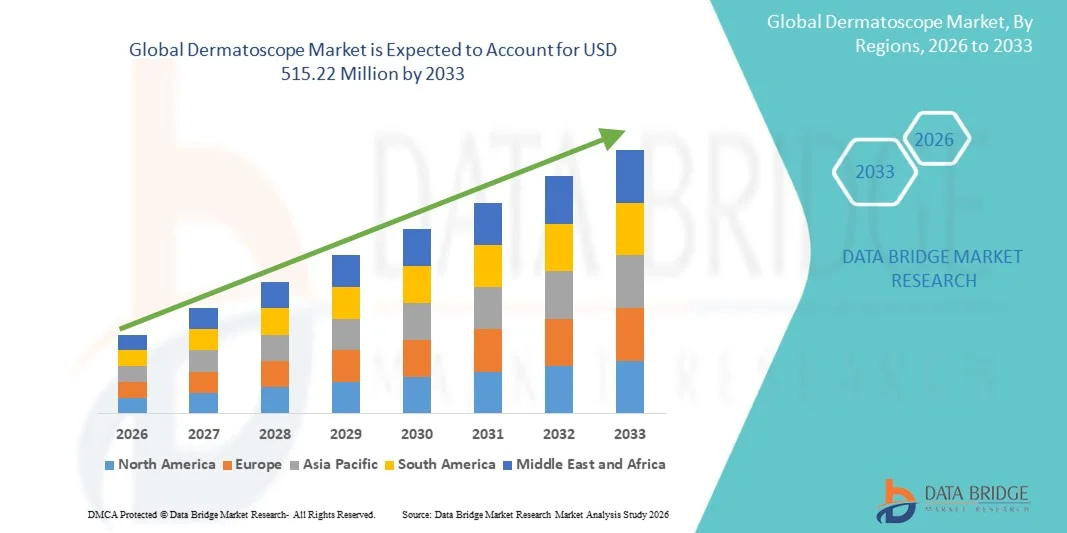
- The global dermatoscope market size was valued at USD 201.38 million in 2025and is expected to reach USD 515.22 million by 2033, at a CAGR of 12.46% during the forecast period
- The market growth is primarily driven by the rising incidence of skin disorders and skin cancer globally, coupled with increasing awareness regarding early and accurate dermatological diagnosis, leading to higher adoption of advanced dermoscopy devices in clinical practice
- Furthermore, rapid technological advancements such as digital dermatoscopes, integration of artificial intelligence for lesion analysis, and growing utilization of teledermatology solutions are strengthening diagnostic efficiency and expanding access to dermatological care, thereby significantly boosting industry growth
Dermatoscope Market Analysis
- Dermatoscopes, which are specialized diagnostic devices used for non-invasive examination of skin lesions and early detection of melanoma and other skin cancers, are becoming increasingly essential in dermatology clinics and primary care settings due to their ability to enhance visualization of subsurface skin structures and improve diagnostic accuracy
- The escalating demand for dermatoscopes is primarily driven by the rising global burden of skin cancer and dermatological disorders, growing emphasis on early diagnosis and preventive healthcare, and increasing adoption of advanced diagnostic tools supported by improving healthcare infrastructure and awareness programs
- North America dominated the dermatoscope market with the largest revenue share of 38.6% in 2025, supported by high skin cancer screening rates, strong dermatology practice adoption, advanced healthcare infrastructure, and the presence of leading medical device manufacturers, particularly in the U.S., where routine skin examinations and technological integration in dermatology are highly prevalent
- Asia-Pacific is expected to be the fastest growing region in the dermatoscope market during the forecast period due to rising healthcare expenditure, increasing awareness of skin health, expanding dermatology services, and growing access to advanced diagnostic equipment in emerging economies
- The handheld segment dominated the dermatoscope market with the largest market share of 52.4% in 2025, attributed to its portability, cost-effectiveness, ease of use in clinical and field settings, and widespread adoption among dermatologists and general practitioners for routine skin examinations
Report Scope and Dermatoscope Market Segmentation
|
Attributes |
Dermatoscope Key Market Insights |
|
Segments Covered |
|
|
Countries Covered |
North America · U.S. · Canada · Mexico Europe · Germany · France · U.K. · Netherlands · Switzerland · Belgium · Russia · Italy · Spain · Turkey · Rest of Europe Asia-Pacific · China · Japan · India · South Korea · Singapore · Malaysia · Australia · Thailand · Indonesia · Philippines · Rest of Asia-Pacific Middle East and Africa · Saudi Arabia · U.A.E. · South Africa · Egypt · Israel · Rest of Middle East and Africa South America · Brazil · Argentina · Rest of South America |
|
Key Market Players |
|
|
Market Opportunities |
· The integration of AI-powered dermatoscopy with smartphone-based imaging systems · Expanding adoption of dermatoscopes in aesthetic dermatology and cosmetic clinics |
|
Value Added Data Infosets |
In addition to the insights on market scenarios such as market value, growth rate, segmentation, geographical coverage, and major players, the market reports curated by the Data Bridge Market Research also include in-depth expert analysis, patient epidemiology, pipeline analysis, pricing analysis, and regulatory framework |
Dermatoscope Market Trends
“Advancement in Digital Imaging and AI-Assisted Diagnosis”
- A significant and accelerating trend in the global dermatoscope market is the rapid adoption of digital dermatoscopes integrated with artificial intelligence (AI) and teledermatology platforms, enhancing lesion visualization, documentation, and diagnostic accuracy in clinical dermatology settings
- For instance, DermLite DL5 dermatoscope is increasingly used with smartphone adapters and digital imaging systems, enabling high-resolution skin lesion capture and seamless sharing with dermatologists for remote consultation and analysis
- AI integration in dermatoscopes enables automated lesion pattern recognition, early melanoma risk assessment, and improved diagnostic decision support, with systems such as FotoFinder utilizing AI-based algorithms to track mole changes over time and flag suspicious lesions
- The integration of dermatoscopes with telemedicine platforms and electronic health records is enabling centralized patient data management, allowing dermatologists to monitor skin conditions remotely and maintain longitudinal imaging records for better clinical decisions
- Increasing adoption of handheld and smartphone-connected dermatoscopes in primary care settings is expanding early screening capabilities beyond dermatology specialists, improving accessibility in rural and semi-urban regions.
- This trend towards smart, connected, and AI-enabled diagnostic imaging systems is reshaping dermatology workflows, with companies such as Canfield Scientific developing advanced dermatoscopy systems offering 3D imaging and AI-powered skin analysis tools.
- The demand for AI-assisted and digital dermatoscopes is growing rapidly across hospitals, dermatology clinics, and telehealth providers, as healthcare systems increasingly prioritize early detection and minimally invasive diagnostic solutions.
Dermatoscope Market Dynamics
Driver
“Rising Skin Cancer Incidence and Demand for Early Diagnosis”
- The increasing prevalence of skin cancer and other dermatological disorders, coupled with growing awareness of early-stage diagnosis, is a major driver for the rising demand for dermatoscopes across global healthcare systems
- For instance, in April 2025, MetaOptima Technology Inc. expanded its AI-based skin imaging platform MoleScope, enhancing dermatoscopic screening capabilities for early melanoma detection in primary care settings
- As patients and healthcare providers prioritize early and accurate diagnosis, dermatoscopes provide enhanced visualization of skin structures, enabling non-invasive detection of malignant and benign lesions with improved clinical confidence
- Furthermore, rising investment in dermatology infrastructure and increasing government-led skin cancer awareness campaigns are driving the adoption of advanced dermatoscopic tools in hospitals and specialty clinics
- The convenience of portable dermatoscopes, integration with smartphones, and ability to support teledermatology consultations are key factors accelerating adoption across both developed and emerging healthcare markets
- Growing adoption of preventive dermatology and routine skin screening programs in high-risk populations is further boosting the consistent demand for dermatoscopy devices in clinical practice
- Expansion of cosmetic dermatology and aesthetic clinics is also contributing to higher utilization of dermatoscopes for pre-procedure skin assessment and treatment monitoring
Restraint/Challenge
“High Device Cost and Limited Skilled Dermatology Workforce”
- Concerns regarding the high cost of advanced digital and AI-enabled dermatoscopes, along with limited reimbursement coverage in certain regions, pose a significant challenge to broader market penetration, particularly in cost-sensitive healthcare systems
- For instance, high-end dermatoscopy systems such as FotoFinder ATBM can be financially restrictive for small clinics and private practitioners, limiting adoption in developing healthcare markets despite their diagnostic benefits
- In addition, the shortage of trained dermatologists and limited expertise in dermoscopic interpretation in several regions reduces effective utilization of these devices, impacting diagnostic consistency and clinical outcomes
- While portable and smartphone-based dermatoscopes are becoming more affordable, advanced imaging systems with AI capabilities and full-body mapping features still involve high capital investment and maintenance costs
- Lack of standardized training programs for dermatoscopy interpretation across emerging economies further limits widespread clinical adoption and optimal device utilization
- Overcoming these challenges through cost-effective device innovations, training programs for healthcare professionals, and improved insurance reimbursement policies will be critical for sustained market expansion
Dermatoscope Market Scope
The market is segmented on the basis of product, technology, modality, application, and end use.
- By Product
On the basis of product, the dermatoscope market is segmented into contact dermatoscope, hybrid dermatoscope, and non-contact dermatoscope. The contact dermatoscope segment dominated the market with the largest market revenue share of 46.8% in 2025, driven by its widespread clinical adoption for routine skin examinations and its ability to provide enhanced lesion clarity through direct skin contact and immersion fluids. Dermatologists prefer contact dermatoscopes due to their high diagnostic accuracy in evaluating pigmented skin lesions and their cost-effectiveness compared to advanced digital systems. The segment also benefits from strong usage in hospitals and dermatology clinics where standardized skin cancer screening procedures are frequently performed.
The non-contact dermatoscope segment is anticipated to witness the fastest growth rate of 18.9% from 2026 to 2033, fueled by increasing demand for infection-free diagnostic tools and the rising adoption of teledermatology practices. Non-contact devices eliminate direct skin contact, making them suitable for sensitive lesions and improving hygiene standards in clinical workflows. The integration of polarized light and high-resolution imaging technologies further enhances diagnostic performance without the need for immersion fluids. Growing use in remote consultation and AI-based digital imaging platforms is also accelerating the adoption of non-contact dermatoscopes globally.
- By Technology
On the basis of technology, the dermatoscope market is segmented into LED, xenon, halogen, and ultraviolet. The LED segment held the largest market revenue share of 52.4% in 2025, driven by its superior illumination quality, energy efficiency, longer lifespan, and ability to provide consistent, high-contrast imaging of skin structures. LED-based dermatoscopes are widely preferred in modern dermatology practices due to reduced heat emission and compatibility with both polarized and non-polarized imaging modes. The increasing shift toward portable and battery-operated devices further strengthens LED adoption across clinical settings.
The ultraviolet (UV) dermatoscope segment is expected to witness the fastest CAGR of 19.6% from 2026 to 2033, driven by its growing use in detecting fungal infections, bacterial conditions, and early-stage skin abnormalities not easily visible under visible light. UV technology enhances visualization of subsurface skin fluorescence, enabling more detailed diagnostic assessment in complex dermatological cases. Rising research applications and increasing use in specialized dermatology and infectious disease diagnostics are further supporting segment growth. Technological advancements improving UV safety and imaging precision are also expanding clinical acceptance.
- By Modality
On the basis of modality, the dermatoscope market is segmented into handheld, trolley-mounted, and headband dermatoscopes. The handheld dermatoscope segment dominated the market with the largest market revenue share of 52.4% in 2025, driven by its portability, ease of use, and widespread adoption across dermatology clinics and primary care settings. Handheld devices are preferred for routine skin examinations, offering flexibility, cost efficiency, and compatibility with smartphone-based imaging systems. Their ability to support both contact and non-contact modes further enhances clinical utility in diverse diagnostic environments.
The headband dermatoscope segment is anticipated to witness the fastest growth rate of 17.4% from 2026 to 2033, fueled by increasing demand for hands-free operation during complex dermatological procedures and surgical examinations. Headband systems provide improved precision and stability, allowing dermatologists to conduct detailed examinations while maintaining better focus and ergonomics. Growing adoption in surgical dermatology and cosmetic procedures is further accelerating demand. Integration with high-resolution imaging and digital recording systems is also enhancing their clinical value.
- By Application
On the basis of application, the dermatoscope market is segmented into skin tumors, scabies, warts, and fungal infections. The skin tumors segment dominated the market with the largest market revenue share of 61.5% in 2025, driven by the rising global incidence of melanoma and non-melanoma skin cancers and the critical need for early detection. Dermatoscopes play a vital role in evaluating pigmented lesions and distinguishing benign from malignant tumors with high diagnostic accuracy. Increasing screening programs and awareness campaigns for skin cancer further strengthen this segment’s dominance.
The fungal infections segment is expected to witness the fastest CAGR of 16.8% from 2026 to 2033, driven by the rising prevalence of dermatophytic infections and increasing demand for rapid, non-invasive diagnostic tools. Dermatoscopes help in identifying characteristic fungal patterns on the skin, reducing dependence on laboratory confirmation in early-stage diagnosis. Growing cases linked to humidity, lifestyle changes, and immunocompromised populations are further supporting demand. Expanding use in primary care and teledermatology consultations is also accelerating segment growth.
- By End Use
On the basis of end use, the dermatoscope market is segmented into hospitals, dermatology clinics, and others. The dermatology clinics segment dominated the market with the largest market revenue share of 49.7% in 2025, driven by high patient footfall for skin disorder diagnosis and treatment and the strong preference for specialized dermatological care. Clinics frequently adopt dermatoscopes for routine screening, cosmetic consultations, and mole mapping due to their efficiency and accuracy. The availability of trained dermatologists and advanced diagnostic equipment further supports segment dominance.
The hospitals segment is anticipated to witness the fastest growth rate of 17.9% from 2026 to 2033, fueled by increasing integration of dermatology departments within multispecialty hospitals and rising adoption of advanced diagnostic technologies. Hospitals are increasingly investing in digital and AI-enabled dermatoscopes to enhance early detection and improve patient outcomes. Growing inpatient and outpatient dermatology services, along with expanding healthcare infrastructure in emerging economies, is further accelerating adoption. Integration with hospital information systems is also improving workflow efficiency and driving segment growth.
Dermatoscope Market Regional Analysis
- North America dominated the dermatoscope market with the largest revenue share of 38.6% in 2025, supported by high skin cancer screening rates, strong dermatology practice adoption, advanced healthcare infrastructure, and the presence of leading medical device manufacturers
- Consumers and healthcare providers in the region highly value the accuracy, early detection capability, and integration of digital dermatoscopes with AI-based imaging systems and teledermatology platforms for improved diagnostic efficiency and remote consultation
- This widespread adoption is further supported by high healthcare expenditure, strong presence of leading medical device manufacturers, and a highly aware patient population undergoing regular skin cancer screening, establishing dermatoscopes as a standard tool in dermatology clinics and hospitals
U.S. Dermatoscope Market Insight
The U.S. dermatoscope market captured the largest revenue share of 79% in 2025 within North America, fueled by the high prevalence of skin cancer, strong adoption of advanced dermatology diagnostic tools, and widespread routine skin screening practices. Consumers and healthcare providers increasingly prioritize early detection of melanoma and other skin disorders, driving demand for digital and AI-enabled dermatoscopes in clinical settings. The growing preference for teledermatology, along with integration of dermatoscopes with smartphones and electronic health records, further propels market growth. Moreover, strong presence of leading medical device companies and advanced healthcare infrastructure significantly contributes to the country’s dominance.
Europe Dermatoscope Market Insight
The Europe dermatoscope market is projected to expand at a substantial CAGR throughout the forecast period, primarily driven by increasing awareness of skin cancer screening and strong healthcare systems supporting preventive dermatology. Rising demand for early diagnosis, along with growing adoption of digital healthcare technologies, is fostering the use of dermatoscopes across hospitals and dermatology clinics. European consumers also value accuracy, safety, and non-invasive diagnostic approaches, which supports steady adoption. The region is witnessing growing utilization in both public healthcare systems and private dermatology practices, with increasing integration of dermatoscopes into telemedicine platforms.
U.K. Dermatoscope Market Insight
The U.K. dermatoscope market is anticipated to grow at a noteworthy CAGR during the forecast period, driven by rising skin cancer awareness and increasing focus on early-stage diagnosis in primary care settings. Healthcare providers are increasingly adopting dermatoscopes to improve diagnostic accuracy and reduce referral delays for suspected melanoma cases. In addition, growing digital health adoption and expansion of teledermatology services are supporting market growth. The U.K.’s strong NHS infrastructure and increasing investment in dermatology services further enhance the adoption of advanced dermatoscopic technologies.
Germany Dermatoscope Market Insight
The Germany dermatoscope market is expected to expand at a considerable CAGR during the forecast period, fueled by high awareness of skin health, strong emphasis on preventive healthcare, and demand for technologically advanced diagnostic devices. Germany’s well-developed healthcare infrastructure supports widespread use of dermatoscopes in both hospitals and specialized dermatology clinics. Increasing adoption of digital imaging systems and AI-assisted diagnostics is also contributing to market growth. Furthermore, the country’s focus on precision medicine and high-quality clinical standards promotes the use of advanced dermatoscopic solutions.
Asia-Pacific Dermatoscope Market Insight
The Asia-Pacific dermatoscope market is poised to grow at the fastest CAGR of 20.6% during 2026 to 2033, driven by rising skin disease prevalence, improving healthcare infrastructure, and increasing awareness of early dermatological diagnosis. Rapid urbanization and growing healthcare spending in countries such as China, Japan, and India are accelerating adoption of dermatoscopes. Government initiatives promoting healthcare modernization and digital diagnostics are further supporting market expansion. In addition, increasing availability of cost-effective and portable dermatoscopes is expanding access across both urban and semi-urban healthcare facilities.
Japan Dermatoscope Market Insight
The Japan dermatoscope market is gaining momentum due to its advanced healthcare system, aging population, and strong emphasis on early disease detection and preventive care. The country’s high-tech medical environment supports adoption of digital and AI-integrated dermatoscopes in dermatology practices. Increasing cases of skin cancer among the elderly population are also driving demand for accurate diagnostic tools. Furthermore, integration of dermatoscopes with telemedicine and electronic medical systems is enhancing efficiency in clinical workflows.
India Dermatoscope Market Insight
The India dermatoscope market accounted for the largest market revenue share in Asia Pacific in 2025, attributed to rapid urbanization, rising awareness of skin disorders, and increasing adoption of advanced diagnostic technologies in healthcare facilities. India is witnessing growing demand for affordable and portable dermatoscopes in hospitals, dermatology clinics, and primary care centers. Expansion of telemedicine services and digital healthcare initiatives is further boosting market penetration. In addition, increasing investments in healthcare infrastructure and rising focus on early diagnosis of skin diseases are key factors propelling market growth in India.
Dermatoscope Market Share
The Dermatoscope industry is primarily led by well-established companies, including:
- HEINE Optotechnik (Germany)
- DermLite LLC (U.S.)
- Canfield Scientific, Inc. (U.S.)
- FotoFinder Systems GmbH (Germany)
- Firefly Global (U.S.)
- MetaOptima Technology Inc. (Canada)
- Caliber Imaging & Diagnostics, Inc. (U.S.)
- Illuco Corporation Ltd. (South Korea)
- Opticlar Vision Ltd. (U.K.)
- Rudolf Riester GmbH (Germany)
- Kirchner & Wilhelm GmbH + Co. KG (Germany)
- Dino-Lite Europe (Netherlands)
- AMD Global Telemedicine, Inc. (U.S.)
- Baxter (U.S.)
- NIDEK CO., LTD. (Japan)
- Medicam Technology Co., Ltd. (India)
- Pixience SAS (France)
- Quantificare S.A. (France)
- Skyscope Digital Imaging Ltd. (U.K.)
- MoleMax Systems (Austria)
What are the Recent Developments in Global Dermatoscope Market?
- In March 2026, Canfield Scientific, a leading dermatology imaging solutions provider, announced that its D2 Digital Dermatoscope received recognition for innovation in dermatological diagnostics, highlighting its advanced high-resolution imaging capabilities and integration with modern dermatology workflows. The device is widely used for precise skin lesion evaluation and supports improved clinical decision-making in dermatology practices, reinforcing the growing adoption of digital dermatoscopy solutions in skin cancer screening
- In June 2025, AI-enabled mobile dermatology platforms gained strong momentum with the introduction of advanced smartphone-based dermoscopy applications such as DermAI, allowing real-time skin lesion capture, classification, and analysis. These solutions enhance traditional dermatoscope functionality by enabling automated assessment and remote consultation, supporting early detection of skin abnormalities and expanding access to dermatology services
- In March 2024, FotoFinder Systems, a key player in digital skin imaging, launched its new wireless dermatoscope “Skeen,” designed to enhance mobile dermatological diagnostics through high-resolution imaging and seamless connectivity with digital platforms. The device supports advanced skin lesion documentation and enables dermatologists to perform efficient AI-assisted analysis, strengthening teledermatology capabilities and remote skin cancer screening workflows
- In February 2024, advancements in hyperspectral imaging technology led to the development of a next-generation dermatoscope capable of capturing multi-spectral skin data beyond visible light, significantly improving diagnostic precision for complex dermatological conditions. This innovation enhances lesion differentiation accuracy and supports future integration with AI-based diagnostic systems, marking a major step forward in advanced dermoscopic imaging research
- In September 2023, leading dermatoscope manufacturers including Canfield Scientific, FotoFinder Systems, and HEINE Optotechnik continued to expand their digital dermatoscopy portfolios by introducing upgraded imaging systems with improved optical clarity and software integration. These developments reflect the industry’s shift toward AI-supported diagnostic imaging and strengthened focus on portable, high-accuracy dermatoscopic devices for clinical and teledermatology applications
SKU-
Get online access to the report on the World's First Market Intelligence Cloud

- Interactive Data Analysis Dashboard
- Company Analysis Dashboard for high growth potential opportunities
- Research Analyst Access for customization & queries
- Competitor Analysis with Interactive dashboard
- Latest News, Updates & Trend analysis
- Harness the Power of Benchmark Analysis for Comprehensive Competitor Tracking
Research Methodology
Data collection and base year analysis are done using data collection modules with large sample sizes. The stage includes obtaining market information or related data through various sources and strategies. It includes examining and planning all the data acquired from the past in advance. It likewise envelops the examination of information inconsistencies seen across different information sources. The market data is analysed and estimated using market statistical and coherent models. Also, market share analysis and key trend analysis are the major success factors in the market report. To know more, please request an analyst call or drop down your inquiry.
The key research methodology used by DBMR research team is data triangulation which involves data mining, analysis of the impact of data variables on the market and primary (industry expert) validation. Data models include Vendor Positioning Grid, Market Time Line Analysis, Market Overview and Guide, Company Positioning Grid, Patent Analysis, Pricing Analysis, Company Market Share Analysis, Standards of Measurement, Global versus Regional and Vendor Share Analysis. To know more about the research methodology, drop in an inquiry to speak to our industry experts.
Customization Available
Data Bridge Market Research is a leader in advanced formative research. We take pride in servicing our existing and new customers with data and analysis that match and suits their goal. The report can be customized to include price trend analysis of target brands understanding the market for additional countries (ask for the list of countries), clinical trial results data, literature review, refurbished market and product base analysis. Market analysis of target competitors can be analyzed from technology-based analysis to market portfolio strategies. We can add as many competitors that you require data about in the format and data style you are looking for. Our team of analysts can also provide you data in crude raw excel files pivot tables (Fact book) or can assist you in creating presentations from the data sets available in the report.