


Digital Audio Workstation (DAWs) Market Size
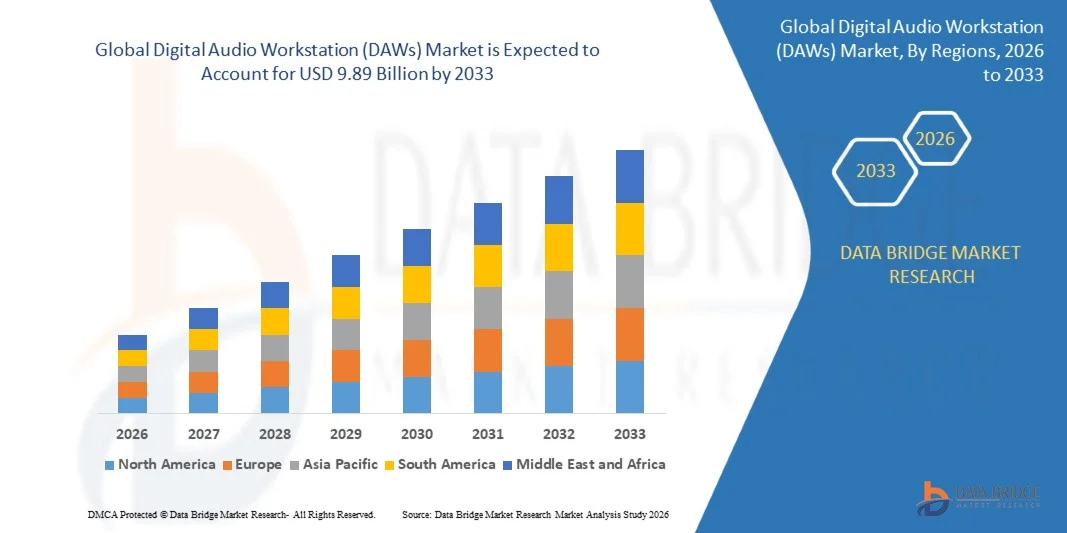
- The global digital audio workstation (DAWs) market size was valued at USD 4.89 billion in 2025 and is expected to reach USD 9.89 billion by 2033, at a CAGR of 9.21% during the forecast period
- The market growth is largely fuelled by the increasing adoption of DAWs across music production, podcasting, film scoring, and broadcast media, driven by advancements in audio editing features and real‑time processing capabilities
- Rising demand for home studios and independent content creation, supported by affordable software options and cloud‑based collaboration tools, is encouraging widespread DAW adoption among professionals and hobbyists
Digital Audio Workstation (DAWs) Market Analysis
- The market is characterized by continuous innovation in software functionalities, including enhanced plug‑in integration, AI‑based mastering tools, and intuitive user interfaces that support complex audio workflows
- Increasing integration with hardware controllers, virtual instruments, and digital mixers is expanding DAW application across professional and prosumer segments, strengthening end‑user engagement
- North America dominated the global digital audio workstation (DAWs) market with the largest revenue share in 2025, driven by widespread adoption of professional music production tools, high-quality audio editing software, and strong demand from studios, broadcasters, and independent creators.
- Asia-Pacific region is expected to witness the highest growth rate in the global digital audio workstation (DAWs) market, driven by expanding creative industries, rising investment in music and multimedia production, increasing adoption of mobile and cloud-based DAWs, and supportive government initiatives in digital media and education
- The software segment held the largest market revenue share in 2025, driven by the growing adoption of feature-rich DAWs offering advanced editing, mixing, and recording capabilities. Software solutions provide seamless integration with hardware, plugins, and virtual instruments, making them the preferred choice for professional studios and independent content creators. In addition, continuous updates, compatibility with multiple devices, and extensive plugin libraries are supporting the sustained growth of this segment
Report Scope and Digital Audio Workstation (DAWs) Market Segmentation
|
Attributes |
Digital Audio Workstation (DAWs) Key Market Insights |
|
Segments Covered |
|
|
Countries Covered |
North America
Europe
Asia-Pacific
Middle East and Africa
South America
|
|
Key Market Players |
• Ableton AG (Germany) |
|
Market Opportunities |
• Rising Adoption Of Cloud-Based DAWs For Collaborative Music Production |
|
Value Added Data Infosets |
In addition to the market insights such as market value, growth rate, market segments, geographical coverage, market players, and market scenario, the market report curated by the Data Bridge Market Research team includes in-depth expert analysis, import/export analysis, pricing analysis, production consumption analysis, and pestle analysis. |
Digital Audio Workstation (DAWs) Market Trends
“Rising Demand for Advanced Audio Production Tools”
• The growing adoption of digital audio workstations (DAWs) is significantly shaping the global market, as consumers and professionals increasingly prefer software that offers high-quality, flexible, and efficient audio editing, mixing, and mastering capabilities. DAWs are gaining traction due to their ability to streamline production workflows, enhance sound quality, and integrate with multiple hardware and software platforms. This trend strengthens their adoption across music production, broadcasting, podcasting, and film scoring, encouraging developers to innovate with new features that cater to evolving user needs
• Increasing awareness around professional audio quality, independent content creation, and remote collaboration has accelerated the demand for DAWs in studios, home setups, and live production environments. Musicians, sound engineers, and content creators are actively seeking DAWs with intuitive interfaces and advanced functionality, prompting software companies to prioritize cloud integration, plugin compatibility, and cross-platform performance
• User experience and productivity trends are influencing purchasing decisions, with developers emphasizing feature-rich platforms, subscription models, and compatibility with third-party plugins. These factors help brands differentiate products in a competitive market and build loyalty, while also driving adoption of educational and certification programs. Companies are increasingly using marketing campaigns to highlight these advantages to reinforce brand positioning and attract professional and amateur users
• For instance, in 2024, Ableton in Germany and FL Studio in the U.K. expanded their product offerings by incorporating AI-assisted mixing, cloud collaboration, and mobile DAW capabilities. These updates were introduced in response to rising consumer preference for versatile and accessible audio production tools, with distribution across software stores, subscription platforms, and online marketplaces. The updates were also marketed as productivity-enhancing solutions, improving user engagement and satisfaction
• While demand for DAWs is growing, sustained market expansion depends on continuous software development, cost-effective licensing models, and maintaining compatibility with diverse operating systems and hardware setups. Developers are also focusing on improving scalability, user support, and creating innovative features that balance performance, affordability, and usability for broader adoption
Digital Audio Workstation (DAWs) Market Dynamics
Driver
“Rising Adoption of Advanced Audio Production Tools”
• Growing demand for intuitive, professional-grade software is a major driver for the DAWs market. Users are increasingly replacing manual or analog audio production methods with digital workstations to improve efficiency, audio quality, and flexibility. This trend is also driving innovation in AI-powered features, plugin integration, and cross-platform solutions
• Expanding applications in music production, podcasting, film scoring, broadcasting, and live performance are influencing market growth. DAWs help enhance workflow efficiency, sound fidelity, and collaboration, enabling professionals and enthusiasts to meet evolving expectations for high-quality audio output. Increasing engagement in independent music production and online content creation further reinforces this trend
• Software developers are actively promoting DAW-based solutions through feature enhancements, marketing campaigns, and industry partnerships. These efforts are supported by growing demand for remote collaboration, cloud-based platforms, and user-friendly interfaces, and they also encourage collaborations between DAW providers and hardware manufacturers to optimize performance and reduce workflow friction
• For instance, in 2023, Avid in the U.S. and Steinberg in Germany reported increased adoption of their DAWs in music studios, broadcast setups, and online content production. This expansion followed higher user demand for professional, affordable, and versatile solutions, driving repeat subscriptions and software upgrades. Both companies also emphasized integration capabilities and educational support to strengthen user trust and brand loyalty
• Although rising digital production and remote collaboration trends support growth, wider adoption depends on software affordability, plugin ecosystem availability, and continuous feature upgrades. Investment in cloud platforms, user support, and AI-assisted functionalities will be critical for meeting global demand and maintaining competitive advantage
Restraint/Challenge
“High Cost and Complex Functionality Limiting Adoption”
• The relatively high cost of professional DAWs compared to entry-level or free audio software remains a key challenge, limiting adoption among hobbyists and price-sensitive users. Premium licensing fees and ongoing subscription models contribute to elevated costs, and frequent updates or add-ons can further affect affordability
• User familiarity and technical expertise remain uneven, particularly in emerging markets where digital audio production is still growing. Limited understanding of advanced DAW functionalities restricts adoption across certain segments. This also leads to slower uptake of complex features in regions where educational initiatives on DAW usage are minimal
• Hardware and software compatibility challenges also impact market growth, as DAWs require sufficient computing power, peripheral devices, and operating system support. Integration complexities, latency issues, and frequent software updates increase operational demands. Companies must provide comprehensive tutorials, support networks, and optimized system requirements to maintain user satisfaction
• For instance, in 2024, small-scale studios and independent producers in Southeast Asia reported slower adoption due to high costs and limited technical expertise compared to conventional audio production tools. Hardware requirements and plugin compatibility were additional barriers. These factors also prompted some educational institutions to delay DAW-based curriculum updates, affecting training and skill development
• Overcoming these challenges will require cost-effective software models, simplified user interfaces, and targeted educational initiatives for users. Collaboration with hardware manufacturers, educational platforms, and industry organizations can help unlock the long-term growth potential of the global DAWs market. Furthermore, continuous innovation and marketing strategies emphasizing productivity, usability, and professional-quality output will be essential for widespread adoption
Digital Audio Workstation (DAWs) Market Scope
The market is segmented on the basis of component, type, operating system, deployment model, and end-user.
• By Component
On the basis of component, the global digital audio workstation (DAWs) market is segmented into software and services. The software segment held the largest market revenue share in 2025, driven by the growing adoption of feature-rich DAWs offering advanced editing, mixing, and recording capabilities. Software solutions provide seamless integration with hardware, plugins, and virtual instruments, making them the preferred choice for professional studios and independent content creators. In addition, continuous updates, compatibility with multiple devices, and extensive plugin libraries are supporting the sustained growth of this segment.
The services segment is expected to witness the fastest growth rate from 2026 to 2033, driven by increasing demand for subscription-based models, cloud collaboration, plugin support, and AI-assisted audio production services. These services allow users to access professional-grade tools without heavy upfront investment, enabling remote collaboration among distributed teams. The growing adoption of cloud-based learning and virtual studios is further enhancing the appeal of DAW services, particularly among emerging musicians and small studios.
• By Type
On the basis of type, the market is segmented into editing, mixing, and recording. The editing segment dominated in 2025 due to widespread adoption in music production, post-production, and podcasting workflows that require precise sound manipulation. Advanced editing functionalities, such as multi-track management, waveform visualization, and automated correction tools, continue to attract professionals and independent users alike. Rising content creation trends and increasing demand for high-quality audio in media are sustaining the segment’s growth.
The mixing segment is expected to witness the fastest growth during the forecast period, fueled by increasing demand for multi-track mixing capabilities, plugin integration, and high-quality sound output in professional and independent productions. Improved automation, AI-assisted mixing tools, and real-time effects processing are expanding the segment’s application across recording studios, live performances, and online content creation. Growth in electronic music production and independent artist communities also contributes significantly to this segment.
• By Operating System
On the basis of operating system, the market is segmented into MAC, Windows, Linux, and Android. The MAC segment held the largest revenue share in 2025, owing to its compatibility with premium DAW software, stability, and popularity among professional audio engineers and studios. Creative professionals often prefer MAC for its performance in handling large projects, seamless plugin integration, and low-latency audio processing. This segment is further supported by growing demand for high-end audio production tools in professional media and entertainment sectors.
The Windows segment is expected to record the fastest growth from 2026 to 2033, supported by affordability, flexibility, and increasing adoption of high-performance Windows systems in educational institutes, home studios, and emerging markets. Windows-based DAWs offer scalability, extensive hardware compatibility, and access to a wide range of software plugins, making them attractive for a diverse user base. Increasing remote learning and online production courses also boost Windows adoption in DAW workflows.
• By Deployment Model
On the basis of deployment model, the market is segmented into on-premises and cloud. The on-premises segment dominated the market in 2025 due to strong demand from traditional studios and professional users who require full control over DAW features, plugins, and hardware integration. These solutions offer reliability, offline access, and advanced customization, which are essential for large-scale music production, film scoring, and post-production work. Established studios continue to invest heavily in on-premises DAWs to ensure stable performance.
The cloud segment is expected to witness the fastest growth during the forecast period, driven by rising demand for remote collaboration, real-time project sharing, subscription-based access, and AI-enhanced audio processing capabilities. Cloud-based DAWs facilitate collaboration among artists, producers, and educators across geographies, reducing hardware dependency. The adoption of virtual studios and online music education platforms is also accelerating growth in this segment.
• By End-User
On the basis of end-user, the market is segmented into professional/audio engineers and mixers, songwriters and production teams, electronic musicians, artists/performers, educational institutes, music studios, and others. The professional/audio engineers and mixers segment held the largest market share in 2025, due to their need for high-performance, multi-functional DAWs for complex production environments. This segment benefits from advanced features such as surround sound mixing, plugin integration, and precise automation capabilities. The growing number of media production houses and recording studios supports sustained demand.
The electronic musicians and songwriters segment is expected to witness the fastest growth from 2026 to 2033, supported by rising independent music production, home studios, and demand for affordable, intuitive, and mobile-compatible DAW solutions. Increasing online music streaming, social media platforms, and self-publishing opportunities are motivating independent artists to adopt DAWs. The availability of subscription models and cloud collaboration tools further fuels growth in this segment.
Digital Audio Workstation (DAWs) Market Regional Analysis
• North America dominated the global digital audio workstation (DAWs) market with the largest revenue share in 2025, driven by widespread adoption of professional music production tools, high-quality audio editing software, and strong demand from studios, broadcasters, and independent creators.
• Users in the region highly value advanced features, seamless plugin integration, cross-platform compatibility, and cloud-based collaboration capabilities offered by DAWs, which enhance workflow efficiency and production quality.
• This widespread adoption is further supported by high disposable incomes, a technologically adept user base, and the growing trend of home studios and remote audio production, establishing DAWs as essential tools for both professional and amateur content creators.
U.S. Digital Audio Workstation (DAWs) Market Insight
The U.S. DAWs market captured the largest revenue share in 2025 within North America, fueled by the increasing adoption of digital content creation, music streaming platforms, and independent music production. Users are prioritizing high-quality audio editing, mixing, and recording capabilities, alongside features such as AI-assisted mastering and real-time collaboration. The growth of online learning platforms and virtual studios, combined with the popularity of mobile and cross-platform DAW solutions, is significantly contributing to market expansion.
Europe Digital Audio Workstation (DAWs) Market Insight
The Europe DAWs market is expected to witness the fastest growth rate from 2026 to 2033, primarily driven by rising adoption of digital audio solutions in music production, broadcasting, and post-production workflows. Increased government support for creative industries, rising interest in independent content creation, and high demand for cloud-based collaboration tools are fostering market growth. European consumers and professionals are increasingly drawn to DAWs that offer intuitive interfaces, flexible deployment options, and integration with educational and professional audio platforms.
U.K. Digital Audio Workstation (DAWs) Market Insight
The U.K. DAWs market is expected to witness the fastest growth rate from 2026 to 2033, driven by increasing adoption of music production software in educational institutes, recording studios, and independent content creation. Growing awareness about high-quality audio content and the convenience of digital workflows is motivating both professionals and hobbyists to invest in DAWs. In addition, the U.K.’s well-established music industry and robust digital infrastructure are supporting the uptake of advanced DAW features and subscription-based solutions.
Germany Digital Audio Workstation (DAWs) Market Insight
The Germany DAWs market is expected to witness the fastest growth rate from 2026 to 2033, fueled by increasing demand for professional-grade audio software in music production, post-production, and broadcast applications. Germany’s emphasis on technological innovation and high-quality production standards promotes DAW adoption, particularly among professional studios and media houses. Integration with cloud services, virtual instruments, and AI-assisted plugins is enhancing usability and efficiency, driving the market’s expansion in the country.
Asia-Pacific Digital Audio Workstation (DAWs) Market Insight
The Asia-Pacific DAWs market is expected to witness the fastest growth rate from 2026 to 2033, driven by rising digital content creation, growing adoption of online music platforms, and increasing investment in home and professional studios. The region’s expanding creative industries, coupled with technological advancements and affordable software solutions, are encouraging widespread adoption. Government initiatives supporting digital media and online education platforms are also accelerating DAW penetration among students, artists, and independent creators.
Japan Digital Audio Workstation (DAWs) Market Insight
The Japan DAWs market is expected to witness the fastest growth rate from 2026 to 2033 due to the country’s high-tech culture, rapid digitalization, and strong emphasis on music and media production. Japanese users are increasingly adopting DAWs for music production, podcasting, and multimedia projects, with particular demand for intuitive software that integrates with hardware controllers and cloud services. The growing number of home studios and creative content creators further supports market growth.
China Digital Audio Workstation (DAWs) Market Insight
The China DAWs market accounted for the largest revenue share in Asia-Pacific in 2025, attributed to rapid digital media adoption, expanding creative industries, and rising demand for professional and semi-professional music production tools. China’s large base of content creators, online musicians, and educational institutions is driving DAW adoption. Affordable software solutions, cloud collaboration platforms, and government initiatives supporting digital media education are key factors propelling the market in China.
Digital Audio Workstation (DAWs) Market Share
The Digital Audio Workstation (DAWs) industry is primarily led by well-established companies, including:
• Ableton AG (Germany)
• Acoustica, Inc. (U.S.)
• Avid Technology, Inc. (U.S.)
• Cakewalk, Inc. (U.S.)
• BandLab Technologies (Singapore)
• PreSonus Audio Electronics, Inc. (U.S.)
• Renoise (Belgium)
• REASON INC. (Sweden)
• Apple Inc. (U.S.)
• Harrison Consoles (U.S.)
• Cockos Incorporated (U.S.)
• Native Instruments (Germany)
• MOTU, Inc. (U.S.)
• Adobe (U.S.)
• Steinberg Media Technologies GmbH (Germany)
• MAGIX Software GmbH (Germany)
Latest Developments in Global Digital Audio Workstation (DAWs) Market
- In January 2026, Apple Inc. introduced Apple Creator Studio, a subscription-based creative suite that integrates Logic Pro, Final Cut Pro, Motion, Compressor, MainStage, and Pixelmator Pro. The platform features AI-powered tools for intelligent editing, automated music composition, and workflow optimization, with seamless cross-device compatibility across Mac, iPad, and iPhone. This development strengthens Apple’s position in the professional audio and multimedia market by providing a unified ecosystem for creators
- In November 2025, Steinberg Media Technologies GmbH launched Cubase 15, introducing a Melodic Pattern Sequencer, updated Expression Maps, six additional Modulators, AI-powered stem separation, and new plugins such as Omnivocal, UltraShaper, and PitchShifter. The update enhances instruments, effects, workflow, and project compatibility, empowering musicians and producers with more creative flexibility and efficiency
- In June 2025, Avid Technology Inc. released Pro Tools 2025.6, featuring MIDI enhancements, AI-powered Speech-to-Text, expanded Melodyne ARA integration, ADR workflow improvements, and Splice integration for royalty-free samples. These enhancements streamline composition and post-production processes, improving editing speed, collaborative integration, and overall creative productivity for audio professionals
- In May 2024, Apple Inc. launched Logic Pro for iPad 2 and Logic Pro for Mac 11, introducing advanced songwriting, beat-making, production, and mixing tools enhanced with AI-powered studio assistant features. The updates help artists maintain control while speeding up creative workflows, reinforcing Apple’s influence in mobile and desktop music production markets
- In February 2024, Ableton announced Live 12, a major update introducing new devices, MIDI-transforming tools, and an upgraded MIDI editor for enhanced workflow, including reorganization of note selection by velocity, pitch, or duration. This development improves user efficiency and strengthens Ableton’s reputation as a leading DAW for electronic musicians and live performers
- In September 2023, PreSonus launched Studio One 6.5, incorporating Dolby Atmos support for immersive audio mixing, editing, and recording. The update enhances workflow, note editing, and mixing capabilities, providing audio engineers and producers with advanced tools for professional and spatial audio production, driving broader adoption of immersive audio technologies
- In October 2023, THX, in collaboration with Plugin, released THX Spatial Creator, enabling 3D-powered immersive audio for music, podcasts, and video content. The software allows creators to design live, 360-degree, and spatial audio experiences, expanding opportunities in immersive sound production and enhancing audience engagement
- In April 2023, Audio Design Desk introduced Audio Design Desk 2.0 (ADD), a DAW focused on audio creation for video, integrating industry-standard NLEs and Makr.ai, an AI-powered social platform for collaboration and content sharing. The innovation simplifies audio workflows for multimedia projects and encourages community-driven collaboration, broadening DAW applications beyond music production

- Interactive Data Analysis Dashboard
- Company Analysis Dashboard for high growth potential opportunities
- Research Analyst Access for customization & queries
- Competitor Analysis with Interactive dashboard
- Latest News, Updates & Trend analysis
- Harness the Power of Benchmark Analysis for Comprehensive Competitor Tracking
Data collection and base year analysis are done using data collection modules with large sample sizes. The stage includes obtaining market information or related data through various sources and strategies. It includes examining and planning all the data acquired from the past in advance. It likewise envelops the examination of information inconsistencies seen across different information sources. The market data is analysed and estimated using market statistical and coherent models. Also, market share analysis and key trend analysis are the major success factors in the market report. To know more, please request an analyst call or drop down your inquiry.
The key research methodology used by DBMR research team is data triangulation which involves data mining, analysis of the impact of data variables on the market and primary (industry expert) validation. Data models include Vendor Positioning Grid, Market Time Line Analysis, Market Overview and Guide, Company Positioning Grid, Patent Analysis, Pricing Analysis, Company Market Share Analysis, Standards of Measurement, Global versus Regional and Vendor Share Analysis. To know more about the research methodology, drop in an inquiry to speak to our industry experts.
Data Bridge Market Research is a leader in advanced formative research. We take pride in servicing our existing and new customers with data and analysis that match and suits their goal. The report can be customized to include price trend analysis of target brands understanding the market for additional countries (ask for the list of countries), clinical trial results data, literature review, refurbished market and product base analysis. Market analysis of target competitors can be analyzed from technology-based analysis to market portfolio strategies. We can add as many competitors that you require data about in the format and data style you are looking for. Our team of analysts can also provide you data in crude raw excel files pivot tables (Fact book) or can assist you in creating presentations from the data sets available in the report.













