




Global Digital Process Automation Market
Market Size in USD Billion
CAGR :
% 
 USD
16.15 Billion
USD
38.48 Billion
2025
2033
USD
16.15 Billion
USD
38.48 Billion
2025
2033
 Forecast Period Forecast Period |
2026 –2033 |
 Market Size (Base Year) Market Size (Base Year) |
USD 16.15 Billion |
 Market Size (Forecast Year) Market Size (Forecast Year) |
USD 38.48 Billion |
 CAGR CAGR |
% |
| Major Markets Players |
|
What is the Global Digital Process Automation Market Size and Growth Rate?
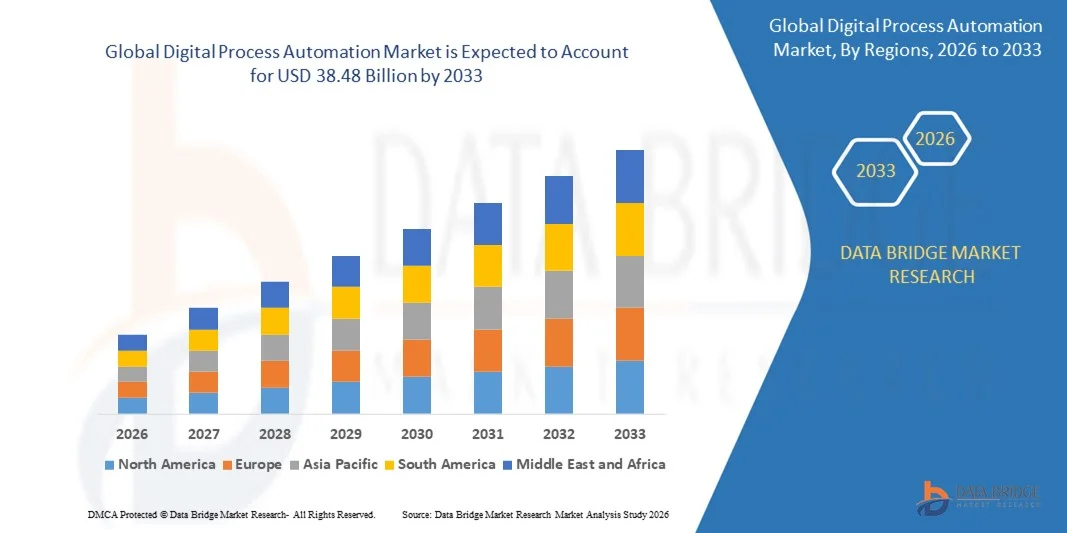
- The global digital process automation market size was valued at USD 16.15 billion in 2025 and is expected to reach USD 38.48 billion by 2033, at a CAGR of 13.20% during the forecast period
- The rise in the demand for automating business processes across various industry verticals acts as one of the major factors driving the growth of the digital process automation market
- The increase in automation in business processes such as marketing, sales, production, inventory control, supply chain, IT, and administration and rapid strides made in digital transformation by businesses in various end-use industries accelerate the market growth
What are the Major Takeaways of Digital Process Automation Market?
- The deployment of digital process automation in sectors such as healthcare, energy and utility, media and entertainment, transport and logistics, telecom, IT, and retail and consumer goods, further influence the market
- In addition, the rise in edge computing going mainstream urbanization and digitization, the surge in investments, and increased adoption of the low-code automation platform positively affect the digital process automation market
- North America dominated the digital process automation market with a 41.7% revenue share in 2025, driven by rapid enterprise digital transformation, strong adoption of robotic process automation (RPA), AI-powered workflow platforms, and widespread integration of low-code automation tools across the U.S. and Canada
- Asia-Pacific is projected to register the fastest CAGR of 10.36% from 2026 to 2033, driven by rapid enterprise digitization, expanding IT infrastructure, increasing cloud adoption, and strong government-led digital economy initiatives across China, Japan, India, South Korea, and Southeast Asia
- The Solutions segment dominated the market with a 63.5% share in 2025, driven by rising enterprise demand for workflow automation platforms, robotic process automation (RPA), case management systems, and AI-enabled decision engines
Report Scope and Digital Process Automation Market Segmentation
|
Attributes |
Digital Process Automation Key Market Insights |
|
Segments Covered |
|
|
Countries Covered |
North America
Europe
Asia-Pacific
Middle East and Africa
South America
|
|
Key Market Players |
|
|
Market Opportunities |
|
|
Value Added Data Infosets |
In addition to the insights on market scenarios such as market value, growth rate, segmentation, geographical coverage, and major players, the market reports curated by the Data Bridge Market Research also include in-depth expert analysis, pricing analysis, brand share analysis, consumer survey, demography analysis, supply chain analysis, value chain analysis, raw material/consumables overview, vendor selection criteria, PESTLE Analysis, Porter Analysis, and regulatory framework. |
What is the Key Trend in the Digital Process Automation Market?
Increasing Shift Toward AI-Driven, Low-Code, and Cloud-Native Automation Platforms
- The digital process automation market is witnessing strong adoption of AI-powered, low-code, and no-code platforms designed to streamline complex enterprise workflows and improve operational agility
- Vendors are introducing intelligent automation suites integrating robotic process automation (RPA), workflow orchestration, process mining, and decision management tools to enhance end-to-end business efficiency.
- Growing demand for cloud-native, scalable, and API-integrated automation frameworks is driving deployment across banking, healthcare, telecom, manufacturing, and government sectors.
- For instance, leading technology providers are upgrading their platforms with embedded AI, real-time analytics dashboards, chatbot integration, and hyperautomation capabilities.
- Increasing focus on customer experience optimization, remote workforce enablement, and digital transformation strategies is accelerating enterprise-wide automation adoption.
- As organizations prioritize operational resilience and cost optimization, Digital Process Automation solutions remain central to workflow modernization and intelligent decision-making
What are the Key Drivers of Digital Process Automation Market?
- Rising demand for business process optimization, cost reduction, and improved productivity is significantly boosting enterprise investment in automation technologies
- For instance, in 2025, major automation vendors expanded their portfolios with AI-enhanced workflow engines, intelligent document processing, and advanced orchestration tools to strengthen automation capabilities
- Growing adoption of cloud computing, big data analytics, and enterprise AI solutions is increasing demand for integrated digital process platforms across the U.S., Europe, and Asia-Pacific
- Advancements in machine learning, natural language processing, and predictive analytics are enabling smarter decision automation and real-time business insights
- Increasing regulatory compliance requirements and need for audit-ready documentation are further driving automated workflow implementation
- Supported by sustained digital transformation initiatives and rising IT modernization budgets, the Digital Process Automation market is expected to witness strong long-term growth
Which Factor is Challenging the Growth of the Digital Process Automation Market?
- High implementation and integration costs associated with enterprise-grade automation platforms limit adoption among small and mid-sized organizations
- For instance, during 2024–2025, rising cloud subscription costs, data migration expenses, and cybersecurity compliance investments increased overall deployment expenditure for enterprises
- Complexity in integrating automation tools with legacy IT systems and heterogeneous enterprise environments creates operational challenges
- Shortage of skilled automation architects and AI specialists slows deployment timelines and optimization efforts
- Concerns related to data security, governance, and regulatory compliance create additional barriers in highly regulated industries
- To address these issues, companies are focusing on modular platform design, subscription-based pricing models, enhanced cybersecurity frameworks, and expanded training programs to accelerate global adoption of digital process automation solutions
How is the Digital Process Automation Market Segmented?
The market is segmented on the basis of service, business function, organization size, deployment type, and industry vertical.
- By Component
On the basis of component, the digital process automation market is segmented into Solutions and Services. The Solutions segment dominated the market with a 63.5% share in 2025, driven by rising enterprise demand for workflow automation platforms, robotic process automation (RPA), case management systems, and AI-enabled decision engines. Organizations increasingly deploy integrated automation suites to streamline operations, enhance compliance tracking, and improve customer engagement. Pre-configured automation modules, analytics dashboards, and low-code development environments further strengthen adoption across industries.
The Services segment is expected to grow at the fastest CAGR from 2026 to 2033, supported by rising demand for consulting, system integration, customization, and managed automation services. As automation ecosystems become more complex, enterprises are relying on third-party expertise for deployment optimization, process redesign, and continuous monitoring, accelerating long-term service revenue growth.
- By Business Function
On the basis of business function, the market is segmented into Sales Process Automation, Supply Chain Automation, Claims Automation, and Marketing Automation. The Sales Process Automation segment dominated the market with a 31.8% share in 2025, driven by increasing adoption of CRM-integrated automation tools, lead management systems, automated proposal generation, and AI-driven customer insights platforms. Enterprises prioritize sales workflow optimization to enhance revenue generation and improve customer lifecycle management.
The Supply Chain Automation segment is projected to grow at the fastest CAGR from 2026 to 2033, fueled by rising demand for real-time inventory tracking, predictive demand forecasting, logistics orchestration, and procurement automation. Increasing supply chain complexity and global trade digitization are accelerating investments in intelligent automation platforms to improve operational resilience and efficiency.
- By Organization Size
On the basis of organization size, the digital process automation market is segmented into Small and Medium-sized Enterprises (SMEs) and Large Enterprises. The Large Enterprises segment dominated the market with a 65.2% share in 2025, supported by substantial IT budgets, advanced digital transformation initiatives, and large-scale process standardization requirements. Multinational corporations leverage DPA platforms for enterprise-wide automation, regulatory compliance management, and cross-department workflow orchestration.
The SMEs segment is expected to grow at the fastest CAGR from 2026 to 2033, driven by increasing availability of cloud-based subscription models and scalable low-code automation tools. Affordable deployment options and simplified integration frameworks are enabling SMEs to automate finance, HR, customer service, and operational workflows efficiently.
- By Deployment Type
On the basis of deployment type, the market is segmented into On-Premises and Cloud. The Cloud segment dominated the market with a 57.6% share in 2025, owing to its scalability, flexibility, lower upfront investment, and remote accessibility. Enterprises increasingly prefer cloud-native automation platforms for seamless updates, faster deployment cycles, and easier integration with third-party applications.
The On-Premises segment is projected to grow steadily but at a slower pace, particularly in highly regulated sectors requiring strict data governance and internal infrastructure control. However, hybrid deployment strategies are emerging as organizations seek balanced security and scalability benefits.
- By Industry Vertical
On the basis of industry vertical, the digital process automation market is segmented into Manufacturing, Retail & Consumer Goods, BFSI, Telecom & IT, Transport & Logistics, Energy & Utility, Media & Entertainment, Healthcare, and Others. The BFSI segment dominated the market with a 28.9% share in 2025, driven by strong adoption of automated loan processing, fraud detection, claims management, compliance reporting, and customer onboarding workflows. Regulatory requirements and digital banking expansion significantly support automation investments.
The Healthcare segment is expected to grow at the fastest CAGR from 2026 to 2033, propelled by rising need for patient data management, automated claims processing, telehealth workflow automation, and regulatory compliance systems. Increasing digital health adoption and operational efficiency initiatives are accelerating automation deployment across healthcare institutions.
Which Region Holds the Largest Share of the Digital Process Automation Market?
- North America dominated the digital process automation market with a 41.7% revenue share in 2025, driven by rapid enterprise digital transformation, strong adoption of robotic process automation (RPA), AI-powered workflow platforms, and widespread integration of low-code automation tools across the U.S. and Canada. Large enterprises across BFSI, healthcare, retail, and telecom sectors are heavily investing in intelligent automation to enhance operational efficiency, regulatory compliance, and customer experience management
- Leading technology providers in the region continue to introduce advanced automation suites integrated with AI, machine learning, analytics, and cloud-native orchestration capabilities, strengthening regional technological leadership. Continuous investments in hyperautomation, enterprise modernization, and SaaS-based automation ecosystems support long-term market expansion
- High concentration of global automation vendors, mature IT infrastructure, strong innovation ecosystems, and substantial enterprise IT budgets further reinforce North America's market dominance
U.S. Digital Process Automation Market Insight
The U.S. is the largest contributor within North America, supported by widespread enterprise automation adoption, strong presence of global DPA vendors, and rapid cloud migration strategies. Organizations across BFSI, healthcare, manufacturing, and retail sectors deploy automation platforms for claims processing, fraud detection, customer onboarding, HR automation, and supply chain optimization. Rising investment in AI-driven decision intelligence, process mining, and intelligent document processing further accelerates adoption. In addition, strong startup ecosystems, venture capital funding, and continuous innovation in enterprise SaaS platforms contribute significantly to market growth.
Canada Digital Process Automation Market Insight
Canada contributes steadily to regional growth, driven by increasing digital transformation initiatives across banking, telecom, public sector, and healthcare industries. Enterprises are adopting automation solutions to streamline back-office operations, enhance compliance management, and improve customer engagement workflows. Government-backed digital modernization programs and investments in cloud infrastructure further stimulate adoption. Growing demand for intelligent automation in insurance claims processing, public administration systems, and enterprise IT modernization strengthens Canada’s position within the regional market.
Asia-Pacific Digital Process Automation Market
Asia-Pacific is projected to register the fastest CAGR of 10.36% from 2026 to 2033, driven by rapid enterprise digitization, expanding IT infrastructure, increasing cloud adoption, and strong government-led digital economy initiatives across China, Japan, India, South Korea, and Southeast Asia. Growing adoption of automation in BFSI, manufacturing, telecom, and e-commerce sectors significantly fuels demand. Rising SME digitalization, cost optimization initiatives, and increasing awareness of low-code platforms further accelerate market expansion across the region.
China Digital Process Automation Market Insight
China is the largest contributor within Asia-Pacific due to rapid enterprise digitalization, expanding fintech ecosystems, and strong government support for smart manufacturing and digital economy initiatives. Large-scale adoption of automation in banking, e-commerce, logistics, and telecom sectors drives demand for workflow orchestration and AI-enabled automation platforms. Increasing investment in cloud computing and AI technologies further strengthens domestic market growth.
Japan Digital Process Automation Market Insight
Japan demonstrates steady growth supported by strong enterprise IT modernization, advanced industrial automation integration, and high focus on operational efficiency. Companies are increasingly adopting automation for supply chain management, finance operations, and customer service optimization. Demand for highly reliable, secure, and scalable automation platforms aligns with Japan’s precision-driven corporate environment, supporting sustained long-term expansion.
India Digital Process Automation Market Insight
India is emerging as a high-growth market driven by expanding startup ecosystems, rapid cloud adoption, and government initiatives such as Digital India. BFSI, telecom, IT services, and e-commerce sectors increasingly deploy automation tools for customer onboarding, KYC processing, invoice management, and HR automation. Growing SME participation and cost-efficient SaaS-based deployment models significantly accelerate market penetration.
South Korea Digital Process Automation Market Insight
South Korea contributes significantly due to strong digital infrastructure, high enterprise technology adoption, and advanced telecom ecosystems. Large enterprises are investing in AI-integrated automation for finance, manufacturing, and IT service management. Increasing deployment of intelligent process automation across electronics, automotive, and logistics industries supports sustained market growth within the country.
Which are the Top Companies in Digital Process Automation Market?
The digital process automation industry is primarily led by well-established companies, including:
- Accenture (Ireland)
- Tata Consultancy Services Limited (India)
- Infosys Limited (India)
- Cognizant (U.S.)
- Capgemini (France)
- SYMPHONY (U.S.)
- HCL Technologies Limited (India)
- Pegasystems Inc. (U.S.)
- Virtual Operations Ltd (U.K.)
- Atos Syntel Inc. (U.S.)
- Happiest Minds (India)
- Tech Mahindra Limited (India)
- Blue Prism Limited (U.K.)
- Xerox Corporation (U.S.)
- Wipro Limited (India)
- CGI Inc. (Canada)
- ExlService Holdings, Inc. (U.S.)
- AVASANT AND AFFILIATED COMPANIES (U.S.)
- UiPath (U.S.)
- Genpact (U.S.)
What are the Recent Developments in Global Digital Process Automation Market?
- In October 2025, ServiceNow announced a USD 2.1 billion acquisition of Process Street, significantly expanding its workflow catalog through the addition of advanced process-mapping and automation assets, strengthening its enterprise workflow automation capabilities and enhancing its competitive position in the Digital Process Automation market. This move is expected to accelerate innovation and broaden ServiceNow’s end-to-end automation portfolio
- In September 2025, Microsoft introduced Azure Process Mining integrated with the Power Platform, enabling AI-driven process discovery and one-click automation deployment to help organizations rapidly identify inefficiencies and implement intelligent workflows, reinforcing Microsoft’s leadership in cloud-based automation ecosystems. This launch is anticipated to simplify enterprise automation adoption and improve operational agility
- In October 2024, UiPath unveiled major enhancements to its AI-powered automation platform by integrating advanced machine learning capabilities designed to automate complex decision-making and deliver real-time analytical insights, further strengthening its position as a global leader in intelligent process automation solutions. This development is expected to boost enterprise adoption of AI-driven automation technologies
- In September 2024, Automation Anywhere launched a cloud-native RPA solution aimed at automating enterprise transactions across finance and healthcare sectors, incorporating artificial intelligence and analytics to optimize workflows while ensuring scalable and secure cloud deployment for end-to-end business process automation. This innovation is such asly to accelerate cloud-based automation transformation across industries
- In July 2024, Blue Prism expanded its strategic collaboration with Microsoft to deepen the integration of Microsoft Azure within its RPA platform, enabling businesses to deploy scalable automation solutions that enhance operational efficiency, agility, and AI-driven digital transformation initiatives. This partnership is expected to strengthen enterprise cloud automation capabilities globally
SKU-
Get online access to the report on the World's First Market Intelligence Cloud

- Interactive Data Analysis Dashboard
- Company Analysis Dashboard for high growth potential opportunities
- Research Analyst Access for customization & queries
- Competitor Analysis with Interactive dashboard
- Latest News, Updates & Trend analysis
- Harness the Power of Benchmark Analysis for Comprehensive Competitor Tracking
Research Methodology
Data collection and base year analysis are done using data collection modules with large sample sizes. The stage includes obtaining market information or related data through various sources and strategies. It includes examining and planning all the data acquired from the past in advance. It likewise envelops the examination of information inconsistencies seen across different information sources. The market data is analysed and estimated using market statistical and coherent models. Also, market share analysis and key trend analysis are the major success factors in the market report. To know more, please request an analyst call or drop down your inquiry.
The key research methodology used by DBMR research team is data triangulation which involves data mining, analysis of the impact of data variables on the market and primary (industry expert) validation. Data models include Vendor Positioning Grid, Market Time Line Analysis, Market Overview and Guide, Company Positioning Grid, Patent Analysis, Pricing Analysis, Company Market Share Analysis, Standards of Measurement, Global versus Regional and Vendor Share Analysis. To know more about the research methodology, drop in an inquiry to speak to our industry experts.
Customization Available
Data Bridge Market Research is a leader in advanced formative research. We take pride in servicing our existing and new customers with data and analysis that match and suits their goal. The report can be customized to include price trend analysis of target brands understanding the market for additional countries (ask for the list of countries), clinical trial results data, literature review, refurbished market and product base analysis. Market analysis of target competitors can be analyzed from technology-based analysis to market portfolio strategies. We can add as many competitors that you require data about in the format and data style you are looking for. Our team of analysts can also provide you data in crude raw excel files pivot tables (Fact book) or can assist you in creating presentations from the data sets available in the report.












