Global Door Control Modules Market
Market Size in USD Billion
CAGR :
% 
 USD
1.99 Billion
USD
3.56 Billion
2025
2033
USD
1.99 Billion
USD
3.56 Billion
2025
2033
 Forecast Period Forecast Period |
2026 –2033 |
 Market Size (Base Year) Market Size (Base Year) |
USD 1.99 Billion |
 Market Size (Forecast Year) Market Size (Forecast Year) |
USD 3.56 Billion |
 CAGR CAGR |
% |
| Major Markets Players |
|
What is the Global Door Control Modules Market Size and Growth Rate?
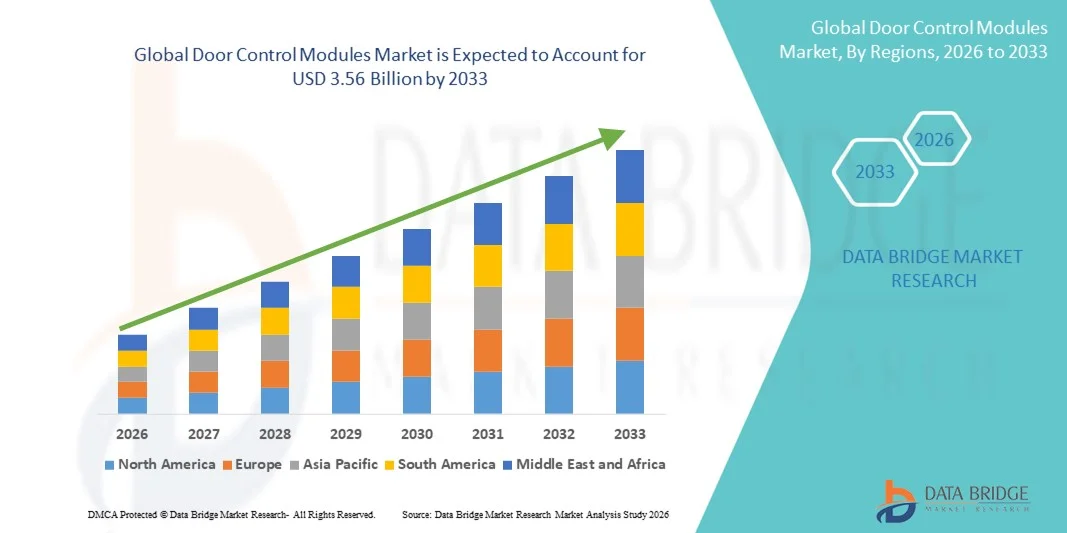
- The global door control modules market size was valued at USD 1.99 billion in 2025 and is expected to reach USD 3.56 billion by 2033, at a CAGR of7.50% during the forecast period
- The door control modules market has a huge potential and is expected grow over the forecast period, owing to the rise in disposable income of consumers which has boosted vehicle production. In addition, the increase in the demand for comfort and cabin features and rise in the production of autonomous vehicles and electrified cars are also largely influencing the growth of the door control modules market
- Also, the increase in demand for lightweight doors and high demand for aesthetics and cabin ambience are other factors anticipated to flourish the door control modules market growth
What are the Major Takeaways of Door Control Modules Market?
- The rapid development to enhance the adoption of door control panel in next-generation vehicles, in which the doors are lightweight and slimmer when compared to traditional vehicle doors which is also expected to boost the growth of the door control modules market
- However, the market of door control modules though has certain limitations which are expected to obstruct the potential growth of the market such as the volatile raw material prices and rapid change in the trade policies for automotive components, whereas the rapid increase in the production of battery electric vehicle can challenge the growth of the door control modules market
- Asia-Pacific dominated the door control modules market with a 40.8% revenue share in 2025, driven by rapid expansion of semiconductor manufacturing, high-volume electronics production, automotive ECU development, and embedded system adoption across China, Japan, India, South Korea, and Southeast Asia
- North America is projected to register the fastest CAGR of 10.02% from 2026 to 2033, led by the U.S. and Canada. The region benefits from strong semiconductor design, embedded electronics development, and rapid expansion of automotive, aerospace, and industrial R&D centers
- The Centralized segment dominated the market with a 42.3% share in 2025, driven by its ability to integrate multiple door functions into a single control unit, reduce wiring complexity, and enhance overall vehicle reliability
Report Scope and Door Control Modules Market Segmentation
|
Attributes |
Door Control Modules Key Market Insights |
|
Segments Covered |
|
|
Countries Covered |
North America
Europe
Asia-Pacific
Middle East and Africa
South America
|
|
Key Market Players |
|
|
Market Opportunities |
|
|
Value Added Data Infosets |
In addition to the insights on market scenarios such as market value, growth rate, segmentation, geographical coverage, and major players, the market reports curated by the Data Bridge Market Research also include in-depth expert analysis, pricing analysis, brand share analysis, consumer survey, demography analysis, supply chain analysis, value chain analysis, raw material/consumables overview, vendor selection criteria, PESTLE Analysis, Porter Analysis, and regulatory framework. |
What is the Key Trend in the Door Control Modules Market?
Increasing Shift Toward Compact, Multi-Functional, and Intelligent Door Control Modules
- The door control modules market is witnessing strong adoption of compact, software-integrated, and multi-channel modules designed for advanced automotive electronic systems, smart vehicle networks, and connected mobility application
- Manufacturers are introducing modular, scalable, and IoT-compatible door control systems that offer enhanced diagnostics, remote control, and integration with central vehicle electronics
- Growing demand for lightweight, energy-efficient, and field-deployable modules is driving usage across passenger cars, commercial vehicles, and luxury segments
- For instance, companies such as Continental AG, Robert Bosch GmbH, STMicroelectronics, HELLA GmbH, and Johnson Controls have upgraded their door control solutions with multi-door support, high-speed communication buses (CAN, LIN, FlexRay), and advanced safety features
- Increasing need for rapid prototyping, real-time monitoring, and seamless integration with vehicle electronics is accelerating the shift toward intelligent, PC-compatible modules
- As vehicles become more connected, electrified, and software-driven, Door Control Modules will remain critical for enhanced safety, automation, and user convenience
What are the Key Drivers of Door Control Modules Market?
- Rising demand for advanced, reliable, and cost-efficient door control solutions to support automotive safety, remote access, and vehicle connectivity features
- For instance, in 2025, leading companies such as Bosch, Continental, HELLA, STMicroelectronics, and Johnson Controls launched next-generation modules with multi-channel integration, diagnostic capabilities, and support for electric and autonomous vehicles
- Growing adoption of electric vehicles, connected cars, and smart mobility solutions is boosting demand for high-performance door control systems across Europe, North America, and Asia-Pacific
- Advancements in microcontrollers, communication protocols, and embedded software have strengthened functionality, reliability, and integration efficiency
- Rising use of autonomous driving systems, keyless entry, and smart sensor networks is creating demand for intelligent, multi-feature door control modules
- Supported by steady investments in automotive R&D, EV technology, and smart vehicle infrastructure, the Door Control Modules market is expected to witness strong long-term growth
Which Factor is Challenging the Growth of the Door Control Modules Market?
- High costs associated with advanced, multi-channel, and software-integrated door control modules restrict adoption among small automakers and emerging EV startups
- For instance, during 2024–2025, fluctuations in semiconductor prices, chip shortages, and longer lead times increased module production costs for several global vendors
- Complexity in integrating modules with multiple vehicle networks, safety systems, and electronic control units increases the need for skilled engineers and specialized software
- Limited awareness in emerging markets regarding advanced door module features and smart automotive electronics slows adoption
- Competition from integrated body control modules (BCMs), smart lock systems, and aftermarket retrofit solutions creates pricing pressure and reduces product differentiation
- To address these issues, companies are focusing on cost-optimized designs, modular architectures, cloud-based diagnostics, and enhanced software integration to increase global adoption of door control modules
How is the Door Control Modules Market Segmented?
The market is segmented on the basis of product type, vehicle type, and distribution channel.
- By Product Type
On the basis of product type, the door control modules market is segmented into Centralized and Decentralized systems. The Centralized segment dominated the market with a 42.3% share in 2025, driven by its ability to integrate multiple door functions into a single control unit, reduce wiring complexity, and enhance overall vehicle reliability. Centralized modules are widely adopted in passenger cars and luxury vehicles where consolidated control of locks, windows, and security features improves efficiency, simplifies diagnostics, and reduces maintenance costs. The Decentralized segment is expected to grow at the fastest CAGR from 2026 to 2033, owing to increasing demand for modular, scalable, and distributed architectures in electric vehicles (EVs), connected cars, and commercial vehicles. Decentralized systems allow independent door control, reduce latency in signal processing, and support easier upgrades, making them ideal for advanced ADAS integration and high-end mobility applications.
- By Vehicle Type
On the basis of vehicle type, the market is segmented into Passenger Cars, Light Commercial Vehicles (LCVs), and Heavy Commercial Vehicles (HCVs). The Passenger Cars segment dominated the market with a 48.1% share in 2025, driven by high production volumes, rising consumer preference for smart and automated door systems, and growing demand for safety features such as keyless entry, remote access, and child lock mechanisms. Door Control Modules in passenger cars are widely deployed for seamless integration with central body electronics, infotainment systems, and connected mobility features. The Heavy Commercial Vehicle segment is expected to grow at the fastest CAGR from 2026 to 2033, propelled by increasing adoption of EV trucks, advanced fleet management systems, and stricter safety and regulatory requirements. HCVs demand robust, durable, and high-performance modules capable of handling complex multi-door architectures, fleet telematics, and real-time diagnostics under harsh operating conditions.
- By Distribution Channel
On the basis of distribution channel, the market is segmented into OEMs and Aftermarket. The OEM segment dominated the market with a 53.2% share in 2025, as original equipment manufacturers integrate advanced Door Control Modules during vehicle assembly to ensure optimal performance, reliability, and compliance with safety regulations. OEM-installed modules are preferred due to their higher quality standards, compatibility with central vehicle electronics, and warranty-backed support. The Aftermarket segment is expected to grow at the fastest CAGR from 2026 to 2033, driven by increasing vehicle age, rising demand for retrofitted smart door systems, and replacement needs in light and heavy commercial vehicles. Aftermarket adoption is also supported by the availability of cost-efficient, plug-and-play modules that can upgrade existing vehicles with remote access, smart locking, and IoT-enabled control, enhancing vehicle lifespan and user convenience globally.
Which Region Holds the Largest Share of the Door Control Modules Market?
- Asia-Pacific dominated the door control modules market with a 40.8% revenue share in 2025, driven by rapid expansion of semiconductor manufacturing, high-volume electronics production, automotive ECU development, and embedded system adoption across China, Japan, India, South Korea, and Southeast Asia. Growing production of consumer electronics, IoT devices, EV electronics, and industrial automation systems continues to fuel demand for compact, high-performance door control modules
- Leading companies in the region are introducing multi-channel, multi-protocol modules with enhanced diagnostic capabilities, energy efficiency, and seamless integration with advanced vehicle networks, strengthening Asia-Pacific’s technological leadership. Continuous investments in 5G infrastructure, smart devices, and AI hardware further accelerate regional market growth
- Strong manufacturing ecosystems, government-backed innovation programs, and a skilled engineering workforce reinforce the region’s dominance in Door Control Modules adoption
China Door Control Modules Market Insight
China is the largest contributor to Asia-Pacific, supported by massive semiconductor investments, robust electronics manufacturing capacity, and strong government incentives for digital innovation. Rising development of high-speed digital circuits, AI chips, and automotive ECUs drives demand for Door Control Modules with high channel counts, advanced protocol support, and real-time diagnostic functionality. Competitive pricing and large-scale domestic production further increase market penetration across consumer, automotive, and industrial sectors.
Japan Door Control Modules Market Insight
Japan shows steady growth due to advanced industrial electronics, precision manufacturing, and modernization of automotive and industrial control systems. Focus on high-reliability modules, low-latency performance, and robotics integration drives adoption of premium Door Control Modules. Increasing demand for high-speed embedded systems and industrial automation supports long-term expansion.
India Door Control Modules Market Insight
India is emerging as a significant growth hub, driven by expanding semiconductor and embedded system R&D, rising startup activity, and government-backed electronics manufacturing initiatives. Demand for automotive electronics, IoT devices, and digital prototyping environments is increasing adoption of Door Control Modules. Expansion of digital infrastructure and increased R&D investment further accelerate market growth.
North America Door Control Modules Market
North America is projected to register the fastest CAGR of 10.02% from 2026 to 2033, led by the U.S. and Canada. The region benefits from strong semiconductor design, embedded electronics development, and rapid expansion of automotive, aerospace, and industrial R&D centers. Increasing development of AI processors, high-speed communication modules, and EV electronics drives adoption of high-performance, PC-integrated Door Control Modules capable of multi-channel signal analysis and protocol decoding. Leading players continue to innovate with modular, cloud-enabled solutions, supporting sustained market growth across engineering labs and automotive testing facilities.
U.S. Door Control Modules Market Insight
The U.S. is the largest contributor to North America, driven by high adoption of embedded systems, FPGA-based designs, and advanced digital debugging tools across automotive, aerospace, defense, and industrial sectors. Development of AI chips, autonomous vehicle electronics, and high-speed processors fuels demand for multi-channel, portable Door Control Modules.
Canada Door Control Modules Market Insight
Canada contributes significantly through expanding electronics R&D clusters, increasing adoption of embedded systems, and growing investment in automotive, telecom, and defense sectors. Engineering labs and universities extensively use Door Control Modules for prototyping, FPGA development, and IoT device testing. Government initiatives and skilled workforce availability strengthen adoption across the country.
Which are the Top Companies in Door Control Modules Market?
The door control modules industry is primarily led by well-established companies, including:
- Continental AG (Germany)
- STMicroelectronics (Switzerland)
- Robert Bosch GmbH (Germany)
- Texas Instruments Incorporated (U.S.)
- WABCO (Switzerland)
- STONERIDGE, INC. (U.S.)
- Magna International Inc. (Canada)
- ROHM CO., LTD. (Japan)
- HELLA GmbH & Co. KGaA (Germany)
- DURA AUTOMOTIVE SYSTEMS (U.S.)
- Gestamp (Spain)
- Groupo Antolin (Spain)
- Beijing Jingwei Hirain Technologies Co., Inc. (China)
- Johnson Controls Inc. (U.S.)
- Pektron (Taiwan)
- KOSTAL Automobil Elektrik GmbH & Co. KG (Germany)
- AISIN SEIKI Co., Ltd. (Japan)
- KÜSTER Unternehmensgruppe (Germany)
- Inteva Products (U.S.)
- Brose Fahrzeugteile SE & Co. KG (Germany)
What are the Recent Developments in Global Door Control Modules Market?
- In November 2025, Inteva Products announced the expansion of its operations in Pune, India, with a new manufacturing plant focused on producing next-generation closure systems, including E-Latches and Power Tailgate motors, to support the rapid growth of the Indian SUV market, strengthening the company’s presence in the region and enhancing production capabilities
- In September 2025, Brose completed its acquisition of the Proseat Group, a strategic move to enhance its expertise in complete seat and interior systems while expanding its European manufacturing footprint to support integrated vehicle access solutions, further solidifying its position in the automotive interior market
- In September 2025, Aisin Corporation opened a new manufacturing facility in the Czech Republic to expand its European production capacity for powertrain and body-related products, including power sliding door systems, aiming to meet growing demand from regional OEMs and improve supply chain efficiency
- In September 2025, Bosch announced at the IAA Mobility event the expansion of its "Vehicle Motion Management" portfolio to include body comfort functions, integrating door control, braking, and steering into a centralized software-defined vehicle architecture, enabling personalized entry experiences and advancing its automotive software solutions
- In July 2025, ZF Lifetec inaugurated a new production facility in Morocco to manufacture advanced occupant safety systems, including side-impact airbags integrated into door panels, supporting growing demand for higher safety standards in the African and European markets, and reinforcing its commitment to vehicle safety innovations
SKU-
Get online access to the report on the World's First Market Intelligence Cloud

- Interactive Data Analysis Dashboard
- Company Analysis Dashboard for high growth potential opportunities
- Research Analyst Access for customization & queries
- Competitor Analysis with Interactive dashboard
- Latest News, Updates & Trend analysis
- Harness the Power of Benchmark Analysis for Comprehensive Competitor Tracking
Research Methodology
Data collection and base year analysis are done using data collection modules with large sample sizes. The stage includes obtaining market information or related data through various sources and strategies. It includes examining and planning all the data acquired from the past in advance. It likewise envelops the examination of information inconsistencies seen across different information sources. The market data is analysed and estimated using market statistical and coherent models. Also, market share analysis and key trend analysis are the major success factors in the market report. To know more, please request an analyst call or drop down your inquiry.
The key research methodology used by DBMR research team is data triangulation which involves data mining, analysis of the impact of data variables on the market and primary (industry expert) validation. Data models include Vendor Positioning Grid, Market Time Line Analysis, Market Overview and Guide, Company Positioning Grid, Patent Analysis, Pricing Analysis, Company Market Share Analysis, Standards of Measurement, Global versus Regional and Vendor Share Analysis. To know more about the research methodology, drop in an inquiry to speak to our industry experts.
Customization Available
Data Bridge Market Research is a leader in advanced formative research. We take pride in servicing our existing and new customers with data and analysis that match and suits their goal. The report can be customized to include price trend analysis of target brands understanding the market for additional countries (ask for the list of countries), clinical trial results data, literature review, refurbished market and product base analysis. Market analysis of target competitors can be analyzed from technology-based analysis to market portfolio strategies. We can add as many competitors that you require data about in the format and data style you are looking for. Our team of analysts can also provide you data in crude raw excel files pivot tables (Fact book) or can assist you in creating presentations from the data sets available in the report.