


Global Earth Observation Satellite Market
Market Size in USD Billion
CAGR :
% 
 USD
7.37 Billion
USD
11.14 Billion
2025
2033
USD
7.37 Billion
USD
11.14 Billion
2025
2033
 Forecast Period Forecast Period |
2026 –2033 |
 Market Size (Base Year) Market Size (Base Year) |
USD 7.37 Billion |
 Market Size (Forecast Year) Market Size (Forecast Year) |
USD 11.14 Billion |
 CAGR CAGR |
% |
| Major Markets Players |
|
What is the Global Earth Observation Satellite Market Size and Growth Rate?
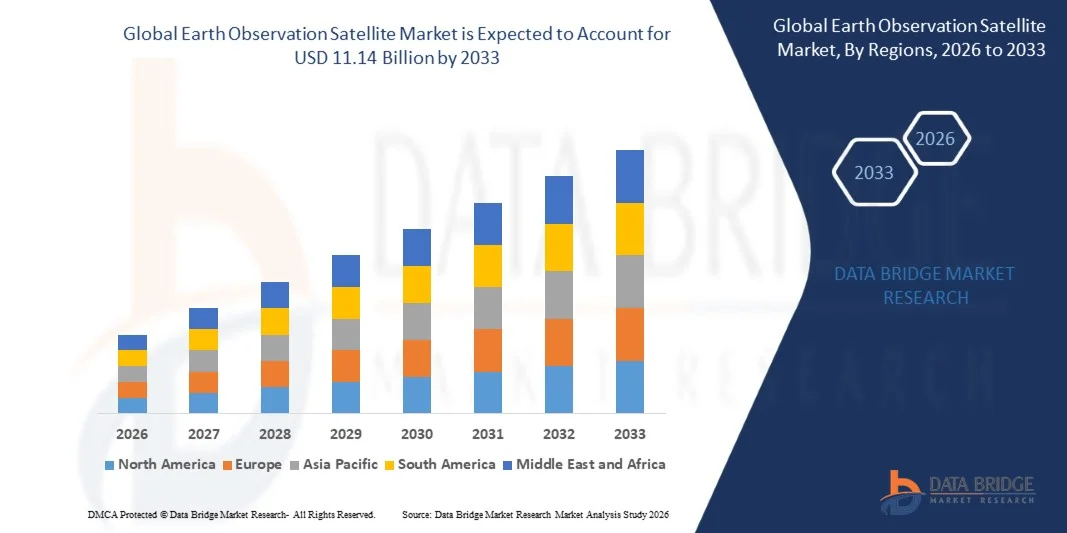
- The global earth observation satellite market size was valued at USD 7.37 billion in 2025 and is expected to reach USD 11.14 billion by 2033, at a CAGR of8.80% during the forecast period
- The factors such as proliferation in earth observation satellite constellations, growth in adoption of earth observation satellite in several end-use sectors and integration in digital data analysis and geo-spatial data fusion has resulted in growth in the market value
- Surge in the government participation in the development of earth observation fleet for various purposes including earth science, remote sensing and meteorology, ongoing advancement in sensor and instrumentation technologies and the recognition of the its huge potential by commercial operators and service providers to provide information and images is also estimated to cushion the growth of the market
What are the Major Takeaways of Earth Observation Satellite Market?
- The shortcomings in operating performance of the earth observation satellite, such as high initial investment cost, coordination among different reusability, databases, customization and isolation of various satellites from one another and other Interoperability Issues will hamper the market growth rate
- Also, integration of precise positioning and geographical information and the potential of these satellites cater to wider applications generate new opportunities for the market. The lack of standardization in the regulations and regional policies for earth observation satellites will further restrict the scope of growth for the market
- North America dominated the earth observation satellite market with a 41.6% revenue share in 2025, driven by strong investments in space technology, advanced satellite manufacturing capabilities, and increasing demand for geospatial intelligence across defense, environmental monitoring, and infrastructure planning applications in the U.S. and Canada
- Asia-Pacific is projected to register the fastest CAGR of 6.99% from 2026 to 2033, driven by increasing investments in national space programs, rising demand for satellite-based monitoring systems, and rapid development of aerospace manufacturing capabilities across China, Japan, India, South Korea, and Southeast Asia
- The Imaging segment dominated the market with a 35.8% share in 2025, as high-resolution satellite imaging plays a critical role in geospatial intelligence, environmental monitoring, infrastructure planning, and disaster response
Report Scope and Earth Observation Satellite Market Segmentation
|
Attributes |
Earth Observation Satellite Key Market Insights |
|
Segments Covered |
|
|
Countries Covered |
North America
Europe
Asia-Pacific
Middle East and Africa
South America
|
|
Key Market Players |
|
|
Market Opportunities |
|
|
Value Added Data Infosets |
In addition to the insights on market scenarios such as market value, growth rate, segmentation, geographical coverage, and major players, the market reports curated by the Data Bridge Market Research also include in-depth expert analysis, pricing analysis, brand share analysis, consumer survey, demography analysis, supply chain analysis, value chain analysis, raw material/consumables overview, vendor selection criteria, PESTLE Analysis, Porter Analysis, and regulatory framework. |
What is the Key Trend in the Earth Observation Satellite Market?
“Increasing Deployment of Small Satellites and AI-Enabled Earth Observation Systems”
- The earth observation satellite market is witnessing strong adoption of small satellites and nanosatellites designed to deliver high-resolution imagery, real-time environmental monitoring, and rapid data acquisition for multiple industries
- Manufacturers are introducing advanced satellite constellations equipped with high-resolution sensors, hyperspectral imaging systems, and AI-powered data processing technologies to enhance monitoring capabilities and data accuracy
- Growing demand for cost-efficient, high-frequency Earth monitoring solutions is increasing the deployment of low-cost satellite constellations capable of capturing images of the same location multiple times per day
- For instance, companies such as Planet Labs, Airbus, ICEYE, Capella Space, and BlackSky are expanding satellite constellations to improve real-time monitoring, geospatial intelligence, and environmental data analytics
- Increasing need for real-time geospatial insights, climate monitoring, disaster management, and precision agriculture is accelerating the shift toward advanced Earth observation satellite networks
- As demand for high-resolution geospatial intelligence and continuous global monitoring increases, Earth Observation Satellites will remain essential for supporting environmental analysis, defense surveillance, and global infrastructure planning
What are the Key Drivers of Earth Observation Satellite Market?
- Rising demand for high-resolution satellite imagery and geospatial analytics to support environmental monitoring, urban planning, agriculture management, and disaster response is significantly driving market growth
- For instance, in 2024–2025, leading companies such as Planet Labs, ICEYE, and Capella Space expanded their satellite constellations to improve Earth monitoring frequency and enhance geospatial data services for government and commercial users
- Growing adoption of satellite-based monitoring across defense surveillance, climate monitoring, precision agriculture, maritime tracking, and infrastructure planning is boosting demand for advanced Earth observation satellite technologies worldwide
- Advancements in synthetic aperture radar (SAR), hyperspectral imaging, AI-driven image processing, and cloud-based geospatial analytics have significantly improved data accuracy, accessibility, and real-time monitoring capabilities
- Increasing deployment of low-cost small satellites and large satellite constellations is creating new opportunities for continuous Earth monitoring and high-frequency data collection
- Supported by rising investments in space technology development, satellite manufacturing, and geospatial intelligence infrastructure, the Earth Observation Satellite market is expected to witness strong long-term growth
Which Factor is Challenging the Growth of the Earth Observation Satellite Market?
- High costs associated with satellite manufacturing, launch services, and ground station infrastructure remain major barriers for new market entrants and small satellite operators
- For instance, during 2024–2025, fluctuations in launch costs, satellite component supply chains, and specialized sensor technologies increased operational expenses for several Earth observation satellite companies
- Complex regulatory frameworks and licensing requirements for satellite deployment and geospatial data usage create operational challenges for satellite operators across different countries
- Limited availability of skilled aerospace engineers and satellite data analysts can slow the development and operational deployment of advanced Earth observation systems
- Competition from aerial imaging technologies, drones, and alternative remote sensing platforms may reduce reliance on certain satellite-based monitoring applications
- To address these challenges, companies are focusing on miniaturized satellite technologies, reusable launch systems, advanced AI-based analytics, and cost-efficient satellite constellation models to expand the global adoption of Earth observation satellite solutions
How is the Earth Observation Satellite Market Segmented?
The market is segmented on the basis of payload type, altitude, technology, applications, and end-user vertical.
• By Payload Type
On the basis of payload type, the earth observation satellite market is segmented into SATCOM, EO/IR, Communication, Imaging, and Navigation. The Imaging segment dominated the market with a 35.8% share in 2025, as high-resolution satellite imaging plays a critical role in geospatial intelligence, environmental monitoring, infrastructure planning, and disaster response. Imaging payloads are widely used by government agencies, research institutions, and commercial enterprises to capture detailed satellite images for mapping, land use monitoring, and urban development analysis. Continuous improvements in high-resolution cameras, multispectral imaging, and hyperspectral sensors further strengthen the importance of imaging payloads in modern Earth observation missions.
The EO/IR (Electro-Optical/Infrared) segment is expected to grow at the fastest CAGR from 2026 to 2033, driven by rising demand for advanced surveillance, climate monitoring, and defense reconnaissance applications. EO/IR payloads provide high-precision imaging and thermal sensing capabilities, enabling enhanced monitoring during both day and night conditions.
• By Altitude
On the basis of altitude, the market is segmented into Below 500–600 km and Above 600 km. The Below 500–600 km segment dominated the market with a 54.2% share in 2025, as satellites operating in low Earth orbit (LEO) provide higher image resolution, faster revisit times, and improved data collection capabilities. These satellites are widely used in Earth observation missions due to their ability to capture detailed images of the planet’s surface while enabling frequent monitoring of environmental changes and infrastructure developments. LEO satellites are increasingly deployed as part of large satellite constellations designed for real-time monitoring and geospatial analytics.
The Above 600 km segment is projected to grow at the fastest CAGR from 2026 to 2033, driven by increasing deployment of satellites designed for broader coverage and extended operational lifetimes. Higher altitude satellites enable wider geographic monitoring capabilities and are increasingly used for large-scale environmental monitoring and climate observation missions.
• By Technology
On the basis of technology, the earth observation satellite market is segmented into Optical and Synthetic Aperture Radar (SAR). The Optical segment dominated the market with a 57.1% share in 2025, as optical imaging satellites provide high-resolution visual images widely used for mapping, agriculture monitoring, urban planning, and environmental research. These satellites capture images in visible and infrared spectrums, allowing detailed observation of land, vegetation, and infrastructure. Advancements in high-resolution optical sensors and multispectral imaging technologies continue to expand the capabilities of optical Earth observation systems.
The Synthetic Aperture Radar (SAR) segment is expected to grow at the fastest CAGR from 2026 to 2033, supported by its ability to capture images regardless of weather conditions, cloud cover, or lighting conditions. SAR technology enables continuous monitoring capabilities, making it highly valuable for defense surveillance, maritime monitoring, and disaster response applications.
• By Applications
On the basis of applications, the market is segmented into Infrastructure, Environment Monitoring, Energy, Natural Resources Monitoring, Maritime, Disaster Management, and Others. The Infrastructure segment dominated the market with a 31.6% share in 2025, driven by increasing use of satellite imagery for urban planning, transportation network development, smart city initiatives, and large-scale infrastructure monitoring. Governments and private companies rely on satellite data to monitor construction progress, track infrastructure assets, and plan new development projects.
The Disaster Management segment is expected to grow at the fastest CAGR from 2026 to 2033, supported by the increasing need for real-time monitoring and early warning systems for natural disasters such as floods, earthquakes, wildfires, and hurricanes. Earth observation satellites provide critical geospatial data that helps emergency response teams assess damage, coordinate rescue operations, and plan recovery efforts.
• By End-user Vertical
On the basis of end-user vertical, the earth observation satellite market is segmented into Defense and Intelligence, Infrastructure and Engineering, Agriculture, Energy, and Power. The Defense and Intelligence segment dominated the market with a 43.9% share in 2025, driven by the increasing use of Earth observation satellites for national security, border surveillance, intelligence gathering, and strategic monitoring operations. Governments across the world are investing heavily in satellite-based monitoring systems to enhance situational awareness and strengthen defense capabilities.
The Agriculture segment is projected to grow at the fastest CAGR from 2026 to 2033, fueled by increasing adoption of precision agriculture technologies. Satellite imagery is widely used to monitor crop health, analyze soil conditions, optimize irrigation planning, and improve farm productivity. Growing demand for sustainable agricultural practices and efficient resource management is further accelerating the use of Earth observation satellite data in the agricultural sector.
Which Region Holds the Largest Share of the Earth Observation Satellite Market?
- North America dominated the earth observation satellite market with a 41.6% revenue share in 2025, driven by strong investments in space technology, advanced satellite manufacturing capabilities, and increasing demand for geospatial intelligence across defense, environmental monitoring, and infrastructure planning applications in the U.S. and Canada. Government space agencies and private space companies are actively developing high-resolution Earth observation satellite constellations to support national security, climate monitoring, and commercial data services
- Leading companies in North America are focusing on advanced satellite imaging technologies, synthetic aperture radar (SAR) systems, and AI-driven geospatial analytics platforms, strengthening the region’s leadership in satellite-based Earth monitoring solutions. Continuous investment in space exploration programs, satellite launches, and commercial geospatial services further drives long-term market expansion
- Strong presence of major aerospace companies, advanced research institutions, and a well-developed space industry ecosystem further reinforces North America’s dominant position in the global Earth Observation Satellite market
U.S. Earth Observation Satellite Market Insight
The U.S. is the largest contributor in North America, supported by strong investments in satellite technology development, advanced aerospace manufacturing, and increasing demand for geospatial intelligence across defense, environmental monitoring, and infrastructure planning sectors. Government agencies such as NASA and the Department of Defense rely heavily on Earth observation satellites for climate monitoring, border surveillance, and disaster response. Increasing development of commercial satellite constellations by private space companies further accelerates the demand for advanced Earth observation satellite technologies across the country.
Canada Earth Observation Satellite Market Insight
Canada contributes significantly to regional growth, supported by strong capabilities in satellite engineering, remote sensing technologies, and environmental monitoring programs. Canadian organizations and research institutions actively use Earth observation satellites for climate change studies, forest monitoring, maritime surveillance, and natural resource management. Government-supported space initiatives and collaborations with global aerospace companies continue to strengthen the country’s role in the Earth observation satellite industry.
Asia-Pacific Earth Observation Satellite Market
Asia-Pacific is projected to register the fastest CAGR of 6.99% from 2026 to 2033, driven by increasing investments in national space programs, rising demand for satellite-based monitoring systems, and rapid development of aerospace manufacturing capabilities across China, Japan, India, South Korea, and Southeast Asia. Governments across the region are deploying Earth observation satellites to support environmental monitoring, disaster management, agriculture optimization, and infrastructure planning initiatives.
China Earth Observation Satellite Market Insight
China represents the largest contributor within Asia-Pacific, supported by significant government investment in satellite development programs and rapid expansion of domestic space capabilities. The country has launched multiple Earth observation satellites designed for environmental monitoring, mapping, and defense intelligence applications. Strong government support and rapid technological advancements continue to strengthen China’s position in the global Earth observation satellite market.
Japan Earth Observation Satellite Market Insight
Japan demonstrates steady growth in the Earth observation satellite market due to its strong expertise in advanced satellite engineering and precision technology development. Japanese space agencies and technology companies are actively developing satellites for environmental monitoring, disaster management, and climate research. Continuous investment in space research programs and high-quality satellite technologies further supports long-term market expansion in the country.
India Earth Observation Satellite Market Insight
India is emerging as a major growth hub in the Earth observation satellite market, driven by the rapid expansion of its national space program and increasing investments in satellite-based monitoring solutions. The Indian Space Research Organisation (ISRO) continues to launch advanced Earth observation satellites used for agriculture monitoring, weather forecasting, disaster management, and infrastructure planning. Growing private space startups and expanding satellite data services are further strengthening India’s role in the global Earth observation ecosystem.
South Korea Earth Observation Satellite Market Insight
South Korea contributes significantly to regional market growth due to its expanding aerospace sector and increasing investments in satellite technologies. The country is actively developing Earth observation satellites for environmental monitoring, national security, and urban planning applications. Strong government support for space technology development, along with advancements in satellite imaging and data analytics, continues to drive the adoption of Earth observation satellite systems across the country.
Which are the Top Companies in Earth Observation Satellite Market?
The earth observation satellite industry is primarily led by well-established companies, including:
- Airbus SAS (France)
- Ball Corporation (U.S.)
- DigitalGlobe (U.S.)
- L3Harris Technologies, Inc. (U.S.)
- Lockheed Martin Corporation (U.S.)
- OHB System AG (Germany)
- Thales Group (France)
- Boeing (U.S.)
- BAE Systems (U.K.)
- BlackSky (U.S.)
- Planet Labs Inc. (U.S.)
- Satellogic (U.S.)
- Skylab Analytics (U.S.)
- Spire Global (U.S.)
- Surrey Satellite Technology Ltd (U.K.)
- Orbital Insight (U.S.)
- ImageSat International (Israel)
- ICEYE (Finland)
- Capella Space (U.S.)
- Descartes Labs Inc. (U.S.)
- R S Metrics Asia Holdings (Pvt) Ltd (Sri Lanka)
What are the Recent Developments in Global Earth Observation Satellite Market?
- In February 2026, GalaxEye Space Technologies Pvt. Ltd. introduced Mission Drishti, an AI-enabled Earth observation satellite developed to combine optical and radar imaging for continuous all-weather, day-night monitoring. The satellite incorporates advanced onboard data processing capabilities to support applications such as agriculture monitoring, disaster response, and environmental surveillance, highlighting the growing shift toward intelligent satellite systems and faster data delivery in the Earth observation industry. This development is expected to strengthen next-generation satellite analytics and enhance real-time Earth monitoring capabilities
- In February 2026, Pixxel Space Technologies Pvt. Ltd. partnered with Exotrail SAS, to integrate advanced satellite thruster technology into upcoming Earth observation missions. The collaboration focuses on improving in-orbit maneuverability, operational flexibility, and overall mission efficiency, enabling more agile and responsive satellite constellations designed to support advanced Earth observation services. This partnership is anticipated to improve satellite performance and expand operational capabilities in the evolving Earth observation satellite ecosystem
- In February 2025, the Singapore Land Authority (SLA) announced two strategic partnerships, focused on leveraging space technologies and satellite data to develop geo-enabled services for the country. These initiatives aim to support Singapore’s efforts in climate change mitigation and adaptation by utilizing satellite-derived geospatial insights for environmental monitoring and sustainable urban planning. This initiative highlights the growing role of satellite data in supporting climate resilience and smart city development
- In May 2024, the European Space Agency (ESA) and the World Bank formed a strategic partnership, to utilize satellite Earth observation technologies for global development initiatives. The collaboration focuses on improving access to satellite-based geospatial data to support projects related to climate monitoring, disaster management, and sustainable infrastructure development in emerging economies. This partnership is expected to expand the use of satellite data in addressing global environmental and development challenges
- In January 2023, Axelspace announced a collaboration with NorthStar Earth & Space Inc., under which Axelspace will utilize five AxelGlobe Earth observation satellites, known as GRUS, to provide complementary satellite imaging data for NorthStar’s space situational awareness (SSA) operations. The agreement strengthens capabilities for monitoring space activities and tracking objects in orbit through enhanced satellite imaging support. This collaboration contributes to improved space monitoring systems and strengthens global satellite observation networks
SKU-
Get online access to the report on the World's First Market Intelligence Cloud

- Interactive Data Analysis Dashboard
- Company Analysis Dashboard for high growth potential opportunities
- Research Analyst Access for customization & queries
- Competitor Analysis with Interactive dashboard
- Latest News, Updates & Trend analysis
- Harness the Power of Benchmark Analysis for Comprehensive Competitor Tracking
Research Methodology
Data collection and base year analysis are done using data collection modules with large sample sizes. The stage includes obtaining market information or related data through various sources and strategies. It includes examining and planning all the data acquired from the past in advance. It likewise envelops the examination of information inconsistencies seen across different information sources. The market data is analysed and estimated using market statistical and coherent models. Also, market share analysis and key trend analysis are the major success factors in the market report. To know more, please request an analyst call or drop down your inquiry.
The key research methodology used by DBMR research team is data triangulation which involves data mining, analysis of the impact of data variables on the market and primary (industry expert) validation. Data models include Vendor Positioning Grid, Market Time Line Analysis, Market Overview and Guide, Company Positioning Grid, Patent Analysis, Pricing Analysis, Company Market Share Analysis, Standards of Measurement, Global versus Regional and Vendor Share Analysis. To know more about the research methodology, drop in an inquiry to speak to our industry experts.
Customization Available
Data Bridge Market Research is a leader in advanced formative research. We take pride in servicing our existing and new customers with data and analysis that match and suits their goal. The report can be customized to include price trend analysis of target brands understanding the market for additional countries (ask for the list of countries), clinical trial results data, literature review, refurbished market and product base analysis. Market analysis of target competitors can be analyzed from technology-based analysis to market portfolio strategies. We can add as many competitors that you require data about in the format and data style you are looking for. Our team of analysts can also provide you data in crude raw excel files pivot tables (Fact book) or can assist you in creating presentations from the data sets available in the report.












