What is the Earthworm Farming Market Size and Growth Rate?
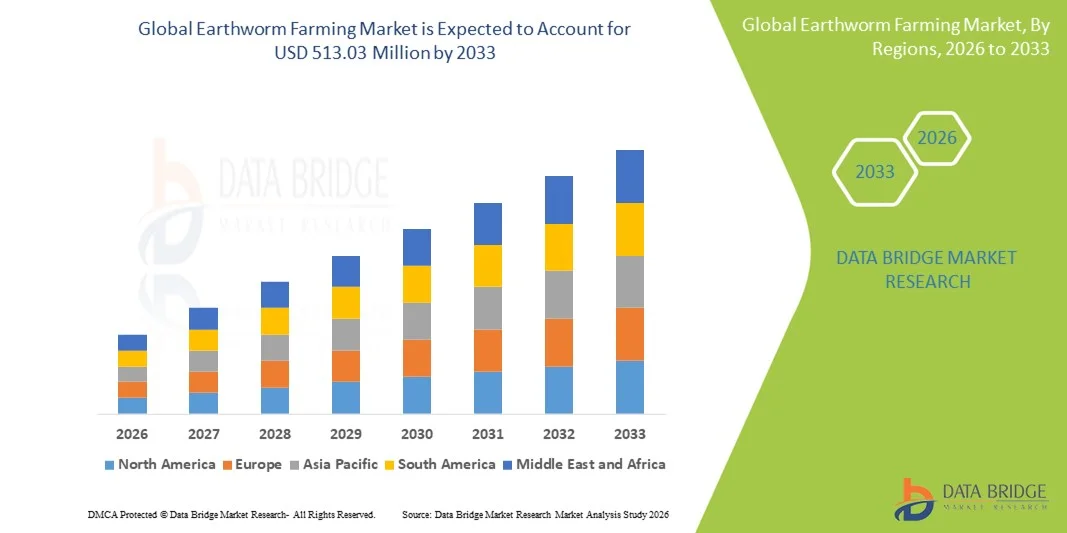
- As per Data Bridge Market Research Analysis the global earthworm farming market size was valued at USD 183.68 million in 2025 and is expected to reach USD 513.03 million by 2033, at a CAGR of 13.70% during the forecast period
- The market growth is largely fueled by the rising adoption of organic farming practices and increasing demand for sustainable agricultural inputs. Farmers and commercial growers are seeking eco-friendly alternatives to chemical fertilizers, driving the uptake of earthworm-based solutions such as vermicompost and worm protein for soil enrichment and feed applications
- Furthermore, growing awareness of environmental sustainability and circular agriculture practices is positioning earthworm farming as a key solution for waste management and nutrient recycling. These converging factors are accelerating the adoption of vermiculture, thereby significantly boosting the growth of the earthworm farming industry
Market Size & Forecast
- Global Market Value (2025): USD 183.68 million
- Expected Market Value (2033): USD 513.03 million
- Forecast CAGR (2026–2033): 13.70%
Earthworm Farming Market Analysis
- Earthworm farming involves the cultivation of species such as Eisenia Foetida, Perionyx Excavates, and Eudrilus Eugeniae for applications including vermicomposting, organic fertilizers, animal and fish feed, and fishing bait. The practice improves soil fertility, enhances crop productivity, and supports sustainable livestock and aquaculture feed systems
- The escalating demand for earthworm-based products is primarily fueled by the expansion of organic farming, increasing awareness of eco-friendly waste management, and the growing preference for natural feed and fertilizer alternatives. In addition, innovations in vermicomposting technologies and commercial-scale worm production systems are further driving market growth and adoption across global agricultural sectors
- Asia-Pacific dominated the earthworm farming market with a share of over 45% in 2025, due to expanding organic farming practices, growing awareness of sustainable agriculture, and a strong presence of vermiculture initiatives across the region
- North America is expected to be the fastest growing region in the earthworm farming market during the forecast period due to adoption of organic farming, horticulture, and sustainable waste management practices
- Eisenia Foetida segment dominated the market with a market share of 39% in 2025, due to its rapid reproduction, high organic waste consumption, and ease of maintenance. Farmers prefer it for consistent vermicompost production and suitability for both small and commercial farms, supporting soil fertility and sustainable agriculture initiatives
Report Scope and Earthworm Farming Market Segmentation
|
Attributes |
Earthworm Farming Key Market Insights |
|
Segments Covered |
|
|
Countries Covered |
North America
Europe
Asia-Pacific
Middle East and Africa
South America
|
|
Key Market Players |
|
|
Market Opportunities |
|
|
Value Added Data Infosets |
In addition to the insights on market scenarios such as market value, growth rate, segmentation, geographical coverage, and major players, the market reports curated by the Data Bridge Market Research also include import export analysis, production capacity overview, production consumption analysis, price trend analysis, climate change scenario, supply chain analysis, value chain analysis, raw material/consumables overview, vendor selection criteria, PESTLE Analysis, Porter Analysis, and regulatory framework. |
What is the Key Trend in the Earthworm Farming Market?
Rising Adoption of Vermicomposting for Sustainable Agriculture
- A prominent trend in the earthworm farming market is the increasing adoption of vermicomposting practices, driven by the need for sustainable soil management and organic waste recycling. Farmers and agricultural enterprises are recognizing the benefits of earthworm-based compost in enhancing soil fertility, improving crop yield, and reducing dependency on chemical fertilizers
- For instance, organizations such as Oxfam India and Ecoverse implement large-scale vermicomposting projects that convert agricultural and organic waste into nutrient-rich compost using species such as Eisenia fetida. These initiatives are encouraging both smallholder and commercial farmers to integrate earthworm farming into sustainable agricultural practices
- The awareness of environmental sustainability is driving farmers to explore eco-friendly fertilization methods, with vermicomposting serving as an effective solution to reduce greenhouse gas emissions from traditional composting
- Research institutions and agricultural universities are increasingly promoting earthworm farming techniques to improve soil health and enhance crop quality. Demonstration farms and training programs are supporting the spread of this practice across rural and peri-urban regions
- The market is witnessing growth in the integration of organic waste management with earthworm cultivation, allowing food processing units and municipal bodies to convert bio-waste into valuable vermicompost. This approach strengthens the circular economy and encourages wider adoption of earthworm farming
- Increasing consumer preference for organic produce is pushing commercial farms to adopt vermicomposting to meet organic certification standards. This trend is positioning earthworm farming as a key component in the organic agriculture supply chain
Earthworm Farming Market Dynamics
Driver
Rising Demand for Organic Fertilizers
- The demand for natural and eco-friendly fertilizers is driving the earthworm farming market, as farmers and agricultural businesses seek alternatives to chemical fertilizers that degrade soil health. Vermicompost produced from earthworm farming provides essential nutrients, improves soil structure, and enhances moisture retention
- For instance, companies such as Tata Chemicals and ICAR-NBAIR supply vermicompost and earthworm-based soil conditioners to commercial farms and horticultural setups. Their products support sustainable agriculture practices and help farms achieve higher productivity without relying on synthetic chemicals
- Government initiatives promoting organic farming in countries such as India and the U.K. are encouraging the adoption of vermicomposting methods among both small-scale and large-scale farmers. Subsidies, technical guidance, and demonstration programs are accelerating market growth
- The growing awareness of soil degradation due to excessive chemical fertilizer use is motivating agricultural cooperatives and NGOs to promote earthworm farming. These stakeholders are demonstrating the long-term economic and environmental benefits of organic fertilization
- The increasing export potential of organic crops is creating additional demand for vermicompost and organic soil amendments. Earthworm farming is therefore becoming integral to achieving certified organic status, particularly in high-value horticultural and vegetable crops
Restraint/Challenge
Limited Technical Expertise in Large-Scale Farming
- The earthworm farming market faces challenges due to the lack of technical knowledge and expertise in scaling vermiculture operations for commercial production. Successful large-scale earthworm farming requires precise management of environmental conditions, feedstock quality, and pest control, which can be complex for new entrants
- For instance, smallholder farmers attempting to replicate commercial vermicomposting operations often face difficulties in maintaining optimal moisture, temperature, and pH levels required for species such as Eisenia fetida. This leads to slower growth and lower compost yields, limiting profitability
- The market is constrained by the limited availability of trained professionals and extension services that can guide large-scale earthworm cultivation. Without proper training, operational efficiency and worm survival rates remain low
- High initial investment in infrastructure for commercial vermiculture, including bedding systems, aeration, and feedstock management, further challenges adoption among small and medium enterprises
- Addressing these technical and operational gaps remains critical for the market to expand, as large-scale adoption hinges on providing training, guidance, and scalable farming solutions
Earthworm Farming Market Scope
The market is segmented on the basis of type of species and application.
- By Type of Species
On the basis of species, the earthworm farming market is segmented into Eisenia Foetida, Perionyx Excavates, Lumbricus Terrestris, Eisenia Hortensis, Aporrectodea Calignosa, and Eudrilus Eugeniae. The Eisenia Foetida segment dominated the largest market revenue share of 39% in 2025, driven by its rapid reproduction, high organic waste consumption, and ease of maintenance. Farmers prefer it for consistent vermicompost production and suitability for both small and commercial farms, supporting soil fertility and sustainable agriculture initiatives.
The Perionyx Excavates segment is expected to witness the fastest growth from 2026 to 2033, fueled by adoption in tropical regions and high efficiency in organic matter conversion. For instance, National Vermicomposting Pvt. Ltd. leverages Perionyx Excavates for large-scale vermiculture projects due to its rapid growth and adaptability. Its short life cycle and compatibility with other species in polyculture systems enhance productivity and commercial viability.
- By Application
On the basis of application, the earthworm farming market is segmented into fishing bait, agriculture, animal and fish feed, fowl feed, vermicomposting, and others. The vermicomposting segment dominated the largest market revenue share in 2025, driven by rising organic farming practices and the demand for eco-friendly fertilizers. It improves soil fertility, reduces chemical fertilizer use, and is cost-effective for sustainable agriculture.
The fishing bait segment is expected to witness the fastest growth from 2026 to 2033, driven by increasing recreational and commercial fishing activities. For instance, WormWorld Enterprises promotes earthworms as high-quality bait due to their effectiveness in attracting fish. Its convenience, nutritional benefits for fish, and growing angler community support strong market adoption.
Earthworm Farming Market Regional Analysis
- Asia-Pacific dominated the earthworm farming market with the largest revenue share of over 45% in 2025, driven by expanding organic farming practices, growing awareness of sustainable agriculture, and a strong presence of vermiculture initiatives across the region
- The region’s cost-effective labor, favorable government policies promoting organic waste management, and rising investments in agricultural technology are accelerating market expansion
- The availability of skilled farmers, increasing demand for organic fertilizers, and rapid adoption of vermicomposting techniques across developing economies are contributing to increased consumption of earthworms for both agriculture and feed applications
China Earthworm Farming Market Insight
China held the largest share in the Asia-Pacific earthworm farming market in 2025, owing to its extensive agricultural sector and initiatives promoting organic farming. The country’s government support, large-scale farming infrastructure, and growing export potential for vermicompost and live earthworms are major growth drivers. Demand is further bolstered by the use of earthworms in fishing bait, animal feed, and soil health improvement programs for sustainable agriculture.
India Earthworm Farming Market Insight
India is witnessing the fastest growth in the Asia-Pacific region, fueled by rising awareness of organic fertilizers, expanding agriculture sector, and increasing commercial vermiculture farms. For instance, government initiatives under the “National Mission on Organic Farming” and the adoption of eco-friendly farming practices are strengthening the demand for earthworm farming. Growing use of earthworms in vermicomposting, animal feed, and fishing bait applications is contributing to robust market expansion
Europe Earthworm Farming Market Insight
The Europe earthworm farming market is expanding steadily, supported by strict regulations on chemical fertilizers, growing demand for organic produce, and investments in sustainable agricultural practices. Strong emphasis on quality and environmentally friendly farming, particularly in horticulture and organic crop production, drives market growth. Increasing use of earthworms in soil restoration and large-scale vermiculture projects further enhances demand.
Germany Earthworm Farming Market Insight
Germany’s earthworm farming market is driven by leadership in organic farming, strong research in soil health, and a growing export-oriented vermiculture industry. Well-established networks between academic institutions, agricultural research centers, and commercial farms foster innovation in vermicomposting techniques. High demand for premium vermicompost and sustainable feed applications for livestock and aquaculture supports market expansion.
U.K. Earthworm Farming Market Insight
The U.K. market is supported by a mature organic farming sector, rising government initiatives promoting sustainable agriculture, and increasing awareness of eco-friendly waste management. Focus on research and development in soil fertility and vermiculture systems drives growth. Adoption of earthworms in vermicomposting and garden applications is fueling consistent market demand.
North America Earthworm Farming Market Insight
North America is projected to grow at the fastest CAGR from 2026 to 2033, driven by adoption of organic farming, horticulture, and sustainable waste management practices. Strong focus on soil health, technological advancements in vermiculture, and growing demand for organic fertilizers are boosting market expansion. Commercial vermicomposting farms and collaborations between agriculture and research institutions are supporting growth.
U.S. Earthworm Farming Market Insight
The U.S. accounted for the largest share in the North America market in 2025, underpinned by its expansive organic farming industry, strong research infrastructure, and significant investment in vermiculture technology. Emphasis on sustainability, regulatory support for organic farming, and growing demand for animal feed and fishing bait encourage adoption of earthworm farming. Presence of key commercial farms and a mature distribution network solidifies the U.S.'s leading position in the region.
Earthworm Farming Market Share
The earthworm farming industry is primarily led by well-established companies, including:
- Guangxi Xintianyu Technology Co., Ltd. (China)
- Vermi Co (U.S.)
- Organic Sunrise Natural (India)
- My NOKE (China)
- NutriSoil (Australia)
- Kahariam Farms (Philippines)
- Davo’s Worm Farms (Australia)
- Worm Power (U.S.)
- Black Diamond Vermicompost (U.S.)
- VermiCo (U.S.)
- Sonoma Valley Worm Farm (U.S.)
- Earthworm Organic Fertilizer Sdn. Bhd. (Malaysia)
- Wurm Paradise (Germany)
- Agrilife Vermiculture (India)
Latest Developments in Global Earthworm Farming Market
- In January 2025, Worm Power secured a US $900,000 USDA grant to expand and modernize its vermicomposting fertilizer production. This investment significantly enhances the company’s production capacity, allowing it to meet the rising global demand for organic soil enhancers. The expansion is expected to increase availability of high-quality vermicompost, support sustainable farming practices, and strengthen the company’s competitive position in the earthworm farming market. It also signals growing institutional recognition of earthworm-based solutions as viable contributors to sustainable agriculture and environmental stewardship
- In July 2024, EcoWorms launched its “EcoWorms Protein Meal” product aimed at aquaculture and pet food applications. This launch is expanding the commercial scope of earthworm farming beyond traditional vermicomposting into the growing sustainable protein market. By providing an eco-friendly alternative to conventional fishmeal and soy-based feeds, it is helping reduce environmental impact and promoting circular agriculture. The product also boosts market adoption of worm-derived protein and encourages other players to explore value-added applications for earthworm farming
- In May 2024, WormPower Organic introduced a certified organic earthworm meal product for agriculture and animal feed markets. The product strengthens the market by demonstrating the versatility of earthworm-based solutions, catering to farmers seeking organic fertilizers and sustainable feed ingredients. It supports soil fertility improvement while also tapping into the rising demand for natural and eco-conscious feed products. This development contributes to the overall expansion of earthworm farming into high-value sectors and encourages increased investment in sustainable agricultural inputs
- In December 2023, Auchan, BioMar, Edpacif, and Earthworm Foundation launched a sustainable shrimp product line that incorporates responsibly sourced aquafeeds and earthworm-based inputs. This cross-sector partnership highlights the integration of earthworm farming into sustainable aquaculture supply chains. It impacts the market by setting a precedent for environmentally responsible sourcing, raising consumer awareness about sustainability, and creating new commercial opportunities for worm-derived products in feed applications beyond traditional agriculture
- In April 2022, Earthworm Foundation partnered with BioMar to drive responsibly sourced shrimp projects in Ecuador. The collaboration focuses on capacity-building initiatives, deforestation-free aquafeeds, and social sustainability programs. This development underscores the role of earthworm farming and related practices in promoting sustainability across the value chain. It strengthens the market by demonstrating earthworm farming’s potential to support eco-friendly aquaculture, enhance supply chain transparency, and encourage adoption of responsible production practices in emerging markets

- Interactive Data Analysis Dashboard
- Company Analysis Dashboard for high growth potential opportunities
- Research Analyst Access for customization & queries
- Competitor Analysis with Interactive dashboard
- Latest News, Updates & Trend analysis
- Harness the Power of Benchmark Analysis for Comprehensive Competitor Tracking
Data collection and base year analysis are done using data collection modules with large sample sizes. The stage includes obtaining market information or related data through various sources and strategies. It includes examining and planning all the data acquired from the past in advance. It likewise envelops the examination of information inconsistencies seen across different information sources. The market data is analysed and estimated using market statistical and coherent models. Also, market share analysis and key trend analysis are the major success factors in the market report. To know more, please request an analyst call or drop down your inquiry.
The key research methodology used by DBMR research team is data triangulation which involves data mining, analysis of the impact of data variables on the market and primary (industry expert) validation. Data models include Vendor Positioning Grid, Market Time Line Analysis, Market Overview and Guide, Company Positioning Grid, Patent Analysis, Pricing Analysis, Company Market Share Analysis, Standards of Measurement, Global versus Regional and Vendor Share Analysis. To know more about the research methodology, drop in an inquiry to speak to our industry experts.
Data Bridge Market Research is a leader in advanced formative research. We take pride in servicing our existing and new customers with data and analysis that match and suits their goal. The report can be customized to include price trend analysis of target brands understanding the market for additional countries (ask for the list of countries), clinical trial results data, literature review, refurbished market and product base analysis. Market analysis of target competitors can be analyzed from technology-based analysis to market portfolio strategies. We can add as many competitors that you require data about in the format and data style you are looking for. Our team of analysts can also provide you data in crude raw excel files pivot tables (Fact book) or can assist you in creating presentations from the data sets available in the report.